Introduction
Walk into any pharmacy in Pakistan and the face wash section alone is overwhelming. There are charcoal ones, brightening ones, moisturising ones, anti-acne ones — all making compelling-sounding claims. Picking one randomly and hoping it works is how most people end up with a cleanser that is either stripping their skin dry or not cleaning it thoroughly enough. Either outcome sends the rest of the routine sideways before it even begins.
How to choose face wash for your skin type is not complicated once you know what your skin actually is and what each formula type is designed to do. This guide covers every skin type, explains how to identify yours in five minutes at home, walks through what to look for and what to avoid in each category, and answers the most searched questions about skin types, cleansing methods, and routine ingredients along the way. You can also explore the Gleamcia Skin Care range for face washes formulated with active ingredients for every skin type in Pakistan’s climate.
Why Getting the Face Wash Right Matters More Than Any Other Step
Cleansing is the foundation. Every product applied after it — serum, moisturiser, SPF — performs relative to how well the cleanser prepared the skin surface to receive it.
A face wash that strips the skin’s natural moisture barrier leaves it reactive, tight, and overproducing oil as a compensatory response. A face wash that does not clean effectively enough leaves a layer of SPF, sebum, and pollution over the pores, reducing how much active ingredient absorption happens in the steps that follow. Both extremes produce skin that does not respond the way it should to an otherwise good routine.
The right face wash for your skin type is one that removes what needs to go — oil, pollution, makeup, sunscreen — without disturbing what should stay. The natural acid mantle (the skin’s pH-protective surface film), the moisture in the deeper layers, and the microbiome balance that keeps skin calm all need to remain intact after cleansing. Choosing by skin type is the fastest path to a cleanser that achieves this.
How Can I Check My Skin Type in 5 Minutes?
The bare-face test is the most reliable at-home skin type assessment and it costs nothing.
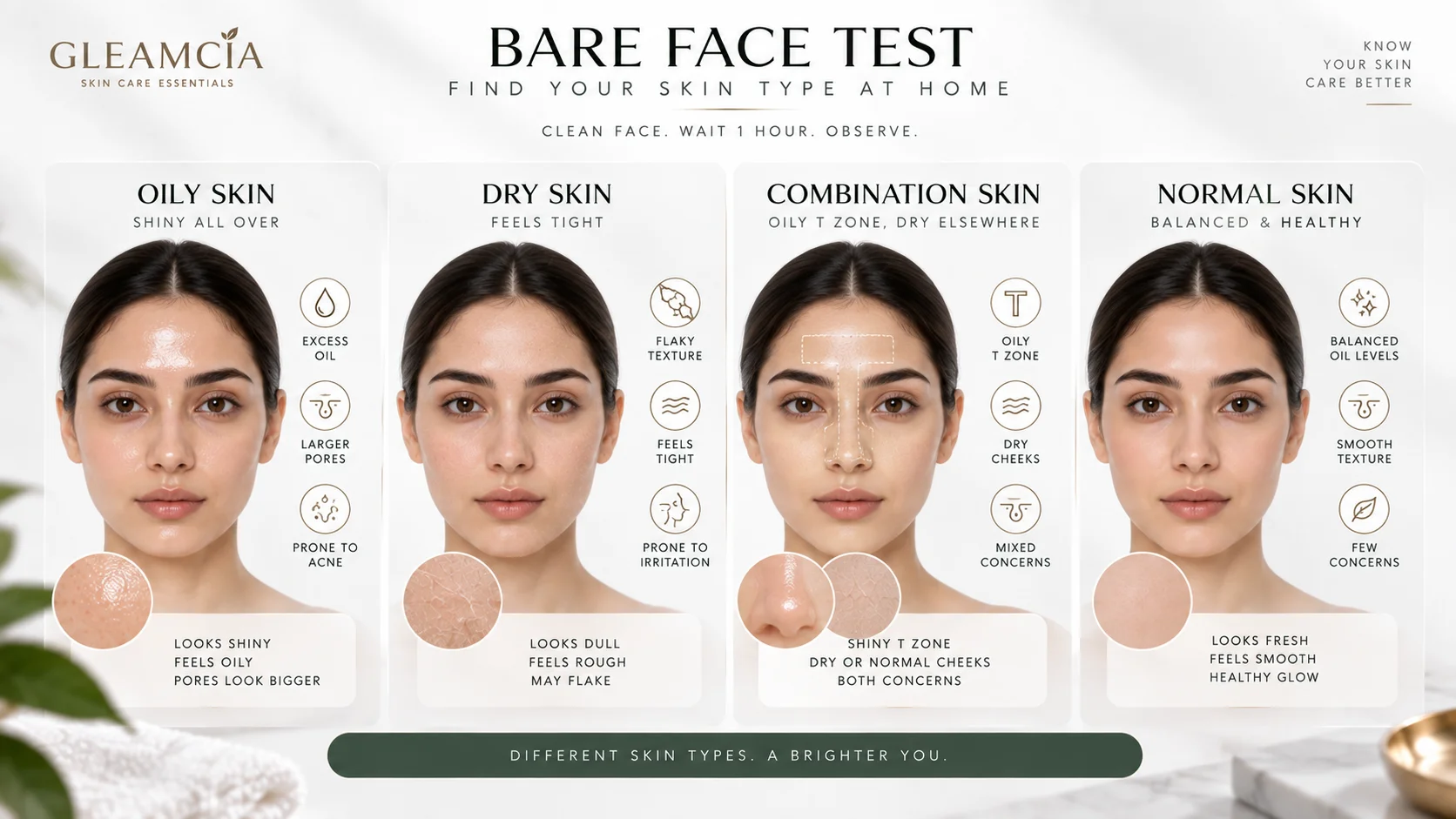
Cleanse your face thoroughly with a gentle, neutral cleanser and do not apply any product afterward. Wait one full hour — this gives the skin time to return to its natural balance without any product influence. Then observe what is happening across different zones of the face.
All over shine and visible greasiness: Oily skin. The sebaceous glands are overproducing across the full face.
Tightness, flaking, or a rough, dry feel: Dry skin. The skin is not retaining adequate moisture and the barrier is showing it.
Shine concentrated on the forehead, nose, and chin (the T-zone) with drier or comfortable cheeks: Combination skin. The most common type in Pakistan.
No particular issues — comfortable, neither tight nor oily: Normal skin. More balanced than average and not prone to either extreme.
Redness, itchiness, flushing, or reactivity visible in the waiting period or triggered by the cleanse: Sensitive skin. The barrier is reactive and needs gentler handling than other types.
A second method is the blotting paper test. Press a clean blotting paper against the forehead, nose, cheeks, and chin immediately after the bare-face hour. Oil visible from all zones confirms oily skin. Oil only from the T-zone with dry cheeks confirms combination. No oil from any zone on a comfortable face confirms dry or normal.
Which Skin Type Is the Rarest?
True normal skin — dermatologically defined as a skin that is neither oily nor dry, not sensitive, with minimal visible concerns, well-balanced sebum production, and a fully intact moisture barrier — is the rarest skin type.
Most studies and skin surveys suggest genuine normal skin affects a very small percentage of the adult population, with estimates as low as 1% to 2% when applying strict criteria. The reason is that even people who would loosely describe their skin as “normal” usually have at least one zone behaving differently from the others, some sensitivity to specific ingredients, or seasonal fluctuation between dryness and oiliness.
Combination skin is likely the most common type globally, particularly in countries with seasonal climate variation. In Pakistan’s context — with significant humidity differences between summer and winter, and universal hard water exposure — combination and oily skin types dominate, especially in coastal cities like Karachi.
Normal skin does not need complex products, which is part of why it rarely generates urgent skincare searches. Most of the skincare conversation — and most of the product innovation — is oriented toward oily, combination, and dry skin concerns.
How to Choose Face Wash for Oily Skin
Oily skin needs a face wash that removes excess sebum effectively without triggering the rebound overproduction that comes from over-stripping. The goal is clean, not squeaky clean.
What to look for:
- Gel or foam texture that lathers gently and rinses clean without residue
- Salicylic Acid (BHA) at 0.5% to 2% — penetrates inside pores and dissolves oil-based congestion
- Niacinamide — regulates sebum production over time as part of the cleanser formula
- Kaolin or Bentonite Clay — absorbs excess surface oil without dehydrating the skin
- Gentle, sulphate-free surfactants — cleanse without stripping the barrier
What to avoid:
- High-concentration SLS (sodium lauryl sulphate) — over-strips the barrier and triggers compensatory oil production
- Heavy emollient bases designed for dry skin
- Alcohol as a primary ingredient — temporarily reduces oil but seriously dehydrates over time
- Coconut oil or other comedogenic oils added to gel cleansers
The right technique for oily skin: Spend 60 seconds massaging the cleanser into the scalp to allow the active ingredients adequate contact time. Rinse thoroughly with lukewarm water — not hot, which stimulates oil glands.
The Gleamcia Brightening Face Wash is sulphate-free and formulated with brightening actives that work well as a daily cleanser for oily skin without the barrier stripping that leads to rebound greasiness.
How to Choose Face Wash for Dry Skin
Dry skin needs a cleanser that removes surface impurities without taking the skin’s already-limited moisture content with them. Cleaning efficiently while protecting is the entire brief.
What to look for:
- Cream, milk, or balm textures that dissolve surface buildup without aggressive lathering
- Ceramides — reinforce the moisture barrier that dry skin struggles to maintain
- Hyaluronic Acid — draws moisture into the skin during the cleanse rather than removing it
- Glycerin — a gentle humectant that leaves the skin feeling comfortable immediately after rinsing
- Squalane — a lightweight oil-based ingredient that cleans without stripping
What to avoid:
- Foaming cleansers with strong surfactants — even sulphate-free formulas can be too active for very dry skin if the surfactant concentration is high
- Any cleanser that produces a tight, dry feeling within minutes of rinsing
- Exfoliating acids (AHAs, BHAs) as daily cleanser actives — too drying for skin that is already struggling with moisture retention
- Alcohol in any significant concentration
The right technique for dry skin: Use lukewarm to cool water rather than warm. Apply the cream cleanser in gentle circular motions and rinse thoroughly but gently. Pat dry immediately with a clean towel and apply the next skincare step while the skin is still slightly damp.
How to Choose Face Wash for Combination Skin
Combination skin presents the biggest formulation challenge because two different concerns — T-zone oiliness and cheek dryness — need to be managed with one product. The goal is a balanced formula that addresses neither extreme perfectly but handles both adequately without worsening either.
What to look for:
- Gel-cream hybrid textures — light enough for the T-zone, gentle enough for the cheeks
- Niacinamide — regulates sebum in the oily zones while supporting the barrier in the drier zones
- Aloe Vera — calming and hydrating across all zones without adding oil
- Gentle, balanced surfactants at a concentration that cleanses without stripping
- pH-balanced formulation around 5.5
What to avoid:
- Very foaming cleansers that dry out the cheeks to address the T-zone
- Very creamy cleansers that leave a residue on the oily T-zone and congest it over time
- Single-zone solutions (a pure clay cleanser used all over will dry the cheeks)
The advanced approach: Some people with pronounced combination skin use two different cleansers — a gel formula on the T-zone and a cream formula on the cheeks in the evening cleanse. This is more involved but produces noticeably better results than a compromise formula used uniformly.
How to Choose Face Wash for Sensitive Skin
Sensitive skin reacts to ingredients that other skin types tolerate without issue — fragrances, certain preservatives, high-concentration actives, and sometimes even apparently neutral bases. The formula needs to be as stripped back as possible.
What to look for:
- Fragrance-free — this is the most important label to look for on any sensitive skin product
- Hypoallergenic formulation with a minimal ingredient list
- Centella Asiatica (Cica) — reduces redness and calms reactive skin
- Chamomile or Oat Extract — anti-inflammatory and soothing
- No more than eight to twelve ingredients on the label — shorter lists mean fewer potential triggers
- pH-balanced to avoid disrupting the sensitive barrier
What to avoid:
- Any fragrance or essential oil (lavender, eucalyptus, citrus, tea tree in high concentration)
- Alcohol in any form as a primary ingredient
- Sulphates in any concentration
- Exfoliating acids as daily cleanser actives
- Preservatives like methylisothiazolinone, known sensitisers in reactive skin
How to Choose Face Wash for Normal Skin
Normal skin has the widest formula tolerance. Almost any well-formulated, pH-balanced cleanser performs adequately on normal skin. The priority here is maintenance rather than targeted treatment.
A gentle foam or gel cleanser that rinses cleanly without leaving a tight or greasy feeling covers the brief entirely. Adding an active like Niacinamide or a mild brightening ingredient to the cleanser provides a small daily treatment benefit without any meaningful risk. Normal skin does not require premium active-heavy cleansers — it just needs consistency and a gentle formula used twice daily.
What Is the 4-2-4 Method in Skincare and Which Skin Types Benefit Most?
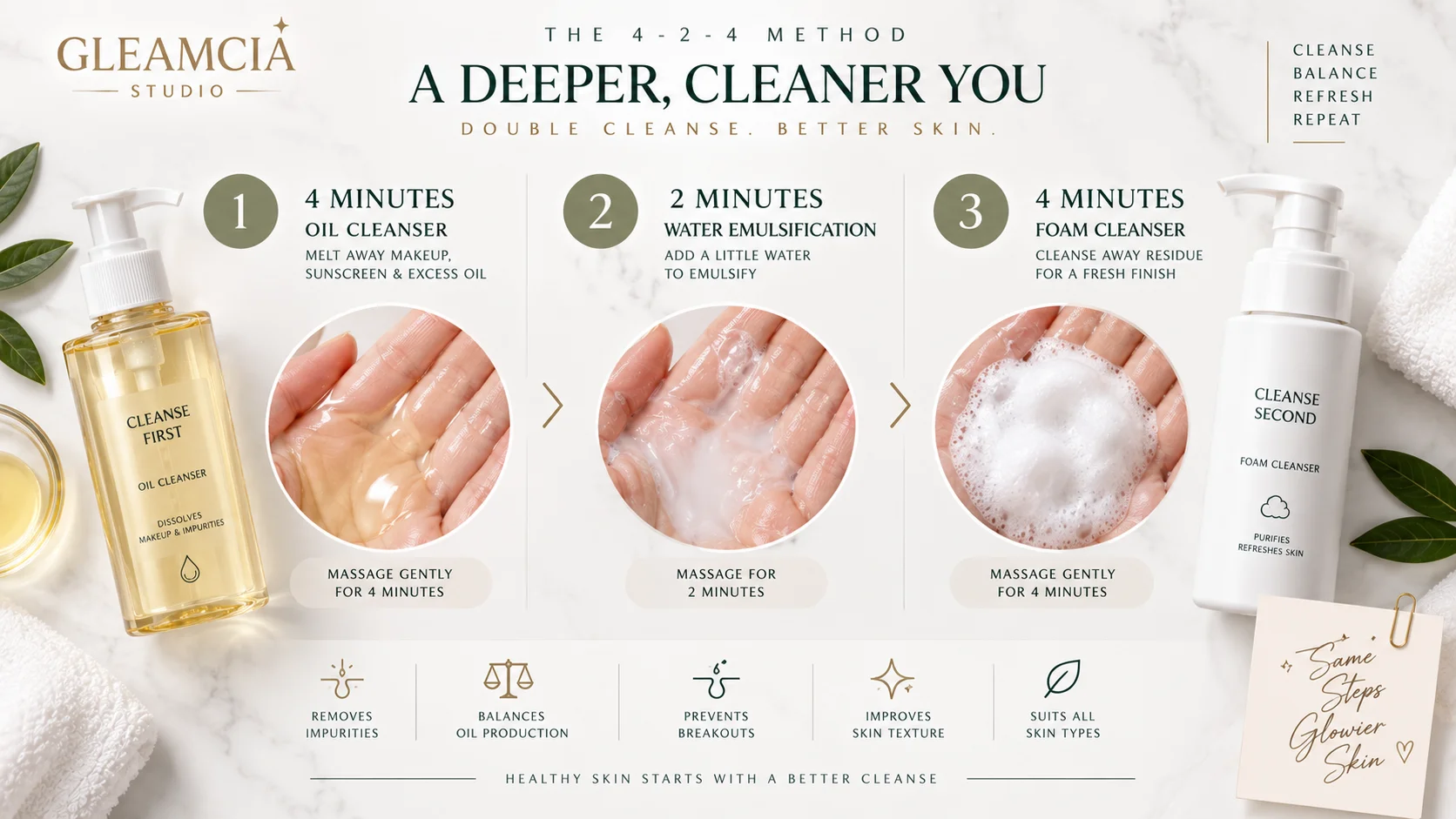
The 4-2-4 method is a deep double-cleansing technique that originated in Korean skincare and is designed to ensure the skin is completely clear of SPF, makeup, and daily buildup before actives and treatments are applied at night.
The method works as follows: massage an oil-based cleanser or cleansing balm onto dry skin for a full four minutes, then emulsify with water and massage for a further two minutes before rinsing. Follow immediately with a gentle water-based cleanser for another four minutes of massage, then rinse thoroughly.
The extended massage time — particularly the initial four-minute oil cleanse — dissolves buildup that a standard 30-second wash does not reach. It also improves scalp circulation in the face, which supports better absorption of the products that follow.
For oily and combination skin, the 4-2-4 method used two to three times per week produces a noticeably cleaner pore environment that reduces congestion over time. For dry skin, the full ten minutes of cleansing is more than the skin needs daily — a gentler variation using two minutes of oil cleanse followed by two minutes of cream cleanse is more appropriate. Sensitive skin types should approach the 4-2-4 with very gentle, fragrance-free formulas and less time per step to avoid over-sensitising the barrier.
Gel Face Wash vs Cream Face Wash vs Foam Face Wash: Which Suits Your Skin Type?
| Feature | Gel Face Wash | Cream Face Wash | Foam Face Wash |
| Best for | Oily, combination skin | Dry, very dry, sensitive skin | Oily skin (with gentle surfactants) |
| Lather | Light to medium | Minimal to none | Dense, rich |
| Moisture retention | Good — minimal stripping | Excellent — adds moisture | Variable — depends on surfactant strength |
| Pore cleansing | Thorough | Gentle surface cleanse | Thorough with strong foamers |
| Suitable for daily oily use | Yes | Not ideal — leaves residue on oily skin | Yes — if sulphate-free |
| Suitable for dry skin | Not ideal — too drying | Yes | No — strips dry skin further |
| Suitable for combination | Excellent | Only on dry cheek zone | Suitable with gentle formula |
| Contains active ingredients | Common — salicylic acid, niacinamide | Less common — usually hydration focused | Common — salicylic acid for acne variants |
| Under-makeup suitability | Good | Heavy feel can affect makeup | Good |
| Pakistan climate suitability | Excellent year-round for oily types | Better in cooler winter months for dry types | Year-round for oily types |
The table makes the choice straightforward. Gel for oily and combination. Cream for dry and sensitive. Foam with gentle surfactants for oily skin that prefers a richer lather experience without the drawbacks of sulphates.
Key Ingredients to Look For in Face Wash by Skin Type
A quick reference for what your skin type specifically benefits from in a cleanser:
Oily skin: Salicylic Acid, Niacinamide, Kaolin Clay, Tea Tree Extract (in moderate amounts), Zinc
Dry skin: Ceramides, Hyaluronic Acid, Glycerin, Squalane, Aloe Vera, Shea Butter (in some cream formulas)
Combination skin: Niacinamide, Aloe Vera, Glycerin, gentle balanced surfactants like Cocamidopropyl Betaine
Sensitive skin: Centella Asiatica, Chamomile, Oat Extract, Allantoin, Aloe Vera, fragrance-free preservation
Normal skin: Hyaluronic Acid, Niacinamide, Vitamin C derivatives in cleanser form for gentle brightening
Which Two Serums Cannot Be Used Together?
This question belongs in face wash conversations because the wrong serum combination can disrupt a skin type in ways that make it harder to identify whether the face wash is working correctly.
The combinations to separate into different time slots rather than the same layer:
Retinol and AHAs or BHAs together — both exfoliate the skin through different mechanisms and combined in one application step they push the skin into irritation and barrier disruption. Use AHAs at night on alternating evenings from Retinol.
Vitamin C and Retinol in the same step — Vitamin C works best at a low pH, Retinol at a higher pH. Together they destabilise each other and increase irritation risk. Vitamin C in the morning routine, Retinol in the evening.
Benzoyl Peroxide and Retinol — BPO is an oxidising agent that deactivates Retinol on contact. They must be used on completely separate evenings to preserve the Retinol’s efficacy.
Vitamin C and AHA at the same time — pH competition reduces the effectiveness of both and increases sensitisation. Vitamin C in the morning, AHA at night.
The rule of thumb is that potent actives need their own uncontested absorption window. A correctly matched face wash for your skin type helps the barrier tolerate actives better — which is another reason getting the cleanser right matters beyond cleansing alone.
Do Oily Skin People Age Slower? What the Science Says
Yes — and there is real biology behind it.
Sebum provides a continuous lipid layer over the skin surface that supplements the moisture barrier and keeps the skin hydrated more consistently than dry skin manages without heavy product support. That natural, ongoing moisturisation is what delays the formation of fine lines and wrinkles on oily skin types. People with oily skin consistently show smoother skin texture and fewer surface lines in their 40s and 50s compared to dry-skinned peers.
The important nuance is that oily skin ageing is not strictly better — it is different. Oily skin is more prone to enlarged pores over time, sebaceous hyperplasia (visibly enlarged oil glands), and persistent pigmentation from years of acne and breakouts. These are the trade-offs that come with higher sebum production in later decades.
And crucially, oily skin that is managed with a daily SPF ages significantly better than oily skin left unprotected. UV damage breaks down collagen at the same rate regardless of skin type. The sebum advantage disappears quickly under years of unprotected sun exposure — particularly in Pakistan’s sun intensity.
The American Academy of Dermatology identifies daily broad-spectrum SPF as the single most evidence-based anti-ageing intervention available, applicable to every skin type including oily.
Common Face Wash Mistakes by Skin Type
Oily skin: Using a stripping cleanser twice daily and wondering why the skin keeps getting oilier. The cleanser is triggering the compensatory sebum cycle. Switch to a gentle, sulphate-free gel formula.
Dry skin: Using a foaming cleanser because it seems more thorough. Foaming cleansers remove more than sebum — they remove the limited natural oils dry skin is trying to retain. Cream and milk cleansers clean just as effectively with none of the stripping.
Combination skin: Using a clay or charcoal wash designed for oily skin across the entire face. The cheeks do not need that level of oil removal and respond with dryness and flaking that gets misread as a new skin concern.
Sensitive skin: Using a face wash with fragrance because it smells appealing and the label says “gentle.” Fragrance is one of the most common sensitisers in skincare. Fragrance-free is a non-negotiable baseline for reactive skin.
All skin types: Using water that is too hot. Hot water raises the skin’s surface temperature, opens the barrier, and allows mineral ions from hard water to penetrate the skin during cleansing. Cool to lukewarm water is the correct temperature across every skin type.
What to Expect After Switching to the Right Face Wash for Your Skin Type
The skin responds to a better-matched cleanser faster than most people expect.
- Day 1 to 3: Skin feels more comfortable immediately after washing. No tightness (dry skin), no rebound greasiness within the hour (oily skin), no irritation (sensitive skin).
- Week 1 to 2: Barrier function starts improving. Products applied after the cleanser absorb more evenly and feel more effective. Less midday shine for oily skin. Less flaking for dry.
- Week 3 to 4: Visible improvement in skin texture, tone evenness, and overall skin response. For oily skin, less compensatory sebum. For dry skin, less reactive tightness after washing.
- Month 2 and beyond: Sustained improvement in skin balance that makes active ingredients in the rest of the routine perform noticeably better.
Aftercare Tips After Finding the Right Face Wash for Your Skin Type
Do:
- Wash your face within a minute of stepping out of the shower on wash days — leaving cleanser on the face longer than needed does not improve cleansing and risks over-exposure for sensitive and dry types
- Apply the next skincare step while the skin is still slightly damp — damp skin absorbs serums and moisturisers more efficiently
- Clean towels are not optional — a used towel transfers bacteria to a freshly cleansed face, which defeats the whole purpose of cleansing properly
Do not:
- Switch face washes immediately because a purging or adjustment phase makes the skin look worse for a week — give any new cleanser two full weeks before assessing results
- Use the same cleanser morning and night if your skin type warrants a different approach at each time — some skin types benefit from a lighter morning cleanse and a more thorough double cleanse in the evening
- Assume that more lather equals better cleansing — it does not. Lather is driven by surfactant concentration, not cleansing effectiveness
What Does a Quality Face Wash Cost in Pakistan by Skin Type?
Formulation complexity drives the price difference between cleansers in Pakistan’s market. A basic soap-based face wash with no active ingredients has a low production cost. A sulphate-free gel cleanser with 1% Salicylic Acid, Niacinamide at 2%, and a pH-balanced preservation system costs significantly more to formulate correctly — and delivers a meaningfully different result.
For oily and combination skin types, the investment in an active-ingredient cleanser is particularly worthwhile because the salicylic acid and niacinamide work during the contact time on the skin, not just as a passive carrier. That functional cleansing step reduces the workload on the serums and treatments that follow.
Bottle size affects value significantly for a product used twice daily. A 100ml face wash depletes in roughly 30 to 45 days with consistent use. A 150ml or 200ml format extends this to 60 to 90 days and typically reduces the per-use cost substantially.
Buying the face wash as part of a bundle — paired with a matching toner, serum, or moisturiser from the same range — ensures formulation compatibility and usually offers better per-product pricing. Gleamcia delivers from Karachi to every city in Pakistan. Check current face wash pricing at gleamcia.com/shop.
Why Choose Gleamcia
Gleamcia builds every face wash around what a specific skin type actually needs — not a generic formula that half-works across all skin types and does none of them particularly well.
- Sulphate-free formulations that clean effectively without stripping the barrier in any skin type
- Active ingredients like Niacinamide and brightening complexes included at concentrations that make the cleanser step functional, not just preparatory
- Formulated for Pakistan’s climate — the humidity in summer, the dryness in winter, and the hard water that affects every skin type’s response to daily cleansing
- Full ingredient transparency so you can confirm the formula is right for your skin before it arrives
- Nationwide delivery from Karachi to every city in Pakistan, fast dispatch, and reliable packaging
Frequently Asked Questions
1. How can I check my skin type at home? Use the bare-face test. Cleanse with a neutral face wash, apply nothing, and wait one hour. Shine all over = oily. Tightness and flaking = dry. Shine on the T-zone with comfortable or dry cheeks = combination. No specific issue = normal. Redness or reactivity = sensitive. You can also press a blotting paper on different zones — oil from all zones confirms oily, oil only from the T-zone confirms combination, no oil and comfortable skin confirms dry or normal.
2. What is the 4-2-4 method in skincare? It is a deep double-cleansing technique. Massage an oil-based cleanser onto dry skin for four minutes to dissolve SPF, makeup, and buildup. Add water to emulsify and rinse over two minutes. Follow with a water-based cleanser massaged in for four more minutes, then rinse thoroughly. Best used two to three evenings per week for oily and combination skin. Dry and sensitive skin types use a gentler, shorter variation of the same principle.
3. Which skin type is the rarest? True normal skin — skin that is balanced, neither oily nor dry, not sensitive, with consistent comfortable behaviour across all zones — is the rarest. Estimates suggest only 1% to 2% of adults have genuinely normal skin by strict dermatological standards. Most people have at least one zone behaving differently from the others, which places them in combination skin territory or beyond. Combination is likely the most common skin type globally and is particularly prevalent in Pakistan’s population.
4. Which two serums cannot be used together? Retinol and AHAs or BHAs should never be applied in the same step — both exfoliate aggressively and together they breach the skin’s tolerance threshold. Vitamin C and Retinol belong in separate routines — Vitamin C in the morning, Retinol at night — because their optimal pH levels conflict. Benzoyl Peroxide and Retinol used together result in BPO deactivating the Retinol before it can absorb. Vitamin C and AHA at the same time create pH competition that reduces both. Separate potent actives into different time slots rather than stacking them.
5. Do oily skin people age slower? Yes, with qualifications. Sebum provides a natural lipid layer that keeps oily skin more consistently moisturised than dry skin, which delays the formation of fine lines and wrinkles. Studies show oily skin types maintain smoother texture into later decades. The trade-off is more pronounced concerns with enlarged pores, sebaceous hyperplasia, and pigmentation from years of breakouts. And oily skin with no daily SPF ages at the same rate as any unprotected skin type — the sebum advantage does not extend to UV protection.
6. Can I use the same face wash for morning and night on any skin type? For most skin types, yes — a gentle, pH-balanced cleanser works consistently across both morning and evening washes. The difference is that the evening wash, particularly if you wore SPF, benefits from a double cleanse (oil cleanser first, then water-based second) to fully remove the day’s accumulation. The morning wash is a lighter maintenance cleanse. The same water-based gel or cream cleanser used for the second step of the evening double cleanse is perfectly appropriate for the morning wash on its own.
7. How do I know if my face wash is wrong for my skin type? Clear signals: tightness immediately after rinsing (wrong for dry skin — too stripping), rebound oiliness within 30 to 60 minutes of washing (wrong for oily skin — over-stripped and triggering compensatory sebum), increased breakouts around the nose and chin after starting a new cleanser (comedogenic ingredients blocking pores), or persistent redness and irritation that was not present before the product change. Any of these within the first two weeks of a new face wash is a reliable sign the formula is not matched to your skin type.
The Right Face Wash Changes How Every Other Product Performs
Getting the cleanser matched to your skin type is the one decision that makes the rest of the routine work better — because everything from serums to SPF performs relative to the base the cleanser prepared. Order the Gleamcia Brightening Face Wash or browse the full Gleamcia Skin Care range — nationwide delivery across Pakistan, order from Karachi and get it delivered anywhere in the country.
For personalised skin type guidance and product recommendations, reach us on WhatsApp at 0336 1223363 before ordering.
Shop Gleamcia Face Wash | Full Skin Care Range | All Products