Introduction
Oily skin and moisturizer sounds like a contradiction. The skin is already producing more oil than it needs — why would you add more moisture on top of that? It is a completely logical conclusion, and it is also why so many people with oily skin skip this step entirely, watch their skin get oilier and more congested, and never connect the two things.
Do you need moisturizer if you have oily skin? You do. Not despite your skin being oily, but precisely because of how oily skin works. The relationship between sebum and skin hydration is genuinely misunderstood and getting it wrong keeps oily skin stuck in a cycle of grease and breakouts that the right moisturizer could quietly break. This guide covers the full picture — why oily skin produces more oil when it is dehydrated, what happens when you skip moisturizer, whether oily skin ages better, and which formula to actually choose. Browse the Gleamcia Skin Care range for moisturisers formulated specifically for oily skin types in Pakistan’s climate.
The Core Misunderstanding: Sebum Is Not the Same as Skin Hydration
This is the single most important distinction in the oily skin moisturiser conversation.
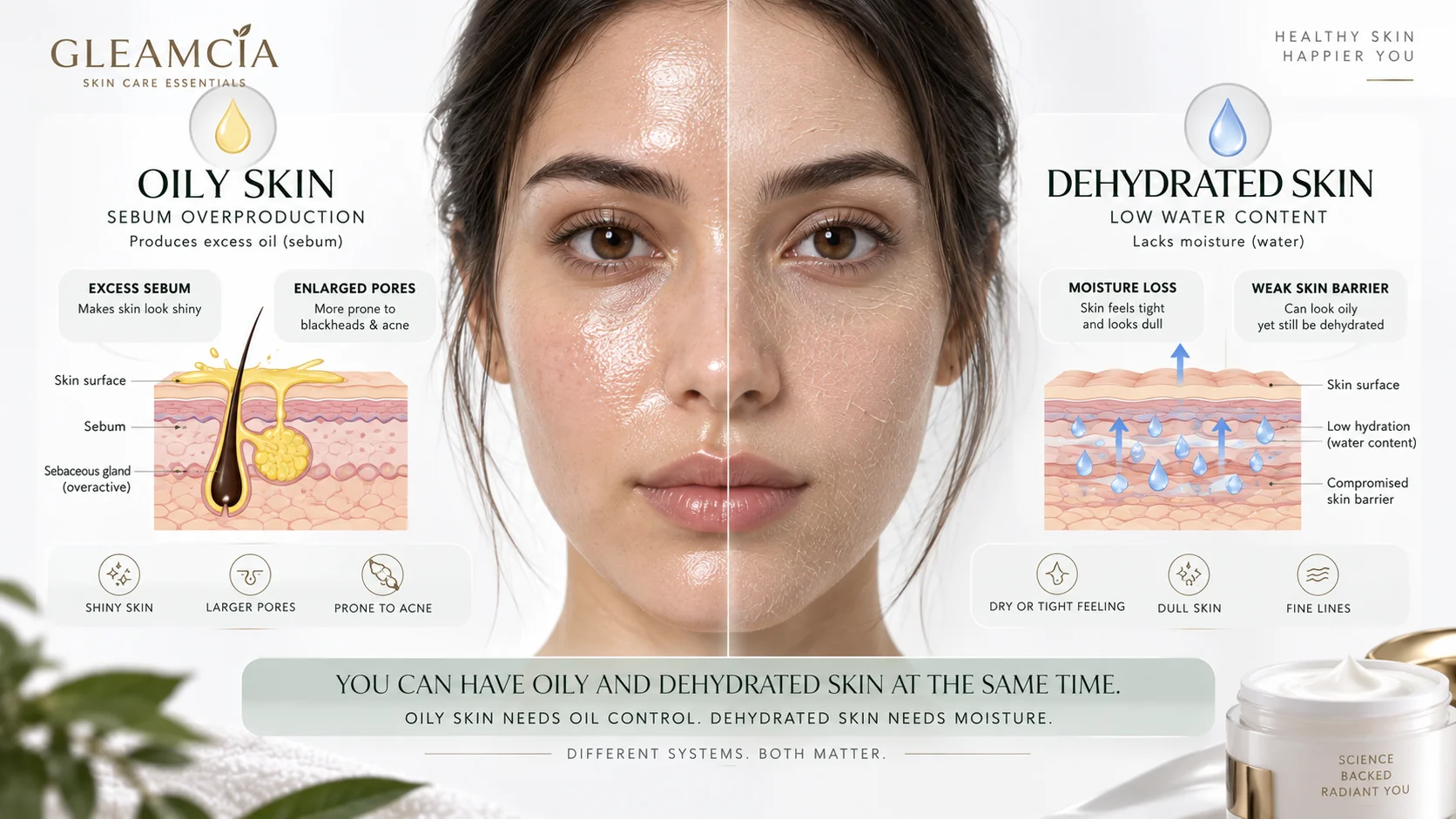
Your skin produces two things that affect how it feels: sebum and water. Sebum comes from sebaceous glands embedded in the dermis. It is an oil — it lubricates the skin surface, provides some antimicrobial protection, and creates a physical barrier. Sebum production is driven by genetics, androgens (hormones), diet, and stress.
Water content in the skin is a completely different system. It sits in the skin’s layers and is regulated by the skin barrier — the outermost layer of the epidermis — which acts like a seal that prevents moisture from evaporating out. When this barrier is intact, skin stays hydrated. When it is compromised, moisture escapes through a process called transepidermal water loss (TEWL), and the skin becomes dehydrated regardless of how much sebum it is producing.
Oily skin has high sebum output. That tells you nothing about its water content. The skin can produce excessive oil while simultaneously losing water through a weakened barrier — and that combination is far more common than most people realise, particularly in Pakistan’s climate where heat, hard water, and frequent washing all stress the barrier.
Moisturiser does not add more oil to oily skin. It supports the water-retention function of the skin barrier. These are different things, and confusing them is exactly what leads people to skip moisturiser and make the situation worse.
What Happens When You Skip Moisturizer If You Have Oily Skin?
Skipping moisturiser on oily skin does not reduce oil. It increases it.
Here is the mechanism. When the skin’s moisture barrier is not supported — through regular moisturiser use that reinforces it — the barrier weakens. A weakened barrier allows more water to evaporate from the skin’s inner layers. The skin detects this moisture loss and signals the sebaceous glands to produce more sebum as a compensatory response. The skin is trying to seal what it is losing, using the only tool it has available: oil.
The result is a skin that becomes progressively oilier the longer moisturiser is skipped. People notice they need to blot more frequently, their T-zone is constantly shiny, and the oil returns within an hour or two of washing. This is the dehydrated-oily cycle — and it is entirely driven by a compromised skin barrier trying to compensate for the moisture it is not retaining.
Breakouts also increase. A weakened barrier has micro-cracks in its structure that allow acne-causing bacteria to enter the skin more easily. The increased sebum production gives those bacteria more material to feed on. The combination produces the persistent congested breakouts that many people with oily skin deal with despite a very thorough cleansing routine.
Applying a lightweight, appropriate moisturiser consistently is what breaks this cycle. It tells the skin barrier that moisture is being retained, sebum overproduction reduces to a more normal level, and the shiny-by-noon situation becomes significantly more manageable.
Can I Skip Moisturizer for Oily Skin?
The answer is no — but the follow-up question is always: what should I use instead of skipping it?
The discomfort people with oily skin have about moisturisers is usually about texture, not moisturiser itself. A heavy cream designed for dry skin will absolutely make oily skin worse. It sits on the surface, blocks pores, and adds occlusive weight to a skin type that is already producing occlusive oil. That experience is what creates the reasonable-seeming conclusion that moisturiser is wrong for oily skin.
The solution is not to skip moisturiser. It is to use the right moisturiser. A gel-based or water-based formula that is non-comedogenic absorbs into the skin quickly, provides the barrier support that reduces sebum overproduction, and leaves no residue on the surface. That experience is entirely different from what happens with the wrong formula — and it is what oily skin actually needs.
The American Academy of Dermatology specifically recommends that people with oily skin use an oil-free, non-comedogenic moisturiser daily, even when the skin feels adequately moisturised from sebum production. The distinction between sebum and water moisture is exactly why the recommendation stands regardless of skin oiliness.
Can Oily Skin Still Be Dry? Understanding Dehydrated Oily Skin
Yes. This is one of the most common and least understood skin conditions: dehydrated oily skin.
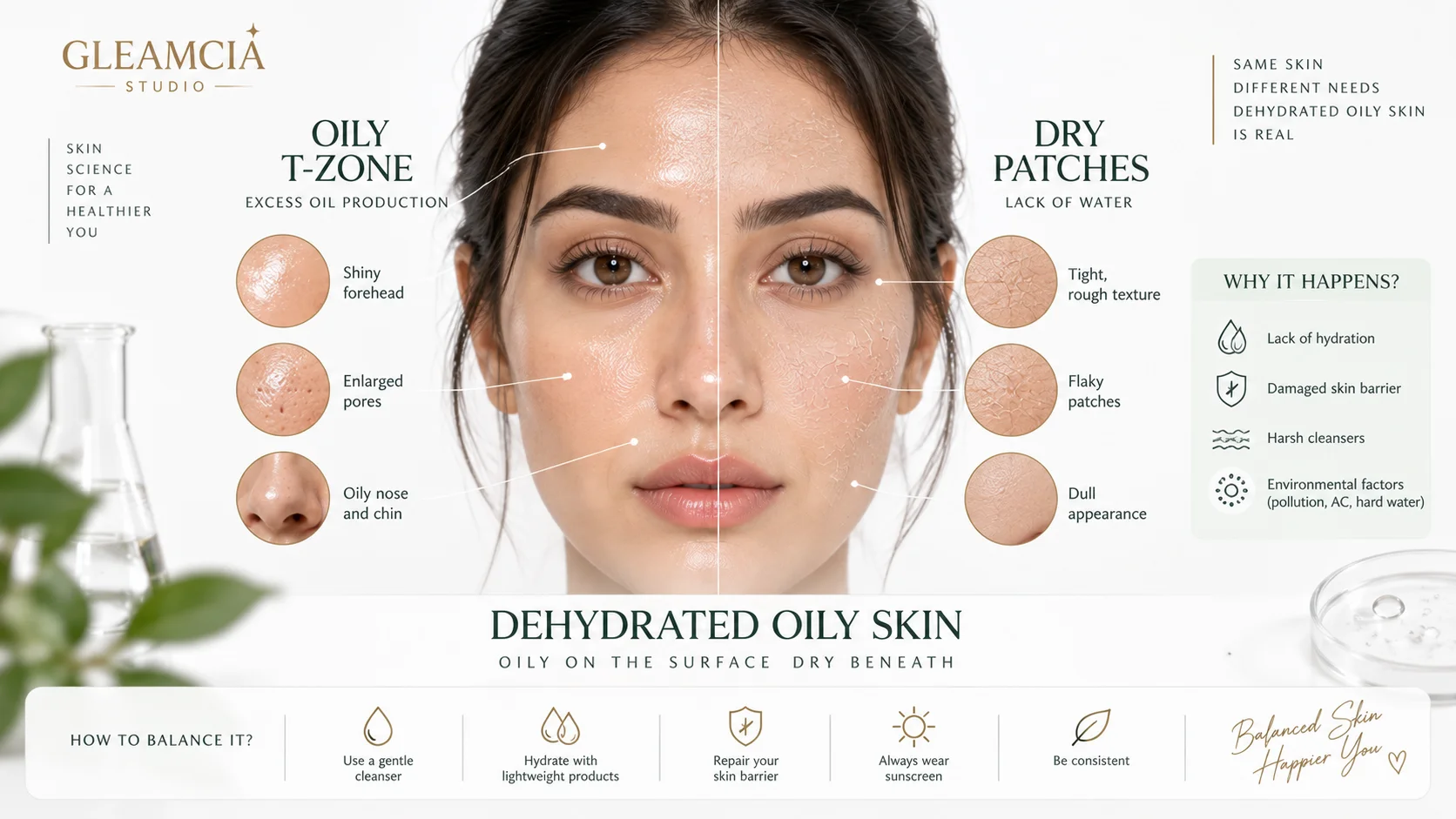
It sounds like an impossibility but it is straightforward once the sebum-versus-water distinction is clear. Dehydrated oily skin is producing normal or excess sebum — which creates the characteristic shine and grease — while simultaneously lacking adequate water content in the skin’s deeper layers. The sebaceous glands are doing their job. The moisture barrier is not doing its job. Both things are happening at once.
Signs of dehydrated oily skin specifically include:
- Skin appears shiny but also feels tight after cleansing
- A rough, almost sandpapery texture despite the surface oiliness
- Makeup that sits awkwardly — settling into fine lines and dry patches even on a skin type that is producing visible oil
- Oily in the T-zone but flaky or dry around the cheeks and eye area simultaneously
- Skin that becomes very oily within an hour of washing — the compensatory sebum response to dehydration
- Pores that look enlarged and congested while the surrounding skin feels dry
Dehydrated oily skin needs hydration — specifically water-binding ingredients like Hyaluronic Acid and Glycerin delivered in a lightweight, gel-based format that does not add more oil to the surface while restoring water content to the skin’s layers.
In Pakistan’s climate — where the combination of heat, hard water, and frequent washing in summer months is common — dehydrated oily skin is particularly prevalent. Many people in Karachi and Lahore are dealing with this exact combination without recognising it.
Do Oily Skin Types Age Slower?
There is genuine scientific basis to this one. Oily skin does tend to develop visible signs of ageing — particularly fine lines and wrinkles — later than dry skin types.
The reason is that sebum provides a natural, ongoing layer of lipid protection over the skin surface. This layer supplements the skin barrier, reduces transepidermal water loss, and keeps the skin surface more consistently moisturised than a dry skin type manages without significant product intervention. That ongoing natural moisture is what maintains skin plumpness and delays the formation of fine surface lines.
Studies on skin ageing across skin types consistently show that people with oilier skin maintain a smoother, more youthful-looking complexion into their 40s and 50s compared to those with dry or combination skin. The sebum that caused so much frustration in their 20s becomes an advantage that shows up visibly in later decades.
The nuance is that oily skin ages differently, not simply better. It has its own ageing-related concerns: enlarged pores, sebaceous hyperplasia (visibly enlarged oil glands), and persistent pigmentation from years of acne and breakouts. The trade is fewer fine lines for more textural and pore-related concerns as the skin ages.
And regardless of how oily the skin is, the absence of proper moisturiser and daily SPF will accelerate ageing in oily skin just as in any other type. Sebum alone does not block UV radiation. Oily skin with no SPF still develops sun damage, collagen breakdown, and photopigmentation at the same rate as any skin type with unprotected UV exposure.
Does Oily Skin Mean It’s Healthy?
Oily skin is a skin type — not a health status. Having oily skin does not indicate that the skin is in optimal condition or that anything special is happening. It indicates that the sebaceous glands are producing sebum at a higher rate than average, which is driven by genetics, hormone levels, and environmental factors.
Excessive oil production can actually be a signal of imbalance rather than health. Very oily skin that worsens suddenly in adulthood can indicate hormonal changes — elevated androgens being a common driver. Increased oiliness during periods of stress reflects cortisol’s stimulation of sebaceous gland activity. Diet high in refined carbohydrates and dairy has also been associated with increased sebum production in research looking at acne and skin type.
The goal for oily skin is not zero oil — some sebum production is part of a healthy skin barrier. The goal is regulated, balanced oil production where the skin stays comfortable throughout the day, pores remain minimally congested, and the skin barrier has enough moisture support to function without overproducing sebum as a compensatory response.
A properly moisturised oily skin, with the right lightweight formula applied consistently, tends to produce less oil over time — not more. The sebum overproduction dial turns down once the barrier is supported and the skin is not compensating for dehydration. That more balanced state is what healthy oily skin actually looks like.
What Kind of Moisturizer Does Oily Skin Actually Need?
The formula type makes all the difference. The right moisturiser for oily skin feels like nothing on the skin — it absorbs quickly, leaves no greasy film, and does not congest pores. The wrong one does the opposite of everything you need.
Gel-based and water-based moisturisers are the standard recommendation for oily skin. They deliver hydration through water-binding ingredients without adding any lipid-based heaviness to the skin surface. They absorb in seconds, sit cleanly under SPF and makeup, and do not contribute to congestion.
Lightweight emulsions — thin, fluid lotions — are the next step up from gels for people who need slightly more barrier support, perhaps in drier seasons or after using active ingredients that sensitise the skin.
Avoid cream and balm formulations with occlusive-heavy bases. These include anything that lists petrolatum, mineral oil, lanolin, shea butter, or coconut oil in the first half of the ingredient list. On oily skin, these sit on top of existing sebum and block the follicle openings that are already prone to congestion.
Best Ingredients in Moisturizer for Oily Skin
Not all moisturising ingredients behave the same way on oily skin. These are the ones that work:
- Hyaluronic Acid — draws water into the skin from the environment and the deeper skin layers. Purely hydrating, completely oil-free, and one of the most effective moisture-retention ingredients available.
- Niacinamide — regulates sebum production directly at the sebaceous gland level. A moisturiser containing Niacinamide provides barrier hydration while simultaneously addressing the oil itself. Best at 5% to 10%.
- Glycerin — a humectant that holds water in the skin’s surface layers without any oily feel. Common in gel moisturisers and a cornerstone of lightweight oily-skin formulas.
- Centella Asiatica (Cica) — calms the inflammation and redness that oily, acne-prone skin frequently carries. Works well in soothing gel formulas.
- Aloe Vera — hydrates and soothes without any oil content. Anti-inflammatory and cooling, particularly useful in summer in Pakistan’s heat.
- Ceramides at low concentration — help reinforce the skin barrier without the occlusive heaviness of higher-concentration formulas designed for dry skin.
- Salicylic Acid (in some formula types) — in low concentrations within a moisturiser, provides mild ongoing pore-clearing action alongside hydration.
Ingredients to Avoid in Moisturizer for Oily Skin
- Coconut oil — highly comedogenic (pore-blocking rating of 4 out of 5). Widely promoted as natural skincare but consistently problematic for oily and acne-prone skin.
- Shea Butter — rich and occlusive. Works beautifully on dry skin, clogs pores on oily skin.
- Mineral oil and petrolatum — occlusive sealers that trap everything underneath, including bacteria and congestion already present.
- Lanolin — derived from sheep’s wool, highly occlusive, and a common sensitiser in acne-prone skin.
- Heavy silicones — dimethicone and similar in high concentrations create a film over the skin that feels silky short-term but builds up with repeated use and congests pores over time.
- Fragrance and essential oils — not directly comedogenic but trigger inflammation and sensitivity in reactive oily skin types, worsening the breakout pattern.
Gel Moisturizer vs Cream Moisturizer for Oily Skin
| Feature | Gel Moisturizer | Cream Moisturizer |
| Texture | Lightweight, water-based, absorbs immediately | Rich, thicker, occlusive feel on skin |
| Recommended for oily skin | Yes — the standard choice | Not generally — risk of congestion |
| Pore congestion risk | Very low with non-comedogenic formula | Higher — depends on oils in formula |
| Sebum contribution | None — adds no oil | Yes — adds lipids that compound existing sebum |
| Suitable under SPF and makeup | Excellent | Less ideal — creates slippage under makeup |
| Best season in Pakistan | Year-round, especially summer | Cooler months only if dry-combination |
| Hydration depth | Surface and mid-level hydration | Deeper occlusive seal — more intense |
| Suitable for dehydrated oily skin | Yes — best choice | No |
| Niacinamide compatibility | Most gel formulas include it | Available but heavier base |
| Best for combination skin | Yes — apply everywhere | Only on very dry zones |
For oily skin in Pakistan — where humidity and heat are the norm for most of the year — a gel or water-gel moisturiser is the reliable year-round choice. A very lightweight emulsion works in the cooler months if the gel formula starts to feel insufficient.
How to Apply Moisturizer Correctly on Oily Skin
Technique affects how well even the right formula performs on oily skin.
Apply to slightly damp skin — not dripping wet, but after patting dry so a small amount of moisture remains. Damp skin absorbs humectants like Hyaluronic Acid and Glycerin significantly better than bone-dry skin, and this is the difference between a gel moisturiser that sits on the surface and one that absorbs cleanly.
Use a small amount — a pea-sized amount is typically enough for the full face. Gel formulas spread easily and a larger amount does not improve results, it just extends the dry-down time.
Press and pat rather than rubbing. Rubbing disrupts even distribution and can push product into already-dilated pores on oily skin. Pressing it gently into the skin with fingertips or clean palms gives more even coverage.
In the morning: moisturiser goes before SPF. Allow it to absorb for 30 to 60 seconds before applying SPF — the SPF needs to sit evenly on the skin surface, not slide over an unevenly absorbed moisturiser.
In the evening: moisturiser is the final seal after any serums or treatments. Allow serums to absorb first, then apply the gel moisturiser to lock them in without adding a heavy occlusive layer.
Morning vs Night Moisturizer for Oily Skin
The same lightweight gel formula typically works for both morning and night on oily skin — with one practical difference.
In the morning, the priority is a formula that sits well under SPF and, if relevant, makeup. Matte-finish gels that absorb completely without any residual tackiness are ideal for mornings because they create a clean base for everything applied on top.
At night, the skin barrier is in repair mode and benefits from slightly more barrier support. If the daytime gel formula feels adequate, it works at night too. If the skin feels tight or reactive after using actives like Retinol or AHAs in the evening routine, a gel moisturiser with Niacinamide and Centella applied after those treatments calms and seals without adding occlusive weight.
People with oily skin who also use Retinol at night benefit from applying the moisturiser before the Retinol as a buffer — this is called the sandwich method. Moisturiser first, Retinol second reduces the intensity of Retinol on sensitive oily skin while still delivering the active ingredient effectively.
Common Mistakes Oily Skin Types Make with Moisturizer
Skipping moisturiser entirely and then wondering why the skin is getting oilier. The compensatory sebum cycle is the direct result. Moisturiser is what breaks it — not what sustains it.
Using a toner with high alcohol content as a substitute for moisturiser. Alcohol-based toners do temporarily reduce surface oil but strip the barrier aggressively, triggering the exact compensatory overproduction that skipping moisturiser does. They feel like they are working and are making the situation considerably worse in the same action.
Using a friend’s cream moisturiser because it felt nice on their skin. Skin type compatibility is real. What works on a dry or normal skin type will often congest oily skin. The formula matters as much as the step.
Applying too much gel moisturiser because it does not feel like it is doing enough. A pea-sized amount of a quality gel moisturiser is sufficient. Doubling the amount does not increase hydration — it extends the time the product sits on the surface rather than being absorbed, which increases the risk of congestion.
Not pairing moisturiser with SPF in the morning. SPF and moisturiser are not the same product in most cases. Applying a gel moisturiser and then not following with SPF means the skin is hydrated but fully exposed to UV. Sun damage makes oily skin concerns — pigmentation, enlarged pores, uneven tone — worse over time.
How Soon Does Oily Skin Respond to Consistent Moisturizer Use?
The cycle shift takes a few weeks because sebum production does not recalibrate overnight.
- Day 1 to 7: The skin may initially feel slightly more hydrated but not dramatically different. Some people notice their skin stays more comfortable after washing — less immediate tightness despite it being oily.
- Week 2 to 3: Midday oiliness may start to reduce as the skin’s compensatory sebum overproduction begins to stabilise. The barrier is improving.
- Week 4 to 6: Visible reduction in the “shine within an hour of washing” pattern that characterises barrier-disrupted oily skin. Skin starts to feel more balanced throughout the day.
- Month 2 and beyond: Consistent sebum regulation, fewer congested breakouts, and better absorption of serums and SPF as the skin barrier performs correctly.
Individual response varies based on how significantly the skin was dehydrated before starting consistent moisturiser use, and how oily the skin is at baseline.
Aftercare and Daily Habits for Oily Skin Moisturizer Use
Do:
- Apply moisturiser twice daily — morning and evening — consistently without skipping
- Use a gentle, sulphate-free cleanser before moisturising so you are applying to a clean skin surface. The Gleamcia Brightening Face Wash is sulphate-free and gentle enough for twice-daily use on oily skin without stripping the barrier
- Follow morning moisturiser immediately with SPF — never moisturiser without SPF in the morning
- Use blotting papers during the day to manage surface oil rather than washing again — mid-day washing strips the barrier and restarts the overproduction cycle
Do not:
- Add facial oil on top of a moisturiser on oily skin — this adds back exactly the lipid-based occlusion the gel moisturiser was chosen to avoid
- Use a moisturiser that was not specifically formulated to be non-comedogenic on oily skin
- Skip moisturiser on days the skin feels particularly oily — this is the dehydration signal, not a sign the skin needs less product
What Does Moisturizer for Oily Skin Cost in Pakistan?
Gel moisturisers formulated for oily skin range significantly in price based on active ingredient complexity. A gel moisturiser that simply hydrates with Glycerin and Aloe is less expensive to produce than one that combines Hyaluronic Acid, Niacinamide at 10%, Centella Asiatica, and a sebum-regulating base. The ingredient list tells you more than the price point does.
Tube versus pot packaging affects both cost and hygiene. Tubes are more hygienic for oily-acne-prone skin because the formula is not repeatedly exposed to fingers contaminating the remaining product. Slightly higher cost per product is worth it for reduced bacteria introduction into an already breakout-prone skin type.
Bundle purchasing — gel moisturiser paired with a matching toner, serum, or SPF from the same range — reduces the per-product cost and ensures the full routine is formulated to work together without conflicting ingredients. Entry-level single products for starting with one step are available across the range.
Visit gleamcia.com/shop for current pricing on gel moisturisers and the full oily skin care range, with nationwide delivery across Pakistan from Karachi.
Why Choose Gleamcia
Every Gleamcia moisturiser for oily skin is formulated around one straightforward standard: it has to absorb cleanly, support the barrier without adding oil, and work within Pakistan’s climate — not just in air-conditioned lab conditions.
- Lightweight, non-comedogenic gel formulas with Niacinamide and Hyaluronic Acid at concentrations that regulate sebum and restore hydration simultaneously
- Tested for oily skin compatibility — no hidden comedogenic oils in the base or fragrance that triggers inflammation
- Skincare designed for South Asian skin types in Pakistan’s heat, humidity, and hard water conditions
- Full ingredient transparency so you know exactly what you are applying to skin that is already prone to congestion
- Nationwide delivery from Karachi to every city in Pakistan, fast dispatch, and reliable packaging
Frequently Asked Questions
1. Can I skip moisturizer if I have oily skin? No. Skipping moisturiser on oily skin triggers a compensatory sebum overproduction cycle — the skin’s moisture barrier weakens, it loses water through transepidermal water loss, and the sebaceous glands increase oil output as a substitute seal. The result is skin that becomes oilier the longer moisturiser is skipped, along with increased breakouts from a weakened barrier that allows bacteria to enter more easily. The fix is the right moisturiser — a lightweight, non-comedogenic gel formula — not the absence of one.
2. Do you need moisturizer if you have oily skin? Yes. Oily skin produces excess sebum (oil) but that is a completely separate system from the skin’s water content and barrier function. A skin can be oily and dehydrated simultaneously — and that combination is what drives the excessive shininess and congestion most oily skin types experience. A gel moisturiser with Hyaluronic Acid and Niacinamide supports the water-retention side of the equation without adding any oil to the skin surface.
3. Can oily skin still be dry? Yes — this is called dehydrated oily skin and it is very common, particularly in Pakistan’s climate. The skin produces excess sebum (which creates the characteristic shine) while simultaneously lacking adequate water content in the deeper layers. Signs include skin that looks oily but feels tight, makeup that settles into dry patches despite an oily base, and skin that becomes very greasy within an hour of washing. A lightweight Hyaluronic Acid and Glycerin-based moisturiser addresses the dehydration without adding more oil.
4. Do oily skin types age slower? Yes, with qualifications. Sebum provides a consistent natural lipid layer over the skin surface that maintains moisture and delays the formation of fine lines and wrinkles. People with oily skin consistently develop these signs of ageing later than those with dry skin. The trade-off is that oily skin ages with different concerns — enlarged pores, sebaceous hyperplasia, and persistent pigmentation from long-term breakouts. Oily skin without consistent SPF still develops sun damage and collagen breakdown at the same rate as any skin type, so the ageing benefit of oiliness is conditional on proper daily sun protection.
5. Does oily skin mean it’s healthy? Oily skin is a skin type, not a health indicator. Some natural sebum production is part of a healthy skin barrier, but excessive oiliness can reflect hormonal imbalance, dietary patterns linked to increased androgen activity, or a dehydrated skin barrier stimulating compensatory sebum overproduction. The goal for oily skin is regulated, balanced sebum output — not the absence of oil, and not the unchecked overproduction that causes congestion, enlarged pores, and persistent breakouts.
6. What is the best moisturiser for oily skin in Pakistan? A non-comedogenic, gel-based or water-based formula containing Hyaluronic Acid for hydration and Niacinamide for sebum regulation is the most suitable option for oily skin in Pakistan’s climate. The formula should absorb quickly, leave no greasy residue, and sit cleanly under SPF without creating slippage. Avoid moisturisers with coconut oil, shea butter, heavy silicones, or fragrance in the first half of the ingredient list. Browse the Gleamcia Skin Care range for oily skin moisturisers formulated for daily Pakistani heat and humidity.
7. Should I apply moisturizer before or after SPF on oily skin? Moisturiser goes before SPF, always. Apply your gel moisturiser to clean, slightly damp skin, allow 30 to 60 seconds for it to absorb, and then apply your SPF as the final layer before leaving the house. SPF applied directly to unevenly absorbed moisturiser can streak and settle unevenly. Moisturiser applied over SPF defeats the purpose — SPF needs to be the outermost layer to function as a UV barrier.
Your Oily Skin Needs Moisturizer — Just the Right One
Oily skin and moisturiser are not opposites. They are complementary, and getting this right is what finally breaks the cycle of constant shine, midday blotting, and persistent congestion. Order from the Gleamcia Skin Care range available at gleamcia.com, with nationwide delivery across Pakistan from Karachi to every city.
For personalised product advice on the right oily skin routine for your specific concerns, order on WhatsApp at 0336 1223363 and our team will help you choose.