Introduction
Anyone who has moved to Karachi from abroad or from a city with softer water notices it within weeks. The hair feels different — heavier, drier, rougher to the touch, and somehow less clean after washing despite using more shampoo than usual. And then, a few months in, the shower drain starts telling a different story. More hair. More consistently.
Hard water hair fall in Karachi is not a coincidence or a personal hair type problem. It is a direct consequence of what is coming out of the taps — and most people in the city are experiencing it to some degree without knowing what is actually causing it. This guide explains the full picture: what Karachi’s water does to your hair, why it makes every strand feel rough after washing, how that roughness connects to the hair fall, and what a properly structured routine looks like to reverse both. Browse the Gleamcia Hair Care range for chelating and hard water-targeted hair products formulated for Karachi’s specific water conditions.
Table of Contents
How Hard Is Karachi’s Water? What the Science Says
Karachi’s water comes from a combination of groundwater aquifers, the Indus River system, and the Hub Dam catchment. As it moves through the geological layers before reaching the distribution network, it picks up calcium, magnesium, iron, and other dissolved minerals in concentrations that classify it firmly as “hard to very hard” by any international water quality standard.
Water hardness is measured in milligrams of calcium carbonate equivalent per litre (mg/L CaCO₃). Soft water sits below 60 mg/L. Hard water is classified at 120 mg/L and above. Very hard water exceeds 180 mg/L. Karachi’s water, depending on the zone and the source, frequently tests above 200 mg/L — more than three times the soft water threshold.
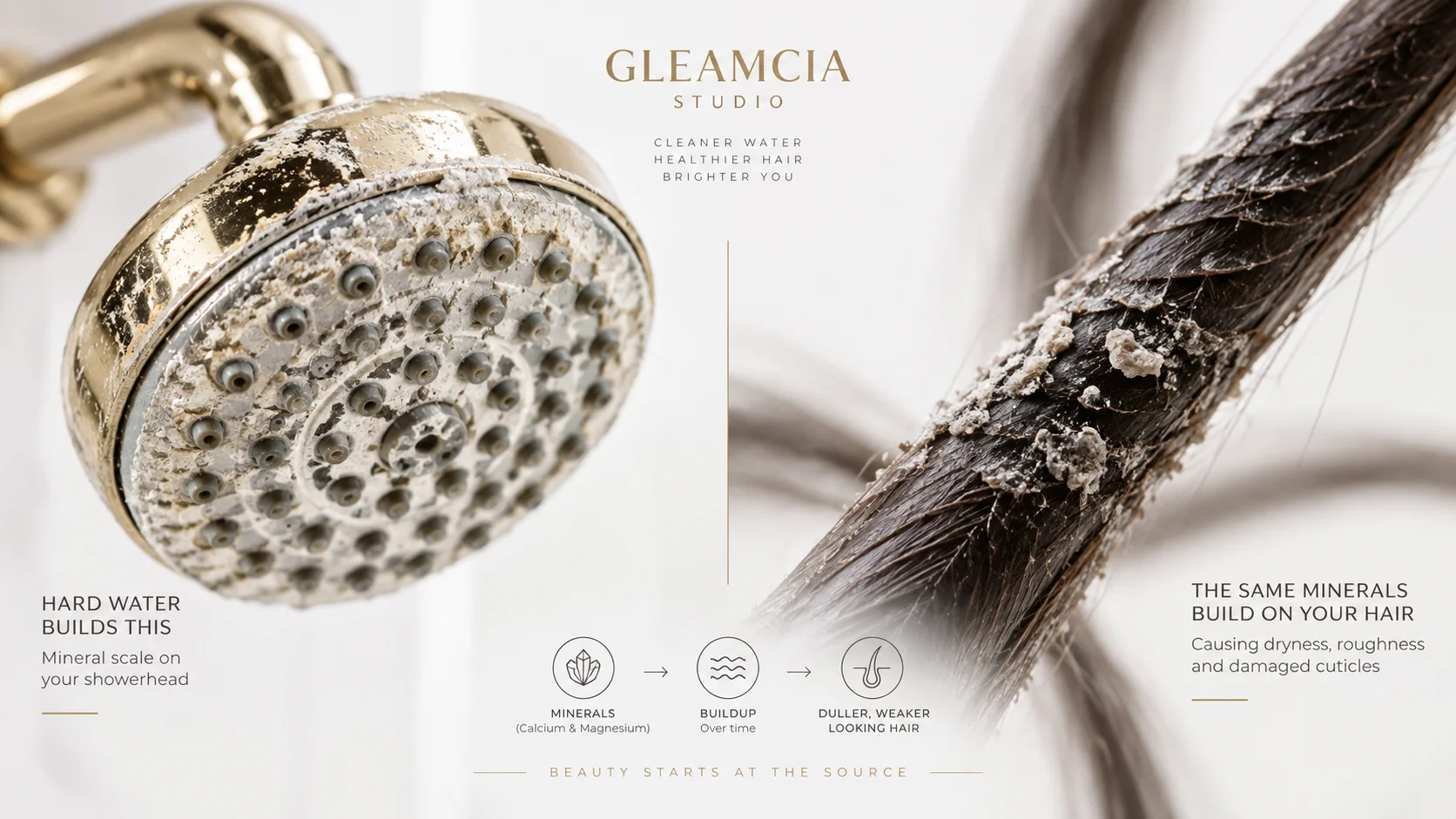
The visible evidence of this is everywhere in the city. The white scale on taps and showerheads. The film inside kettles. The chalky residue on tiles after the water dries. Every one of those deposits is the same calcium and magnesium that is also landing on your hair and scalp with every wash.
Why Hard Water Makes Hair Feel Rough After Every Wash in Karachi
The mechanism is specific enough to explain the exact sensation most Karachi residents describe — the hair feels clean immediately after washing for about thirty seconds, then feels coated and rough as it starts to dry.
Hair has a naturally negatively charged surface. Calcium and magnesium ions in hard water are positively charged. The opposite charges attract, and the minerals bind to the hair shaft surface during washing and rinsing. Every time Karachi’s water passes through the hair, it deposits a new layer of mineral ions onto the strand.
These mineral deposits do three things that produce the roughness:
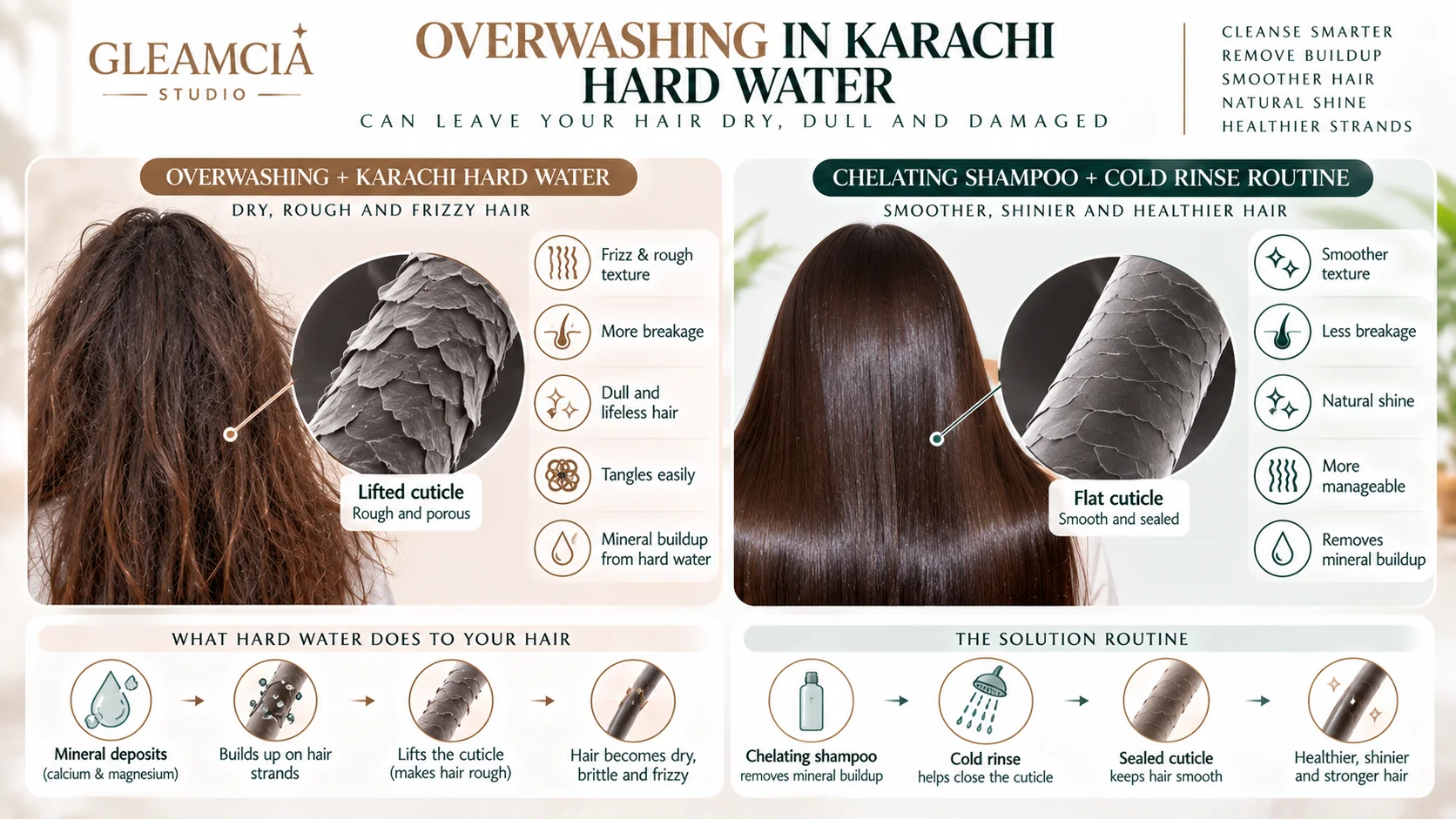
The cuticle — the overlapping protective layer of scales on the hair surface — is physically lifted and roughened by the mineral adhesion. A smooth cuticle feels silky. A raised, rough cuticle feels like what most Karachi residents describe: coarse, dull, and resistant to detangling.
The mineral film prevents conditioner from reaching the actual hair shaft. The conditioner sits on top of the mineral layer rather than penetrating to the cortex where hydration is needed. This is why conditioning with increasingly expensive products does not solve the problem — the issue is what is under the conditioner, not the conditioner itself.
Karachi’s water also contains iron in some areas. Iron oxidises on the hair surface, adding brassiness or a dull, yellowish cast to hair and increasing the structural roughness of the mineral coating further.
How Hard Water Hair Fall Actually Happens in Karachi
The connection between rough-feeling hair and hair fall runs through the scalp rather than the strand.
The same calcium and magnesium that coat the hair strand also deposit on the scalp surface and inside follicle openings. Karachi’s water has an alkaline pH — typically between 7.5 and 8.5. The scalp’s natural healthy pH is acidic, around 5.5. Every hard water wash shifts the scalp’s pH upward, disrupting the acid mantle that protects the scalp from inflammation and bacterial or fungal overgrowth.
A chronically alkaline scalp is more inflamed. Follicles surrounded by chronically inflamed tissue spend less time in the active growth phase and more time in the resting, pre-shedding phase. This is the same follicle disruption mechanism at work in dandruff-related hair fall and post-illness telogen effluvium — the inflammation pushes more follicles toward premature shedding simultaneously.
The mineral buildup at the follicle opening physically congests the follicle over time. A congested follicle cannot anchor the hair root as effectively, and strands that would normally complete a full growth cycle shed earlier.
Karachi’s heat compounds the issue. When mineral deposits on the scalp mix with sweat in the heat, the concentration of ionic material sitting against the scalp increases. The inflammatory load builds faster in Karachi’s summer than it would in a cooler, less humid climate — which is partly why hair fall in the city tends to be more noticeable in the warmer months.
Why Your Hair Feels So Rough After Shampooing in Karachi
This is one of the most confusing experiences with hard water. You shampoo. The hair should be cleaner. But it feels worse.
Standard shampoos are designed to remove sebum, product residue, and surface dirt. They are not formulated with chelating agents — compounds that bind to and remove mineral ions. After shampooing with a regular formula in Karachi’s water, the sebum is removed but the mineral coating remains intact on the hair surface. The hair is “clean” in the sebum sense but still coated with calcium and magnesium that the shampoo could not lift.
On top of that, the rinse water itself deposits new minerals. Every litre of water that passes through the hair during rinsing is adding more calcium and magnesium to the surface, regardless of how good the shampoo was. Regular shampoos do not prevent this deposit — and some high-surfactant formulas actually increase mineral adhesion by stripping the surface charge that would otherwise repel some ions.
The result after a standard shampoo in Karachi: the hair feels rough because the cuticle is coated with a fresh mineral layer from the rinse water, laid over whatever mineral buildup was already there from previous washes.
Why Hair Is So Frizzy After Washing in Karachi
The frizz and roughness are two manifestations of the same problem but through a slightly different mechanism.
A smooth, flat cuticle controls moisture exchange between the hair shaft and the environment — it allows some moisture in but prevents uncontrolled swelling. When the cuticle is raised and roughened by mineral deposits, it loses this regulation. In Karachi’s humidity, the raised cuticle allows ambient moisture to enter the hair shaft rapidly and unevenly. Uneven moisture swelling is the definition of frizz — different parts of the hair shaft absorbing different amounts of water, causing the strand to expand irregularly and lose its structure.
This is why Karachi hair can be simultaneously dry (the actual moisture content of the cortex is low because the conditioner could not penetrate the mineral barrier) and frizzy (the raised cuticle is absorbing ambient humidity from the outside in an uncontrolled way). The internal shaft is parched. The cuticle surface is reacting to Karachi’s humid air. The result is frizz with no body.
How to Soften Rough Hair from Hard Water in Karachi
Softening hard water-roughened hair requires one step that most people have never taken: chelation. Removing the mineral layer before trying to condition the hair.
Chelating or clarifying shampoo is the foundational intervention. A chelating shampoo contains ingredients like EDTA (ethylenediaminetetraacetic acid) or phytic acid that bind to calcium and magnesium ions and lift them away from the hair surface. Used once a week or every ten days, a chelating shampoo resets the mineral buildup that accumulated through the week’s regular washes. The first use produces a noticeable and often dramatic difference in how the hair feels after washing — it is the closest thing to the “clean” feeling that was expected from washing but never quite arrived.
Apple cider vinegar rinse is the most accessible home approach. Two to three tablespoons in one litre of water, used as a final rinse after shampooing, provides mild acid-chelation that shifts the scalp and hair back toward the correct acidic pH while loosening some mineral deposits. The smell dissipates once the hair dries.
Vitamin C rinse — ascorbic acid dissolved in water — chelates calcium and magnesium specifically. Crush one vitamin C tablet into 300ml of water, apply to the scalp and hair, leave for five minutes, and rinse before shampooing. Used as a pre-shampoo treatment once a week, it significantly reduces the mineral layer before the chelating or anti-hair fall shampoo cleanses.
Deep conditioning mask immediately after chelating is non-negotiable. The chelating shampoo removes mineral buildup but also removes natural oils alongside it. A protein or moisture-rich mask applied for five to ten minutes after chelating restores what the hair needs before the mineral layer had a chance to build back.
How to Make Hair Silky Smooth After Washing in Karachi
Getting silky smooth hair from Karachi’s water requires a specific sequence rather than just a better conditioner.
The cold rinse is one of the most immediately effective steps. After conditioning, rinsing with the coolest water you can tolerate closes the cuticle. Hot water opens the cuticle and allows more mineral adhesion from the rinse water. A cool or cold final rinse closes the cuticle over the conditioner that has just been applied, sealing it in and leaving the hair noticeably smoother and shinier after drying than a hot rinse would.
Microfibre towels make a genuine difference. Standard cotton towels have a rough texture that agitates the already-raised cuticle during drying. A microfibre towel absorbs water by pressing and drawing rather than friction — keeping the cuticle from being roughed up further immediately after the rinse step where it was starting to close.
Applying a leave-in conditioner or a hair serum to slightly damp hair after towel drying is the step that locks in smoothness through the drying process. In Karachi’s humidity, this product layer also acts as a barrier between the raised cuticle and the ambient moisture that would otherwise cause frizz before the hair has fully dried.
Air drying completely rather than heat-drying whenever time allows preserves the smoothness longer. If heat drying is needed, applying a heat protectant first and using the dryer on cool setting for the last two minutes closes the cuticle with directed airflow rather than heat.
The Complete Hard Water Hair Routine That Works in Karachi
Every wash day (three to four times weekly):
- Pre-wash: Vitamin C rinse or coconut oil applied to the hair lengths for 15 to 20 minutes before shampooing
- Anti-hair fall shampoo — a sulphate-free formula that does not compound mineral adhesion with aggressive stripping
- Scalp massage during shampooing — two to three minutes — to physically loosen mineral deposits and improve circulation
- Conditioner from mid-length to ends — left for three to five minutes
- Cool final rinse to close the cuticle
- Microfibre towel pressing, not rubbing
- Leave-in serum or conditioner applied to damp hair
Once weekly:
- Chelating shampoo to strip the accumulated mineral buildup of the week
- Deep conditioning mask immediately after — a protein or moisture mask appropriate for hair type
Between washes:
- Anti-hair fall scalp spray applied to the scalp on non-wash days
- No dry shampoo directly on the scalp — it adds product residue that interacts with mineral deposits to congest follicles further
Regular Shampoo vs Chelating Shampoo for Hard Water Hair Fall in Karachi
| Feature | Regular Shampoo | Chelating Shampoo |
| Removes sebum and dirt | Yes | Yes |
| Removes mineral deposits (calcium, magnesium) | No | Yes — specifically formulated for this |
| Suitable for daily use in hard water | No — minerals accumulate wash by wash | No — use weekly or fortnightly |
| Effect on frizz in Karachi | Limited — does not address mineral-raised cuticle | Significant — mineral removal smooths cuticle |
| Effect on hard water hair fall | Indirect — if anti-hair fall formula | Indirect — by removing follicle-clogging mineral buildup |
| Needs to be followed by deep conditioner | Not essential every wash | Yes — chelating removes natural oils alongside minerals |
| pH restoring | Standard formulas rarely pH balanced | Better formulas include pH adjustment |
| Suitable for Karachi weekly use | Yes — between chelating washes | Yes — once weekly, not more |
| Available in Pakistan | Yes | Yes |
| Price range | Wide | Typically mid to higher range |
The practical routine for Karachi: chelating shampoo once a week to reset mineral buildup, followed by a deep conditioning mask. Use an anti-hair fall sulphate-free shampoo for the remaining two to three wash days in the week. Between wash days, apply a scalp spray and do not touch the hair with dry shampoo or heavy styling products at the scalp.
Shower Filter vs Chelating Shampoo for Karachi Hard Water Hair: Which Matters More?
Both address the problem but at different stages of it.
A shower filter (KDF or activated carbon type installed on the showerhead) reduces the mineral content and chlorine in the water before it reaches the hair and scalp. A good shower filter can reduce calcium and magnesium content by 50% to 70%, which means every wash deposits significantly less mineral on the hair and scalp. This is preventive — it reduces the rate at which the problem builds.
A chelating shampoo used weekly removes the mineral buildup that has accumulated despite the filter or in the absence of one. This is corrective — it addresses what is already there.
For Karachi residents: starting with the chelating shampoo provides immediate noticeable improvement that is felt with the first use. Adding a shower filter reduces the weekly mineral accumulation, which means the chelating shampoo is doing less work over time and the hair condition stays better between chelating sessions.
Neither is optional if you are experiencing significant hard water hair fall and roughness in Karachi. Together they produce the most sustainable result.
What Are Signs of Overwashing Hair in Karachi?
Hard water creates an interesting trap. The hair and scalp never quite feel clean — which makes people wash more frequently trying to achieve the clean feeling. That increased frequency makes the hard water damage worse. Knowing the signs of overwashing helps break this cycle.
The skin on the scalp tightens immediately after washing and stays tight. Clean, healthy skin should feel balanced after washing — not pulled or stripped. If it consistently feels tight within minutes of rinsing, the barrier is being stripped on every wash.
Oil returns within hours rather than a full day. A scalp that is overwashed loses its natural barrier rapidly and triggers compensatory sebum production to try to restore it. The faster oil returns after washing, the more likely the wash frequency is too high.
Hair fall increases during washing. A larger-than-normal volume of strands in the drain with every wash is often a sign that daily washing in hard water is weakening the root anchorage and removing strands that have not yet completed their growth cycle.
Frizz and dryness increase the more frequently the hair is washed. Moisture is being stripped faster than it can be replenished between washes, producing hair that is simultaneously dry, frizzy, and rough despite washing frequently.
The scalp develops red patches, flaking, or itching that was not there before the frequency increased. Barrier disruption from overwashing creates exactly the conditions where Malassezia and seborrhoeic dermatitis accelerate — the warmth, the pH disruption, the stripped barrier.
For most Karachi residents with hard water: three to four washes per week is the appropriate maximum, with a chelating wash once in that cycle and anti-hair fall shampoo for the others. Daily washing in Karachi’s hard water is what produces the cycle of rough hair, hair fall, and scalp problems most people are experiencing without connecting it to the frequency.
Common Mistakes Karachi Residents Make With Hard Water Hair Care
Washing more frequently to try to get clean. The harder the water and the rougher the post-wash feel, the more often people wash trying to recapture the clean feeling. Daily washing in Karachi’s hard water deposits more minerals, strips more of the natural protective layer, and accelerates both the roughness and the hair fall.
Using more conditioner to fix the roughness without addressing the mineral buildup underneath it. The conditioner cannot penetrate the mineral film. More of it on top of a mineral-coated strand provides marginal improvement and wastes product. The fix is removing the mineral layer first with chelation, then conditioning.
Assuming the roughness is a hair type issue. Many Karachi residents believe they simply have rough, dry hair by nature. The first time someone with this assumption uses a chelating shampoo and then visits a city with softer water, they realise the hair they thought they had is not the hair they actually have. The hardness of Karachi’s water is the dominant factor, not the hair type.
Rinsing with very hot water. Hot water opens the cuticle and maximises mineral ion absorption from the rinse water. In Karachi’s hard water, hot rinsing is actively making the coating worse with every wash. Lukewarm to cool water for rinsing reduces mineral adhesion in the rinse step itself.
Not conditioning the scalp edge. While conditioner should not go directly on the scalp, the inch or two of hair closest to the scalp — often the most mineral-coated zone — frequently gets left unconditioned because people apply from the mid-lengths down. The hair at the root is the most recently grown and most structurally intact; skipping that zone wastes the opportunity to protect the newest growth.
How Quickly Does Hard Water Hair Improve in Karachi With the Right Routine?
The improvement timeline after starting a chelating shampoo and corrected washing routine is faster than most hard water concerns.
After the first chelating wash: most people notice their hair feels lighter, smoother, and more responsive to conditioner immediately. The change within the first wash is often significant enough to confirm the hard water diagnosis on its own.
After two to three weeks of weekly chelating: visible reduction in frizz, noticeably smoother texture at the scalp-length zone, and hair that holds moisture from conditioner rather than feeling coated and stiff.
After four to six weeks of the full routine including the Vitamin C rinse pre-wash and cool final rinse: hair texture substantially improved, hair fall from scalp mineral buildup and inflammation reducing, and overall shine returning to dull hard water-damaged hair.
Month two to three onward: sustained improvement as the scalp inflammation and follicle congestion from mineral buildup continues to reduce with weekly chelating and reduced daily mineral accumulation.
Aftercare and Weekly Habits for Hard Water Hair in Karachi
Do:
- Use a Vitamin C rinse or pre-wash oil on the lengths before each wash to provide a mild barrier against new mineral adhesion during rinsing
- Rinse with the coldest water you can manage as the final step — this simple habit makes a visible difference to post-wash smoothness in Karachi’s hard water
- Change pillowcases twice a week — fabric that absorbs minerals, sebum, and environmental dust overnight transfers them back to freshly washed hair
- Use a microfibre towel for drying — the reduced friction on the cuticle is immediately noticeable compared to a standard cotton towel
Do not:
- Use the same hot shower temperature for washing and rinsing — hot rinse is where the majority of the final mineral adhesion happens
- Skip the deep conditioning mask after chelating — the mineral removal process also removes protective oils and the hair needs that moisture restoration
- Apply dry shampoo directly at the roots between washes — it adds residue that compounds mineral buildup at the follicle opening
What Does Hard Water Hair Care Cost in Karachi?
Chelating shampoo is the new product most people in Karachi need to add to their routine — and the price reflects its specialised formulation. Standard shampoos use surfactants for sebum removal. Chelating shampoos add chelating agents (EDTA, phytic acid, citric acid) that require more complex formulation. Used once a week rather than daily, a 250ml bottle of chelating shampoo lasts considerably longer than a daily-use shampoo of the same size — which balances the per-bottle price against actual cost per wash.
A shower filter installed on the showerhead involves a higher upfront investment but a low cost per month across its filter lifespan. The ongoing cost reduction in chelating shampoo frequency — because the filter pre-treats the water before it reaches the hair — means the filter pays for itself over a few months of combined use.
The complete hard water hair routine for Karachi — chelating shampoo, anti-hair fall sulphate-free shampoo, deep conditioning mask, scalp spray, and biotin supplement — is more economical as a bundle than as individual product purchases. Gleamcia bundles from the same range ensure product compatibility and reduce the per-item cost.
Nationwide delivery from Karachi across Pakistan is available at gleamcia.com/shop — current pricing on all hard water and hair fall products is listed there.
Why Choose Gleamcia
Gleamcia is based in Karachi — which means every hair product in the range is formulated with exactly the water conditions being discussed here as the primary environmental context.
- Hard water-compatible hair care formulas with chelating and barrier-supportive actives that work with what comes out of Karachi’s taps
- Sulphate-free anti-hair fall shampoos that do not compound mineral adhesion with aggressive stripping surfactants
- Scalp sprays with caffeine and niacinamide formulated for the follicle environment that Karachi’s water compromises over time
- Full transparency on which products address which part of the hard water problem — chelation, scalp health, or strand repair — so the routine is coherent rather than accumulated randomly
- Nationwide delivery across Pakistan, from Karachi to Lahore, Islamabad to Quetta — fast dispatch and reliable packaging
Frequently Asked Questions
1. Why does my hair feel so rough after shampooing in Karachi? Karachi’s hard water deposits calcium and magnesium ions on the hair shaft during washing and rinsing. These mineral deposits raise and roughen the cuticle — the protective scale layer on the hair surface — and prevent conditioner from penetrating underneath. Standard shampoos remove sebum and dirt but cannot chelate (bind and remove) mineral ions. The rough post-wash feeling is the mineral coating that the shampoo left behind. A chelating shampoo used once weekly removes this mineral layer and restores the smooth texture that conditioner and regular washing cannot reach.
2. How do I soften rough hair damaged by Karachi’s hard water? The first step is chelation — using a chelating shampoo to strip the mineral buildup from the hair shaft. Following that with a deep conditioning mask restores moisture to the now-clear hair shaft. Between chelating washes, a Vitamin C rinse (ascorbic acid dissolved in water) or an apple cider vinegar rinse after regular washing provides mild ongoing chelation and pH restoration. A cool final rinse closes the cuticle and locks in conditioner. A microfibre towel for drying and a leave-in serum on damp hair complete the routine.
3. Why is my hair so frizzy when I wash it in Karachi? The mineral deposits from Karachi’s hard water raise the hair cuticle, which normally controls moisture exchange between the hair shaft and the environment. A raised cuticle allows ambient moisture to enter the hair shaft rapidly and unevenly in Karachi’s humidity — causing the shaft to swell irregularly, which is what frizz looks like physically. The hair is simultaneously dehydrated inside (because conditioner cannot penetrate the mineral barrier) and reacting to external moisture from the humid air. Chelating the mineral layer and using a cool rinse to close the cuticle after washing resolves the frizz more effectively than any anti-frizz product applied on top.
4. How do I make hair silky smooth after washing in Karachi? Use a chelating shampoo to clear mineral buildup first. Condition thoroughly from mid-length to ends, leaving the conditioner for three to five minutes. Rinse with the coldest water you can manage as the final step — cool water closes the cuticle that the conditioning step has just smoothed. Press dry with a microfibre towel rather than rubbing with cotton. Apply a leave-in conditioner or serum to slightly damp hair before air drying. In Karachi’s heat, applying to damp rather than soaking hair allows faster absorption without product sitting heavily on the strand.
5. What are the signs of overwashing hair in Karachi? The scalp feels tight immediately after washing and stays that way. Hair becomes oily within hours of washing rather than a full day. More hair falls during washing than feels normal. Frizz and dryness increase despite washing more frequently. The scalp becomes itchy, red, or flaky after a period of higher wash frequency. In Karachi’s hard water, daily washing is the most common driver of all five signs simultaneously — each wash deposits more minerals, strips more barrier, and accelerates the cycle of roughness, oiliness, and hair fall that daily washing is trying to solve.
6. How often should I use chelating shampoo in Karachi? Once weekly is the practical standard for most people in Karachi’s very hard water. Using it more frequently removes natural oils at a rate the scalp cannot replenish comfortably, which can dry the scalp and trigger more sebum production — the opposite of what you want. Once every seven to ten days clears the mineral buildup before it becomes significant while allowing the scalp’s natural oils to maintain the barrier in between. Always follow a chelating wash with a deep conditioning mask.
7. Does a shower filter help with hard water hair fall in Karachi? Yes — a shower filter reduces the mineral content in the water before it reaches the hair and scalp on every wash. A KDF or activated carbon filter can reduce calcium and magnesium by 50% to 70%, meaning significantly less mineral deposit with every wash and rinse. It does not eliminate all hard water damage but substantially reduces the rate at which it accumulates. Used alongside a weekly chelating shampoo, the filter means the chelating shampoo is removing less buildup per session — keeping the hair in better condition between treatments.
Your Hair Is Not the Problem — Karachi’s Water Is
The roughness, the frizz, the hair fall — none of it started because something changed in your hair. Karachi’s water has always been this hard and it will continue to be. What changes is how you manage it. A weekly chelating shampoo, a corrected washing routine, and the right anti-hair fall products between washes will produce a difference you will feel within the first week. Order from the Gleamcia Hair Care range — we are based in Karachi and ship nationwide across Pakistan. Order from Karachi and get it delivered anywhere in the country.
Order on WhatsApp at 0336 1223363 for personalised advice on the right hard water hair routine for your hair type.