Introduction
You made it through nine months of pregnancy. Your hair was thicker than it had ever been. And then — somewhere around three months after delivery — it starts. Strands in the shower drain in numbers that feel impossible. Clumps when you run your fingers through. A visible change in the mirror that no one warned you to expect.
Postpartum hair fall is one of the most common and most alarming experiences new mothers face in Pakistan, and one of the least talked about. Most women go through it without knowing what it is, whether it will stop, or whether their hair will ever come back. This blog answers all three directly, explains why it happens at a biological level, and gives you a specific recovery routine built for Pakistan’s nutritional realities and climate. Browse the Gleamcia Hair Care range for gentle, sulphate-free formulas and supplements designed to support hair recovery in the postpartum period.
What Is Postpartum Hair Fall and Why Does It Happen?
Postpartum hair fall — medically called postpartum telogen effluvium — is not really hair loss in the way most people think of it. It is hair normalisation after pregnancy. And understanding this distinction is what makes it less frightening when it starts.
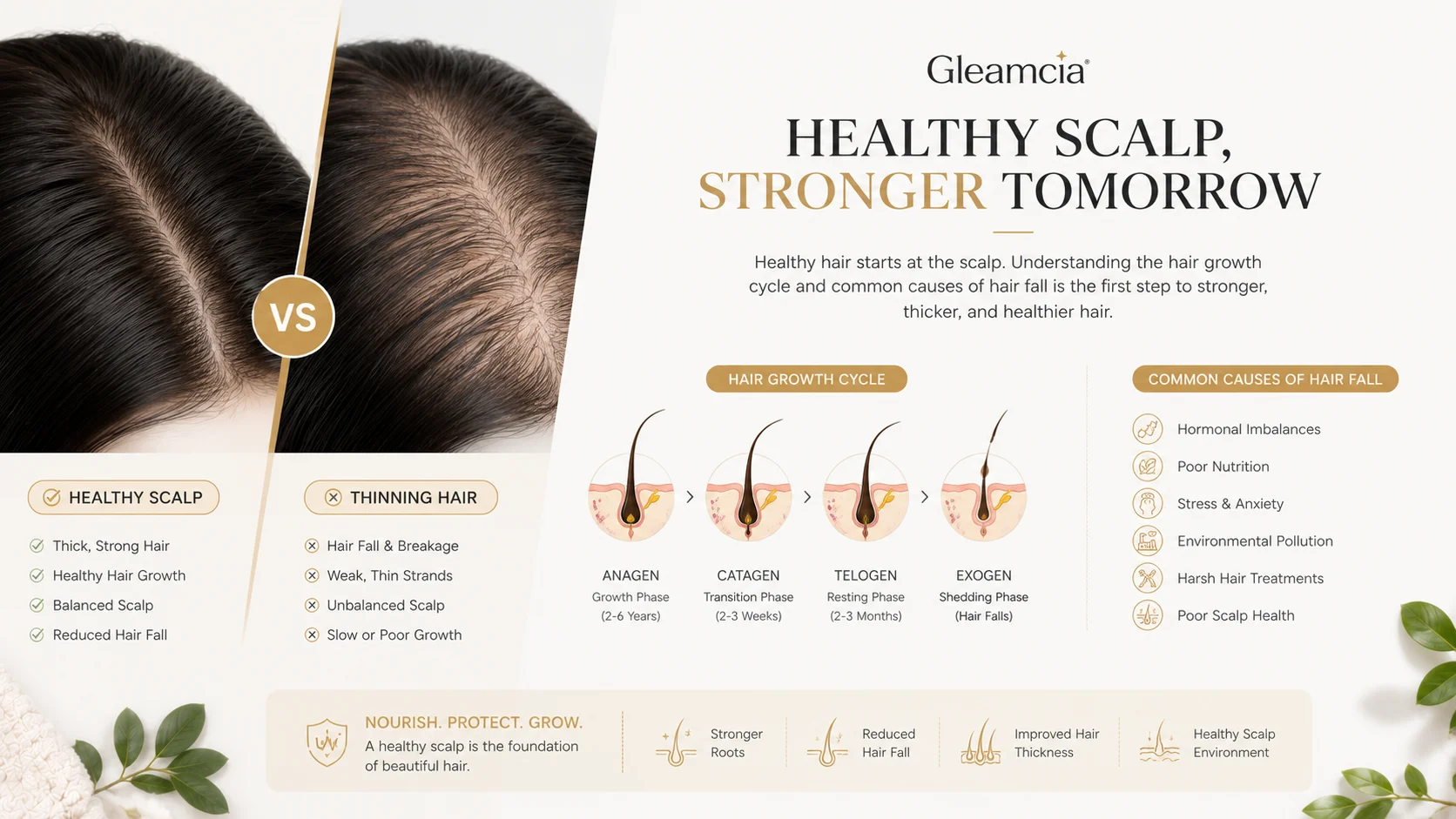
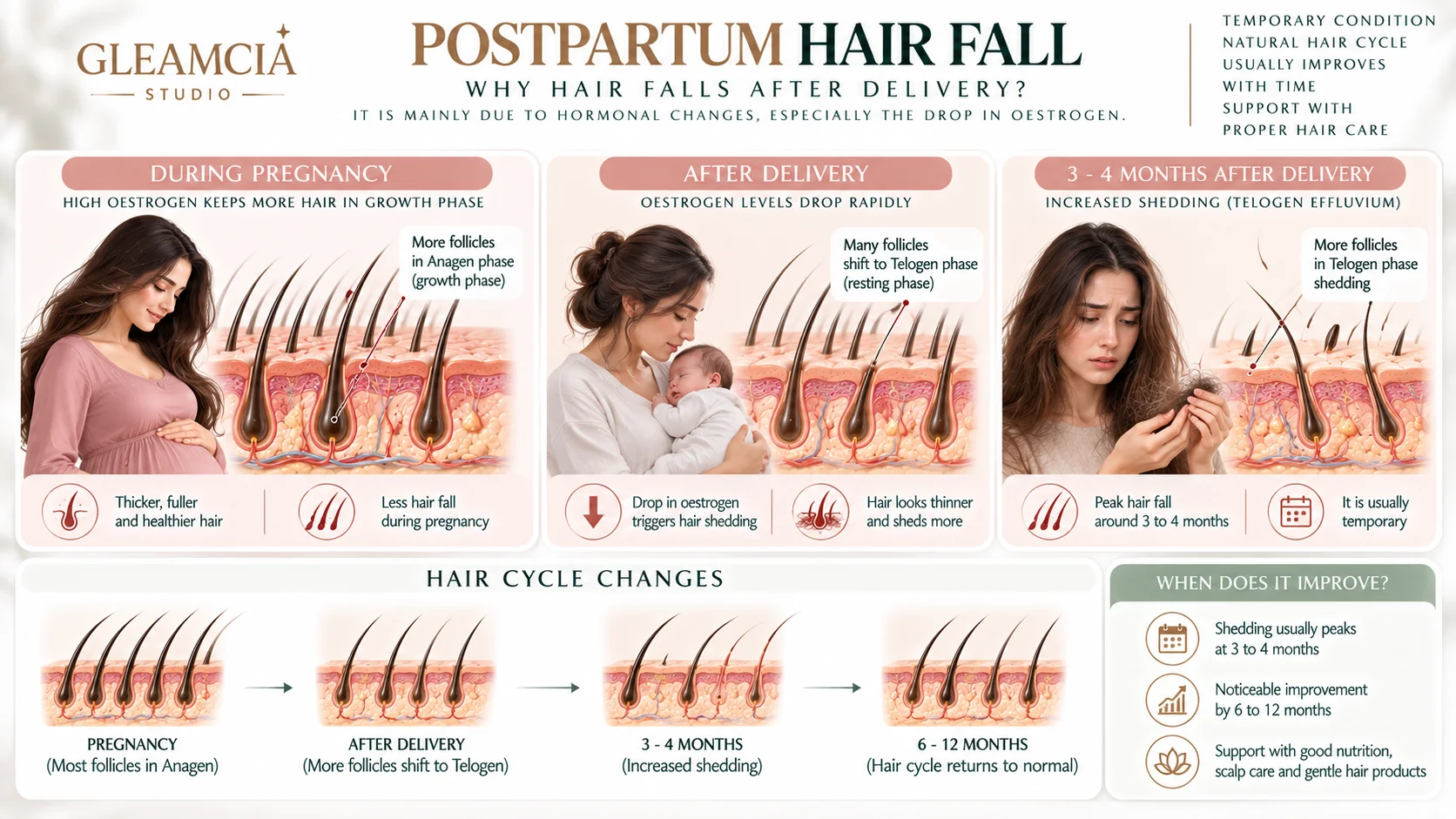
During pregnancy, elevated oestrogen levels extend the anagen (active growth) phase of the hair cycle. Normally, roughly 85% of hair follicles are in the growth phase at any given time while the remaining 10% to 15% are resting and preparing to shed. During pregnancy, oestrogen keeps nearly 95% of follicles in anagen simultaneously. This is why pregnant hair is often the thickest, fullest, most lush hair a woman will ever have. The hair that would normally be falling is staying.
The reckoning comes after delivery. When oestrogen drops — and it drops dramatically within 24 to 48 hours of delivery — all the follicles that were being held in anagen are released simultaneously into the telogen (resting) phase. Three months after that mass telogen entry, those follicles complete their rest cycle and shed all at once. This is the postpartum hair fall most women notice: a sudden, alarming volume of shedding that appears weeks after the delivery itself.
The hair that falls is not new loss. It is the accumulated shedding from the nine months of pregnancy when the hair was not falling at its normal rate — delivered all at once rather than gradually.
When Does Postpartum Hair Fall Start?
Most women notice postpartum hair fall beginning between two and six months after delivery. The most common onset is around the three-month mark — which corresponds to the typical duration of the telogen phase (two to three months) running its course after the mass telogen entry at delivery.
For some women it starts as early as six to eight weeks postpartum. For others, particularly those who are breastfeeding and whose hormonal adjustment is more gradual, the onset may be closer to four to five months.
The one consistent pattern is the delay. The hair fall does not start with delivery. It starts after a lag period that frequently confuses new mothers who have already moved past the acute phase of recovery and are adjusting to life with a newborn. The delayed onset makes it easy to misattribute the fall to the stress of new motherhood, the change in diet, or a new shampoo — rather than recognising it as the hormonal cascade that began the day of delivery.
When Is Postpartum Hair Loss the Worst?
The peak of postpartum hair fall typically happens between months three and five after delivery. During this window, the daily loss volume is at its highest — sometimes three to four times the normal shedding rate of 50 to 100 hairs per day. Finding hair on the pillow, in significant amounts in the shower, and throughout the day during normal handling is the peak experience.
For women with additional nutritional deficiencies — which is significantly more common in Pakistan due to the dietary context around the postnatal period — the peak can be slightly more pronounced and slightly longer in duration than the typical timeline. Iron deficiency anaemia is particularly common postpartum across Pakistan’s population and directly amplifies the severity of telogen effluvium. When follicles are nutritionally deprived at the same time as they are managing the hormonal transition, the shedding is heavier than it would be in a well-nourished state.
Breastfeeding prolongs the nutritional drain on the body. The body continues to prioritise breast milk production over maternal tissue maintenance — including hair follicle function. This does not mean stopping breastfeeding, but it does mean being particularly attentive to nutrition throughout the breastfeeding period rather than only in the weeks immediately following delivery.
When Does Postpartum Hair Fall Stop?
In most cases, postpartum hair fall slows substantially by months six to nine after delivery and resolves largely by twelve months. The body’s oestrogen levels stabilise, the mass telogen wave completes itself, and follicles gradually return to their normal cycling pattern.
The reduction in daily shedding is gradual rather than sudden. From the peak at months three to five, the fall rate decreases week on week through the middle months of the year. By month eight or nine, most women describe the shedding as having returned to something close to what it was before pregnancy.
Women who are still experiencing significant postpartum hair fall beyond twelve months, or who notice a defined patterned progression rather than the diffuse shedding typical of telogen effluvium, should see a dermatologist. Postpartum thyroiditis — a thyroid condition that can develop in the months after delivery — produces hair fall that is distinct from standard postpartum telogen effluvium and requires specific diagnosis and management.
Does Your Hair Actually Grow Back After Postpartum Hair Loss?
Yes. In virtually all cases of straightforward postpartum telogen effluvium, the hair grows back completely.
The follicles are not damaged by the postpartum hormonal shift. They have gone dormant temporarily as a consequence of the oestrogen withdrawal and subsequent telogen wave, but they return to the anagen phase as the hormonal environment normalises. New growth is almost always visible by months four to six as fine, short hairs — often described as baby hairs — appearing at the hairline and across the scalp.
These new hairs take time to mature into the full terminal hair length. The hairline baby hairs that appear at month five may still be noticeably shorter and finer by month ten — which creates the frustrating halo of short hairs around the hairline that many women notice as their hair recovers. But their presence is a definitive sign of recovery in progress.
Full density recovery — where the new growth has reached lengths comparable to the rest of the hair — typically happens between twelve and eighteen months postpartum. For women with longer hair, the recovery is visible throughout that period as the new growth gradually catches up to the pre-postpartum length.
The American Academy of Dermatology confirms that postpartum hair loss is temporary in the great majority of cases and that complete recovery is the expected outcome.
How to Regrow Hair After Pregnancy: The Real Approach
Regrowing hair after postpartum loss is less about aggressive treatment and more about creating the right conditions for the follicles to return to their natural growth cycle.
Nutrition restoration is the most critical active step. Pregnancy depletes iron, zinc, Vitamin D, and B vitamins significantly — and in Pakistan, these deficiencies are often more pronounced because the prenatal nutritional environment is already compromised for many women. The follicles emerging from telogen need these nutrients to produce healthy anagen hair. Without them, the regrowth is thinner and slower than it should be.
A postnatal multivitamin that continues through the breastfeeding period addresses multiple deficiencies simultaneously. Iron in particular warrants specific attention — a blood test to confirm whether deficiency is present is worth requesting at the first postpartum checkup. If iron is confirmed low, targeted iron supplementation alongside Vitamin C (which improves iron absorption significantly) makes a meaningful difference to the recovery timeline.
Protein intake needs to rise during breastfeeding. Hair is a protein structure and breastfeeding mothers have increased protein requirements. Many Pakistani new mothers eat an adequate calorie diet during recovery but not an adequate protein one. Eggs, dahi, chicken, daal, and fish are the most practical daily protein sources to build back into meals alongside traditional recovery foods.
Scalp massage for two minutes daily stimulates blood circulation to the follicles that are transitioning from telogen back to anagen. This does not require a product. Fingertip massage during a quiet moment — while the baby naps — or during shampooing adds real follicle stimulation that accelerates the transition.
An anti-hair fall scalp spray or serum applied between wash days delivers follicle-stimulating actives — caffeine, niacinamide, rosemary extract — directly to the scalp during the regrowth phase. Leave-on products provide hours of active ingredient contact compared to the brief contact of a rinse-off shampoo. Browse the Gleamcia hair recovery range for gentle, postpartum-appropriate options.
What Vitamins and Nutrients Help Postpartum Hair Loss?
The nutritional side of postpartum hair recovery deserves a full explanation because it is where most Pakistani new mothers have the most room to improve outcomes.
Iron is the most important. Iron deficiency is the single most common nutritional cause of hair fall in women of reproductive age globally, and postpartum blood loss combined with the iron demands of pregnancy makes new mothers particularly vulnerable. Symptoms of iron deficiency anaemia — fatigue, breathlessness, pale skin — may be attributed to new-mother exhaustion rather than deficiency. A blood test for serum ferritin (not just haemoglobin) is the most sensitive screening. Supplementation at confirmed-low levels produces visible hair fall reduction within months of correction.
Vitamin D is deficient in a surprisingly large percentage of the Pakistani population despite the country’s sun exposure. This happens because cultural practices of covering, time spent indoors, and the skin’s melanin content all reduce synthesis. Vitamin D receptors are found in hair follicle cells and Vitamin D deficiency is associated with hair fall. A blood test and supplementation if low is straightforward and effective.
Biotin (Vitamin B7) supports keratin production and strand integrity. Breastfeeding can deplete biotin. Supplementation at 2,500 to 5,000 mcg daily supports strand quality during the regrowth phase. Note: high-dose biotin can interfere with certain thyroid blood tests, so inform your doctor if supplementing and a thyroid test is planned.
Zinc is required for follicle cell repair and the normal hair growth cycle. Depleted during pregnancy and further reduced through breastfeeding. Food sources include pumpkin seeds, meat, lentils, and nuts — increasing these in the daily diet alongside supplementation if deficiency is confirmed.
Omega-3 fatty acids from fish, flaxseeds, and walnuts reduce the scalp inflammation that can compound postpartum shedding. They also support the lipid content of the hair strand itself.
Folic acid continues to be important postpartum, particularly during breastfeeding. It supports cell growth and follicle renewal, and prenatal folic acid supplementation should continue through the breastfeeding period.
Postpartum Hair Fall in Pakistan: The Nutritional Realities That Make It Harder
The postpartum recovery environment in Pakistan creates specific nutritional pressures that worsen and prolong postpartum hair fall beyond the typical timeline.
Iron deficiency anaemia is significantly more prevalent among Pakistani women than WHO averages for South Asia. Many women enter pregnancy already iron-deficient and leave delivery with iron stores further depleted. Without targeted correction, the hair fall that runs through the postpartum period has a nutritional amplifier that makes it longer and more severe than the hormonal shift alone would produce.
Traditional Pakistani postpartum recovery diets — while well-intentioned and culturally meaningful — do not always prioritise iron-rich foods. The emphasis on warming, hearty foods is valuable for energy, but correcting iron deficiency specifically requires consistent daily intake of red meat, lentils, spinach, and Vitamin C alongside them for absorption.
Vitamin D deficiency is widespread across the country. Women who spend significant time indoors during pregnancy and the postpartum period — which is common in the recovery weeks after delivery — get even less of whatever limited synthesis their skin was managing before. Postpartum Vitamin D supplementation is rarely routinely prescribed in Pakistan despite its impact on hair health.
Hard water exposure in Karachi and other major cities adds mineral damage to scalp and hair that layers on top of the hormonal hair fall, creating a combined effect more significant than either condition alone. The standard chelating shampoo guidance applies here too — weekly chelating during the postpartum recovery period prevents mineral buildup from compounding the hormonally-driven shedding.
Postpartum Hair Fall vs Pattern Hair Loss: How to Tell the Difference
This distinction matters enormously for the anxiety many new mothers carry about whether their hair will fully return.
| Feature | Postpartum Hair Fall (Telogen Effluvium) | Androgenetic Alopecia (Pattern Hair Loss) |
| Cause | Oestrogen withdrawal after delivery | DHT hormonal sensitivity + genetics |
| Pattern | Diffuse — thinning across the entire scalp | Patterned — crown, hairline, temples |
| Onset | 2 to 6 months after delivery | Gradual over years |
| Fully reversible | Yes — almost always | Without treatment, no |
| Baby hairs visible | Yes — at 4 to 6 months | No — follicles not transitioning back |
| Resolves without treatment | Yes — 6 to 12 months typically | No |
| Duration | Finite | Ongoing without intervention |
| Symmetry | Diffuse and non-patterned | Follows defined progression pattern |
For a new mother: if the thinning is diffuse across the whole scalp without a defined pattern, and it started two to six months after delivery — postpartum telogen effluvium is almost certainly the cause. The hair comes back. The follicles are intact. The timeline is fixed.
If the thinning is progressive over months without signs of baby hair regrowth, concentrated in a specific pattern, or continuing well beyond twelve months postpartum, a dermatologist assessment helps distinguish additional contributing factors.
The Best Hair Care Routine for Postpartum Hair Fall
Every wash (two to three times weekly): A gentle, sulphate-free anti-hair fall shampoo applied with a two-minute fingertip scalp massage. The massage is as important as the product during this phase. Heavy, stripping formulas are counterproductive when the scalp is already in a stressed state — the formula needs to be gentle and the technique needs to be consistent.
A light conditioner from mid-length to ends after shampooing keeps the strands that are present from breaking during the regrowth period. Postpartum hair that has been through months of nutritional depletion is structurally weaker than pre-pregnancy hair. Reducing mechanical breakage is a practical way to maintain density while the new growth catches up.
Between wash days: A scalp spray with caffeine and niacinamide applied to the scalp keeps the follicle stimulation going between washes. The active contact time from a leave-on product significantly exceeds what a rinse-off shampoo achieves in two minutes of washing. During the postpartum regrowth phase, maximising active contact time at the scalp level matters.
Once weekly: For women in Karachi or other hard water areas, a chelating shampoo used once weekly prevents mineral buildup from adding to the hormonal hair fall burden. Follow immediately with a deep conditioning mask to restore moisture after chelation.
Daily supplements: Biotin 2,500 to 5,000 mcg, a postnatal multivitamin, iron supplementation if deficiency is confirmed, and Vitamin D if blood levels are low.
What to Avoid During Postpartum Hair Fall
Tight hairstyles. Ponytails, braids, and buns that create traction at the hairline add mechanical stress to follicles that are already in a vulnerable transition. The traction alopecia risk is higher during a telogen effluvium phase than at normal times. Loose styles or low manipulation hairstyles protect the regrowth zone.
Aggressive combing on wet hair. Postpartum hair at peak shedding is at its most fragile when wet. A wide-tooth comb, starting from the ends and working upward, and gentle handling reduces the breakage that multiplies the apparent hair loss during this period.
Chemical treatments during peak shedding. Colour, bleach, relaxers, and keratin treatments stress the hair shaft at a time when strands are already structurally weaker from the nutritional depletion of pregnancy. These are better reserved for after the recovery phase is well underway — around the nine to twelve month mark.
Skipping the multivitamin because the postpartum chaos makes it easy to forget. A single daily tablet placed next to the baby’s morning supplements is the most reliable habit anchor for this.
When to See a Doctor About Postpartum Hair Fall
For most new mothers, postpartum hair fall is a self-resolving condition that needs nutritional support and patience rather than medical intervention.
See a doctor if the hair fall has not begun to slow by nine to twelve months postpartum. If it is continuing or worsening at that point, additional factors are likely contributing — thyroid dysfunction, ongoing iron deficiency anaemia, or an underlying hormonal imbalance that has not normalised after delivery.
Postpartum thyroiditis affects an estimated 5% to 10% of new mothers and can cause hair fall alongside symptoms like fatigue, weight changes, feeling unusually cold or warm, or mood changes. A simple thyroid function blood test confirms or rules this out. Thyroid-related hair fall does not resolve on its own until the thyroid condition is treated.
A blood test panel including serum ferritin, Vitamin D, TSH (thyroid), and a full blood count within the first three months postpartum is worth requesting at a routine follow-up visit in Pakistan’s health context, where multiple deficiencies are statistically common and often undetected.
Results Timeline for Postpartum Hair Recovery
Knowing what to expect at each stage removes the anxiety of not knowing when it will end.
Months one to three postpartum: hair fall increases, sometimes dramatically. This is expected and normal. New growth has not yet started.
Months three to five: peak shedding. The shower drain, the pillow, the brush — all at their worst during this window. This is the lowest point and it is also temporary.
Months four to six: baby hairs appear at the hairline and across the scalp surface. These are the physical confirmation that recovery is in progress. They are fine, short, and very noticeable against longer existing hair.
Months six to nine: daily shedding noticeably reduces. Not back to the pre-pregnancy baseline yet, but measurably better than the peak.
Months nine to twelve: shedding approaches the pre-pregnancy normal. The baby hairs continue to grow and are now visible as a slightly different texture zone near the scalp.
Twelve to eighteen months: full density recovery for most women. The new growth has reached lengths comparable to the rest of the hair and the postpartum change is largely no longer visible.
Aftercare During the Postpartum Hair Recovery Period
Do:
- Take progress photos monthly — the baby hairs appearing by month five are easy to miss without visual documentation, but they are the most reassuring thing to see during the recovery
- Take your postnatal or biotin supplement at the same time every day — linking it to a regular feeding or meal time creates the habit
- Protect the regrowth zone around the hairline from tight hairstyles for the full first year
- Eat foods rich in Vitamin C alongside iron-containing meals — it significantly improves how much iron the body absorbs from plant sources like lentils and spinach
Do not:
- Heat style the baby hairs that are growing in — they are fine and fragile and heat damage on new growth is permanent until that section grows out
- Stop the recovery routine when the shedding reduces at month six or seven — the regrowth still has months of work to do and the scalp care routine supports that growth even after the visible shedding phase is over
What Does Postpartum Hair Recovery Cost in Pakistan?
The postpartum hair recovery protocol involves a few consistent product categories over a twelve to eighteen month period.
A sulphate-free anti-hair fall shampoo used two to three times weekly depletes slower than a daily-use shampoo, making the per-month cost lower than the bottle size might suggest. Buying a larger format reduces the per-wash price significantly over an extended treatment period.
Biotin supplement cost depends on concentration and pack size. Buying a 90-capsule pack at 5,000 mcg rather than a 30-capsule pack reduces the per-day price considerably for what is a months-long supplementation course.
A scalp spray used between washes lasts longer than a shampoo because the amount per application is small. One 100ml bottle used five days per week lasts approximately a month.
Bundles — shampoo, scalp spray, and biotin together from the same range — reduce the per-product price and ensure the products are formulated to work alongside each other. Gleamcia offers nationwide delivery from Karachi to every city in Pakistan. Visit gleamcia.com/shop for current pricing on postpartum hair recovery bundles.
Why Choose Gleamcia
Gleamcia builds hair care products for the real conditions women in Pakistan face — and postpartum hair fall, compounded by nutritional deficiencies, hard water, and the demands of caring for a newborn, is one of the most specific contexts we formulate for.
- Gentle, sulphate-free anti-hair fall formulas appropriate for the postpartum scalp — not aggressive actives that are too stimulating for a sensitive post-delivery system
- Biotin supplements at effective concentrations appropriate for the breastfeeding period
- Scalp sprays with caffeine and niacinamide formulated for the follicle stimulation needed during the telogen-to-anagen transition phase
- Products designed for South Asian hair and Pakistan’s nutritional context — not formulations built for an entirely different hair type or health environment
- Nationwide delivery from Karachi across Pakistan, fast dispatch, reliable packaging, and a WhatsApp team that can help answer questions specific to your postpartum recovery stage
Frequently Asked Questions
1. Does your hair grow back after postpartum hair loss? Yes — in virtually all cases. Postpartum hair fall is telogen effluvium driven by oestrogen withdrawal after delivery, not damage to the follicles themselves. Once the hormonal environment stabilises and the telogen wave completes, follicles return to the anagen (active growth) phase. Baby hairs appear at the hairline and scalp within four to six months, and full density recovery happens by twelve to eighteen months postpartum for most women. Nutritional support — particularly iron and biotin — shortens the recovery timeline.
2. When is postpartum hair loss the worst? The peak typically falls between months three and five postpartum. This corresponds to the mass telogen entry triggered by oestrogen withdrawal at delivery completing its resting phase of two to three months. The daily hair fall volume during this window can be three to four times the normal 50 to 100 hair baseline, which feels alarming but is the body processing the entire pregnancy’s worth of delayed shedding. Nutritional deficiencies — particularly iron, which is common postpartum in Pakistan — can make the peak heavier and longer.
3. How do I regrow hair after pregnancy in Pakistan? Restore nutrition first — iron (confirmed by a serum ferritin blood test), Vitamin D, zinc, and biotin are the most critical. A postnatal multivitamin continued through breastfeeding covers multiple deficiencies simultaneously. Eat protein at every meal — hair is a protein structure and breastfeeding increases protein requirements significantly. Use a gentle sulphate-free anti-hair fall shampoo with two minutes of scalp massage at every wash, and apply a caffeine or niacinamide scalp spray between washes for leave-on follicle stimulation. The biology resolves on its own — these steps shorten the recovery timeline.
4. What vitamins help with postpartum hair loss? Iron is the most important, particularly in Pakistan where deficiency is widespread postpartum — confirmed by a serum ferritin test before supplementing. Biotin at 2,500 to 5,000 mcg supports keratin production and strand integrity. Vitamin D is commonly deficient across Pakistan’s population despite sun exposure and significantly affects follicle function. Zinc supports follicle cell repair and the normal hair cycle. Folic acid and omega-3 fatty acids complete the nutritional support picture. A postnatal multivitamin covering most of these alongside targeted iron supplementation if deficient is the most practical approach.
5. Does breastfeeding make postpartum hair fall worse? Breastfeeding prolongs the body’s nutritional drain because breast milk production is prioritised over maternal tissue maintenance including hair follicle function. Women who breastfeed may experience a slightly longer duration of postpartum shedding than those who do not. This does not mean stopping breastfeeding — the benefits to the baby are significant and the hair does recover. It does mean being more attentive to nutrition throughout the breastfeeding period — ensuring protein, iron, and B vitamins are consistently adequate in the diet.
6. How soon can I start using anti-hair fall products after delivery? Gentle, sulphate-free anti-hair fall shampoos and topical scalp sprays are appropriate from the early postpartum weeks. There is no need to wait — the scalp and hair benefit from active care even before the shedding peaks. Products containing caffeine, niacinamide, and rosemary extract are safe for topical scalp use during the postpartum and breastfeeding period. Avoid strong chemical treatments, high-concentration acids on the scalp, and any oral supplement not confirmed safe for breastfeeding by a healthcare provider.
7. When should I see a doctor about postpartum hair fall? See a doctor if significant shedding continues beyond twelve months postpartum, if the thinning follows a defined pattern rather than diffuse shedding, or if hair fall is accompanied by fatigue, mood changes, weight changes, or feeling unusually cold — symptoms that suggest postpartum thyroiditis. A blood test including serum ferritin, Vitamin D, and TSH (thyroid) at the three to six month postpartum mark is worth requesting in Pakistan’s context where multiple deficiencies are common and often undetected.
Your Hair Will Come Back — It Just Needs Support Getting There
Postpartum hair fall ends. For almost every woman who goes through it, the hair returns — and with the right nutritional and scalp care support in place, it returns faster and fuller. Order from the Gleamcia Hair Care range via our online store, available at gleamcia.com with nationwide delivery across Pakistan from Karachi.
Order on WhatsApp at 0336 1223363 and our team will help you build the right postpartum hair recovery routine for your specific stage — whether you are at peak shedding or starting to see the baby hairs appear.