Introduction
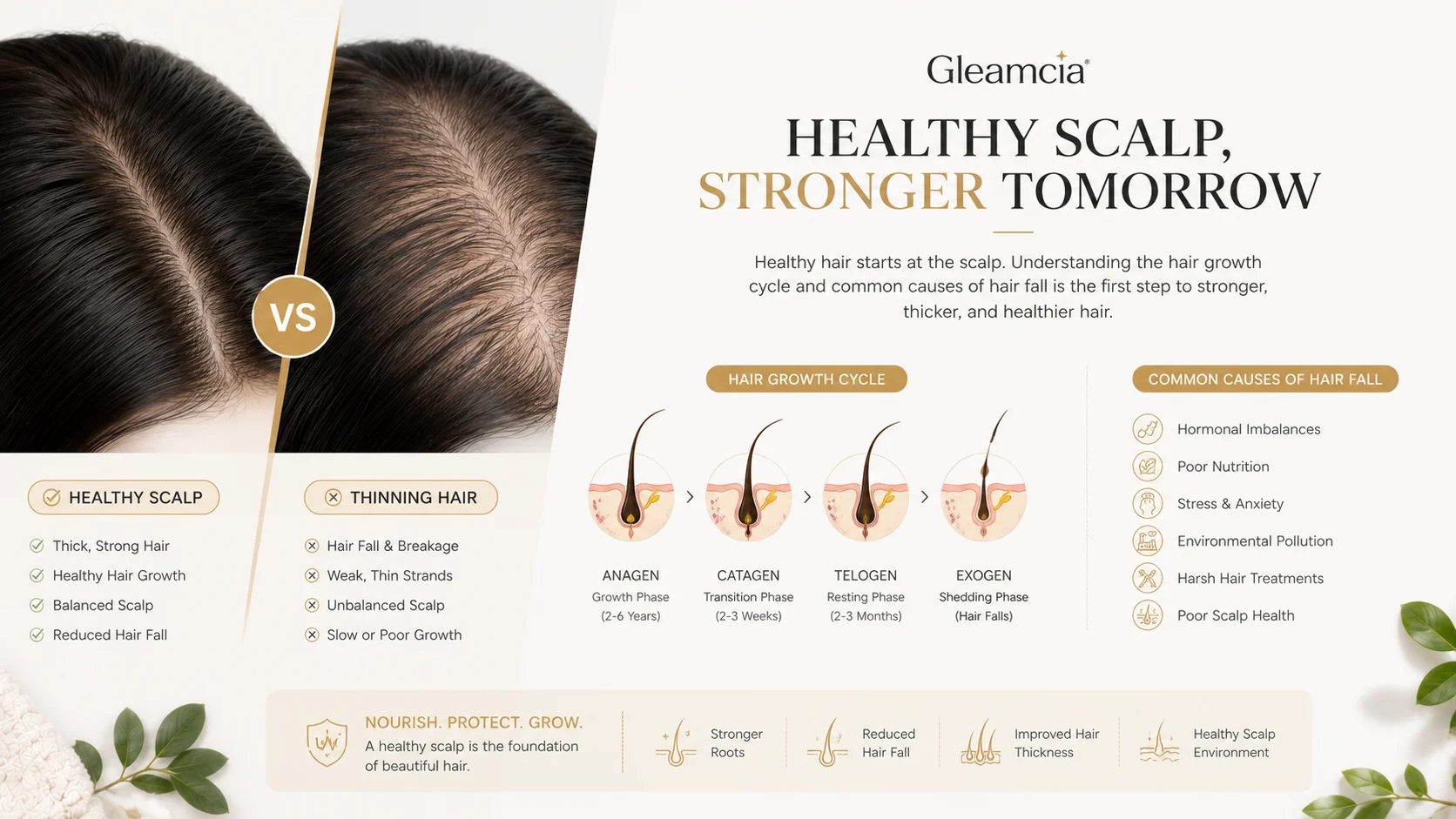
When hair starts thinning, most people want two things fast: a clear explanation for why it is happening and a product that will actually fix it. The two most searched options right now are biotin supplements and hair growth sprays. Both claim to reduce shedding and support regrowth. Both are widely available in Pakistan. But biotin vs hair growth spray is not as simple as picking the one with better reviews.
They work completely differently, target the problem from completely different angles, and suit different causes of thinning. Understanding which one your hair situation actually needs — or whether you need both — is what this blog is here to explain. Explore the Gleamcia Hair Care range for hair fall solutions built around proven actives and backed by real formulation science.
What Is Biotin and How Does It Help Thinning Hair?
Biotin is Vitamin B7, a water-soluble B-complex vitamin that is essential for the body’s keratin production. Keratin is the structural protein that hair, skin, and nails are made of. When biotin levels are insufficient, keratin synthesis slows, and the result shows up as weaker, thinner hair strands that break and shed more easily than they should.
Biotin does not work directly on the scalp or the hair follicle from the outside. It works systemically — through the bloodstream. When you take a biotin supplement, it is absorbed through the digestive system, enters circulation, and supports the metabolic processes that produce keratin throughout the body. The benefit to hair is internal, which is why it takes time to show up as visible change.
For people whose hair thinning is connected to a biotin deficiency — which is more common than many people realise, particularly in those with restrictive diets, digestive absorption issues, or pregnancy-related nutrient depletion — supplementing biotin can produce significant improvement in strand thickness and reduced daily shedding over a period of months.
Even for people who are not technically deficient, increased biotin intake supports stronger keratin architecture in each strand, which means less breakage and better strand survival across the normal growth cycle.
What Is Hair Growth Spray and How Does It Work on the Scalp?
A hair growth spray is a topical treatment applied directly to the scalp, usually between washes or daily, targeting the follicle environment from the outside. Rather than working through the bloodstream, it delivers active ingredients directly where hair growth happens — at scalp level, inside and around the follicle.
Effective hair growth sprays contain actives that work through specific mechanisms:
- Caffeine penetrates the hair follicle and stimulates cell metabolism, helping follicles stay in the active growth phase (anagen) for longer. Research has shown caffeine counteracts the effects of DHT on the follicle, which makes it particularly relevant for pattern-related hair thinning.
- Saw Palmetto is a natural DHT blocker. DHT (dihydrotestosterone) is the hormone that shrinks hair follicles in pattern hair loss. Saw palmetto inhibits the enzyme that converts testosterone to DHT, slowing follicle miniaturisation.
- Rosemary extract has been compared directly to 2% minoxidil in clinical settings, with results showing it supports follicle stimulation and improved scalp circulation. It is now one of the most used actives in non-prescription hair growth formulas.
- Niacinamide improves scalp circulation and reduces inflammation around follicles — one of the often-overlooked drivers of accelerated hair shedding.
- Peptides signal follicular cells to stay active and support the structural proteins that anchor hair at the root.
- Biotin (topical) added to some sprays — less effective than oral biotin for internal keratin support, but complements the formula.
The key difference is localisation. A hair growth spray acts precisely where hair loss is happening — the scalp — rather than working across the whole body through the bloodstream.
Biotin vs Hair Growth Spray: The Core Difference That Determines Which You Need
Here is the clearest way to understand the difference between the two.
Biotin works from the inside. It supports the building blocks that create a healthy hair strand — improving keratin quality, strand thickness, and the nutritional environment that the follicle draws from. It is a foundational approach that addresses hair fall caused by nutritional gaps, stress on the body’s nutrient supply, hormonal changes, or general systemic deficiency.
Hair growth spray works from the outside. It acts directly on the scalp, stimulating follicles that are slowing down, blocking hormonal triggers of follicle miniaturisation, and improving the local circulation and environment that follicles need to stay active. It is a targeted approach that addresses the scalp and follicle level directly.
The cause of your hair thinning determines which is the better starting point.
If your hair thinning is diffuse — happening all over the scalp, often linked to nutritional deficiency, stress, or postpartum changes — biotin supplementation addresses the most likely underlying contributor. If your thinning is pattern-related — concentrated at the temples, crown, or hairline, suggesting follicle miniaturisation from DHT — a hair growth spray with follicle-stimulating and DHT-blocking actives is the more directly targeted tool.
For most people dealing with thinning hair, the answer is not one or the other. It is both, working together from two directions simultaneously.
Should I Take Biotin If My Hair Is Falling Out?
Yes, biotin is worth including in a hair fall routine — but with the right expectations about what it will and will not do.
Biotin directly supports keratin production. Stronger keratin means stronger strands. Stronger strands break less, shed less during combing, and hold their density better across the natural growth cycle. For someone losing hair partly because strands are weak and breaking at the shaft rather than shedding from the root, biotin can produce a visible difference in hair density over time.
Biotin is also particularly relevant for people whose hair fall is linked to nutritional factors. Biotin deficiency is not always obvious — it does not show up on standard blood panels unless specifically tested. People who eat restrictive diets, have digestive conditions that affect nutrient absorption, or have been under sustained physical stress are more likely to be running low.
What biotin will not do is reverse genetic pattern hair loss or directly block DHT. If the primary driver of your thinning is hormonal — which is the case for a significant portion of people experiencing hair fall, both male and female — biotin alone is insufficient. The American Academy of Dermatology notes that androgenetic alopecia (pattern hair loss) requires specific hormonal intervention, which is where topical DHT-blocking sprays or other treatments become necessary.
Biotin is not wasted effort for anyone with hair fall. It supports the quality of whatever hair you do have. But matching it with a topical spray that addresses the scalp level gives the treatment more complete coverage.
Can Biotin Regrow Thinning Hair?
Biotin can support regrowth in hair that has thinned due to nutritional deficiency, physical stress on the body, or poor keratin synthesis. What it cannot do is regrow hair from follicles that have been permanently miniaturised by DHT or scarred by prolonged neglect.
The distinction matters because it shapes what success looks like.
For someone whose thinning is relatively recent and linked to identifiable stress — postpartum hair loss, crash dieting, illness, or rapid weight loss — biotin supplementation combined with restored nutrition can produce real regrowth as the body recovers and follicles re-enter the active growth phase.
For someone dealing with gradual, progressive thinning at the temples or crown over several years, biotin is unlikely to bring dormant or miniaturised follicles back to full function on its own. The follicle itself needs stimulation, and that is where a hair growth spray becomes the more essential tool.
Both situations benefit from biotin. But the expectations need to be realistic. Biotin improves the foundation. It does not always restore what has been lost if the cause is structural and hormonal rather than nutritional.
How Much Biotin Should I Take If My Hair Is Thinning?
There is no one universal dose because it depends on the severity of deficiency and the goal. Here is what the research and clinical practice support:
2,500 mcg (2.5 mg) per day is the most commonly used starting dose for general hair health support. This is well above the RDA (which is only 30 mcg for adults) and is the dose range where most people with mild deficiency notice improved hair strength and reduced shedding.
5,000 mcg (5 mg) per day is widely used for more pronounced hair thinning or when faster results are desired. This is the concentration found in most purpose-made biotin supplements for hair and nail health.
10,000 mcg (10 mg) per day is used in some clinical settings for severe deficiency. At this level, biotin can interfere with certain thyroid hormone tests and troponin assays — so if you are on any hormonal medication or anticipate blood tests, inform your doctor about high-dose biotin supplementation before testing.
For most people dealing with general hair thinning in Pakistan, a 5,000 mcg daily supplement taken consistently with food is a practical and well-tolerated starting point. Results from oral biotin build gradually — expect three to four months of daily use before drawing conclusions about effectiveness.
Browse Gleamcia’s biotin and hair supplement range for options formulated at effective concentrations.
Key Ingredients to Look for in a Hair Growth Spray
Not all hair growth sprays are equal. The label claim matters far less than what is actually inside the bottle. Here is what to look for:
- Caffeine at a meaningful concentration — stimulates follicles, counteracts DHT locally
- Saw Palmetto Extract — natural DHT blocker with clinical research support
- Rosemary Extract — follicle stimulant with comparative efficacy data against minoxidil
- Niacinamide — improves scalp microcirculation and reduces follicular inflammation
- Peptides — signal follicle cells to remain active and support root anchoring
- Zinc PCA — regulates sebum, has mild DHT-reducing action at scalp level
- Hyaluronic Acid — keeps the scalp hydrated, particularly in dry or dehydrated scalp conditions that weaken follicle anchoring
Avoid sprays with high alcohol content as the primary carrier — alcohol dehydrates the scalp, which counteracts the goals of the treatment formula. A water or aloe base is preferable.
Who Should Choose Biotin Over Hair Growth Spray?
Biotin is the better starting point if your hair thinning looks like this:
- Diffuse thinning across the whole scalp rather than concentrated at the crown or temples
- Increased shedding that started alongside a period of physical stress — illness, surgery, pregnancy, significant weight loss
- Hair that feels thin, breaks easily, and lacks the thickness it had before
- You have been eating poorly, dieting restrictively, or your diet lacks protein, eggs, nuts, or fish
- Postpartum hair loss — a very common temporary pattern driven by nutrient depletion during pregnancy and recovery
- Nails that have also become brittle alongside the hair loss, which suggests systemic B7 deficiency
In all of these cases, the problem has a nutritional and systemic component that a topical spray cannot fix on its own. The body needs building blocks, and biotin delivers them.
Who Should Choose Hair Growth Spray Over Biotin?
A hair growth spray is the more targeted tool if your thinning looks like this:
- Pattern thinning concentrated at the temples, the crown, or a specific area of the scalp
- A receding hairline or noticeable density loss in the same place your parents or siblings have also experienced it
- Oily, congested scalp with visible follicle blockage alongside the thinning
- Hair fall that seems unconnected to diet or body stress, and has been gradually progressive over months or years
- You have tried dietary improvements and supplements for several months without significant change
Pattern-related thinning driven by DHT or follicle miniaturisation requires a product that works at scalp level. Oral biotin will not block DHT. A spray with caffeine, saw palmetto, and rosemary extract addresses the actual mechanism happening in the follicle.
Can You Use Biotin and Hair Growth Spray Together for Thinning Hair?
Yes — and for most people dealing with thinning hair, combining them is the most effective approach available without a prescription.
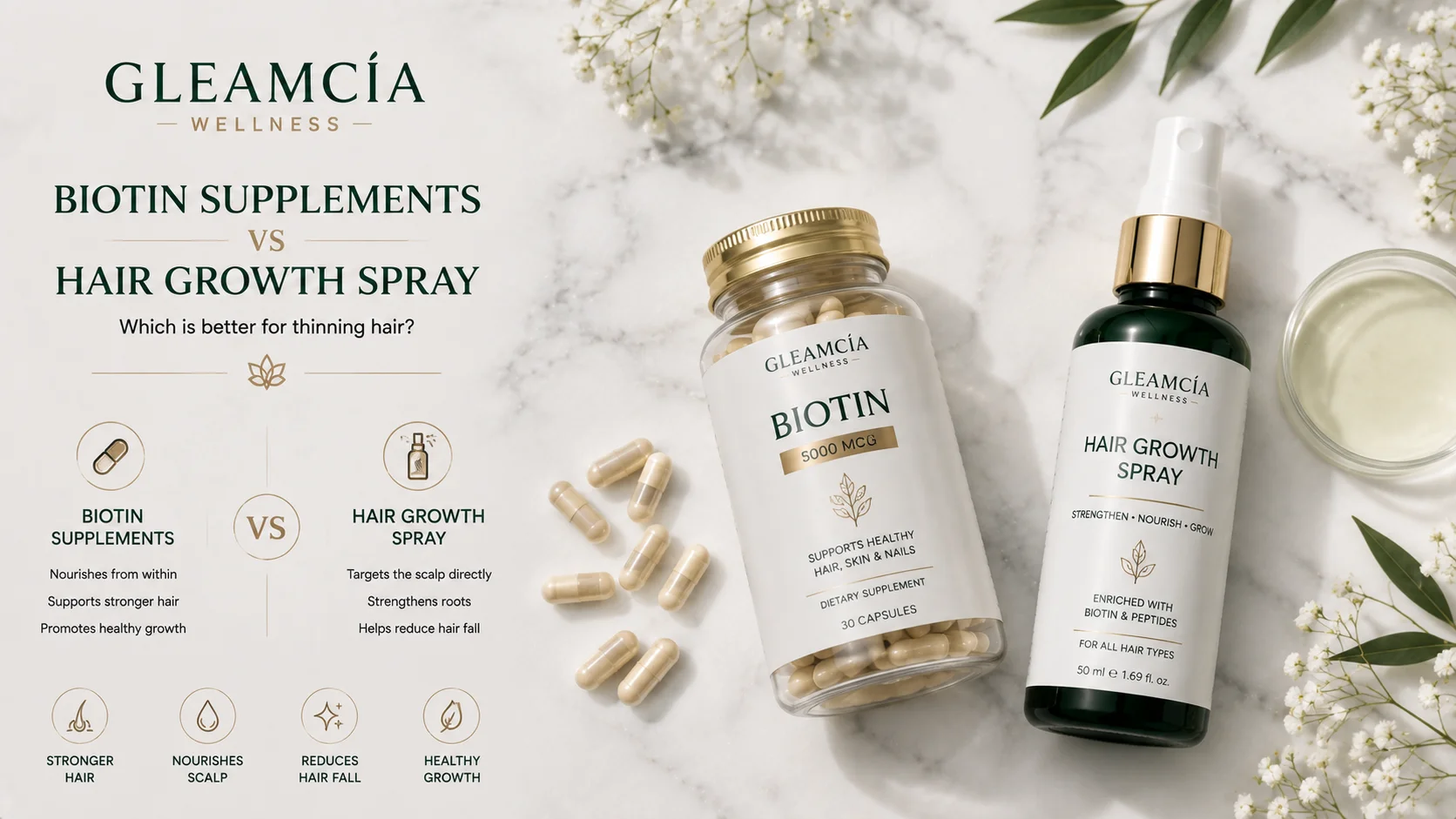
Biotin builds the internal foundation: stronger keratin, better strand architecture, improved resilience from the roots out. A hair growth spray addresses the scalp and follicle from the outside: stimulating inactive follicles, blocking DHT, improving circulation, and extending the active growth phase.
The two work at different levels and do not compete or interfere with each other. Using both gives thinning hair treatment from two directions simultaneously — systemic support from the supplement and localised follicle stimulation from the spray.
For anyone serious about stopping hair fall and supporting visible density over time, combining both is the clearest path. Individual products produce partial results. The combination addresses the problem more completely.
Biotin Tablets vs Hair Growth Spray: Full Comparison
| Feature | Biotin Tablets | Hair Growth Spray |
| How it works | Internally through bloodstream, supports keratin | Topically on scalp, stimulates follicles directly |
| Best for | Nutritional deficiency, diffuse thinning, breakage | Pattern thinning, DHT-related loss, follicle stimulation |
| Target area | Systemic — whole body including hair strand | Local — scalp and follicle specifically |
| Suitable for all hair loss types | Not for pattern/DHT-driven loss | Addresses DHT-linked and congestion-driven loss |
| Results timeline | 3 to 6 months of daily use | 8 to 16 weeks with consistent application |
| Application | One capsule daily with food | Applied to scalp, typically daily or 5 times a week |
| Blocks DHT | No | Yes — with saw palmetto and caffeine formulas |
| Safe for daily use | Yes | Yes |
| Suitable for all genders | Yes | Yes |
| Side effects | Minimal — very high doses can affect thyroid tests | Minimal — depends on formula; avoid high-alcohol sprays |
| Used together | Yes — works alongside spray with no conflict | Yes — complements biotin supplementation |
| Available in Pakistan | Yes | Yes |
The table makes the conclusion clear: biotin and hair growth spray are not competitors. They are partners covering different angles of the same problem.
How Soon to Expect Results from Biotin vs Hair Growth Spray
This is one of the most common questions and the timeline genuinely differs between the two.
Biotin results timeline:
- Weeks 1 to 4: Hair may feel slightly stronger and less prone to snapping during combing. Nail growth can accelerate noticeably as an early indicator the biotin is being absorbed.
- Months 2 to 3: Reduced daily shedding becomes more noticeable. Hair density may look marginally better as fewer strands are lost per day.
- Months 3 to 6: Visible improvement in strand thickness, hair fullness, and overall density for those whose thinning had a nutritional component.
Hair growth spray results timeline:
- Weeks 2 to 4: Scalp may feel less congested and more balanced, particularly if the formula includes sebum-regulating actives.
- Weeks 6 to 8: Reduced shedding during washing and combing as follicles stabilise.
- Weeks 8 to 16: Noticeable improvement in density and reduced visible scalp for pattern-related thinning with consistent daily application.
Used together, the combined approach typically produces the most meaningful visible result by the 3-month mark, as internal keratin support and topical follicle stimulation work in parallel.
Common Mistakes When Using Biotin or Hair Growth Spray
Stopping too early. Hair growth is a slow biological process. Quitting at six weeks because the result is not dramatic yet is the most common reason people underestimate how well these products actually work. Both require months of consistency.
Taking biotin in doses too low to make a difference. The RDA for biotin is 30 mcg. Most people eating a normal diet already get close to that. For hair thinning, the dose needs to be 2,500 to 5,000 mcg — a meaningful supplement concentration, not just a multivitamin with a trace amount.
Applying hair growth spray to hair instead of the scalp. The active ingredients work at the follicle level, which is on the scalp. Spraying and rubbing into the hair shaft delivers minimal benefit. Part the hair, apply directly to the scalp, and massage in gently with fingertips.
Using a hair growth spray with high alcohol content. Alcohol as a primary carrier strips the scalp’s natural moisture barrier and creates a dry, irritated environment that works against follicle health. A well-formulated spray uses water or aloe as its base.
Expecting biotin to fix DHT-driven pattern hair loss on its own. It will not. Pattern hair loss requires topical follicle stimulation, DHT management, and in more advanced cases, clinical treatment. Biotin supports what remains but does not reverse the hormonal cause.
Aftercare Tips for Biotin and Hair Growth Spray Use
Do:
- Take biotin daily with food — it is fat-soluble in some metabolic pathways and absorbs better alongside a meal
- Apply hair growth spray to a clean, product-free scalp for best penetration — ideally after shampooing and before conditioning
- Massage the spray gently into the scalp for 1 to 2 minutes using fingertips to stimulate circulation and improve absorption
- Stay consistent with both for a minimum of 12 weeks before evaluating results
- Eat enough protein — biotin supports keratin, but keratin is made from amino acids. Without adequate dietary protein, the building material is not there regardless of biotin levels
Do not:
- Apply hair growth spray and then immediately rinse or wash the scalp — leave-on formulas need contact time
- Take multiple high-dose biotin supplements thinking more will speed things up — above 10,000 mcg daily offers no additional benefit and risks interfering with clinical blood tests
- Combine with harsh sulphate shampoos that strip the scalp — this counteracts the work the spray is doing. Pair with a sulphate-free shampoo for better results
What Do Biotin Supplements and Hair Growth Spray Cost in Pakistan?
Biotin supplement pricing is determined primarily by concentration per capsule and pack size. A 5,000 mcg biotin supplement is significantly more useful than a 100 mcg one, and the price difference between a 30-capsule pack and a 90-capsule pack affects the per-day cost substantially. At daily use, a 30-day supply runs out quickly — a 60 or 90-day supply is far more economical per dose.
Hair growth spray pricing reflects formula complexity. A spray with a full active stack — caffeine, saw palmetto, rosemary extract, niacinamide, and peptides — is a more involved formulation than a basic spray with a single active. Bottle size matters too, particularly if applying to a full scalp with density concerns. A 100ml bottle used daily depletes faster than expected on longer or thicker hair.
Bundle pricing for biotin plus a hair growth spray from the same range typically offers better value per product and delivers the combined approach this blog has outlined. Single products are available at entry-level prices for anyone starting with one step.
Gleamcia delivers from Karachi to every city in Pakistan. Visit gleamcia.com/shop for current pricing and active promotions on hair care products and supplements.
Why Choose Gleamcia
Gleamcia builds every hair care product around what the research actually supports — not what sounds good on a label.
- Biotin supplements at concentrations that make a real difference for thinning hair, not token trace amounts in a multivitamin
- Hair growth formulas with active stacks that address the real mechanisms behind hair fall — DHT, follicle stimulation, scalp circulation, and inflammation
- Products designed for the hair concerns most common in Pakistan’s climate and South Asian hair biology
- Transparent ingredient information on every product
- Nationwide delivery across Pakistan from Karachi, with fast dispatch and careful packaging
Frequently Asked Questions
1. Should I take biotin if my hair is falling out? Yes — with the right expectations. Biotin supports keratin production, which strengthens hair strands and reduces shedding caused by nutritional deficiency, breakage, or physical stress on the body. It is particularly useful for diffuse hair fall, postpartum shedding, or hair loss connected to diet and body stress. If your thinning is pattern-related and driven by DHT, biotin alone is not enough — pair it with a hair growth spray that targets the scalp and follicle directly.
2. Can biotin regrow thinning hair? Biotin can support regrowth in hair thinned by nutritional deficiency, stress, or poor keratin synthesis. It works by improving the internal building blocks hair is made of, which allows follicles that are still active to produce thicker, stronger strands. What biotin cannot do is regrow hair from follicles that have been miniaturised by DHT or permanently dormant over a long period. For pattern hair loss, biotin works better as part of a combined approach alongside a topical hair growth spray.
3. How much biotin should I take if my hair is thinning? For thinning hair, 2,500 to 5,000 mcg (micrograms) daily is the most commonly used effective range. The standard adult RDA for biotin is only 30 mcg, which is too low to produce hair growth results. A purpose-made hair biotin supplement at 5,000 mcg taken daily with food is the most practical starting point. High doses above 10,000 mcg offer no additional proven benefit for hair and can interfere with thyroid blood tests, so inform your doctor if you are supplementing at that level.
4. How long does it take for biotin to work on thinning hair? Biotin results build gradually over three to six months of consistent daily use. Most people notice their nails getting stronger within the first few weeks as an early sign of absorption. Reduced shedding typically becomes noticeable at the two to three month mark, and improved hair density takes the full three to six month window to become visible. Stopping supplementation before that point is one of the most common reasons people underestimate biotin’s effectiveness.
5. Is hair growth spray better than biotin for pattern hair loss? For pattern hair loss driven by DHT and follicle miniaturisation, a hair growth spray with DHT-blocking actives like saw palmetto and follicle-stimulating ingredients like caffeine is the more directly targeted solution. Biotin addresses the nutritional side but does not block the hormonal cause of pattern loss. Using both together is more effective than either one alone — biotin strengthens existing strands while the spray targets the follicle environment where the loss is originating.
6. Can I use biotin and hair growth spray at the same time? Absolutely — and for most people dealing with thinning hair, combining both is the most complete approach. Biotin builds stronger hair from the inside through improved keratin production. A hair growth spray stimulates follicles, improves scalp circulation, and blocks DHT from the outside. They work at different levels and do not interfere with each other. The combination addresses hair thinning from both directions simultaneously.
7. Does hair growth spray actually work for thinning hair? Yes, when the formula contains clinically supported actives. Caffeine, saw palmetto, and rosemary extract all have research backing for follicle stimulation and DHT reduction. Applied consistently to the scalp, these ingredients can slow follicle miniaturisation, extend the active growth phase of existing hairs, and support visible density improvement over 8 to 16 weeks. Results depend on the cause of thinning and the quality of the formulation — a spray with active ingredients at meaningful concentrations will always outperform one with only fragrance and filler.
Start Treating Thinning Hair From Both Directions
Thinning hair rarely has a single cause, which is exactly why a single product rarely provides a complete solution. Biotin builds the foundation from inside. A hair growth spray works at the scalp where the problem actually lives. Together, they cover the full picture. Order from the Gleamcia Hair Care range and browse supplements at gleamcia.com, available with nationwide delivery across Pakistan from Karachi.
Order via WhatsApp at 0336 1223363 for personalised product advice on the right biotin dose and hair growth spray for your specific thinning concern.