Introduction
A lot of people use the same products morning and night, in the same order, and wonder why their skin is not quite where they want it to be. The issue is not always the products. Very often it is the routine structure — because a morning vs night skincare routine should not look identical, and when they do, you end up with a setup that is doing neither job as well as it could.
Your skin behaves differently during the day than it does at night. The morning routine is about protection. The night routine is about repair. The products you choose, the actives you apply, and even the order of your steps should reflect that difference. This guide breaks down exactly what should change between your day and night routine, covers the 7 steps of skincare, explains why Korean girls are obsessed with Vaseline at night, and tells you which serum combinations to stop using together. Explore the full Gleamcia Skin Care range to build a routine that works morning and night.
Why Your Morning and Night Skincare Routine Should Be Different
Skin operates on a circadian rhythm — a 24-hour biological cycle that shifts priorities depending on the time of day.
During the day, skin is focused on defence. It is dealing with UV radiation, pollution, free radicals, temperature changes, humidity, sweat, and everything else the environment throws at it. The morning routine needs to support that defensive mode with protection-focused products.
At night, with exposure removed and cortisol levels dropping, the skin shifts into repair. Cell turnover accelerates, collagen synthesis increases, and the skin barrier actively works to restore moisture and structural integrity. The night routine needs to support this repair cycle by delivering active ingredients at the right concentrations, during the hours the skin is most receptive to them.
Using a full active-ingredient formula in the morning and then a basic moisturiser at night is essentially doing things backwards. And using a rich, occlusive night cream first thing in the morning — particularly one with retinol or AHAs — creates photosensitivity risk with every minute of daytime sun exposure.
The two routines serve two distinct biological functions. Treating them the same means missing the opportunity both windows offer.
What Is the Morning Skincare Routine and What Does It Do?
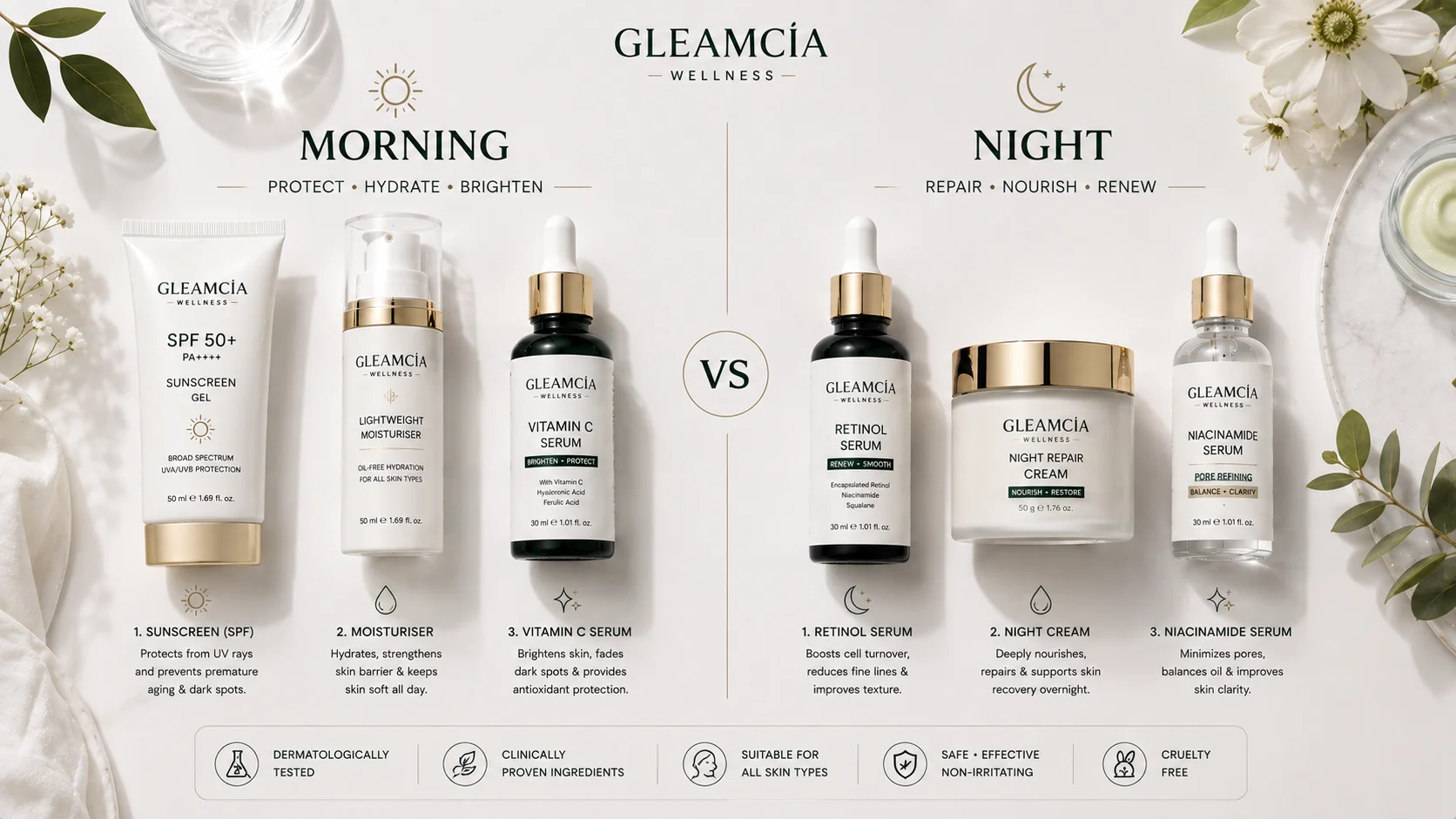
The morning routine is built around one central goal: protecting the skin you are about to send out into the world.
The skin has been repairing overnight. In the morning it is in a relatively clean, hydrated state. The job now is to maintain that and add a layer of defence before the day begins.
A morning routine typically includes a gentle cleanse (not a deep or stripping one since there is no makeup or SPF to remove), a treatment serum if you use one in the mornings, a moisturiser, and SPF. That last step is the most important part of any morning routine, full stop.
Vitamin C serum is the most recommended active for morning use because its antioxidant function directly supports the skin during UV and pollution exposure throughout the day. Niacinamide also works well in the morning for sebum regulation and barrier maintenance.
What the morning routine leaves out: Retinol, strong AHAs, and occlusive rich creams. Retinol is photosensitising. AHAs increase UV sensitivity. Heavy creams sit poorly under makeup and SPF. The morning routine should be clean, layered efficiently, and finished with broad-spectrum sunscreen as the absolute last step before you walk out the door.
What Is the Night Skincare Routine and What Does It Do?
The night routine has more room to work — and more responsibility.
This is when the real skin transformation happens. With no SPF needed and no environmental stressors to manage, the night routine can include higher-concentration actives, richer textures, and ingredients that would cause problems in daylight.
The night routine typically starts with a proper double cleanse (especially if you have worn SPF or makeup), moves through any treatment serums, and finishes with a moisturiser or night cream as the final sealing layer.
Retinol is the most powerful active for the night routine. It accelerates cell turnover, stimulates collagen, fades pigmentation, and reduces fine lines — but it needs to stay away from direct sun exposure to work safely. AHA exfoliants like glycolic acid also belong in the night routine for the same reason.
Ingredients that benefit most from overnight absorption — peptides, ceramides, hyaluronic acid in a richer concentration, and barrier-repairing fatty acids — are most effective in night formulas because there is no daytime interference, no reapplication of SPF over the top, and more time for the skin to absorb and use them.
What Are the 7 Steps of Skincare?
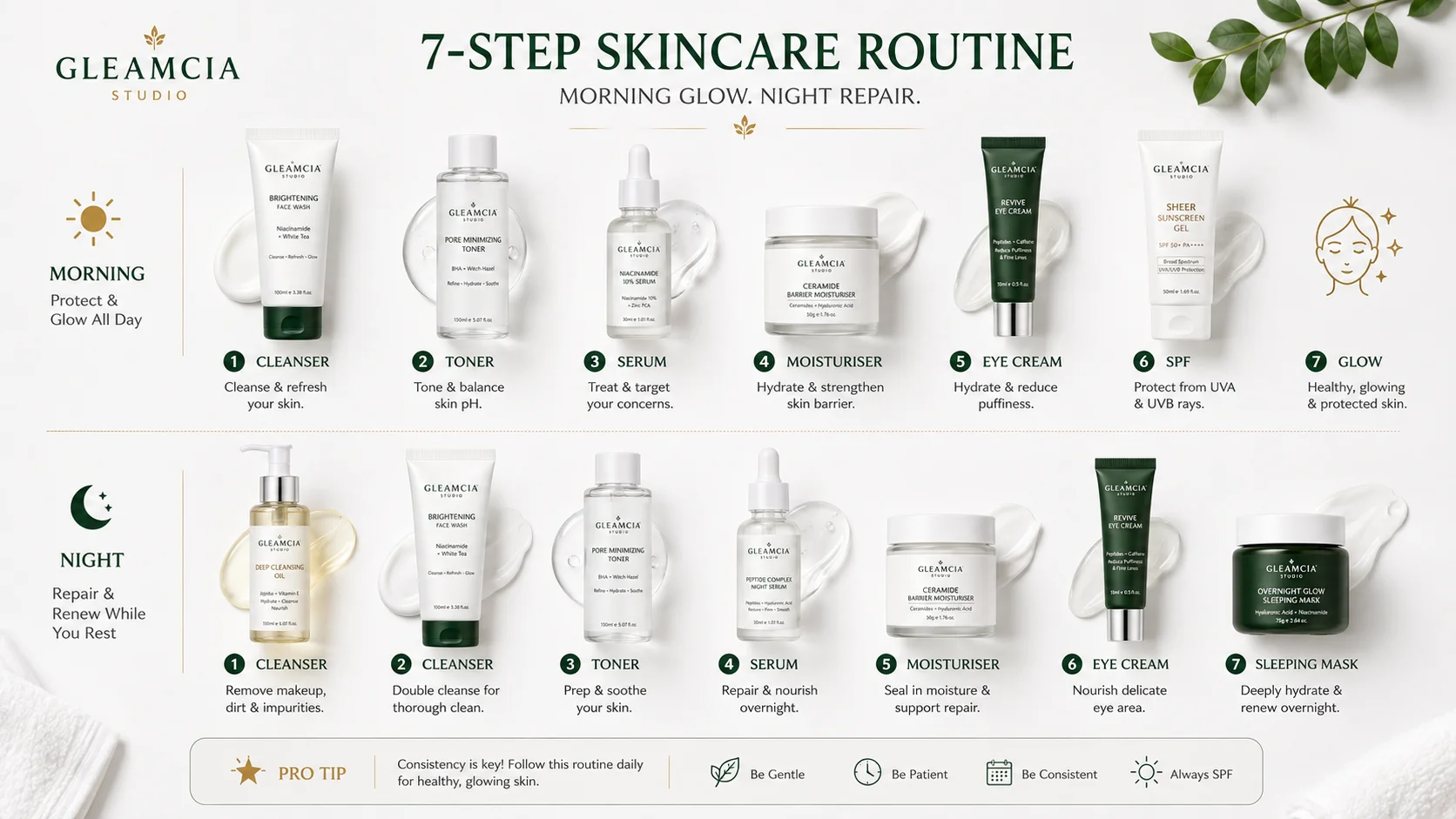
The 7 steps of skincare is a framework, not a strict rule. Some steps are more relevant to morning, others to night, and some to both.
Step 1: Cleanser Removes surface oil, product residue, and environmental impurities. In the morning, a gentle gel or foam cleanser is enough. At night, a double cleanse — oil cleanser first, then a water-based cleanser second — ensures everything from the day is fully removed. The Gleamcia Brightening Face Wash works well as the second cleanse step in an evening double-cleanse routine.
Step 2: Toner Balances skin pH after cleansing and preps the skin to absorb what follows. A hydrating toner or essence works in both morning and night. BHA or AHA toners (exfoliating) are better reserved for the night routine only.
Step 3: Serum or Treatment The active-ingredient step. Vitamin C in the morning, Retinol and AHAs in the evening. Niacinamide and hyaluronic acid work in both routines. Apply from thinnest texture to thickest, and from most acidic to most neutral if layering more than one.
Step 4: Eye Cream Applied after serum, before moisturiser. The skin around the eye is thinner and more delicate — a dedicated eye cream is lighter than a face moisturiser and formulated for that specific area. Tap in gently with your ring finger, never drag.
Step 5: Moisturiser (Morning) or Night Cream (Evening) Seals in the treatment layers below. Morning moisturiser should be lightweight and compatible with SPF layered on top. Night cream is typically richer, with barrier-repairing and hydration-locking ingredients designed for extended overnight contact time.
Step 6: SPF (Morning only) The most important step in the morning routine and the one most consistently skipped. Broad spectrum SPF 30 minimum every day, rain or shine. No active ingredient in your routine will work as well as it should if UV damage is undoing it every morning. SPF is not the last luxury step — it is the foundation of every morning routine.
Step 7: Facial Oil or Sleeping Mask (Night only) Optional but effective for dry or dehydrated skin types. A facial oil applied over moisturiser adds an extra occlusive layer that locks in hydration throughout the night. A sleeping mask does the same and is especially useful during dry seasons or air-conditioned environments that pull moisture from the skin overnight.
Morning vs Night Skincare Routine: What Changes and What Stays the Same
Here is the clearest way to see the full comparison:
| Step | Morning Routine | Night Routine |
| Cleanser | Gentle gel or foam cleanser once | Oil cleanser + water-based cleanser (double cleanse) |
| Toner | Hydrating toner or essence | Hydrating toner OR exfoliating BHA/AHA toner |
| Serum | Vitamin C, Niacinamide, Hyaluronic Acid | Retinol, Peptides, AHAs, Niacinamide, Hyaluronic Acid |
| Eye Cream | Yes, lightweight formula | Yes, richer formula for overnight repair |
| Moisturiser | Lightweight, SPF-compatible | Richer night cream with actives |
| SPF | Non-negotiable last step | Not needed — skip entirely |
| Facial Oil | Not recommended — too heavy for daytime | Yes — optional final seal for dry skin |
| Sleeping Mask | No | Yes — optional, 1 to 2 times a week |
| Retinol | Never — causes photosensitivity | Yes — ideal overnight active |
| AHA Exfoliant | Never | 2 to 3 times a week at night |
| Total time | 5 to 8 minutes | 10 to 15 minutes |
The consistent elements are cleansing, toning, moisturising, and hydration serums. What shifts is the category of active ingredients and the richness of the formula. Morning protects. Night repairs.
How Do Korean Girls Get Clear Skin?
Korean skincare culture treats the skin as something you maintain daily — not something you fix when it breaks. The approach is consistent, layered, and prevention-focused, and it is genuinely the reason Korean skin looks the way it does.
The foundation is double cleansing every single evening. An oil-based cleanser dissolves SPF, makeup, and sebum inside the pores. A gentle second cleanser lifts everything away. This step alone prevents the congestion and dull buildup that makes skin look tired and uneven.
Beyond cleansing, Korean skincare focuses on layered hydration. Rather than one thick moisturiser, multiple thin hydrating layers — toner, essence, serum, moisturiser — are applied in sequence. Each layer adds moisture and prepares the skin to absorb the next one. The result is skin that stays consistently hydrated, which keeps it plump, clear-looking, and less prone to overproducing oil.
Niacinamide is a standard ingredient in most Korean serums and moisturisers. It regulates sebum, reduces the appearance of pores, fades hyperpigmentation, and strengthens the skin barrier. It is not a trendy addition — it is a consistent staple.
SPF is treated as completely non-negotiable. Not “when I remember” or “only in summer.” Every day, regardless of weather or whether you plan to go outside. UV exposure is the biggest driver of uneven tone, premature ageing, and skin dullness, and Korean beauty culture addresses it by making SPF the most important step of the morning routine without exception.
The American Academy of Dermatology confirms that daily broad-spectrum SPF is the single most effective anti-ageing and skin-clarity measure available — and Korean skincare has built its entire morning routine around exactly that principle.
Why Do Koreans Put Vaseline on Their Face at Night?
This is a real practice, and it has a proper explanation. The technique is called slugging.
Slugging involves applying a thin layer of petroleum jelly — or a similar occlusive product — as the very last step of the night routine. The idea originated in Korean skincare communities and spread rapidly because the results for dehydrated and barrier-damaged skin are genuinely significant.
Petroleum jelly is one of the most effective occlusives available. It does not hydrate the skin on its own. What it does is create a physical seal over the surface that prevents transepidermal water loss — the process by which moisture evaporates from the skin overnight, particularly in air-conditioned rooms or dry climates.
Applied over a full night routine, Vaseline locks in everything underneath: the serum, the night cream, the hyaluronic acid. The skin wakes up noticeably softer, more plump, and better-hydrated than it would without the occlusive seal.
Who it works best for: dry skin types, people with a compromised skin barrier (redness, sensitivity, tightness), anyone living in a dry or air-conditioned environment, and skin recovering from active ingredient use or over-exfoliation.
Who should approach it with more caution: oily and acne-prone skin types. Petroleum jelly does not clog pores itself — it is non-comedogenic. But it can trap bacteria and oil against acne-prone skin overnight, which is less than ideal if your skin is breaking out actively.
The technique works. It is not a myth and not a gimmick. For dry and sensitive skin dealing with barrier disruption, it is one of the simplest and most effective overnight treatments available.
Which Two Serums Cannot Be Used Together?
This is one of the most important practical questions in skincare, and the answer matters because mixing the wrong actives together does not just reduce effectiveness — it can actively irritate the skin.
Vitamin C and Retinol together in the same step. Both are powerful actives and both are sensitive to pH and stability. Vitamin C works best at a low pH around 3.5. Retinol is more stable at a higher pH. Together in one application, they can destabilise each other and increase the risk of redness and sensitivity. The correct approach: Vitamin C in the morning, Retinol in the evening. Two different routines, no conflict.
Retinol and AHA/BHA exfoliants in the same step. Retinol increases cell turnover. AHAs and BHAs exfoliate the skin surface and inside pores. Using both at the same time is over-exfoliation — the skin becomes raw, tight, red, and reactive. Alternate them on different nights rather than stacking them on the same evening.
Vitamin C and AHA/BHA in the same step. Both are acidic and effective, but layering them together in the same step destabilises Vitamin C and pushes the skin into irritation territory, particularly for sensitive types. Use Vitamin C in the morning, AHAs at night. Or if using them both at night, allow full absorption between each step.
Benzoyl Peroxide and Retinol together. Benzoyl Peroxide is an oxidising agent. Retinol is vulnerable to oxidation. When they come into contact, Benzoyl Peroxide essentially deactivates the Retinol before it has a chance to work. Use them on alternate nights rather than the same evening.
Niacinamide and Vitamin C at the same step without a wait. The old idea that they form a harmful compound together has been largely debunked at skincare concentrations. The real concern is that Vitamin C’s low pH is disrupted by Niacinamide’s higher pH when applied together. The fix is simple: apply Vitamin C first, wait 5 to 10 minutes, then apply Niacinamide. Or use Vitamin C in the morning and Niacinamide in the evening.
The general rule is straightforward. High-concentration actives work best when given their own dedicated window. Most conflicts are not about chemistry — they are about pH disruption and absorption interference that happens when multiple actives compete in the same layer.
Who Needs Both a Morning and Night Routine?
Short answer: anyone who has a skincare concern and wants consistent results.
A morning-only routine protects the skin from damage. A night-only routine repairs it. Doing both gives your skin a full 24-hour cycle of support, which is the difference between maintaining and improving.
People in their 20s building a foundation benefit from both because early SPF use and consistent cleansing prevent the cumulative damage that shows up as difficult-to-treat concerns in the 30s and 40s.
People dealing with active concerns — hyperpigmentation, acne, dullness, dehydration, fine lines, large pores — need both routines because daytime protection stops the problem getting worse while nighttime actives actually treat it.
Beginners do not need every step from day one. Start with cleanser, moisturiser, and SPF in the morning, and cleanser plus a basic moisturiser at night. Add one active at a time as the skin adjusts. Overloading a new routine with actives causes more problems than it solves.
Common Mistakes in Morning vs Night Skincare Routines
These are the habits that keep people from seeing results, no matter how good their products are.
Applying Retinol or AHA in the morning. Both increase UV sensitivity. Using photosensitising actives in the morning and then heading outside — even with SPF — dramatically increases the risk of sun damage. These belong in the evening routine only.
Skipping SPF in the morning because it is cloudy or because they plan to stay indoors. UV rays penetrate windows. Cloudy days still deliver 80% of UV exposure. SPF is a daily non-negotiable regardless of the weather or the plan for the day.
Using the same cleanser morning and night. The morning cleanser job is light maintenance. The evening cleanser job is serious removal of everything the day deposited on and in the skin. Using a light morning cleanser at night — without double cleansing — leaves SPF and product residue behind.
Introducing multiple new actives at the same time. New serum, new retinol, new acid toner all in one week creates a skin reaction that is impossible to diagnose. Introduce one new active at a time, wait two to three weeks, then add the next.
Applying products in the wrong order. Heavier products before lighter ones block absorption. The rule is always thinnest to thickest: serum before moisturiser, moisturiser before SPF.
How Soon Do You See Results from a Consistent Morning and Night Routine?
Building a consistent two-routine structure does not transform skin overnight. The timeline is gradual and tied to how consistently both routines are maintained.
- Week 1 to 2: Skin starts to feel more balanced. Less tightness after cleansing, more stable hydration during the day.
- Week 3 to 4: Active ingredients like Niacinamide begin producing visible brightening and pore-refinement. Skin tone looks slightly more even.
- Week 6 to 8: Retinol users start noticing smoother texture and reduced fine line appearance. Hyperpigmentation from Vitamin C and AHAs shows visible fading.
- 3 months+: Consistent results in skin clarity, firmness, and overall evenness that reflect the full cycle of both routines working together.
Individual results vary based on skin type, starting condition, routine consistency, and whether SPF is being used daily.
Aftercare and Routine Tips for Morning and Night Skincare
Do:
- Wash hands before every routine — transferring bacteria from fingertips to freshly cleansed skin undoes the first step immediately
- Apply SPF as the final morning step, always
- Double cleanse at night after wearing SPF or any form of makeup or base product
- Let serums absorb for 30 to 60 seconds between layers before applying the next product
- Use a clean pillowcase two to three times a week — used pillowcases transfer oil, bacteria, and old product back onto night-treated skin
Do not:
- Apply retinol and then immediately follow with a wash or additional rinse step — let it stay on the skin
- Skip the moisturiser in the morning to “let the skin breathe” — this disrupts the moisture barrier and increases oil production
- Layer SPF under makeup and then reapply the same SPF over makeup without a proper SPF powder or mist — the underlayer cannot be “topped up” through foundation
- Use a heavy night cream in the morning — the occlusive texture traps daytime pollutants against the skin rather than protecting from them
What Does a Complete Morning and Night Skincare Routine Cost in Pakistan?
Building both routines does not mean buying 14 separate products. The cleansing step is shared. Niacinamide works in both routines. A single hyaluronic acid serum covers both morning and evening application. Most of the core products overlap — the difference is in adding SPF for mornings and Retinol or night cream for evenings.
Formulation quality drives pricing across both routines. An SPF that is both lightweight enough to wear daily and broad-spectrum enough to actually protect costs more than a basic lotion with a printed SPF claim. A Retinol serum at an effective concentration with a stabilised formula costs more than a basic night cream with “contains Retinol” on the label in trace amounts.
Bundles that pair day and night products — SPF plus night cream, Vitamin C serum plus Retinol serum — reduce per-product cost and ensure formulation compatibility. Single-product entry points are available for anyone building a routine gradually.
Gleamcia delivers nationwide across Pakistan from Karachi. Visit gleamcia.com/shop to see current pricing on the full skincare range and active bundle offers.
Why Choose Gleamcia
Gleamcia exists for one reason: to give people in Pakistan access to skincare that is clinically formulated, transparently labelled, and actually built to work on real skin concerns.
- Morning and night formulas designed around the specific functions each time of day demands
- Active ingredients at meaningful concentrations — not token inclusions for label appeal
- Products suited to Pakistan’s climate, skin concerns, and the unique mix of humidity, heat, and sun exposure most people deal with daily
- Fully transparent ingredient listings so you know exactly what you are applying and when
- Nationwide delivery from Karachi to every city in Pakistan with reliable packaging and fast dispatch
Frequently Asked Questions
1. What are the 7 steps of skincare? The 7 steps are cleanser, toner, serum or treatment, eye cream, moisturiser, SPF (morning only), and a facial oil or sleeping mask (night only as an optional final step). Not every step is needed twice a day — the morning routine focuses on cleansing, treating, moisturising, and protecting with SPF, while the night routine focuses on deeper cleansing, active treatments, and moisture-sealing. The exact steps in your routine should match your skin concerns and products, not a fixed list.
2. How do Korean girls get clear skin? Korean clear skin comes from consistency across three daily habits: double cleansing every evening without exception, layering lightweight hydration products (toner, essence, serum) rather than one heavy moisturiser, and treating SPF as the most important step in the morning routine, not optional. Niacinamide is a staple active for sebum control and skin barrier strength. Sheet masks add hydration boosts weekly. The approach is daily prevention and maintenance, not occasional treatment.
3. Why do Koreans put Vaseline on their face at night? The technique is called slugging. Petroleum jelly (Vaseline) is applied as the final step of the night routine as an occlusive seal. It does not hydrate the skin itself — it physically prevents moisture from evaporating overnight, locking in everything applied underneath it including serums and night cream. It works best for dry, dehydrated, or barrier-compromised skin. Oily and acne-prone skin types should use it with more caution as it can trap bacteria and oil against the skin during sleep.
4. Which two serums cannot be used together? Retinol and AHAs or BHAs should not be applied in the same step — combined exfoliation causes irritation and over-sensitisation. Vitamin C and Retinol belong in separate routines — Vitamin C in the morning, Retinol at night. Benzoyl Peroxide and Retinol cannot be used together as BPO oxidises and deactivates Retinol. Vitamin C and AHAs in the same layer create pH competition that reduces effectiveness and can irritate sensitive skin. The general principle is to separate potent actives into different time slots rather than stacking them simultaneously.
5. Should my morning and night skincare routines be completely different? Not completely — but they should have different priorities. Cleansing, toning, and hydration serums like Niacinamide and Hyaluronic Acid work in both routines. What changes is the type of active treatment and the final step. Morning adds SPF and uses antioxidant actives like Vitamin C. Night uses repair-focused actives like Retinol and richer moisturisers or night creams. Using the exact same routine morning and night misses the biological opportunity each time of day offers.
6. Can I skip my morning skincare routine and just use SPF? SPF on its own is significantly better than no SPF, but skipping the full morning routine means missing the treatment and hydration layer underneath it. Serums and moisturisers applied under SPF improve skin health over time and help SPF sit more evenly on the skin. For mornings where time is genuinely limited, the absolute minimum is a gentle cleanse, a lightweight moisturiser, and SPF. That is a functional morning routine even when you cannot do the full version.
7. At what age should you start both a morning and night skincare routine? There is no strict minimum age, but starting a basic morning and night routine in the mid-to-late teenage years — cleanser, moisturiser, and SPF in the morning, cleanser and moisturiser at night — builds the habit and prevents cumulative damage. Active ingredients like Retinol, AHAs, and Vitamin C are typically introduced in the early to mid-20s when the skin begins to benefit from treatment-focused steps. Starting earlier with the basics and adding actives gradually is far more effective than starting a complex routine late.
Build the Routine Your Skin Actually Needs — Morning and Night
Your skin’s needs change between morning and evening, and your routine should too. Get both right and you are giving your skin protection during the day and repair during the night — the complete 24-hour cycle your skin needs to actually improve over time. Order from the Gleamcia Skin Care range via our online store with nationwide delivery across Pakistan.
Place your order directly on WhatsApp at 0336 1223363 and our team will help you build the right morning and night routine for your skin type, concern, and budget.