Introduction
Most people who wear sunscreen are not wearing it correctly. They apply a thin swipe across the nose and cheeks, skip the neck entirely, and assume they are protected for the rest of the day. They are not. The amount of sunscreen you apply and how often you reapply it determines whether you are getting anything close to the SPF protection on the label — or whether you are getting a fraction of it while thinking you are covered.
How much sunscreen to apply is one of the most underdiscussed sunscreen questions, even though it is the thing that makes the biggest practical difference to actual UV protection. This guide answers it clearly, covers every common question about reapplication and SPF 50, and dispels the myths that have been circulating as sunscreen facts for years. Browse the Gleamcia Skin Care range for SPF formulas built for Pakistan’s sun intensity and daily wear.
Why the Amount of Sunscreen You Apply Changes Everything
SPF is not a fixed number regardless of how much you use. Sunscreen is lab-tested for UV protection at a specific application amount: 2 milligrams per square centimetre of skin. That is the measurement where the SPF number on the label is actually accurate.
At half that amount — which is roughly what most people apply — SPF 50 provides closer to SPF 7 protection. Not 25, not 40. Around 7. The same formula, the same skin, but dramatically different protection because the concentration on the skin surface is insufficient to filter UV at the rate the product is designed to.
This is the single most important sunscreen fact most people do not know. And it explains why people who “wear SPF every day” still develop sunburn, hyperpigmentation, and premature ageing at rates that suggest they are not actually protected.
The American Academy of Dermatology consistently identifies inadequate application amount as one of the primary reasons sunscreen underperforms in real-world use. Getting the quantity right is not optional — it is the difference between the product working or not.
How Much Sunscreen Should You Apply to the Face?
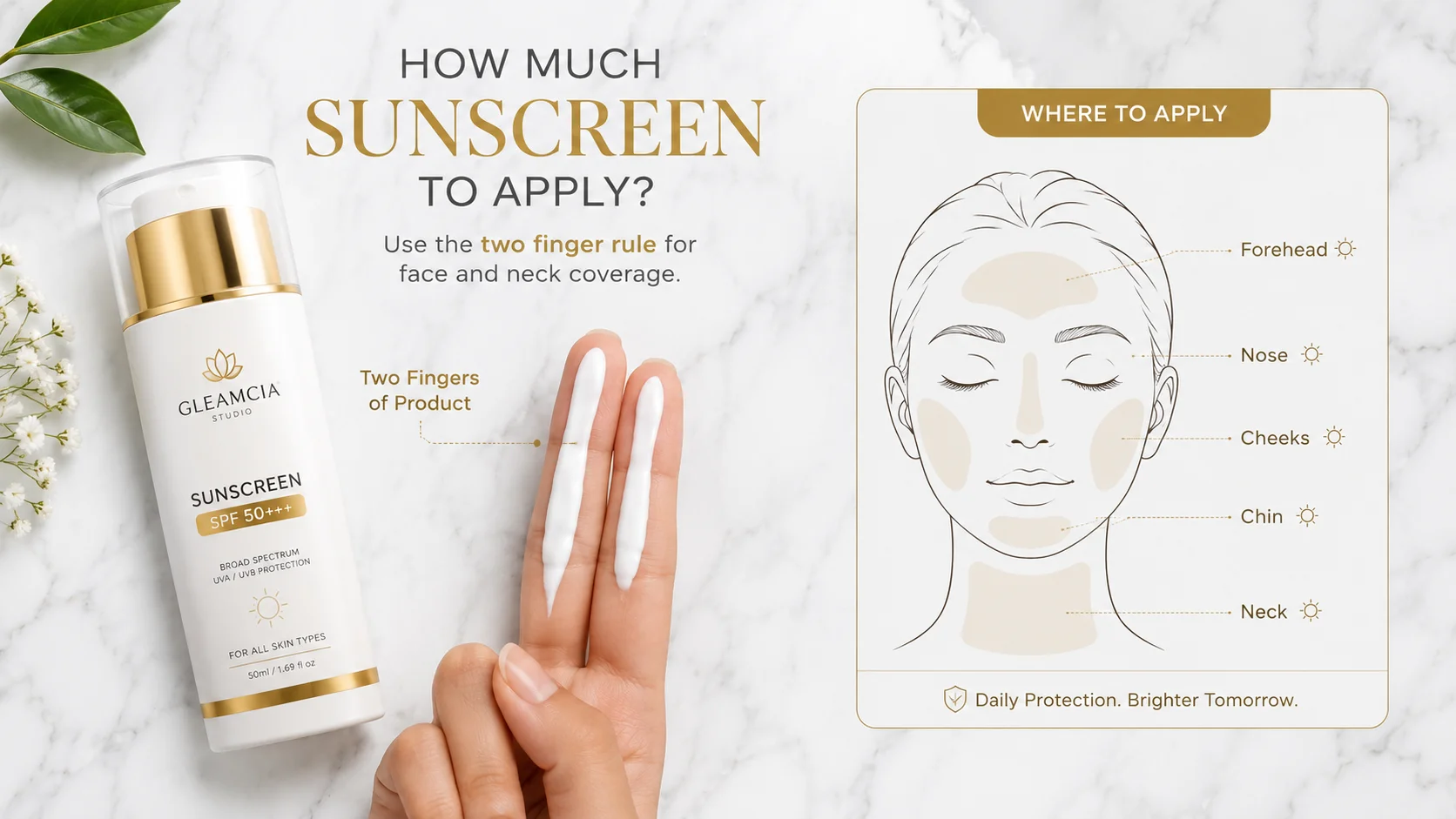
The two-finger rule. Squeeze sunscreen along the full length of your index finger and your middle finger. That is the right amount for the face and neck together.
This sounds like a lot more than most people use. It is. That is precisely the point.
The two-finger amount — roughly one teaspoon or 2ml to 2.5ml — covers the face, ears, and neck at the concentration needed for the SPF on the label to function. Applying less, which is what nearly everyone does when they “use sunscreen daily,” reduces the actual UV protection significantly.
Spread the product across the full face in sections rather than rubbing it in all at once from one central point. Forehead first, then each cheek, then nose and chin. Pat and press gently rather than rubbing aggressively, which can remove some of the product before it has settled. Include the ears, the jaw, and the back of the neck — these are consistently missed and consistently where sun damage accumulates.
For the face alone without the neck, slightly less — the length of one and a half fingers — is closer to correct. But applying the full two-finger amount and taking it down to the collarbone is the better habit because the neck and décolletage age from sun exposure just as visibly as the face.
How Much Sunscreen to Apply on the Body
Full-body application requires significantly more product than most people budget for. The standard recommendation is one ounce — roughly a shot glass full — for the full body including the face.
Breaking it down by area:
- Each arm: approximately half a teaspoon
- Each leg: approximately one teaspoon
- The torso (front): approximately one teaspoon
- The back: approximately one teaspoon
- Face and neck: approximately one teaspoon (the two-finger rule)
For beach days, outdoor events in Pakistan’s sun, or any extended time outside, this full-body application amount is what delivers the protection advertised on the label.
Most people apply sunscreen to visible areas and neglect the scalp part line, the tops of the feet, the back of the hands, and the ears. These are consistently among the most sun-damaged and frequently skin-cancer-affected areas precisely because they are treated as afterthoughts.
How to Apply Sunscreen Correctly for Maximum Protection
The technique matters alongside the amount. Here is the correct approach:
- Apply sunscreen as the last step of your morning skincare routine — after moisturiser, before makeup if you wear it. Sunscreen belongs on the skin, not under a layer of moisturiser where it cannot function as a barrier.
- Apply to dry skin rather than damp skin. Sunscreen applied to damp skin distributes unevenly and coverage gaps develop as the water dries.
- Use the two-finger rule for the face and work in sections — do not rub everything from one central point.
- Include the ears, neck, and jaw every time without exception.
- Press and pat the product in — avoid heavy rubbing that redistributes product away from some areas.
- Apply body sunscreen before dressing for beach or outdoor activities. Applying it over clothing gaps or edges is less reliable than applying before.
- Wait the appropriate absorption time before going outside — more on this below.
How Often Should You Reapply Sunscreen?
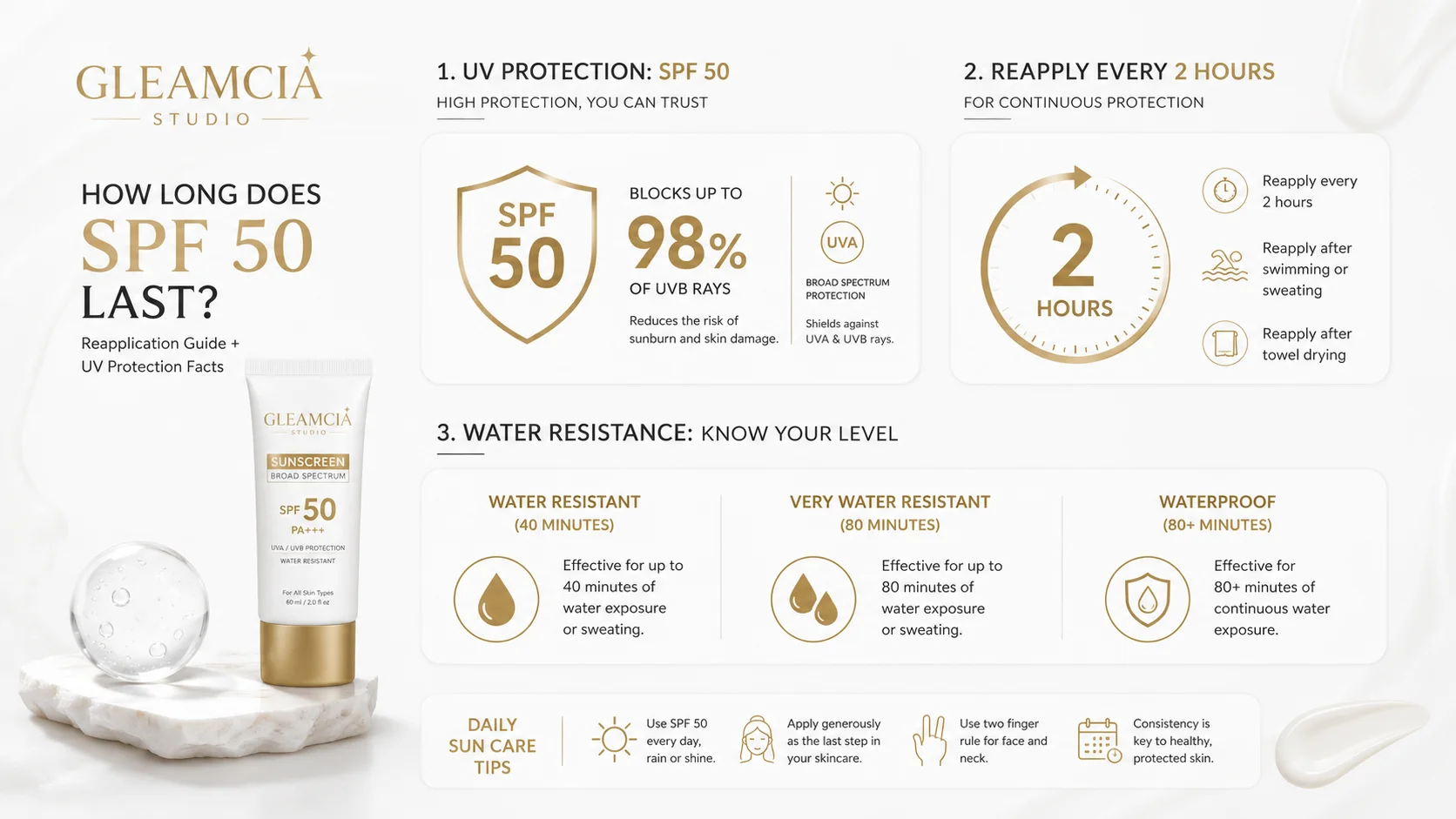
Every two hours during direct sun exposure. And immediately after swimming, heavy sweating, or towelling off — regardless of whether two hours have passed.
Sunscreen does not last indefinitely. It degrades with UV exposure over time, wears off with sweat and water contact, and gets physically removed by rubbing and touching. The two-hour reapplication window is based on the rate at which most sunscreen formulas break down under continuous UV exposure.
In Pakistan’s climate — particularly in Karachi’s heat or during Lahore’s summer months — sweating happens faster and more heavily than in the lab conditions where sunscreens are tested. Reapplication may be needed more frequently than every two hours during outdoor exercise or work in direct midday sun.
For office workers who spend the majority of the day indoors with occasional window or outdoor exposure, morning application may hold reasonably well through the day. But anyone spending two or more hours in direct sun needs to reapply. This includes driving, outdoor lunches, and any time spent in sunlight coming through a car or office window — UVA rays penetrate glass.
Reapplication does not need to be a full routine restart. A dedicated SPF mist, a powder SPF, or a second application of your regular sunscreen layered gently over makeup or bare skin is sufficient. Press it in lightly — do not rub and disturb what is already there.
Does SPF 50 Mean You Reapply Every 50 Minutes?
No. This is one of the most persistent and completely incorrect sunscreen myths in circulation.
The SPF number has nothing to do with time. SPF stands for Sun Protection Factor and the number describes how much UV radiation the product filters compared to unprotected skin — not how many minutes of protection it provides.
SPF 50 means the formula filters approximately 98% of UVB rays when applied at the correct amount. SPF 30 filters approximately 97%. The difference between 30 and 50 is smaller than most people assume — both provide substantial protection when applied correctly and reapplied consistently.
The number 50 carries no time meaning at all. There is no formula where SPF 30 = 30 minutes and SPF 50 = 50 minutes. Sunscreen durability is determined by the formula’s water resistance, its photostability (how well it holds up under UV exposure without breaking down), the amount applied, and how much sweating or water contact happens. None of those factors have anything to do with the SPF number.
How Long Will SPF 50 Actually Last?
SPF 50 provides protection for as long as it is physically intact on the skin and has not been broken down by UV exposure, water, or sweat. There is no fixed time limit baked into the formula.
Under controlled conditions with no sweating or water contact, a single application of SPF 50 applied at the correct amount offers reliable protection for approximately two hours of sun exposure. After two hours of continuous UV exposure, the UV filters in most formulas have degraded enough that reapplication is needed to maintain the original level of protection.
Under real-world Pakistan conditions — heat, humidity, physical activity, or time at the beach — this window shortens. Heavy sweating removes sunscreen from the skin surface faster than UV degradation alone. Water-resistant formulas are more durable but still need reapplication after 40 to 80 minutes of water exposure (the two categories of water resistance tested are 40-minute and 80-minute resistant).
The reliable answer: every two hours of sun exposure, every time, regardless of SPF number.
What Happens If You Don’t Reapply Sunscreen Every 2 Hours?
The consequences are cumulative and not always immediately obvious.
In the short term, the first thing that happens without reapplication is increased UV penetration as the degraded sunscreen formula offers progressively less protection. In strong direct sun — and Pakistani summer sun is intense — sunburn can develop within 20 to 30 minutes on unprotected skin, and the degraded SPF from a morning-only application may not be far off unprotected by the time two hours have passed.
Beyond sunburn, UV damage that accumulates without adequate protection produces hyperpigmentation — the dark spots, uneven patches, and melasma that are among the most treated skin concerns in Pakistan. Every unprotected UV exposure session contributes to melanin irregularity that can take months of consistent treatment to reduce.
Long-term, cumulative UV exposure without proper reapplication is the primary driver of premature skin ageing. Fine lines, loss of skin elasticity, and a gradual worsening of overall skin tone are the visible effects of years of inconsistent SPF habits. The damage is real even when it is not visually apparent yet.
Reapplication is not a bonus habit. It is the step that makes the morning SPF application actually function as intended throughout the day.
How Long Will SPF 50 Last Without Reapplication?
Applied correctly at the full two-finger amount on the face and neck, SPF 50 provides effective UV protection for approximately two hours of continuous sun exposure before the formula degrades enough to require reapplication.
After two hours of direct sun, the UV filters have been progressively broken down by the radiation they are absorbing. The product is still physically on the skin but is no longer providing the same filtration rate it started with.
Without reapplication, each additional hour outside the two-hour window represents increasingly unfiltered UV exposure. The skin is not instantly unprotected after minute 121 — the transition is gradual. But by hour three or four without reapplication in direct sun, a meaningful portion of the original protection has been lost.
The simplest practical habit: set a reminder for two hours after initial application on any day that involves significant time outdoors.
Is SPF 50 Too Strong to Tan?
SPF 50 does not prevent tanning. No sunscreen does, completely.
SPF 50 filters approximately 98% of UVB rays. The remaining 2% of UVB still reaches the skin, along with a portion of UVA (which most sunscreens also filter at varying rates). That residual UV exposure is enough to trigger melanin production — tanning — over time.
What SPF 50 does is slow down the tanning process significantly compared to unprotected skin. A tan that might develop in 30 minutes on bare skin takes considerably longer under SPF 50. But given enough cumulative sun exposure, a tan still develops.
There is an important fact that sits underneath this question: a tan is not a sign of healthy skin. A tan is the skin’s visible response to UV-induced DNA damage. Melanocytes produce extra melanin specifically to try and protect against further cellular damage from UV radiation. Tanning is the skin’s distress signal, not a beauty upgrade.
SPF 50 is not too strong for anyone. It is not possible to over-protect from UV exposure. And it will not keep you from tanning if you spend enough time in the sun, so the premise of the question does not quite hold.
Can I Go Outside After 10 Minutes of Applying Sunscreen?
The answer depends on the type of sunscreen you are using.
Mineral sunscreens (containing zinc oxide or titanium dioxide as the active UV filters) work by sitting on top of the skin surface and physically deflecting UV rays. They do not need to absorb into the skin to work. These can be applied and walked into direct sunlight immediately.
Chemical sunscreens (containing UV filters like avobenzone, octinoxate, oxybenzone, or Tinosorb) work by absorbing UV radiation and converting it to heat. To do this, they need to be absorbed into the outer layers of the skin first. The traditional recommendation is to apply 15 to 30 minutes before sun exposure to allow the chemical filters time to activate.
In practice, most modern chemical sunscreen formulas absorb more quickly than older guidance suggests, and the 15-minute rule is increasingly debated in dermatology. But when in doubt, applying 10 to 15 minutes before going outside is the safer approach if you are using a chemical formula.
If your sunscreen contains a blend of mineral and chemical filters — which is common in modern broad-spectrum formulas — applying 10 minutes before sun exposure is a reasonable, practical middle ground.
SPF 30 vs SPF 50: Which Should You Choose?
This is one of the most asked sunscreen comparison questions. Here is the clear breakdown:
| Feature | SPF 30 | SPF 50 |
| UVB filtration rate | 97% | 98% |
| Protection difference | Significant at correct amount | Marginally higher — 1% more UVB filtered |
| Best for | Daily indoor-to-outdoor use, overcast days, office routines | Extended outdoor exposure, beach, direct midday sun in Pakistan |
| Texture | Often lighter and more wearable daily | Can be thicker — depends on formula |
| Reapplication needed | Every 2 hours outdoor | Every 2 hours outdoor |
| Suitable under makeup | Yes | Yes, with the right formula |
| Adequate for Pakistan’s sun | Yes — if applied correctly and reapplied | Better for high-intensity sun exposure |
| Suitable for sensitive skin | Depends on formula, not SPF number | Depends on formula, not SPF number |
| Skin cancer protection | Substantial when applied correctly | Slightly better UVB coverage |
| Best for prolonged outdoor use | Less ideal | Preferred option |
The honest answer is that SPF 30 applied at the correct amount, reapplied every two hours, provides excellent real-world protection. SPF 50 gives a small additional margin that becomes more meaningful during extended outdoor exposure in strong sun. For Pakistan’s climate and the intensity of sun during summer months, SPF 50 is the better daily choice — but only if applied in the right amount. SPF 50 applied thinly performs worse than SPF 30 applied correctly.
Who Actually Needs SPF 50 for Their Skin?
SPF 50 is not reserved for extreme situations. For most people in Pakistan, it is simply the more practical daily choice.
People with hyperpigmentation, melasma, or dark spots benefit most from maximum UV protection because their skin’s melanin production is already disrupted. Every unfiltered UV exposure session worsens the condition, and SPF 50 reduces that UV load more effectively than SPF 30.
People with fair or medium skin tones burn faster and accumulate UV damage more visibly than those with higher natural melanin. SPF 50 provides a larger safety margin for the days when reapplication is missed or application is imperfect.
Anyone spending significant time outdoors in Pakistan — the beach, outdoor markets, construction sites, sports — benefits from the additional UV filtration that SPF 50 provides over two or more hours of direct exposure.
People who are using Retinol, AHAs, or other photosensitising actives in their night routine are more UV-sensitive than their skin’s baseline. SPF 50 is the appropriate pairing with any active that increases UV sensitivity.
Common Sunscreen Application Mistakes That Reduce Your Actual SPF Protection
These habits are more common than most people realise, and each one meaningfully reduces real-world UV protection.
Not applying enough. The single biggest mistake, already covered in detail. A thin swipe across the face is not adequate. Two finger lengths for the face and neck, every time.
Skipping reapplication. A morning SPF application does not protect you through an afternoon of outdoor activity. The two-hour rule exists because the formula breaks down. Set a reminder if needed.
Applying sunscreen over moisturiser with a thick, occluding texture. Sunscreen belongs directly on the skin, not trapped under a layer of heavy moisturiser. Apply serums and a light moisturiser first, allow them to absorb, then apply SPF.
Relying on makeup with SPF. Foundation and powder with SPF listed on the label does not provide the same protection as dedicated sunscreen applied in the right amount. The SPF in makeup is real but the amount applied is a fraction of what is needed for the label rating to hold.
Skipping the ears, back of the neck, and tops of the hands. These areas receive direct sun exposure constantly and are frequently missed. They are also among the most common sites for visible sun damage and skin changes with age.
Not shaking or mixing the formula before application for some sunscreen types. Certain chemical sunscreen formulas can separate slightly over time. A quick shake or stir ensures the UV filters are evenly distributed before application.
Aftercare and Habits to Maximise Your Sunscreen Results
Do:
- Apply sunscreen as the last step of your morning skincare routine, before any makeup
- Set a phone reminder for two hours after your initial outdoor application on days in direct sun
- Carry a travel-sized SPF or an SPF mist for reapplication during the day
- Wear a hat and seek shade during peak UV hours (10am to 4pm in Pakistan) as supplementary protection alongside SPF
Do not:
- Apply sunscreen and immediately wipe your face or blow your nose — this removes product from the areas you just covered
- Assume cloudy days eliminate the need for sunscreen. Up to 80% of UV radiation passes through cloud cover.
- Skip sunscreen on “quick” outdoor errands. UV exposure is cumulative — five ten-minute trips outdoors add up.
- Combine sunscreen with insect repellent in one product if possible. They interact chemically and the combination reduces the effectiveness of both. Apply SPF first, let it set, then apply repellent over the top if needed.
What Does a Good Sunscreen Cost in Pakistan?
Sunscreen pricing in Pakistan reflects formula complexity and what the product actually does. A mineral sunscreen with zinc oxide at a meaningful concentration and a lightweight, non-white-cast formula costs significantly more to develop than a basic lotion with a printed SPF claim. The price difference is in the UV filter quality, the formulation base, and whether the product has been properly tested for the SPF on its label.
Tube size is the most immediate cost factor for daily use. A 50ml tube applied at the correct two-finger amount lasts roughly 30 days for face and neck alone. A 100ml tube doubles that. Buying a larger format is more economical per day but requires checking that the formulation is stable over the longer open period.
Texture also affects wearability — and wearability affects how consistently people actually apply the right amount. A sunscreen that feels heavy, greasy, or leaves a white cast is one that gets underapplied because the experience is unpleasant. Paying slightly more for a formula with a better texture is a practical investment because it is the formula you will actually use correctly.
Gleamcia delivers from Karachi nationwide across Pakistan. Visit gleamcia.com/shop for current sunscreen and SPF skincare pricing.
Why Choose Gleamcia
Every Gleamcia SPF product is formulated to actually perform what it claims — broad-spectrum protection at the concentration needed for the label rating to hold.
- Broad-spectrum SPF formulas developed for Pakistan’s sun intensity, heat, and the need for daily wearability without a heavy finish
- Active UV filters at effective concentrations, not just a trace amount added to a moisturiser for label marketing
- Lightweight textures designed to be applied correctly and reapplied comfortably throughout the day
- Paired with skincare actives so the SPF step doubles as treatment — not just protection
- Nationwide delivery across Pakistan from Karachi, fast dispatch, and careful packaging to protect SPF formulas from heat damage in transit
Frequently Asked Questions
1. Does SPF 50 mean you reapply every 50 minutes? No. The SPF number has nothing to do with time. SPF 50 means the formula filters approximately 98% of UVB rays when applied at the correct amount — it is a UV filtration measurement, not a duration indicator. Reapplication timing is every two hours during direct sun exposure, regardless of whether the SPF is 30, 50, or 100. The number on the label tells you how much UV is filtered, not how long the product lasts.
2. What happens if you don’t reapply sunscreen every 2 hours? Sunscreen degrades under UV exposure, sweat, and water contact. After two hours of direct sun without reapplication, the UV filters have broken down enough that the skin receives meaningfully more UV radiation than it did at the start. The immediate result is increased sunburn risk. Long-term, cumulative UV exposure without adequate reapplication drives hyperpigmentation, premature skin ageing, and accelerated sun damage — particularly visible in Pakistan’s high-UV climate over months and years.
3. How long will SPF 50 last? Applied at the correct two-finger amount for the face and neck, SPF 50 provides reliable UV protection for approximately two hours of continuous direct sun exposure. After two hours, the UV filter concentration in the formula has degraded enough that reapplication is needed. Water contact, heavy sweating, and physical rubbing shorten this window further. Water-resistant formulas last longer in water — up to 40 or 80 minutes depending on the product rating — but still require reapplication after that period.
4. Is SPF 50 too strong to tan? No. SPF 50 allows tanning. It filters approximately 98% of UVB rays but the remaining 2%, combined with UVA exposure, is sufficient to trigger melanin production over time. A tan will develop more slowly under SPF 50 than on unprotected skin, but it will develop with enough cumulative exposure. A tan is the skin’s response to UV damage — it is melanin produced to shield against further cellular injury. SPF 50 is not too strong for any skin type, and no level of SPF completely prevents tanning.
5. Can I go outside after 10 minutes of applying sunscreen? With mineral sunscreens (zinc oxide or titanium dioxide), yes — these work immediately on application by physically deflecting UV. With chemical sunscreens, a 10 to 15 minute wait before sun exposure allows the UV filters to absorb into the outer skin layers and activate. Most modern chemical formulas absorb faster than older guidance suggested, but 10 minutes before going into direct strong sun is a practical standard for chemical filter products.
6. How much sunscreen should I apply to my face daily? Two full finger lengths of product — the length of your index and middle fingers combined — is the correct amount for the face and neck together. This is approximately one teaspoon and represents the application concentration (2mg per cm²) at which the SPF number on the label was tested and certified. Applying less than this amount reduces actual UV protection proportionally. At half the recommended amount, SPF 50 provides roughly SPF 7 protection.
7. Should I apply sunscreen indoors? UVA rays penetrate glass — windows in homes, offices, and cars. If you sit near a window during the day, applying SPF makes a real difference for long-term skin tone evenness and UV damage prevention. UVB (the burning rays) are largely blocked by glass, but UVA (the ageing and hyperpigmentation-driving rays) are not. For anyone sitting in a sunlit office or near a window for several hours, morning SPF application protects against this UVA exposure throughout the day.
Apply More, Reapply Often, and Let Your SPF Actually Work
The most expensive sunscreen in the world delivers a fraction of its rated protection if it is applied in the wrong amount or not reapplied. Two finger lengths on the face and neck, every two hours outdoors — those two habits change everything about how well your SPF actually functions. Order from the Gleamcia Skin Care range via gleamcia.com, available with nationwide delivery to every city in Pakistan from Karachi.
Order directly on WhatsApp at 0336 1223363 for personalised SPF recommendations based on your skin type, daily routine, and outdoor exposure.