Introduction
By May in Karachi, the air is already thick. By July, it is genuinely difficult to keep makeup, SPF, or any kind of skin product from sliding off before noon. Lahore in summer is its own category — the dry heat before the rains gives way to humid heat that the skin has not quite adjusted to. And across Pakistan’s cities, the same thing happens to a lot of skincare routines: the winter moisturiser that felt perfect in January starts feeling suffocating by April, but stopping all moisture altogether leaves the skin dehydrated and reactive by the end of a day spent in air conditioning.
The answer is a lightweight summer moisturizer — not no moisturizer. This guide explains exactly how to shift the routine, what texture to switch to, why the skin still needs hydration even in humidity, and covers everything from what foods make skin glow in summer to whether the sun actually brightens your skin. Browse the Gleamcia Skin Care range for lightweight moisturisers and summer-ready formulas built for Pakistan’s climate.
Why Pakistan’s Humidity Changes Your Skincare Needs in Summer
Pakistan does not have one summer. Karachi has a coastal summer — the humidity climbs to 70% or above during the monsoon months, the air carries enough moisture that water-based products absorb slower and heavier creams feel genuinely unbearable on the skin. Lahore’s pre-monsoon summer is scorching and dry, which dehydrates the skin from the outside in. Islamabad’s summer is warmer and more temperate but still demands lighter textures than winter.
What all of these have in common is increased sebum production. Heat directly stimulates the sebaceous glands. The skin produces more oil in summer as a response to environmental temperature and UV exposure, which means anything applied on top needs to work with that increased oil rather than adding more to it.
The second shared factor is air conditioning. Almost everyone in urban Pakistan spends significant time in heavily air-conditioned offices, cars, and homes during summer. AC removes moisture from the air and increases transepidermal water loss from the skin — meaning the skin loses its internal water content faster in air-conditioned environments even while the outside air is humid. The result is a skin type that is oily on the surface and dehydrated underneath, which is exactly the situation that the wrong moisturiser makes worse.
What Makes a Lightweight Summer Moisturizer Right for Pakistan
Not all moisturisers labelled “light” are actually lightweight in performance. The texture and ingredient profile both need to be right.
A genuinely lightweight summer moisturiser is water-based or gel-based — meaning water is the first ingredient, not an oil or butter. It delivers hydration through humectants (Hyaluronic Acid, Glycerin) that draw water into the skin rather than through occlusive emollients that seal a layer of oil on the surface. Humectants hydrate without heaviness. They absorb within seconds and leave the skin comfortable without any greasy film.
The formula should be non-comedogenic — meaning the ingredients are selected to avoid blocking pores. In summer, with increased sebum and sweat, pore congestion is more likely. A comedogenic moisturiser in that environment produces breakouts at a rate that a winter application of the same product would not.
Matte-finish or velvety-finish gels are particularly useful in Pakistan’s summer because they absorb excess sebum from the skin surface slightly, reducing the midday shine that most oily and combination skin types experience. A product that hydrates and controls the greasy appearance simultaneously is the ideal summer formula.
The most useful active to look for in a lightweight summer moisturiser is Niacinamide — at 5% or above it regulates sebum production at the gland level, which reduces the oil increase that heat triggers. Aloe Vera as a base ingredient cools and soothes the skin, which is particularly welcome in Karachi’s summer. Centella Asiatica provides anti-inflammatory support for skin that spends extended time outdoors in the sun.
How to Lighten Your Skincare Routine for Summer in Pakistan
The routine shift from winter to summer does not require buying entirely new products. It requires removing or swapping the heaviest layers and streamlining what is left.
Replace the night cream with a lightweight gel moisturiser. The rich, occlusive night cream that worked in dry winter air sits too heavily on summer skin. A gel-based moisturiser with Hyaluronic Acid delivers the overnight hydration the skin needs without the weight.
Remove or significantly reduce facial oil. If a facial oil was part of the winter evening routine, summer is the time to park it. The skin’s own increased sebum production performs the function the oil was filling in winter.
Switch to a lighter, water-based SPF. Pakistan’s summer demands SPF with absolute daily consistency — but the texture of the formula matters for year-round compliance. A heavy cream SPF that feels unbearable on summer skin gets underapplied or skipped. A lightweight gel or essence SPF that absorbs cleanly gets used correctly.
Simplify the serum layer. Winter routines often stack multiple serums — a hydrating one, an active one, a barrier one. In summer, one well-chosen serum is enough. Vitamin C in the morning and Niacinamide in the evening covers the primary skin concerns without creating a heavy multi-layer stack.
Keep the double cleanse at night. SPF use should not be reduced in summer — it should increase. Which means the evening double cleanse is even more important for removing SPF and the day’s pollution, sweat, and sebum before bed.
Reduce AHA exfoliation frequency slightly. High summer heat makes the skin marginally more reactive to acid exfoliation. Dropping from three times a week to once or twice reduces the risk of heat-sensitisation while maintaining cell turnover support.
Best Lightweight Summer Moisturizer Ingredients for Pakistan’s Climate
These are the actives and bases that perform specifically well in hot, humid conditions:
- Hyaluronic Acid — draws water from the environment into the skin, providing hydration without any oil content. Absorbs in seconds and disappears into the skin cleanly.
- Glycerin — a humectant that holds water at the skin surface. The most common ingredient in high-performing lightweight gels.
- Niacinamide (5% to 10%) — regulates sebum production, reduces pore appearance, and strengthens the barrier — addressing the three most common summer skin concerns simultaneously.
- Aloe Vera — soothing, cooling, and anti-inflammatory. Works as a calming gel base and reduces the heat-triggered redness some skin types experience in summer.
- Centella Asiatica (Cica) — calms inflammation and supports barrier repair. Particularly relevant for skin that gets reactive in high UV exposure periods.
- Ceramides at low concentration — reinforces the moisture barrier without the heavy occlusive feel of high-concentration dry skin formulas.
Avoid in summer: Shea butter, coconut oil, petrolatum as primary base ingredients, heavy silicone concentrations, and any formula that creates a greasy surface film. These are excellent for dry winter skin and genuinely counterproductive on summer oily skin in Pakistan’s climate.
How to Get Summer Glowing Skin in Pakistan
Summer glow is achievable — it just requires a specific approach rather than hoping the heat produces a dewy look on its own.
Consistent SPF is the first answer, and it is not the intuitive one. UV exposure without protection dulls the skin progressively by triggering melanin overproduction, breaking down collagen, and creating uneven tone and texture. A skin that is consistently protected from UV reflects light more evenly and appears naturally brighter than one with accumulated sun damage.
Vitamin C serum in the morning provides antioxidant protection against the UV-generated free radicals that cause dullness and pigmentation. Applied under SPF, it significantly boosts the skin’s defence against the environmental oxidative stress that summer intensifies.
Exfoliation — gentle AHA use once or twice a week — removes the layer of dead skin cells that accumulates faster in summer (more sebum, more sweat, more pollution contact). Fresh, newer cells underneath reflect light better and look significantly more even.
Lightweight hydration is the third piece. Dehydrated skin — and in Pakistan’s AC-heavy summer environments this is very common — looks flat, grey, and tired rather than luminous. A Hyaluronic Acid gel moisturiser applied to slightly damp skin keeps the surface plump and reflective.
Double cleansing every evening removes the full day’s sebum, sweat, pollution, and SPF from the skin. Skin that is genuinely clean absorbs the next morning’s Vitamin C and moisturiser more effectively and starts each day from a cleared surface rather than a congested one. The Gleamcia Brightening Face Wash works well as the second cleanse step in an evening routine without stripping the barrier.
How to Avoid Skin Darkening in Summer in Pakistan
Skin darkening in summer is almost entirely UV-driven — and it is preventable.
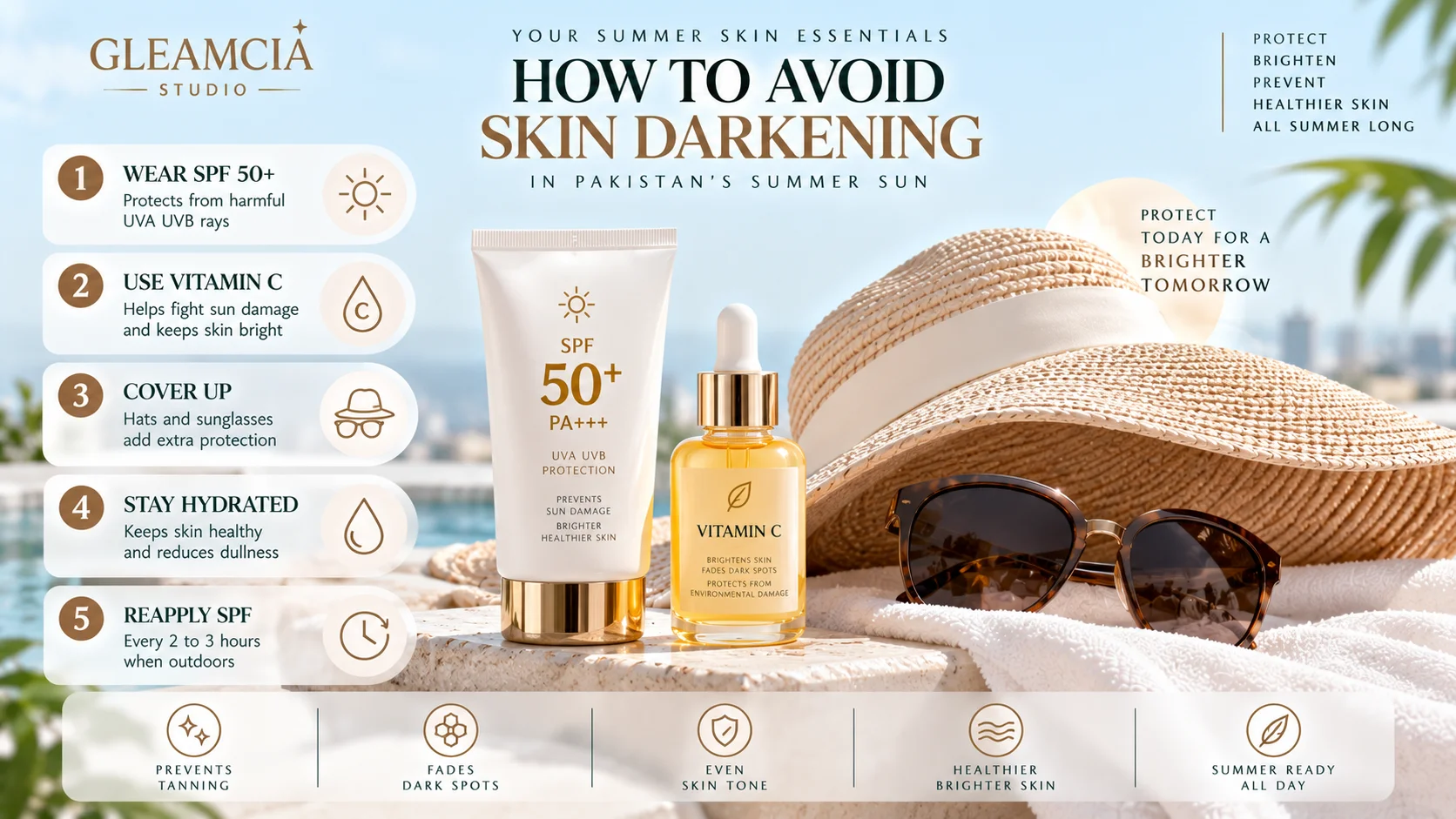
SPF 50+ broad-spectrum applied in the correct amount every morning is the most impactful single step. The two-finger rule for the face and neck, applied after moisturiser, reapplied every two hours of outdoor sun exposure. This is not a recommendation for particularly sun-sensitive people — this is the baseline for anyone in Pakistan’s summer who wants to maintain their current skin tone.
Reapplication during the day is the step most people skip. Morning SPF degrades over two hours of UV exposure. A midday reapplication using an SPF mist or SPF powder over makeup is what keeps protection intact throughout the afternoon in Karachi’s intense summer sun.
Vitamin C in the morning routine adds antioxidant protection that works alongside SPF. While SPF filters UV, Vitamin C neutralises the free radicals that UV generates even through the SPF. Together they provide significantly better melanin suppression than SPF alone.
A wide-brimmed hat during extended outdoor time in summer is the physical layer of UV protection that no product fully replaces for prolonged sun exposure. In Pakistan’s peak summer hours — roughly 10am to 4pm — limiting direct sun exposure and using shade where available is the simplest way to prevent further darkening beyond what topical products address.
Niacinamide in the routine blocks melanin transfer from melanocytes to surface skin cells. Even when some melanin is stimulated by summer UV exposure, Niacinamide reduces how much of it visibly surfaces. It is a daily brightening support that works particularly well in a lightweight summer moisturiser format.
Can Sun Actually Brighten Skin?
No. The sun does not brighten skin in any healthy or sustainable way.
What people perceive as a “sun glow” is usually one of two things. The first is the flushed, slightly reddened appearance of skin that has been warm and stimulated — which can look temporarily more vibrant but is actually a sign of mild UV stress on the surface. The second is a tan, which is the skin’s emergency melanin production response to UV-induced cellular damage. A tan is not brightness — it is the skin’s attempt to shield itself from further DNA damage by producing a pigment barrier.
The American Academy of Dermatology is explicit that UV exposure is one of the primary causes of hyperpigmentation, premature ageing, and uneven skin tone. Every tanning session — however brief — causes cumulative damage that shows up as dark spots, reduced collagen, and textural unevenness over months and years.
True skin brightness comes from within the skincare routine: SPF preventing new melanin formation, Vitamin C inhibiting tyrosinase and protecting against UV-triggered oxidative stress, Niacinamide blocking melanin transfer, and consistent exfoliation removing the dull surface cells that accumulate between cell turnover cycles. None of these require sun exposure. They work most effectively when sun exposure is actively managed with SPF.
What Foods Make Skin Glow in Summer?
Diet contributes to skin appearance more than most people give it credit for, particularly in summer when the skin is dealing with increased UV stress, heat, and the oxidative load that comes with both.
Vitamin C-rich foods are the most directly relevant. Guava (widely available in Pakistan), citrus fruits, papaya, strawberries, and red bell peppers all provide ascorbic acid that supports collagen synthesis and provides internal antioxidant protection. The skin uses dietary Vitamin C the same way it uses topical Vitamin C — to protect against free radical damage and support the structural proteins that keep it looking firm and bright.
Beta-carotene foods — carrots, sweet potato, mango, papaya — are converted in the body to Vitamin A, which supports skin cell turnover and maintains an even, healthy complexion. Mango is both widely available and beloved in Pakistan’s summer and is also genuinely good for the skin when eaten rather than applied.
Omega-3 fatty acids from fish, flaxseeds, and walnuts reduce inflammation in the skin from the inside. Inflammatory skin looks dull, reactive, and uneven. Omega-3s lower the inflammatory baseline that heat and UV increase in summer.
Zinc from pumpkin seeds, legumes, meat, and eggs supports the skin’s natural oil regulation and wound healing. Zinc deficiency is associated with increased acne and slower skin recovery — both more relevant in summer when heat increases sebum and pore congestion.
The simplest food-based summer glow strategy is consistent hydration — water intake throughout the day — combined with seasonal fruits high in Vitamin C and antioxidants. Pakistan’s summer produces some of the most nutrient-dense fruits available: mango, watermelon, guava, papaya. Eating them regularly during the season is one of the most accessible skincare upgrades available.
Which Foods Increase Melanin in Skin?
Melanin production is primarily driven by UV exposure and genetics — not diet. But certain foods provide the raw materials that the melanin production pathway uses, so they can support the process.
Tyrosine-rich foods are the most relevant because tyrosine is the amino acid that melanin is synthesised from. Foods high in tyrosine include eggs, chicken, beef, pumpkin seeds, almonds, walnuts, avocado, and fish. These do not dramatically darken the skin on their own — melanin production requires UV stimulation and the tyrosinase enzyme to be active — but they provide the substrate the process uses.
Copper-rich foods matter because copper is a cofactor for tyrosinase — the enzyme that converts tyrosine into melanin. Nuts, seeds, dark chocolate, shellfish, and whole grains are all copper sources. Again, eating these does not turn the melanin pathway on in the absence of UV and genetic predisposition.
The practical takeaway is that food alone does not meaningfully increase skin darkening. UV exposure is the primary trigger. If someone is trying to support natural skin colour or tan more easily, diet is a very indirect lever. If the goal is preventing skin darkening in Pakistan’s summer, diet is supplementary — the SPF, hat, and vitamin C serum are doing the real work.
For those asking because they want to know if certain foods are making them darker: they are not. UV exposure and inconsistent SPF are almost certainly the more significant contributors.
Heavy Cream Moisturizer vs Lightweight Gel Moisturizer for Pakistan’s Summer
| Feature | Heavy Cream Moisturizer | Lightweight Gel Moisturizer |
| Base | Oil-in-water emulsion, often with butters and waxes | Water-first, humectant-heavy, minimal or no oil |
| Absorption time | Slow — leaves a residue film on skin | Fast — absorbs in 30 to 60 seconds |
| Suitable for summer in Pakistan | No for most skin types — too heavy | Yes — designed for warm, humid conditions |
| Pore congestion risk | Higher — especially in summer heat with increased sebum | Very low with non-comedogenic formula |
| Under SPF and makeup | Creates slippage and pilling | Absorbs cleanly, SPF sits evenly on top |
| Sebum control | None — adds more occlusion | Yes with Niacinamide-containing formulas |
| Best for | Dry skin in winter, extreme dryness, barrier repair | Oily, combination, normal skin in summer |
| Cooling effect | Minimal | Aloe Vera and water-based formulas feel cooling on application |
| Suitable for oily skin in summer | No | Yes — the correct summer format for oily types |
| Niacinamide compatibility | Common | Common — often in combination with Hyaluronic Acid |
The switch from a heavy cream to a lightweight gel in summer is not just a preference — it is the decision that determines whether the rest of the routine performs well or fights against a foundation that is too heavy for the climate.
The Simplified Summer Skincare Routine for Pakistan
Morning:
- Gentle gel cleanser — removes overnight sebum without stripping
- Vitamin C serum — antioxidant protection and brightening for the day ahead
- Lightweight gel moisturiser with Niacinamide — hydration without heaviness, sebum regulation built in
- SPF 50+ — applied in the two-finger amount for face and neck, the most important morning step
Evening:
- Oil cleanser — removes SPF and the day’s sebum
- Gel or foam cleanser as second cleanse — the Gleamcia Brightening Face Wash works well here
- Niacinamide or Retinol serum — treatment step on clean skin
- Lightweight gel moisturiser — the same formula as morning is appropriate
Weekly (once to twice):
- AHA exfoliant in the evening after cleansing, before moisturiser — removes dead skin buildup for a visibly clearer complexion
- Hydrating sheet mask — restores moisture in a cooling, non-greasy format that works well in summer
Common Summer Skincare Mistakes in Pakistan’s Humidity
Stopping moisturiser entirely because the skin feels oily. The skin feels oily in summer heat, but the AC environment simultaneously dehydrates it. Removing moisturiser triggers compensatory sebum overproduction, making the oiliness worse rather than better.
Using the same SPF in summer as in winter without checking the texture. Winter SPF may be richer or thicker — appropriate for cooler air. In Pakistan’s summer heat, that same formula feels heavy, pills under sweat, and ends up being underapplied because it is uncomfortable.
Skipping the evening double cleanse because the skin is tired. Summer days load the skin with SPF, pollution, sweat, and sebum more than any other season. The evening cleanse is more important in summer, not less. Sleeping on that accumulation clogs pores and dulls the complexion over days.
Adding heavy oils or oil-based serums to an already oil-heavy summer routine. Oil layering that works in a dry winter climate sits poorly over summer skin. Reduce oil-based products in summer and let the skin’s own increased sebum do the barrier work those products were filling.
Exfoliating as aggressively as in winter. High-heat periods make the skin more reactive to acid exfoliation. Reducing from three times to once or twice a week, and using a lower-concentration AHA in summer, prevents sensitisation that the heat compounds.
What to Expect After Switching to a Lightweight Summer Moisturizer Routine
The change in skin balance after switching from a heavy to a lightweight routine is faster than most people expect.
Within the first one to two weeks, midday oiliness reduces — not because the skin is producing less sebum immediately, but because the reduced occlusive load means the sebum is not being compounded by a thick product layer. The skin reads the improved barrier hydration and begins modulating the compensatory overproduction.
By weeks three to four, skin texture often improves noticeably. The combination of a lighter moisturiser, consistent SPF, and correct cleansing removes the congestion cycle that summer heat accelerates.
From month two onward, consistent lightweight hydration with Niacinamide and daily SPF produces a more even-toned, less reactive complexion that manages Pakistan’s summer considerably better than a winter-transplanted heavy routine.
Aftercare and Summer Skincare Habits for Pakistan
Do:
- Reapply SPF every two hours during outdoor time — SPF mist is the most practical summer reapplication method
- Change pillowcases every two to three days in summer — heat increases sweating overnight and a damp, used pillowcase worsens pore congestion
- Drink adequate water throughout the day — the skin’s hydration system depends on systemic water intake, which summer heat increases the need for
- Keep skincare products away from direct summer sunlight — heat degrades active ingredients, particularly Vitamin C serums
Do not:
- Apply moisturiser over skin that is still sweating from exercise or heat — wait for the skin to settle before applying
- Use facial wipes as a substitute for cleansing in the heat — they smear product residue rather than removing it and disrupt the skin’s pH with repeated use
- Skip moisturiser on particularly humid days — the humidity is in the outdoor air, not inside air-conditioned spaces where the skin spends most of its time dehydrating
What Does a Lightweight Summer Moisturizer Cost in Pakistan?
Gel and water-based formulas are generally priced at or slightly below rich cream moisturisers because they use fewer expensive occlusive lipid ingredients. The price driver in lightweight moisturisers is the active ingredient quality — a gel with 10% Niacinamide and Hyaluronic Acid at two molecular weights costs more to produce than a basic aloe gel.
Size is the most practical cost factor. A 50ml lightweight moisturiser used twice daily depletes in approximately 30 to 40 days depending on how much is applied per use. Larger formats or summer bundles with a matching SPF and cleanser from the same range reduce the per-day cost compared to single-product purchases.
For the summer period specifically — April through September across most of Pakistan — buying a full summer routine bundle (cleanser, lightweight moisturiser, serum, SPF) from one range ensures formula compatibility and avoids the pilling and conflict that comes from mixing different product bases from different brands.
Gleamcia delivers from Karachi to every city in Pakistan. Visit gleamcia.com/shop for current pricing on the lightweight summer skincare range and any active seasonal promotions.
Why Choose Gleamcia
Gleamcia formulates every summer product with Pakistan’s actual climate in mind — the coastal humidity of Karachi, the heat of Lahore’s summer, and the skin types and concerns most common across Pakistan’s urban population.
- Lightweight gel moisturisers with Niacinamide and Hyaluronic Acid at concentrations that regulate sebum and hydrate simultaneously — the combination summer oily skin needs
- Sulphate-free, gentle cleansers that remove SPF and summer buildup without stripping the barrier that the rest of the routine is trying to support
- SPF formulas developed for wearability in Pakistan’s heat — lightweight enough to wear daily, effective enough to provide genuine protection in high-UV summer conditions
- Full ingredient transparency and clear seasonal usage guidance
- Nationwide delivery from Karachi to every city in Pakistan, reliable packaging, and fast dispatch
Frequently Asked Questions
1. How to get glowing skin in summer in Pakistan? Consistent SPF every morning, Vitamin C serum under that SPF, lightweight hydration with a gel moisturiser, double cleansing every evening to clear the day’s buildup, and AHA exfoliation once or twice a week. Drinking adequate water daily and eating Vitamin C-rich seasonal fruits — guava, papaya, mango — supports the skin’s antioxidant defence from within. The glow in summer comes from protection and hydration, not from sun exposure.
2. What foods make skin glow naturally? Vitamin C-rich foods accelerate collagen synthesis and provide internal antioxidant protection: guava, citrus fruits, papaya, and red peppers are the most accessible in Pakistan. Beta-carotene foods like carrots, mango, and sweet potato support healthy cell turnover. Omega-3 fatty acids from fish, walnuts, and flaxseeds reduce the baseline inflammation that makes skin look dull. Consistent hydration — water throughout the day — is the simplest skin glow dietary habit of all.
3. How to avoid skin darkening in summer in Pakistan? SPF 50+ applied in the correct amount every morning and reapplied every two hours of outdoor sun exposure is the most powerful intervention. Vitamin C serum in the morning adds antioxidant protection that works alongside SPF to reduce UV-triggered melanin production. A wide-brimmed hat during extended outdoor time provides the physical UV blocking that no product fully replaces for prolonged exposure. Niacinamide in the daily routine reduces melanin transfer to the visible skin surface even when some UV-stimulated production occurs.
4. Can the sun actually brighten your skin? No. What looks like a “sun glow” is typically temporary flush from heat stimulation, or a tan — which is the skin’s UV damage response, not brightness. UV exposure causes hyperpigmentation, breaks down collagen, and produces the uneven tone and texture that brightening serums are then needed to address. The American Academy of Dermatology is clear that UV is a leading cause of premature skin ageing and dark spots. True skin brightness is produced by SPF, Vitamin C, Niacinamide, and consistent cell turnover — not sun exposure.
5. Which foods increase melanin in skin? Foods high in tyrosine (the amino acid melanin is made from) provide the raw material for the process: eggs, meat, nuts, seeds, and fish. Copper-rich foods support the tyrosinase enzyme that produces melanin: nuts, seeds, dark chocolate, and shellfish. However, diet is a very indirect and minor lever compared to UV exposure and genetics. The sun activates melanin production — food provides the substrate but does not switch the process on. If someone is trying to prevent darkening in Pakistan’s summer, SPF is doing far more than any dietary adjustment.
6. Do I still need a moisturizer in Pakistan’s summer if my skin is already oily? Yes. Oiliness is sebum production — it is not skin hydration. Air-conditioned environments in Pakistan’s summer cause transepidermal water loss that makes oily skin simultaneously dehydrated. When the skin lacks water, it produces more sebum to compensate, making the oiliness worse. A lightweight gel moisturiser with Niacinamide hydrates without adding oil, regulates sebum over time, and breaks the dehydrated-oily cycle that makes summer skin feel unmanageable.
7. What is the best lightweight moisturizer texture for Pakistan’s humid summer? A water-based gel or gel-cream that absorbs within 30 to 60 seconds and leaves no greasy film. The formula should contain Hyaluronic Acid or Glycerin for hydration, Niacinamide for sebum regulation, and Aloe Vera or Centella Asiatica for the cooling, anti-inflammatory support that summer skin benefits from. It should be non-comedogenic — no heavy butters or occlusive oils in the first half of the ingredient list. The Gleamcia Skin Care range includes lightweight summer-appropriate options at gleamcia.com.
Simplify the Routine, Not the Results
Pakistan’s summer does not mean abandoning skincare — it means using smarter, lighter versions of the same essential steps. One good lightweight summer moisturizer, a consistent SPF, a Vitamin C serum, and a thorough evening cleanse is all the routine that most skin needs to stay clear, balanced, and visibly bright through the humidity. Order from the Gleamcia Skin Care range via our online store — nationwide delivery across Pakistan from Karachi.
Place your order on WhatsApp at 0336 1223363 and our team will help you build the right lightweight summer routine for your skin type and city.