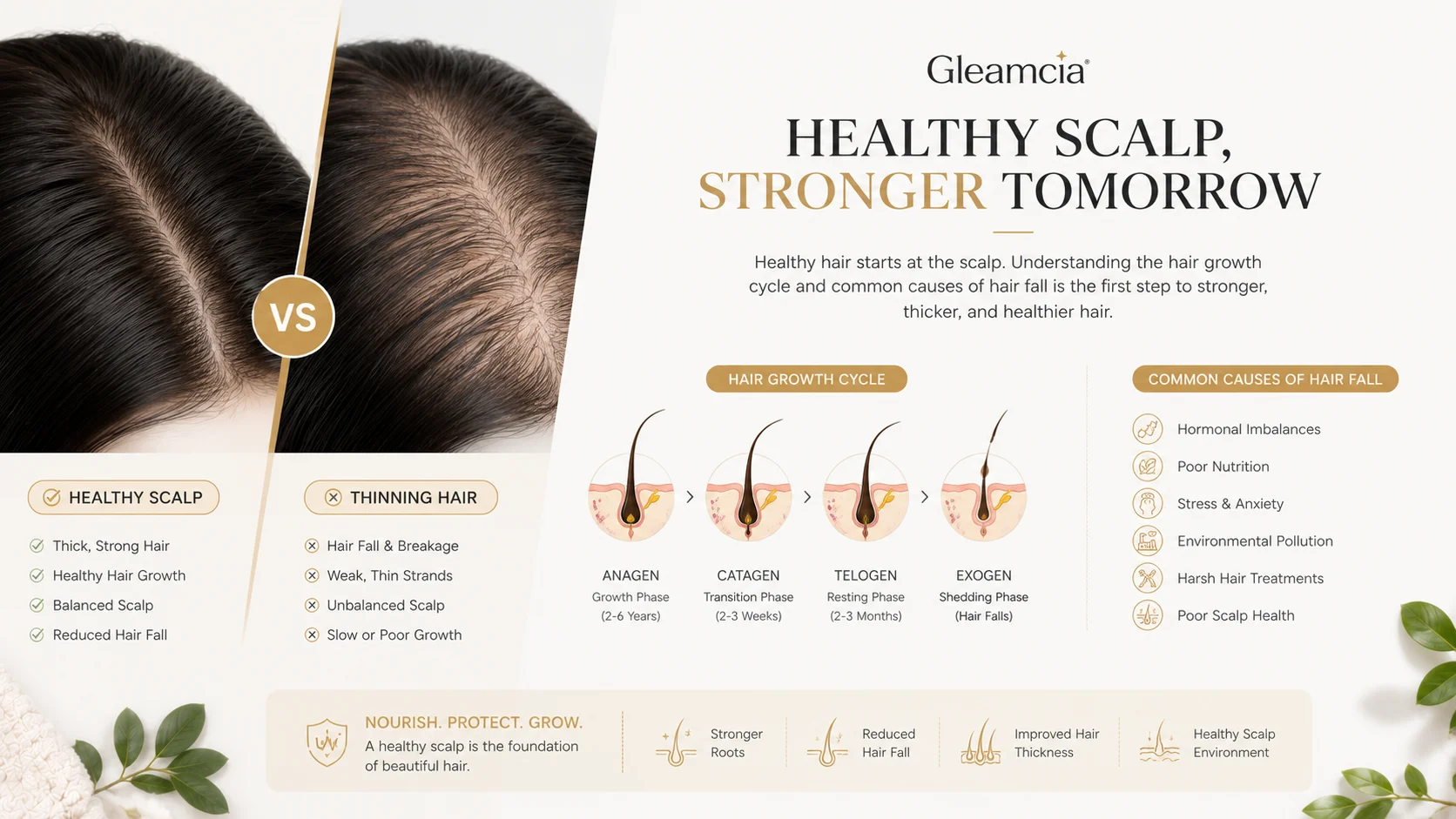
Introduction
If you are researching hair loss treatment online, these two things keep coming up: hair growth sprays and minoxidil. They are both applied to the scalp. They both claim to reduce hair fall and support regrowth. But the way they work, who they work for, what risks they carry, and how long you need to stay on them are entirely different — and picking the wrong one for your specific situation wastes months that earlier intervention could have used better.
Hair growth spray vs minoxidil is not a question with one universal answer. It depends on the type and severity of your hair loss, your risk tolerance for side effects, and whether you want a pharmaceutical intervention or a botanical one. This guide covers both sides of that decision clearly, including whether minoxidil really regrows hair, how many times a day to use it, what the Big 3 for hair regrowth actually are, and how a well-formulated botanical hair growth spray stacks up against the prescription standard. Browse the Gleamcia Hair Care range for hair growth sprays formulated with clinically backed scalp-active ingredients.
What Is a Botanical Hair Growth Spray?
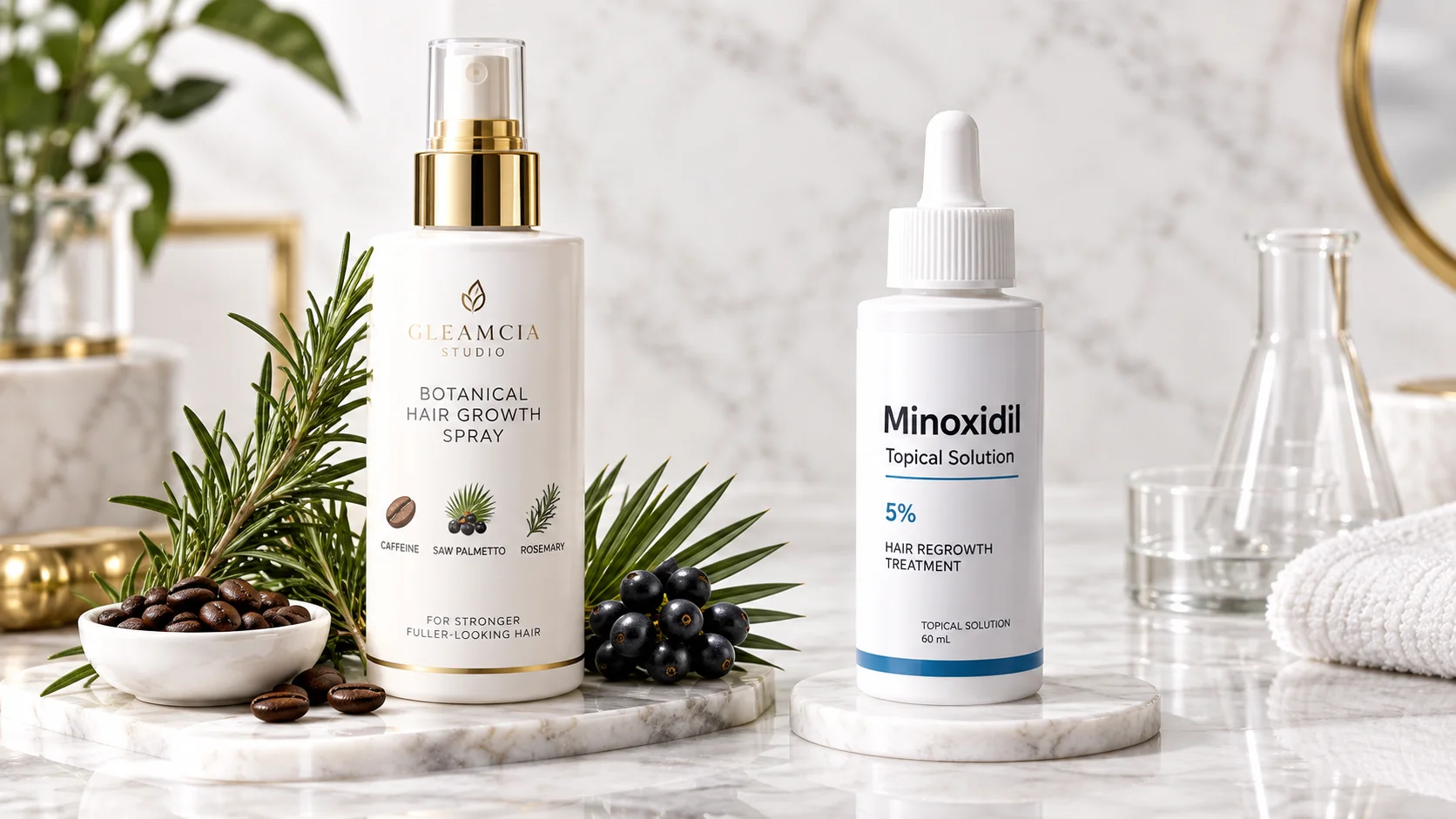
A botanical hair growth spray is a topical, leave-on scalp treatment containing plant-derived and clinically supported active ingredients that address hair loss without using pharmaceutical compounds like minoxidil.
These sprays work through several mechanisms depending on the active ingredients in the formula:
- Caffeine — penetrates the hair follicle during contact, stimulates follicle cell metabolism, extends the anagen (growth) phase, and directly counteracts the effect of DHT on the follicle
- Saw Palmetto Extract — inhibits 5-alpha reductase, the enzyme that converts testosterone to DHT. DHT is the primary hormonal driver of follicle miniaturisation in pattern hair loss
- Rosemary Extract — compared directly to 2% minoxidil in a randomised controlled trial, with comparable results at six months and a significantly better scalp tolerance profile
- Niacinamide — improves scalp microcirculation and reduces follicular inflammation, both linked to accelerated shedding
- Peptides — signal follicle cells to remain active and support the keratin proteins that anchor hair at the root
- Biotin — supports keratin production and strand integrity
These sprays are available without a prescription, have a significantly lower side effect profile than pharmaceutical alternatives, and are the appropriate first-line option for people with mild to moderate hair thinning or those looking to prevent progression before it becomes significant.
What Is Minoxidil and How Does It Work?
Minoxidil started its life as an oral blood pressure medication. During clinical trials in the 1980s, researchers noticed a consistent and unexpected side effect: patients were growing hair in areas previously thinning. Topical minoxidil was developed from that discovery and went on to become the first FDA-approved topical treatment for androgenetic alopecia (pattern hair loss).
Its mechanism is distinct from botanical sprays. Minoxidil is a vasodilator — it dilates the blood vessels around hair follicles, increasing blood flow, oxygen, and nutrient delivery to the follicle bulb. This improved circulation appears to extend the anagen (active growth) phase of the hair cycle and revive follicles that were transitioning into a dormant state.
Topical minoxidil is available in two concentrations: 2% and 5%. The 5% concentration is generally more effective for both men and women and is the concentration most commonly recommended for visible results. It comes in liquid form and foam — the foam absorbs faster and avoids propylene glycol, which causes scalp irritation in some users.
Minoxidil does not block DHT. It supports the follicle’s blood supply without addressing the hormonal cause of pattern hair loss directly. This is why it works best when used alongside a DHT-blocking treatment, and why stopping minoxidil allows hair loss to resume once the blood supply benefit is withdrawn.
Hair Growth Spray vs Minoxidil: The Core Differences
The decision between these two is not about which is objectively better — it is about which is right for the specific type and severity of hair loss being addressed.
The fundamental difference is mechanism and classification. Botanical hair growth sprays address DHT directly (through saw palmetto), stimulate follicles through scalp-active compounds (caffeine, rosemary), and support the hair strand and scalp environment with supporting actives. They work at multiple points in the hair loss chain simultaneously.
Minoxidil works at one point: blood flow to the follicle. It does not block DHT. It does not address scalp inflammation. It does not strengthen the hair strand. It prolongs the growth phase through improved vascular supply to the follicle.
Both require consistent, long-term use. Results from either fade if the product is discontinued — botanical sprays because the DHT blocking and follicle stimulation stop, minoxidil because the vascular support withdraws and the underlying DHT-driven miniaturisation resumes.
Minoxidil is generally considered more potent for established pattern hair loss — it has decades of clinical trial data and FDA approval for androgenetic alopecia. Botanical sprays are more appropriate for early thinning, prevention, mild to moderate hair fall, and situations where the cause is not purely pattern-related.
Will Minoxidil Really Regrow Hair?
Yes — for a meaningful proportion of users, and more specifically for those using it in the right context for the right type of hair loss.
Clinical studies consistently show that minoxidil at 5% produces significant hair regrowth in 40% to 60% of users after 12 months of twice-daily application. The American Academy of Dermatology lists topical minoxidil as one of two first-line treatments for androgenetic alopecia (the other being finasteride), with the clearest evidence base of any OTC hair loss treatment.
The results are most reliable for early to moderate pattern hair loss where the follicles are miniaturised but still alive and responsive. Areas where follicles have been dormant for many years — with visible scalp and no remaining follicle activity — respond less consistently. Minoxidil revives follicles that are struggling, not ones that have already been fully lost.
Women tend to respond as well or better than men to minoxidil in some studies, which is relevant since diffuse thinning in women is common across South Asian populations including Pakistan.
The honest caveat: minoxidil maintains and partially restores. Once stopped, hair loss typically returns to where it would have been without treatment within three to six months. This is not a cure — it is an ongoing treatment.
How Many Times a Day Should You Use Minoxidil Spray?
Twice daily is the standard clinical protocol for minoxidil — once in the morning and once in the evening. This is the frequency used in the clinical trials that established its efficacy and the protocol approved by regulatory agencies for hair loss treatment.
The twice-daily application is not arbitrary. Minoxidil’s half-life in the scalp — the time it takes for the active compound to reduce to half its concentration — is approximately 22 hours. Twice-daily application maintains a more consistent active concentration at the follicle than once-daily dosing.
For the foam formulation, some studies have shown comparable results with once-daily application, particularly when the foam is applied in larger amounts. This has led some dermatologists to recommend once-daily application for compliance-challenged patients — particularly those using the foam version in the morning as part of a hair care routine.
If twice-daily is genuinely difficult to maintain consistently, once-daily at a regular time is significantly better than irregular twice-daily application with frequent misses. Consistency across the week matters more than hitting exactly two applications per day.
Can I Skip Minoxidil for 2 Days?
Occasionally missing one to two days will not reverse established results or cause immediate significant shedding. Minoxidil’s effects on the follicle are cumulative rather than moment-to-moment, and a 48-hour gap is within the margin of biological variability.
What matters is the pattern. Missing one day occasionally is manageable. Missing two or three days per week consistently over months reduces the treatment’s effectiveness significantly — the follicle blood supply boost is not being sustained at the level that produces results.
Stopping completely for a week or more begins to allow the underlying hair loss pattern to accelerate. Stopping entirely, for any extended period, leads to shedding returning within three to six months as the follicles revert to the trajectory they would have taken without treatment.
If a lapse has occurred and significant time has passed without application, restarting produces an initial shedding phase as the follicles are stimulated back into the growth cycle — the same telogen effluvium that occurs when first starting. This is normal and settles over four to six weeks.
Is Minoxidil Completely Safe?
Minoxidil is generally well-tolerated for most healthy adults when used topically as directed. But “generally well-tolerated” is not the same as completely free of side effects — and understanding the actual risk profile is useful before committing to long-term use.
Common side effects from topical minoxidil:
- Initial shedding (telogen effluvium) — the most alarming early reaction that often causes people to stop the treatment before it has a chance to work. This shedding happens because minoxidil shifts follicles rapidly from the resting phase to the active phase, causing resting hairs to shed to make way for new growth. It typically peaks at weeks two to six and resolves on its own. Continuing through this phase is essential.
- Scalp dryness and irritation — particularly with the liquid formula, which contains propylene glycol. The foam is propylene-glycol-free and better tolerated by sensitive scalps.
- Contact dermatitis — an inflammatory reaction at the application site in some individuals. Characterised by redness, itching, and scaling beyond normal dryness.
- Facial hair growth — when liquid minoxidil transfers to the face through pillow contact, touching the scalp then the face, or spray drift. More common with liquid than foam and manageable by washing hands after application and waiting for the product to dry before lying down.
Less common considerations:
- Oral minoxidil — prescribed in tablet form by dermatologists for more significant hair loss — carries systemic effects including fluid retention, increased heart rate, and requires cardiovascular monitoring. This is distinct from topical use.
- People with cardiovascular conditions should consult a doctor before beginning any minoxidil treatment.
- Not recommended in pregnancy.
The risk-to-benefit profile for topical minoxidil is well-established. For most healthy adults with pattern hair loss, it is a reasonable treatment option. But it is not without considerations, and those should be understood before starting a daily long-term application.
What Are the Big 3 for Hair Regrowth?
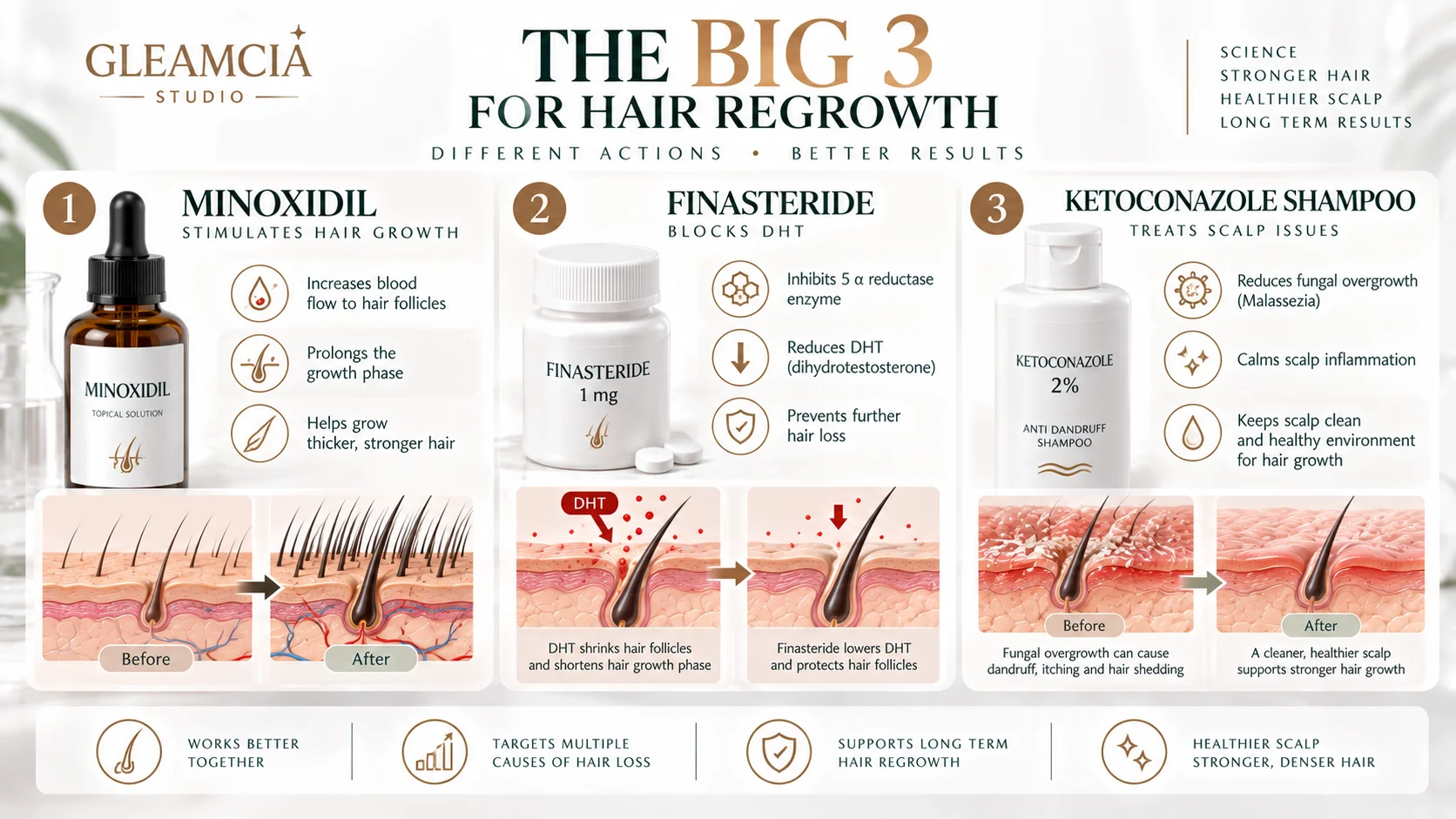
The “Big 3” is a widely referenced framework in the hair loss research and community space — referring to the three interventions with the most clinical backing for slowing and reversing androgenetic alopecia. It is not an official medical protocol, but the evidence base behind each component is real.
1. Minoxidil The only FDA-approved topical treatment for androgenetic alopecia. Applied twice daily to the scalp to improve follicle blood supply and extend the active growth phase. Works without addressing the hormonal cause.
2. Finasteride (Oral) A prescription oral DHT blocker that inhibits 5-alpha reductase — reducing systemic DHT levels by approximately 70%. Addresses the root hormonal cause of pattern hair loss that minoxidil does not touch. Primarily used in men as it can interfere with hormonal function and requires medical supervision. Potential side effects include sexual function changes in a subset of users.
3. Ketoconazole Shampoo An antifungal active used in medicated shampoos that also has demonstrated DHT-blocking properties at the scalp level. Used two to three times weekly rather than daily. The most accessible of the three — available OTC without a prescription and well tolerated by most scalps.
Some updated versions of the Big 3 framework incorporate Dutasteride (a stronger DHT blocker than finasteride), low-level laser therapy (LLLT), or substitute finasteride with Saw Palmetto as a gentler natural DHT blocker for those who prefer a non-pharmaceutical approach.
A botanical hair growth spray with Saw Palmetto positions itself within this framework as the natural equivalent of the DHT-blocking component — without the prescription requirement or systemic side effect profile of finasteride.
Who Should Use a Botanical Hair Growth Spray vs Minoxidil?
The decision depends on the nature and progression of hair loss, individual health considerations, and preference for pharmaceutical vs botanical approaches.
A botanical hair growth spray is the better starting point if:
- The thinning is mild to moderate and caught at an early stage
- Hair fall is diffuse rather than following a defined pattern of recession or crown thinning
- The cause includes scalp inflammation, DHT sensitivity at early stages, or stress-related shedding
- Side effects from pharmaceutical treatment are a concern
- The goal is preventive maintenance alongside a hair care routine
- A prescription is not accessible or preferable
Minoxidil is the stronger choice if:
- Pattern hair loss is clearly established — defined recession at the temples or crown, following the Norwood scale for men or Ludwig scale for women
- The condition has been progressing for several years without treatment intervention
- Botanical approaches have been tried for 3 to 6 months without significant result
- A dermatologist has confirmed androgenetic alopecia as the diagnosis and recommended minoxidil
For many people — particularly those in Pakistan dealing with early-onset thinning from a combination of stress, hard water, diet, and DHT sensitivity — starting with a botanical spray is the appropriate step. It produces real results for mild to moderate cases, has minimal side effects, and preserves the minoxidil option as an escalation if needed.
Can You Use Hair Growth Spray and Minoxidil Together?
Yes — botanical hair growth sprays and minoxidil can be used together, and for moderate to significant pattern hair loss, combining them covers more ground than either product alone.
Minoxidil addresses vascular supply to the follicle. A botanical spray with Saw Palmetto and Caffeine addresses DHT and follicle stimulation. They work through different mechanisms with no known interaction between them. The combination is essentially what the Big 3 framework attempts — multiple simultaneous interventions targeting different stages of the hair loss process.
The practical approach is to apply minoxidil as directed (twice daily) and use the botanical spray on the scalp on wash days or between minoxidil applications when the scalp has absorbed the previous dose. Do not apply both products to a wet scalp simultaneously — allow each product its own absorption window.
Hair Growth Spray vs Minoxidil: Full Comparison
| Feature | Botanical Hair Growth Spray | Minoxidil (Topical 5%) |
| Prescription needed | No | No (topical OTC) |
| Primary mechanism | DHT blocking, follicle stimulation, scalp circulation | Vasodilation — improved blood supply to follicle |
| Blocks DHT | Yes — with Saw Palmetto | No |
| FDA approval for hair loss | No (not required for OTC botanicals) | Yes |
| Initial shedding risk | Low | Yes — common in weeks 2 to 6 |
| Side effects | Minimal | Scalp irritation, dryness, facial hair transfer, contact dermatitis |
| Application frequency | Once daily or 5 times weekly | Twice daily (clinical standard) |
| Results timeline | 3 to 6 months | 4 to 12 months |
| Best for | Early/mild thinning, prevention, DHT-related hair fall, maintenance | Established pattern hair loss, moderate to significant androgenetic alopecia |
| Stops working when discontinued | Yes | Yes — shedding resumes within 3 to 6 months |
| Safe in pregnancy | Generally considered safer | Avoid — not recommended in pregnancy |
| Suitable for sensitive scalps | Yes | Foam version is better tolerated |
| Combined use | Yes — can be used alongside minoxidil | Yes — pair with DHT blocker for best results |
| Available in Pakistan | Yes | Yes |
Results Timeline: Hair Growth Spray vs Minoxidil
Botanical hair growth spray:
- Weeks 1 to 2: Scalp feels less irritated, less itchy between washes
- Weeks 3 to 4: Visible reduction in daily shedding
- Weeks 6 to 8: Stronger, more anchored strands; reduced breakage
- Months 3 to 6: Early density improvement in thinning zones; consistent maintenance of hair that would have progressed to shed
Minoxidil:
- Weeks 2 to 6: Initial shedding phase — alarming but normal. This is the follicle transition to active phase.
- Weeks 6 to 12: Shedding stabilises; scalp begins to feel more comfortable
- Months 3 to 6: New growth visible as fine vellus hairs at thinning zones
- Months 6 to 12: Vellus hairs mature into terminal hairs; most significant visible density improvement
- Month 12 and beyond: Results plateau; continued use maintains gains
Common Mistakes When Using Either Product
With botanical hair growth spray:
- Applying to wet scalp — dilutes the formula and reduces active concentration at the follicle
- Not massaging it in — the massage is part of the mechanism for both scalp circulation and product distribution
- Using it irregularly — three days on, four days off produces no sustained follicle stimulus
With minoxidil:
- Stopping during the initial shedding phase — the most common reason people quit before seeing results
- Washing the scalp within four hours of application — removes the product before adequate absorption
- Transferring to the face — sleeping on an absorbed product risks facial hair growth where the liquid contacts facial skin consistently
- Expecting results in less than six months — minoxidil’s most visible results appear between months six and twelve
Aftercare Tips for Hair Growth Spray and Minoxidil Users
Do:
- Apply either product to a clean, dry scalp for best absorption
- Use scalp massage for one to two minutes after application — improves both product distribution and microcirculation
- Take progress photos monthly in consistent lighting — changes are gradual enough to be missed in daily observation
- Pair both products with a gentle, sulphate-free anti-hair-fall shampoo to maintain a healthy scalp environment
Do not:
- Apply minoxidil immediately before exercise or activities that produce heavy sweating — sweat removes the formula before absorption
- Use minoxidil directly after colouring, bleaching, or chemically treating the hair — wait at least 24 hours after any chemical treatment
- Expect either product to restore hair from follicles that have been fully dormant for many years without dermatologist-guided intervention
What Do Hair Growth Spray and Minoxidil Cost in Pakistan?
Botanical hair growth spray pricing reflects the formulation complexity of the active stack. A spray with meaningful concentrations of caffeine, saw palmetto extract, rosemary oil, niacinamide, and peptides requires more invested formulation than a single-active spray. Bottle size matters significantly for a daily-application product — 100ml depletes in roughly 30 to 40 days at once-daily scalp application.
Minoxidil pricing in Pakistan is relatively accessible given that it is an off-patent pharmaceutical available in several generic formats. The meaningful cost variables are concentration (5% typically preferred over 2%), format (foam is generally priced higher than liquid but better tolerated), and bottle size for a twice-daily application regimen.
Combining both products as a complete hair loss protocol — botanical spray for DHT and scalp stimulation, minoxidil for vascular supply, biotin supplement for internal keratin support — is the most comprehensive approach and bundle purchasing across these three components reduces the per-product price compared to individual purchases.
Browse the Gleamcia Hair Care range for spray pricing and bundle options, with nationwide delivery across Pakistan.
Why Choose Gleamcia
Gleamcia builds every hair growth product around the full hair loss picture — not just a single mechanism, but the multiple simultaneous factors that drive thinning in Pakistan’s context.
- Botanical hair growth sprays formulated with Caffeine, Saw Palmetto, Rosemary Extract, and Niacinamide at concentrations that produce measurable scalp-level results
- Designed for South Asian hair biology and Pakistan’s specific triggers — DHT sensitivity, hard water mineral buildup, heat stress, nutritional gaps
- Transparent ingredient listings with no trace-level actives added for label positioning
- Compatible with minoxidil use — formulas that work alongside pharmaceutical options rather than competing with them
- Nationwide delivery from Karachi to every city in Pakistan, fast dispatch, reliable packaging
Frequently Asked Questions
1. How many times a day should I use minoxidil spray? Twice daily — once in the morning and once in the evening — is the clinical standard. This is the application frequency used in the trials that established minoxidil’s efficacy for hair loss. For the foam formulation, once-daily application has shown comparable results in some studies, and some dermatologists recommend it for patients who find twice-daily difficult to sustain. Consistency over weeks and months matters more than hitting the exact frequency every day.
2. Can I skip minoxidil for 2 days? Occasionally missing one to two days will not immediately reverse established results. Minoxidil’s scalp half-life is approximately 22 hours, so a two-day gap affects the concentration at the follicle but does not undo months of consistent treatment. The concern is the pattern — regularly missing two to three days per week over months significantly reduces effectiveness, and stopping for weeks begins to allow the underlying hair loss to resume. Restart after any lapse and continue consistently.
3. Will minoxidil really regrow hair? Yes, for a meaningful proportion of users — clinical studies show 40% to 60% of users experience significant hair regrowth after 12 months of consistent twice-daily use. The best results are in early to moderate pattern hair loss where follicles are miniaturised but still active. The American Academy of Dermatology lists topical minoxidil as a first-line treatment for androgenetic alopecia. The honest expectation is that it maintains existing hair and partially regrows recently thinned areas — it is not a complete reversal for long-standing significant loss.
4. What are the Big 3 for hair regrowth? The Big 3 is a framework for addressing androgenetic alopecia through multiple simultaneous interventions. The three components are: Minoxidil (topical vasodilator that prolongs the growth phase), Finasteride (oral prescription DHT blocker), and Ketoconazole shampoo (anti-dandruff shampoo with DHT-blocking properties at the scalp, used two to three times weekly). For those preferring a non-pharmaceutical approach, Saw Palmetto in a botanical hair growth spray serves as a natural DHT-blocking alternative to finasteride within this framework.
5. Is minoxidil completely safe? Topical minoxidil is generally well-tolerated by most healthy adults, but it is not without side effects. The most common are initial shedding (a temporary increase in shedding as follicles transition to active growth), scalp dryness and irritation, and facial hair growth if the product transfers to the face. Less common reactions include contact dermatitis. Oral minoxidil carries more significant systemic considerations and requires medical supervision. It should be avoided during pregnancy and used with caution by people with cardiovascular conditions. Safe for most healthy adults when used topically as directed — not entirely side-effect-free.
6. Is a botanical hair growth spray as effective as minoxidil? For early to mild pattern hair loss and preventive maintenance, a well-formulated botanical spray with Caffeine, Saw Palmetto, and Rosemary Extract produces results that are comparable in some studies — a direct comparison of rosemary extract to 2% minoxidil showed comparable outcomes at six months. For established moderate to significant androgenetic alopecia, minoxidil has a stronger evidence base and is the more potent intervention. The two are not mutually exclusive — combining both covers the vascular supply benefit of minoxidil with the DHT-blocking benefit of the botanical spray.
7. Can I stop using minoxidil once my hair grows back? Stopping minoxidil allows hair loss to resume, typically within three to six months. The hair growth benefit is maintained only as long as the treatment continues. This is because minoxidil addresses the vascular supply to the follicle but does not correct the underlying DHT sensitivity that causes pattern hair loss. Stopping is not like completing a course of antibiotics — it removes the support that was maintaining the result. This is why combining minoxidil with a DHT-blocking element (finasteride or botanical Saw Palmetto) produces more stable long-term outcomes.
Choose Based on Your Hair Loss — Not the Marketing
Both botanical hair growth sprays and minoxidil work. They work through different mechanisms for different severities of hair loss and with different side effect profiles. The right choice is the one that matches your specific hair fall pattern, your timeline, and your risk tolerance — not the one with the loudest claims. Order from the Gleamcia Hair Care range on our website for hair growth sprays formulated to perform at the scalp level, available with nationwide delivery from Karachi across Pakistan.
Order on WhatsApp at 0336 1223363 and our team will help you decide the right approach for your hair loss pattern and severity.