Introduction
Ask most people how much sunscreen they apply on their face and they will describe something like half a fingertip, or a thin layer across the nose and cheeks that blends smoothly in thirty seconds. That is not enough. It is not even close to enough. And the gap between what most people apply and what actually delivers the SPF number on the bottle is genuinely significant — not in a minor, percentage-point way, but in a way that effectively reduces SPF 50 to something closer to SPF 7 on the skin.
How much sunscreen to apply on the face is a specific question with a specific, measurable answer. This guide gives it to you — including the two finger rule, how the three finger rule differs, whether you need to reapply indoors, and whether a rainy day actually earns you a morning without SPF. Browse the Gleamcia Skin Care range for SPF formulas that wear correctly in Pakistan’s heat and layer well under or over a daily skincare routine.
Why How Much Sunscreen You Apply on Face Changes Everything
Sunscreen SPF ratings are established through laboratory testing at a specific application density: 2 milligrams per square centimetre of skin (2 mg/cm²). That is the concentration at which the product was measured to deliver the SPF printed on the label.
At half that amount — which is approximately what most people actually apply — the protection is not halved. It drops significantly more than that. Research on this relationship suggests that at 50% of the recommended application amount, SPF 50 effectively delivers approximately SPF 7 protection. The maths is not linear. The film needs to be at a specific minimum density to filter UV at the rated rate. Below that threshold, the filtration efficiency drops steeply.
This is the most important sunscreen fact that most people in Pakistan have never been told. The product is not failing. The amount is. And the two finger rule exists precisely to give a practical, measurable guide to what 2mg/cm² actually looks like on a real face.
How Much Sunscreen to Apply on Face: The Two Finger Rule Explained
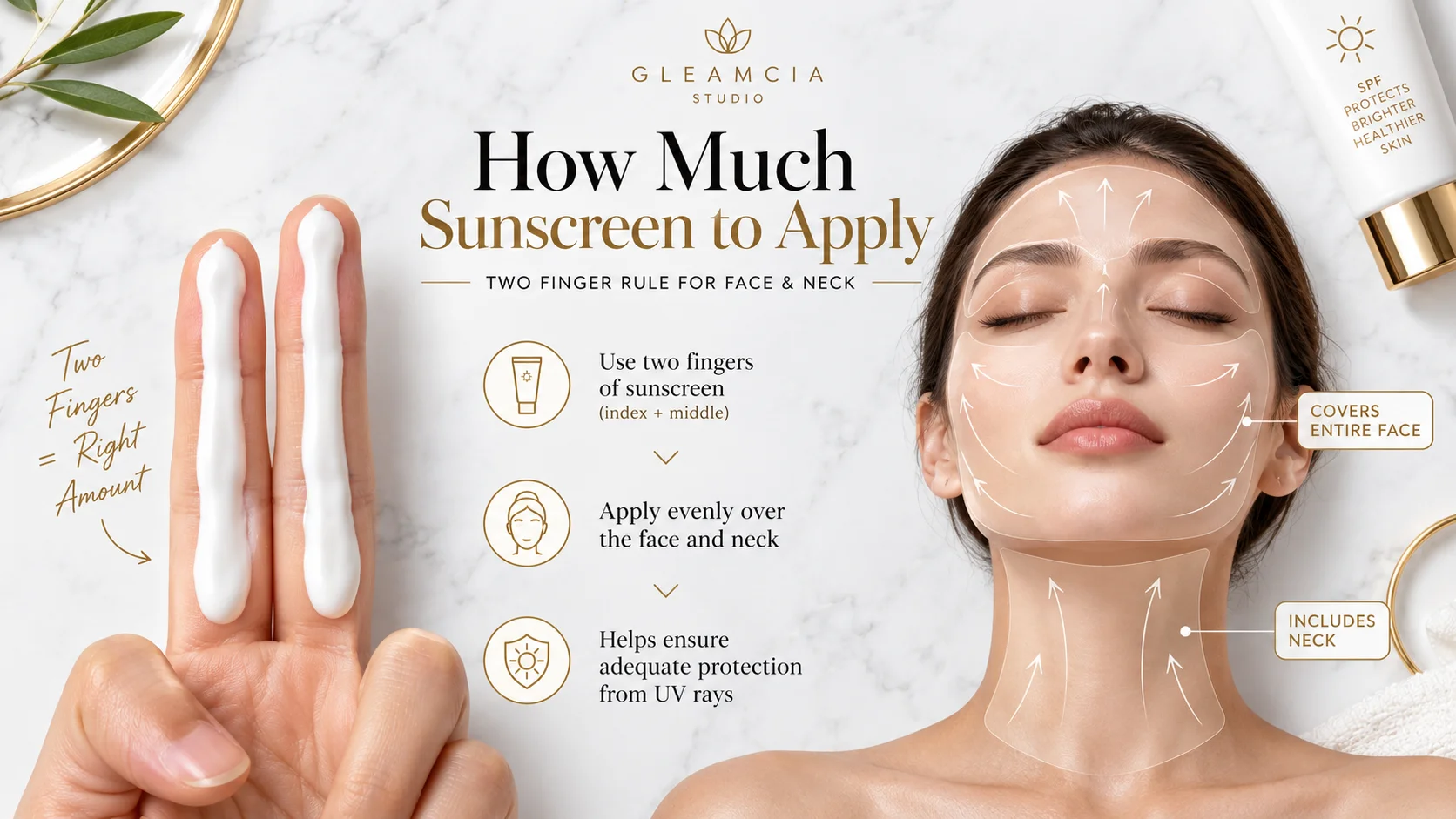
The two finger rule is the most widely used practical guide for face sunscreen application.
Squeeze sunscreen along the full length of your index finger and your middle finger — from the base of the finger to the fingertip. That amount, covering both fingers entirely along their length, gives you approximately one teaspoon or two to two and a half millilitres of product. This is the quantity needed to cover the face and neck at the 2mg/cm² density required for the label SPF to hold.
Look at those two fingers of product. It is more than most people have ever applied in a single face SPF step. That is the point. The gap between what feels like “enough” and what is actually enough is why the two finger rule was developed — to make the correct quantity tangible rather than leaving it to guesswork.
Apply that two-finger amount in sections. Forehead first, then each cheek, then nose and chin, then the neck. Do not start in the centre of the face and spread outward from one point — the product thins as it spreads and you end up with the full coverage at the centre and almost nothing at the edges. Patting and pressing in sections ensures even distribution across the full skin surface.
What Is the 3 Finger Rule for Sunscreen?
The three finger rule is a variation on the two finger rule that extends coverage to the face, neck, and décolletage together — or more precisely, it distributes the correct amount across a slightly larger surface area in a measurable way.
One version of the three finger rule uses the index, middle, and ring fingers: two fingers of product for the face and neck, plus a third finger’s worth specifically for the upper chest and décolletage. This is particularly practical in Pakistan’s climate where necklines and décolletage are more sun-exposed during summer and are frequently missed in the face-only SPF routine.
Another version describes using three finger-lengths distributed specifically for the face only — approximately 1.5 times the two-finger amount — which accounts for people with larger faces, or for those who want slightly more product security to ensure even coverage in the application process.
Both rules originate from the same mathematical basis as the two finger rule: the need to apply approximately 2mg/cm² across the treated surface. The finger-rule format is simply a tactile way to measure that without a scale.
For daily use in Pakistan, the two finger rule for face and neck is the practical standard. Adding a third finger’s worth to cover the décolletage and behind the ears completes the coverage that the face-forward routine most commonly misses.
Two Finger Rule vs 3 Finger Rule vs Teaspoon Rule: Which Is Right for Your SPF Routine?
They are all measuring the same target from different angles. Here is how each translates:
The two finger rule gives approximately one teaspoon (around 2ml to 2.5ml) for face and neck. The three finger rule depending on the variant gives one teaspoon for face and neck plus a partial teaspoon for décolletage, or slightly over one teaspoon for face and neck in people with larger face surface areas. The teaspoon rule — used by the American Academy of Dermatology — explicitly states one teaspoon as the correct measure for the face and neck together.
All three are compatible. None is wrong. The teaspoon is the most precise measurement but the most cumbersome to use daily. The two or three finger rule gives a practical, visual equivalent that can be measured immediately without finding a measuring spoon.
The most useful takeaway is simply this: if the SPF dries down in under thirty seconds after application, not enough was used. A correct amount of sunscreen takes a few minutes to fully absorb and blend into the skin. If it is disappearing instantly, the volume is too low to be providing full-rated protection.
How to Apply Sunscreen on Face Correctly
Amount is only part of the equation. The technique determines whether that amount actually covers the full skin surface at even density.
Start by applying the two-finger amount in five small dots — forehead, each cheek, nose, and chin. This distributes the total product across all five zones before any blending begins, ensuring each area receives a share rather than getting less because the product ran out during spreading.
From each dot, blend outward in that zone with gentle pressing and patting motions rather than sweeping strokes. Pressing the product into the skin rather than dragging it across keeps it at even density. Sweeping thins the product significantly in the direction of movement.
Include the ears, the jawline, the back of the neck and particularly the hairline. These are consistently missed. In Pakistan’s summer, the ears and the back of the neck are some of the most UV-exposed areas on an outdoor day and frequently the first to show sun damage from accumulated unprotected exposure.
Allow the sunscreen to fully absorb — typically two to five minutes depending on the formula — before applying makeup if relevant. A freshly applied SPF that is disturbed by foundation applied too quickly is redistributed unevenly, leaving coverage gaps.
Do Dermatologists Recommend Wearing Sunscreen Indoors?
Yes. The consistent recommendation from dermatologists including the AAD is daily SPF regardless of whether the day is planned indoors or out.
The primary reason is UVA. Ultraviolet A rays — the rays responsible for skin ageing, hyperpigmentation, and deep dermal damage — penetrate glass. The UVB that causes sunburn is largely blocked by window glass. But UVA passes through standard untreated glass at approximately 50% to 75% of its outdoor intensity. Someone sitting at a desk near a window, or in a car during a daily commute in Karachi, is receiving meaningful UVA exposure even while completely “indoors.”
Pakistan’s residential and commercial buildings — the older ones particularly — frequently have large windows in primary living and working areas. School classrooms with side windows. Car interiors during school drop-off and office commutes. Sitting areas in homes facing the morning sun. All of these represent genuine daily UVA exposure that accumulates invisibly over months and years into hyperpigmentation, collagen loss, and uneven skin tone.
The second reason is practical. The most effective sunscreen habit is a daily one that does not require a daily decision. Deciding each morning whether today’s plans warrant SPF is how SPF gets skipped on days when the exposure turns out to be greater than anticipated. A consistent morning SPF step eliminates that decision and ensures protection on the days it is needed unexpectedly.
How Long Does Sunscreen Last When You’re Indoors?
When SPF is used correctly — the right amount applied to clean skin — its degradation rate is primarily driven by two factors: UV exposure breaking down the UV filters, and physical removal through sweating, touching the face, eating, or rubbing.
In a fully indoor environment with no UV exposure and minimal physical contact with the face, a morning sunscreen application retains most of its UV filter integrity throughout the day. The product does not spontaneously degrade on the skin in the absence of UV radiation. This is why the standard “reapply every two hours” guideline specifically applies to outdoor sun exposure, not to time passed indoors.
In a typical Pakistan indoor environment — an office with windows, a home with a sunny sitting area, a car with long commute times — UVA exposure through glass is ongoing during the day. Under these conditions, reapplication around midday is the more protective approach, particularly for people who sit near windows for significant portions of the day.
The practical guideline: apply every morning as a baseline. If you are staying genuinely away from windows and outdoors for the full day, morning application is likely sufficient. If windows or unexpected outdoor moments are part of the day, a midday reapplication with an SPF mist or SPF powder ensures ongoing coverage.
How Often Should I Apply Sunscreen Inside?
For someone spending a typical Pakistan day divided between an air-conditioned office, a car commute, and a home environment with standard windows: morning application plus a single midday reapplication is a practical and comprehensive approach.
The midday reapplication does not require removing and reapplying a full skincare routine. An SPF mist — held at arm’s length and sprayed evenly across the face — provides a reasonable top-up without disturbing makeup or existing product layers. Pressed SPF powder with a brush achieves the same result in a more controlled, makeup-friendly format.
For someone who is genuinely indoors in a basement office, an internal-facing room, or a windowless environment for the full working day: morning application is all that is needed unless outdoor exposure happens during the day.
The simple version of this guidance: once in the morning always, and once more at midday if any window exposure or outdoor moments are part of the day. Twice is not excessive — it is the correct frequency for complete protection in the conditions most Pakistani city residents actually live in.
Can I Skip Sunscreen on a Rainy Day?
No. A rainy day in Pakistan is not a UV-free day. This is one of the most persistent and consequential sunscreen myths worth addressing directly.
Cloud cover and rain reduce the intensity of UV radiation that reaches the skin, but they do not eliminate it. Approximately 80% of UV radiation passes through cloud cover, according to the World Health Organization’s UV guidance. On a heavily overcast monsoon day in Karachi, the UV index may drop from a summer peak of 12 to somewhere around 5 or 6 — which still sits in the “moderate to high” range that warrants protection for extended outdoor exposure.
The weather during Pakistan’s monsoon season is also inconsistent within a single day. A morning that starts with heavy cloud cover can open to direct sun by 11am. An overcast sky at the time of morning SPF application does not guarantee overcast conditions for the rest of the day. Skipping sunscreen based on the morning weather is a gamble on conditions that change.
The practical approach: apply sunscreen every morning regardless of the weather. The marginal cost of applying SPF on a day that turns out to be fully cloudy is the two minutes of routine time. The cost of skipping it on a day that turns out to be UV-heavy is cumulative UV damage that shows up as hyperpigmentation and accelerated ageing over months and years. Those consequences are not comparable.
Sunscreen Indoors vs Outdoors: What Actually Changes
| Factor | Indoors (Near Window) | Outdoors |
| UVB exposure | Very low — mostly blocked by glass | Full exposure based on UV index |
| UVA exposure | Moderate — 50% to 75% passes through glass | Full exposure based on PA rating filter |
| Sunburn risk | Very low | Based on UV index and time |
| Skin ageing risk | Moderate — ongoing UVA damage | High — both UVA and UVB |
| Hyperpigmentation risk | Moderate | High |
| SPF needed | Yes — UVA protection (PA rating) critical | Yes — both UVB and UVA |
| Reapplication needed | Midday if near windows all day | Every 2 hours of outdoor exposure |
| Morning application required | Yes — always | Yes — always |
| Rainy day UV reduction | Approximately 20% blocked by clouds | Approximately 20% blocked by clouds |
| Pakistan-specific consideration | Car commutes, home windows, classroom windows all deliver UVA | UV index peaks at midday — reapplication non-negotiable |
The core message in this table: the distinction between indoor and outdoor SPF use is about reapplication frequency and which UV type is most relevant, not about whether SPF is needed at all.
How Much Sunscreen to Apply on Different Face and Body Areas
The two-finger rule addresses the face and neck. Other areas need their own quantity guidance.
Each ear gets a separate application — they are frequently missed and are common sites of UV damage. A small amount at the tip and around the bowl of each ear after the main face application.
The back of the neck, particularly in Pakistan where necklines are exposed during outdoor activity, needs deliberate coverage — another partial finger’s worth applied as part of the neck step in the routine.
The backs of the hands are some of the most consistently sun-exposed skin on the body and show UV-related ageing early. They are also not part of most people’s SPF routine. A small amount rubbed into the backs of both hands after applying SPF to the face takes fifteen seconds.
For full body application — arms, legs, back, chest — the standard guideline is approximately 30ml (one ounce, or a shot glass full) for the body as a whole in swimwear-level exposure. That translates to roughly half a teaspoon per limb and a teaspoon for the torso front and back.
Common Sunscreen Application Mistakes on the Face
Applying too little and blending it too thoroughly before it has had a chance to form a film. Fast blending indicates insufficient product. There should be a light white or translucent layer visible for a moment before it absorbs.
Applying SPF over other products that are still wet. A wet moisturiser or serum under SPF prevents the sunscreen from forming an even film on the skin — it islands in the drier patches and thins out over the damp ones. Allow previous layers to absorb before applying SPF.
Using SPF fingers on the keyboard and then touching the face repeatedly through the day without reapplication. The sunscreen is not only degrading by UV — it is being transferred to every surface the face contacts. A midday reapplication recovers whatever has been mechanically removed.
Applying SPF in the morning and considering the routine complete for the day. One morning application provides meaningful protection for the period immediately after application. The two-hour reapplication guideline for outdoor exposure is not a suggestion — it reflects the genuine degradation rate of UV filters under direct sun exposure.
Applying only to the visible parts of the face while skipping the hairline, ears, and jaw. These zones receive just as much UV as the nose and cheeks, and they are where precancerous lesions and sun damage accumulate most visibly with age.
What to Expect When You Start Applying the Correct Amount of Sunscreen on Face
The first thing most people notice when they apply the correct two-finger amount for the first time is that it is more product than their formula seems designed for. Some sunscreens at full application amount leave a mild white cast that a half-dose application does not. This is informative — it means at half application there was insufficient product on the skin for the UV filter to function at its rated level.
Over two to four weeks of correct daily application, the skin tone often stabilises or begins very slightly brightening — because the UV stimulation that was producing ongoing low-level melanin production while using insufficient SPF is now genuinely controlled. This is not a dramatic overnight change, but it is noticeable over weeks of consistent correct application in Pakistan’s UV conditions.
Post-inflammatory marks from acne, existing hyperpigmentation, and sun tan all fade faster when protected by correct SPF application, because the UV that was actively slowing their fading is no longer penetrating at the same rate.
Aftercare Habits for Correct Sunscreen Use
Do:
- Apply the full two-finger amount every morning before leaving the house, even on days when outdoor time seems minimal
- Carry a travel-sized SPF mist for midday reapplication — Karachi’s afternoon sun hits peak intensity between 12pm and 3pm and midday reapplication covers that window
- Apply to the ears, back of the neck, and jaw every time without treating them as afterthoughts
- Set a phone reminder at 12pm if reapplication is something that gets forgotten in the workday routine
Do not:
- Mix SPF with foundation to save a step — diluting sunscreen with another product reduces the UV filter concentration per cm² and brings the protection well below the label rating
- Apply the day’s SPF while sitting in a moving car and then go directly into strong sun — the product needs a few minutes to settle before UV exposure to form its protective film correctly
- Rely on SPF in foundation or tinted moisturiser as the only SPF source — the amount of foundation applied is a fraction of what is needed to deliver the labelled SPF number from those products
What Does Sunscreen for Daily Face Use Cost in Pakistan?
Daily facial sunscreen costs are more manageable than most people assume when the correct application amount is factored in. A 50ml SPF 50 tube applied at the two-finger amount (approximately 2.5ml per day for face and neck) lasts approximately 20 days. A 100ml bottle lasts approximately 40 days. On a per-day basis, quality SPF sits at one of the most reasonable daily costs in a skincare routine for the protection it provides.
Formula quality significantly affects price. A lightweight, non-white-cast SPF 50 with both broad-spectrum UVB and high-PA UVA coverage in a formula designed to sit under makeup without pilling is more expensive to develop than a basic SPF cream with a single-filter system. The wearability drives compliance — a formula that feels good at the full two-finger amount is one that actually gets used correctly every day. The SPF that stays in the drawer because it feels too heavy is providing no protection.
Nationwide delivery from Karachi to every city in Pakistan is available at gleamcia.com. Visit gleamcia.com/shop for current SPF and skincare pricing across the full range.
Why Choose Gleamcia
Gleamcia develops SPF formulas with one core requirement: wearability at the correct application amount. An SPF that looks good on paper but becomes greasy or heavy when used in the two-finger quantity defeats the purpose.
- Lightweight SPF 50 formulas with both UVB and high-PA UVA coverage, developed for Pakistan’s UV intensity and humid climate
- Textures that absorb cleanly even at the full recommended amount — no white cast, no greasiness, no interference with the skincare routine underneath
- SPF paired with brightening actives so the protection step also contributes to treatment
- Application guidance included with every product — because the right amount matters as much as the right formula
- Nationwide delivery from Karachi across Pakistan, fast dispatch, and packaging that protects SPF formula stability in transit heat
Frequently Asked Questions
1. What is the 3 finger rule for sunscreen? The 3 finger rule is a variation on the two finger rule that extends SPF coverage to include the face, neck, and décolletage. One interpretation: two fingers of product for the face and neck, one finger for the upper chest. Another: three fingers of product for the face and neck combined, used by those with larger faces or who want extra application security. Both originate from the same target quantity — approximately 2mg per cm² of skin surface — which is the density at which SPF ratings are established. The two finger rule for face and neck is the most commonly used version for daily face routines.
2. How often should I apply sunscreen inside? Apply every morning regardless of plans. If you spend the day near windows — which deliver UVA through glass at 50% to 75% of outdoor intensity — a midday reapplication with an SPF mist or powder is the more protective approach. If you are genuinely away from windows and outdoors for the full day, morning application is sufficient. For most people in Pakistan’s urban environment — car commutes, windowed offices, homes with large windows — morning plus one midday reapplication is the practical recommendation.
3. How long does sunscreen last if you’re indoors? In the absence of UV exposure and physical removal (sweating, touching the face, eating), the UV filter chemistry in a sunscreen does not degrade rapidly. A morning application in a fully indoor, windowless environment theoretically retains much of its integrity through the day. In a typical Pakistan indoor environment with windows and daily face contact, the product is being both UV-degraded (through window UVA) and physically removed throughout the day. Morning application remains the minimum; midday reapplication is the more complete approach for anyone near windows.
4. Do dermatologists recommend wearing sunscreen indoors? Yes, consistently. The American Academy of Dermatology recommends daily SPF use regardless of indoor or outdoor plans for three reasons: UVA rays penetrate glass and cause ongoing dermal damage during indoor time near windows; unexpected outdoor moments happen during days assumed to be indoor; and a daily habit that does not require a daily decision is the most reliably followed habit. The UVA that passes through windows is the same radiation responsible for hyperpigmentation and collagen breakdown — it does not switch off because you are inside.
5. Can I skip sunscreen on a rainy day? No. Approximately 80% of UV radiation passes through cloud cover, including Pakistan’s monsoon cloud cover. On an overcast rainy day, the UV index may be lower than a clear summer peak, but it still reaches levels in the moderate to high range for much of the rainy season. Monsoon cloud cover in Pakistan is also inconsistent — a cloudy morning frequently clears to direct sun by midday. Skipping sunscreen based on morning weather conditions leaves the skin unprotected for the conditions that develop later in the day. Apply every morning regardless of how the sky looks.
6. What happens if I apply less sunscreen than the two finger rule? The effective SPF protection drops significantly below the number on the label. At half the recommended amount, SPF 50 provides approximately SPF 7 protection — not SPF 25, not SPF 35. The relationship between application amount and protection is not linear. The UV filter needs to be at a minimum film density to filter at its rated rate; below that threshold, the filtration efficiency drops steeply. This is why using the correct quantity matters as much as choosing the correct SPF number.
7. Should I apply sunscreen before or after moisturiser? Sunscreen goes after moisturiser as the last skincare step before makeup. Apply serums, then moisturiser, allow them to absorb for 30 to 60 seconds, and then apply SPF as the final skincare layer. SPF needs to sit on the skin surface to form its protective film — applying it directly to bare skin before moisturiser reduces the barrier function of the moisturiser, and applying it over uncleaned skin with product residue prevents even film formation. The sequence: cleanser, toner, serum, moisturiser, sunscreen, makeup (if worn).
Apply the Right Amount and Let Your SPF Actually Work
The sunscreen is only doing its job when there is enough of it on the face. Two fingers, distributed in sections, absorbed before going out. That is what SPF 50 needs to be SPF 50 on your skin rather than SPF 7 applied thinly. Order from the Gleamcia Skin Care range via our online store — order from Karachi and get it delivered anywhere in Pakistan.
Order on WhatsApp at 0336 1223363 for personalised advice on the right SPF formula and texture for your skin type and daily routine.