Introduction
You buy an anti-hair-fall shampoo, use it for two weeks, check the shower drain, and it seems exactly the same. So you start wondering if the product is doing anything, whether the formula is right for your hair, or if anti-hair-fall shampoos are just a well-marketed version of whatever you were using before.
How long does anti hair fall shampoo take to work is the question that should be answered before you even open the bottle, because the timeline is genuinely different from what most people expect. A shampoo is a leave-on product for two to three minutes per wash — and the results it delivers happen on a biological schedule that has nothing to do with how urgently you want to see them. This guide gives you the realistic week-by-week timeline, tells you what the shampoo is actually doing at each stage, and covers every surrounding question about hair fall, Gen Z thinning, whether lost hair comes back, and what it takes to see real density improvement. Browse the Gleamcia Hair Care range for anti-hair-fall shampoos formulated with active ingredients at meaningful concentrations.
What Anti-Hair-Fall Shampoo Is Actually Doing to Your Scalp
Setting the right expectations starts with understanding what this category of product is and is not designed to do.
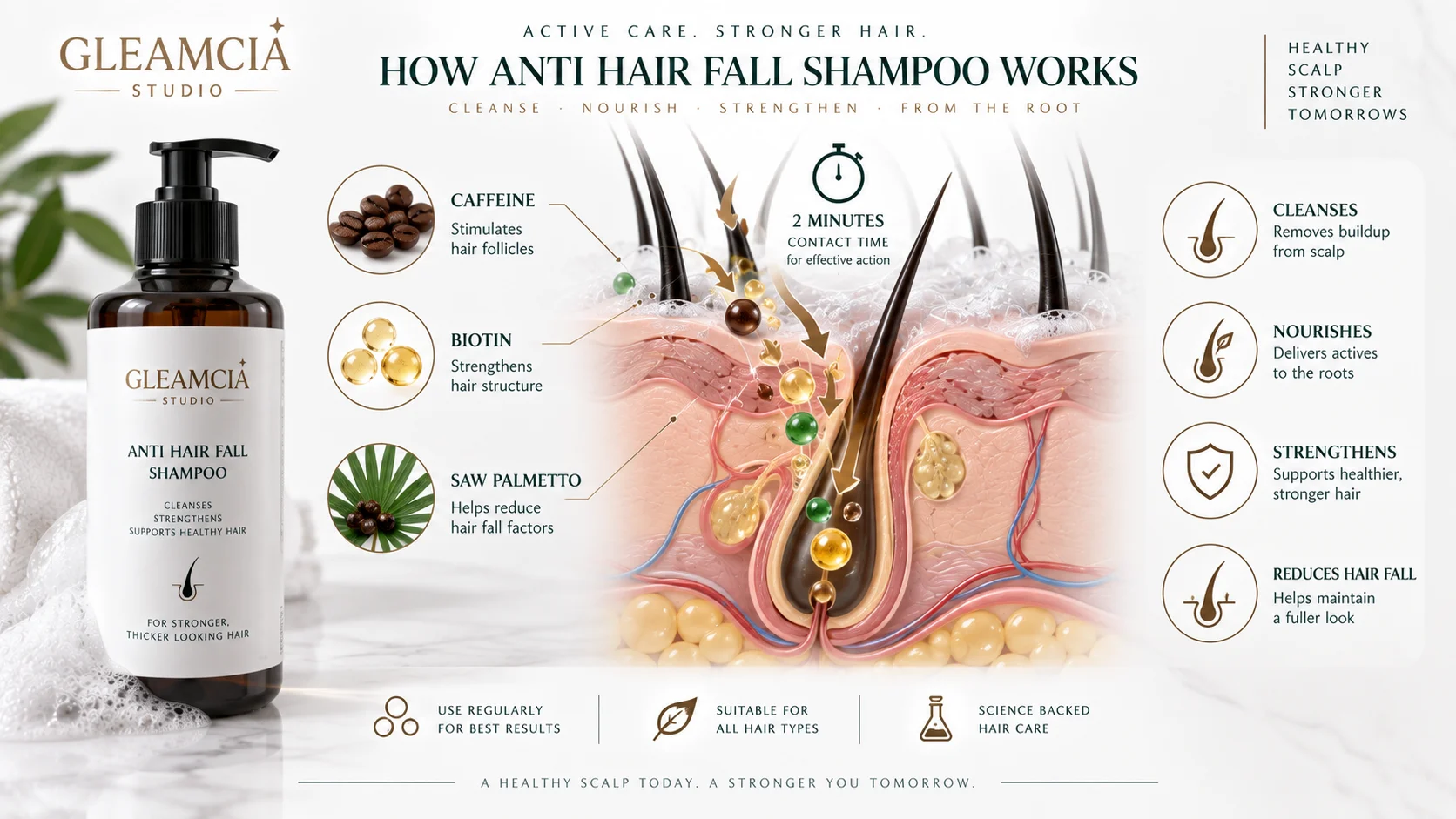
An anti-hair-fall shampoo is a scalp-active cleanser. It removes sebum, product buildup, and pollutants the way any shampoo does — and it does something beyond that. The active ingredients in the formula spend a few minutes in contact with the scalp during the wash, working to reduce inflammation, stimulate blood circulation to the follicle, block DHT accumulation at the scalp surface, or strengthen the hair shaft itself. The contact time is short, which is why the active concentration in the formula matters enormously. A trace amount of caffeine or biotin in a shampoo does very little in a two-minute contact window.
What anti-hair-fall shampoo is not is a hair regrowth treatment. It does not replace a topical growth spray, minoxidil, or a scalp serum applied and left on. Those leave-on products have hours of contact time per application. The shampoo is a foundation — it creates the scalp environment and strand strength that allows hair to survive the growth cycle rather than shedding prematurely. Think of it as part of a system rather than the whole solution.
How Long Does Anti Hair Fall Shampoo Take to Work? The Realistic Week-by-Week Timeline
This is the most common question and the most consistently mis-answered one. The timeline varies by the shampoo’s active ingredients, the cause of hair fall, and how consistently the product is used. But here is the general pattern most people experience:
Week 1 to 2: The scalp starts to feel different before the mirror shows anything. Less itching, less visible flaking, and a cleaner sensation that lasts longer between washes. This is the scalp inflammation reducing and the buildup clearing. Nothing dramatic yet — but the environment is improving.
Week 3 to 4: For many people, this is when shedding in the shower or while brushing starts to noticeably reduce. The hair that would have entered the shedding phase from a weakened, inflamed follicle stays in place a little longer. Hair may feel slightly stronger during combing.
Week 5 to 6: Visible reduction in daily hair fall becomes more consistent. Less hair on the floor, the pillow, and the brush. Existing strands may feel thicker to the touch as keratin-strengthening actives accumulate their effect across multiple wash cycles.
Month 2 to 3: For shampoos containing caffeine, saw palmetto, or other scalp-stimulating actives with meaningful contact time and scalp massage applied during washing, early signs of improved follicle activity may be visible — primarily as slightly denser-looking hair in areas that were previously thinner.
Month 3 to 6: Consistent use over this period, combined with appropriate leave-on treatments and a balanced diet, produces the most meaningful density and thickness results. At this stage the combination of reduced daily shedding plus a healthier scalp environment for the hairs already in the growth cycle shows up as noticeably fuller hair.
The key word in all of this is consistent. Using the shampoo three times one week and once the next resets much of what the previous week built. Hair biology does not accommodate inconsistent treatment.
Do Hair Loss Shampoos Actually Work?
Yes — when the formula is correctly matched to the cause of hair fall, the active ingredients are at meaningful concentrations, and the shampoo is used consistently with the right technique.
The question deserves a clear, honest answer rather than marketing language. Anti-hair-fall shampoos work by addressing the scalp environment. They reduce the inflammatory conditions that push follicles into premature shedding. They remove DHT-containing sebum from the scalp surface, which matters because DHT accumulation at follicle level contributes to miniaturisation in people with pattern hair sensitivity. They improve scalp circulation during the wash massage. And they strengthen the hair shaft to reduce breakage-related thinning that is often mistaken for genuine root-level shedding.
What anti-hair-fall shampoos do not reliably do: regrow hair from follicles that have been permanently dormant for years, reverse advanced androgenetic alopecia without additional prescription treatment, or compensate for severe nutritional deficiency that the body is prioritising over hair retention.
For the majority of people experiencing hair fall in Pakistan — which is typically driven by a combination of scalp inflammation, hard water mineral buildup, nutritional stress, and lifestyle factors — a well-formulated anti-hair-fall shampoo used consistently makes a genuine, measurable difference. The American Academy of Dermatology confirms that scalp health is directly linked to hair retention and density, and scalp-active cleansers address this baseline factor daily.
Is 100 Hairs Falling per Day Normal?
Yes. Losing between 50 and 100 hairs per day is the medically accepted normal range for daily shedding. The American Academy of Dermatology puts this figure at up to 100 strands per day for most adults.
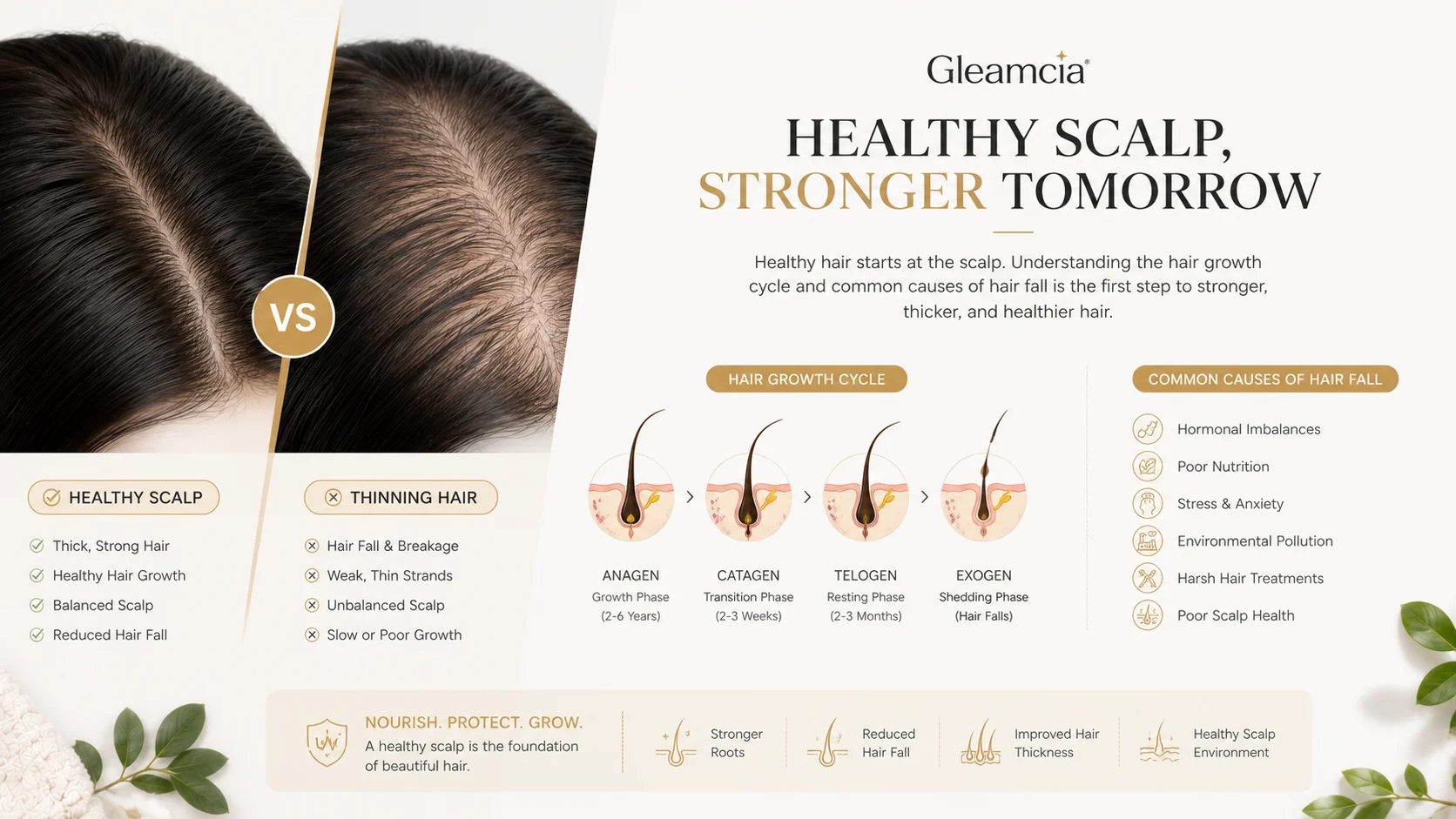
Hair grows in cycles. At any given point, roughly 5% to 10% of your hair follicles are in the telogen (resting and shedding) phase. When those hairs shed, they make room for the next growth cycle to begin. Seeing strands in the shower drain, on the pillow, and on the hairbrush does not on its own indicate a problem.
What does indicate a problem is a sudden, significant increase above that baseline — particularly if the increase is sustained for several weeks, if there is visible thinning in specific zones, if bald patches appear, or if the shedding was triggered by a clear event like extreme stress, illness, or rapid weight change. In those cases, the shedding exceeds what the normal growth cycle accounts for and warrants attention.
For context: the average scalp has between 80,000 and 120,000 hair follicles. Losing 100 hairs daily from that number is a small fraction. The perception of hair loss often feels more dramatic than the actual number because the hair is found in concentrated visible places — the drain, the brush, the floor — rather than distributed invisibly.
Can Hair Grow Back After Thinning?
This is the question that matters most to most people asking about anti-hair-fall shampoo — and the answer depends entirely on the type and duration of the thinning.
Telogen effluvium — the diffuse shedding triggered by physical or emotional stress, illness, nutritional deficiency, or postpartum hormonal change — is fully reversible in the vast majority of cases. Once the triggering cause is resolved and the body’s resources return to normal, hair regrowth follows within six to twelve months. Telogen effluvium is among the most common hair fall presentations in Pakistan and also the most treatable.
Early-stage androgenetic alopecia — the gradual miniaturisation of follicles driven by DHT sensitivity — can be significantly slowed and partially reversed with early intervention. Follicles that are miniaturised but still active respond to topical DHT blockers, scalp stimulants, and consistent treatment. Follicles that have been dormant for years are harder to revive with topical treatment alone.
Traction alopecia from tight hairstyles — braids, ponytails, extensions — can regrow fully if the mechanical tension is stopped before permanent follicle damage occurs.
Breakage-related thinning from hard water, heat styling, or chemical damage is not genuine follicle loss — the follicles are intact. Removing the damaging factor and improving strand strength restores the appearance of density as the hair grows back undamaged.
The earlier any type of hair thinning is addressed, the better the outcome. An anti-hair-fall shampoo is most effective as an early intervention — used when shedding first increases, not after years of progression.
Why Is Gen Z Losing Hair at a Younger Age?
Hair thinning starting in the teens and early 20s is genuinely more common now than it was for previous generations, and the reasons are identifiable rather than mysterious.
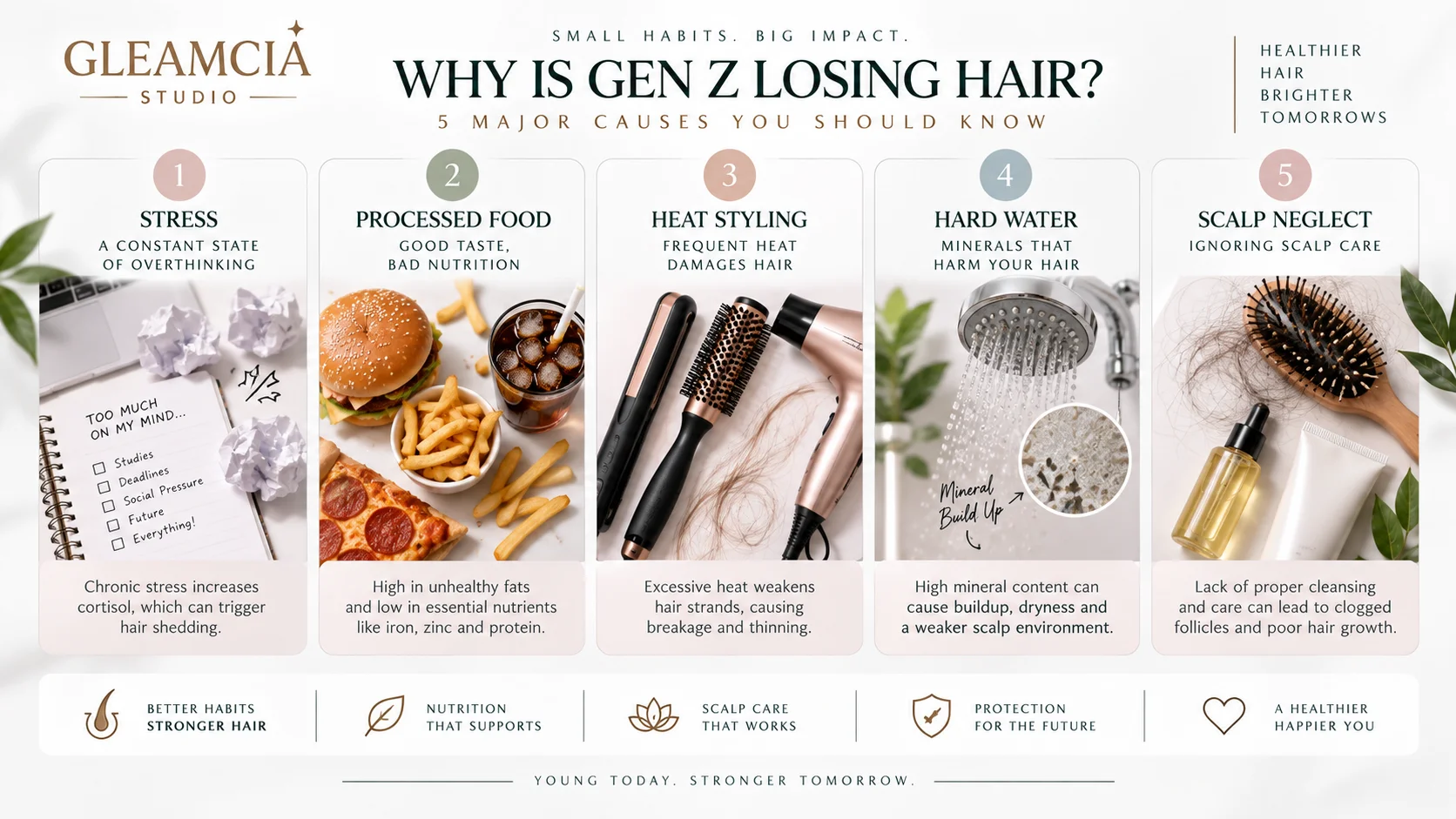
Chronic stress is the most significant driver. Academic pressure, financial anxiety, social comparison on social media, and the always-on digital environment have produced chronically elevated cortisol levels in younger populations. Cortisol directly suppresses hair growth by pushing follicles out of the growth phase prematurely. The stress-to-hair-fall connection is well-documented and the scale of psychological stress among Gen Z is unprecedented.
Diet has shifted toward ultra-processed foods with lower protein, zinc, iron, and biotin content — exactly the nutrients hair follicles depend on. A diet that does not supply adequate keratin-building materials produces hair that is structurally weaker and more likely to shed before completing the full growth cycle.
Scalp care is almost entirely absent from most young people’s routines despite the broader skincare awareness this generation has. Skincare has become a significant cultural conversation, but the scalp — which is skin and behaves like skin — is still treated as something that only needs shampoo with no further consideration.
Hard water exposure across Pakistan’s cities adds cumulative mineral and pH damage to hair and scalp with every wash, and heat styling from an early age weakens the hair shaft structurally over years before visible thinning shows up.
The positive angle is that all of these are addressable. Earlier intervention with the right routine, supplementation, and scalp care produces better outcomes than waiting until the thinning becomes more pronounced.
How Do I Make Thinning Hair Thick Again?
This requires a combination of approaches addressing different aspects of the problem simultaneously. There is no single product that does all of this.
Anti-hair-fall shampoo with active ingredients lays the foundation — reducing scalp inflammation, strengthening existing strands, and creating a healthier follicle environment. It is the daily maintenance step that everything else builds on.
Scalp massage during every wash improves blood circulation to the follicle, which delivers the nutrients follicles need to produce strong hair. Even two minutes of fingertip massage per wash session makes a measurable difference to follicle activity over months.
Biotin supplementation at 2,500 to 5,000 mcg daily supports keratin production from within, addressing strand thickness at a structural level that topical products alone cannot fully reach. Browse the full Gleamcia hair supplement range for biotin options at effective concentrations.
A scalp-targeted leave-on spray or serum with caffeine, saw palmetto, or rosemary extract addresses the follicle environment more directly than a rinse-off shampoo can. Leave-on products have hours of contact time and produce more targeted follicle stimulation.
Diet correction — adequate protein (1.2 to 1.6g per kg of body weight daily), zinc from nuts and seeds, iron from red meat or supplements if deficient, and consistent hydration. Hair is a protein structure and cannot grow with density if the raw materials are not available in the diet.
Heat styling reduction and protective styles during recovery allow the existing hair shaft to survive longer without mechanical damage.
Chelating shampoo once a week if you are in a hard water area like Karachi or Lahore — mineral buildup on the scalp blocks follicle function and undermines every other product you apply.
None of these produce instant thickness. Combined and used consistently over three to six months, they collectively produce the most meaningful density improvement available without prescription intervention.
Active Ingredients That Determine How Fast Anti-Hair-Fall Shampoo Works
The active ingredients in the formula set the timeline ceiling. A shampoo without meaningful actives at meaningful concentrations cannot produce the results a clinically formulated one can, regardless of how consistently it is used.
- Caffeine — penetrates the follicle during scalp contact, stimulates cell metabolism, and extends the anagen (active growth) phase. The most studied scalp-active ingredient for anti-hair-fall shampoos.
- Biotin (topical) — supports keratin integrity in the strand during washing. Less impactful than oral biotin but a useful complement in a comprehensive formula.
- Ketoconazole — antifungal active that also has DHT-blocking properties at the scalp surface. Particularly effective when hair fall is linked to seborrheic dermatitis or dandruff-driven scalp inflammation.
- Saw Palmetto Extract — blocks 5-alpha reductase at the scalp surface, reducing the conversion of testosterone to DHT in the follicle environment.
- Niacinamide — improves scalp microcirculation and reduces the follicular inflammation that accelerates shedding.
- Zinc Pyrithione — controls dandruff and seborrheic dermatitis that often co-occur with hair fall, reducing the scalp inflammation that is a major driver of premature shedding.
- Keratin and Hydrolysed Wheat Protein — fill gaps in the hair shaft cuticle during washing, reducing breakage-related shedding that gets counted as hair fall.
A shampoo with two or more of these actives at meaningful concentrations will always outperform one with a single active at a trace amount.
Anti-Hair-Fall Shampoo vs Regular Shampoo: What Changes and When
| Feature | Anti-Hair-Fall Shampoo | Regular Shampoo |
| Primary function | Cleanse + reduce scalp inflammation + strengthen follicle | Cleanse only |
| Active ingredients | Caffeine, biotin, saw palmetto, niacinamide, keratin | Fragrance, basic surfactants |
| Effect on daily shedding | Reduces over 3 to 6 weeks with consistent use | None |
| Effect on scalp inflammation | Reduces with anti-inflammatory actives | None |
| Effect on DHT at scalp | Some reduction with saw palmetto, ketoconazole | None |
| Scalp circulation benefit | Improved with caffeine and scalp massage during use | Only from massage |
| Hair shaft strengthening | Yes — keratin and protein actives | None |
| Results timeline | 4 to 8 weeks for shedding reduction, 3+ months for density | No targeted result |
| Suitable for daily use | Yes — with sulphate-free formula | Yes |
| Better for hair fall | Significantly | No targeted benefit |
Switching from a regular shampoo to a well-formulated anti-hair-fall shampoo is not a marginal change. It is replacing a maintenance step with a treatment step that performs maintenance and active scalp care simultaneously.
Signs Your Anti-Hair-Fall Shampoo Is Working
Results build gradually enough that many people miss them while they are happening. Look for these specific indicators at each stage of use.
Less hair in the shower drain within weeks three to four. This is the earliest and most reliable early signal. Count strands consistently over a one-week period and compare to the pre-treatment baseline.
Less shedding while combing or brushing. Fewer strands on the brush after washing and styling means the formula is reducing premature shedding and strengthening the root anchor.
Scalp feels less itchy and irritated between washes. Reduced scalp inflammation is a direct sign that the active ingredients are working on the environment where hair growth happens.
Hair feels thicker in the hand. Protein and keratin actives in the formula fill gaps in the cuticle across each wash cycle. Over weeks, the individual strands start to feel more substantial even before density visibly improves.
Progress photos at one month show density difference. Monthly photos in the same light from the same angle make gradual changes visible that daily comparison consistently misses.
Signs Your Anti-Hair-Fall Shampoo Is Not Working and Needs Reassessing
No change in shedding after eight to ten weeks of daily consistent use. The shampoo’s active concentration is likely insufficient for your level of hair fall, or the cause of your hair fall is systemic (nutritional deficiency, hormonal) rather than scalp-level.
Scalp has become dryer or more irritated since starting. The formula contains sulphates or harsh surfactants that are stripping the barrier more than the actives are healing it. Switch to a sulphate-free anti-hair-fall formula.
Breakage has increased. A small number of anti-hair-fall shampoos contain protein actives that create temporary protein overload in low-porosity hair — the hair becomes brittle rather than stronger. A moisture-protein balance check is needed.
Hair fall is clearly patterned or hormonal. Shampoo alone does not address androgenetic alopecia or hormonal hair loss effectively. A dermatologist consultation alongside the shampoo is needed if the pattern suggests those causes.
Common Mistakes That Delay Anti-Hair-Fall Shampoo Results
Not leaving the shampoo on long enough. A quick lather and immediate rinse gives the active ingredients almost no contact time with the scalp. Apply the shampoo, massage it into the scalp for two to three minutes, and leave it in contact for at least another two to three minutes before rinsing. That contact time is when the actives work.
Skipping scalp massage. Applying and rinsing without massaging delivers a fraction of the benefit. The massage distributes the formula, improves circulation, and mechanically stimulates follicles in a way that simply rinsing a shampoo across the scalp does not.
Inconsistent use. Three washes one week and one the next produces no consistent scalp treatment effect. Three to five washes per week, every week, is what builds the cumulative impact the formula is designed to produce.
Using a sulphate-heavy shampoo and expecting anti-hair-fall benefits. Some anti-hair-fall labelled shampoos still contain high-concentration SLS that strips the barrier at the same time as the actives are trying to improve it. The result is a net neutral at best. Choose sulphate-free anti-hair-fall formulas.
Not addressing the cause alongside the shampoo. Shampoo addresses the scalp environment. If hair fall is driven by nutritional deficiency, chronic stress, or hormonal factors, the shampoo improves the baseline but cannot resolve those upstream causes alone.
Aftercare and Habits That Accelerate Anti-Hair-Fall Shampoo Results
Do:
- Massage the shampoo into the scalp with fingertips for two to three minutes every wash — not just the hair lengths
- Follow with a conditioner applied from mid-length to ends only, avoiding the scalp, to maintain strand moisture without weighing down the root
- Pair with a leave-on scalp spray or serum on non-wash days to extend active contact time beyond the shampoo wash window
- Take progress photos monthly to track changes that daily observation misses
Do not:
- Rinse with very hot water — heat disrupts the scalp barrier and washes out the actives before they have fully absorbed
- Towel-dry aggressively — wet hair is at its most fragile; press dry gently rather than rubbing
- Apply heavy styling products directly to the scalp — they create a film that blocks the active ingredients from reaching follicles at the next wash
- Stop using the shampoo as soon as shedding reduces — the scalp environment needs ongoing maintenance
What Does Anti-Hair-Fall Shampoo Cost in Pakistan?
Formula complexity is the price driver. A shampoo with meaningful concentrations of caffeine, saw palmetto extract, biotin, and a sulphate-free cleansing base costs more to produce than a basic shampoo with the same actives at trace amounts. The concentration matters for results, and the production cost of meaningful concentration is higher.
Bottle size affects the real cost of a treatment course. A 200ml bottle used three to five times per week — with a scalp massage contact time of three minutes — depletes in roughly four to six weeks. A treatment course of three to six months requires multiple bottles. Larger formats and bundle pricing reduce the per-wash cost significantly.
Bundle purchasing — anti-hair-fall shampoo paired with a matching conditioner and a biotin supplement from the same range — covers the full hair fall routine and typically offers better per-product value than individual purchases. The combined approach also produces faster, more complete results than the shampoo alone.
Gleamcia ships from Karachi to every city in Pakistan. Visit gleamcia.com/shop for current pricing, size options, and active bundle promotions on the hair care range.
Why Choose Gleamcia
Gleamcia formulates every anti-hair-fall shampoo around what actually matters in the wash cycle — active ingredients at concentrations the scalp can respond to in two to three minutes of contact time.
- Caffeine, biotin, saw palmetto, and niacinamide included at formulation levels that produce results, not amounts added just for label mentions
- Sulphate-free bases that allow consistent daily use without stripping the scalp barrier the actives are working to protect
- Formulas developed for South Asian hair biology and Pakistan’s specific hair fall drivers — hard water, heat, stress, and DHT sensitivity
- Transparent ingredient listings so you know exactly what concentration of active is in every wash
- Nationwide delivery from Karachi across Pakistan, with fast dispatch and packaging designed to protect formula integrity
Frequently Asked Questions
1. Do hair loss shampoos actually work? Yes — when the formula contains proven actives like caffeine, saw palmetto, ketoconazole, or biotin at meaningful concentrations, and is used consistently with scalp massage and adequate contact time. Anti-hair-fall shampoos work best for shedding driven by scalp inflammation, DHT accumulation, dandruff, and strand weakness. They do not replace prescription treatment for advanced pattern hair loss or address nutritional deficiencies. For the majority of people experiencing common hair fall in Pakistan, the right formula produces real, measurable results within four to eight weeks of consistent use.
2. Is losing 100 hairs a day normal? Yes. The American Academy of Dermatology considers 50 to 100 hairs per day within the normal shedding range for most adults. Each hair follicle cycles through active growth, transition, and resting phases, and hairs in the resting phase shed naturally as the new cycle begins. What warrants attention is a sudden, sustained increase significantly above 100 daily, visible thinning in specific zones, or patchy hair loss — these signal that shedding has moved beyond normal cycle activity.
3. Can hair grow back after thinning? It depends on the type and duration of thinning. Telogen effluvium triggered by stress, illness, or nutritional deficiency is fully reversible once the cause is addressed — hair regrows within six to twelve months. Early-stage androgenetic alopecia can be significantly slowed and partially improved with early intervention. Breakage-related thinning from hard water, heat, or chemical damage is not root-level follicle loss and reverses when the damaging factor is removed and strand health is restored. Permanent follicle dormancy from years of untreated advanced pattern loss is harder to reverse, which is why early intervention consistently produces better outcomes.
4. Why is Gen Z losing hair at a younger age? A convergence of factors is compressing the hair loss timeline for younger people: chronic psychological stress from academic pressure and social media, diets lower in the protein and micronutrients hair requires, absence of any scalp care routine despite broader skincare awareness, universal hard water exposure in Pakistani cities, early and frequent heat styling, and in some individuals, earlier onset of DHT sensitivity from genetic and environmental interaction. All of these are addressable with the right combination of scalp care, supplementation, diet, and stress management — the earlier the intervention, the better the outcome.
5. How do I make thinning hair thick again? The most effective approach combines an anti-hair-fall shampoo used consistently with scalp massage, a leave-on scalp spray with follicle-stimulating actives, biotin supplementation at 2,500 to 5,000 mcg daily, adequate dietary protein, reduced heat styling, and — in hard water cities like Karachi — a chelating shampoo used weekly to clear mineral buildup. No single product does all of this. The combination of reduced daily shedding, improved scalp environment, and internal nutritional support produces the most meaningful density improvement over a three to six month consistent routine.
6. How long should I give an anti-hair-fall shampoo before deciding it is not working? Give it a minimum of eight to ten weeks of consistent daily or near-daily use before drawing conclusions. Hair biology is slow, and improvements in scalp health and reduced shedding build gradually over multiple wash cycles. Taking monthly progress photos is the most reliable way to see changes that day-to-day comparison misses. If there is no change in shedding level, no improvement in scalp comfort, and no difference in hair texture after ten weeks, the formula’s active concentration may be insufficient or the cause of hair fall requires additional treatment alongside the shampoo.
7. Should I use conditioner after an anti-hair-fall shampoo? Yes — applied from mid-length to ends only, avoiding the scalp. Conditioner maintains the moisture and smoothness of the hair shaft, which reduces the mechanical breakage that gets counted as hair fall. Applying conditioner directly to the scalp adds weight to the root zone and can coat the follicle opening, which partially counteracts what the anti-hair-fall shampoo is working to keep clear. Mid-length to ends only is the consistent guidance for pairing conditioner with a scalp-active anti-hair-fall shampoo.
The Timeline Is Longer Than Most People Expect — But the Results Are Real
Consistent use, correct technique, and realistic expectations are the three things that separate people who see genuine anti-hair-fall shampoo results from those who do not. The shampoo works. The biology just takes time to respond. Order from the Gleamcia Hair Care range via our online store — nationwide delivery across Pakistan, order from Karachi and get it delivered anywhere in the country.
Order on WhatsApp at 0336 1223363 for personalised guidance on the right anti-hair-fall shampoo and complete routine for your hair type and specific fall pattern.