Introduction
If you have been building a skincare routine and doing your research, chances are you have come across both Vitamin C and Niacinamide. Two of the most searched-for ingredients in skincare right now — and for good reason. But then comes the question that stops a lot of people in their tracks: can you use Vitamin C and Niacinamide together, or does layering them cause more harm than good?
The internet has two camps on this. One side says never mix them. The other says it is completely fine. The truth, backed by current formulation science, sits much closer to the second camp — with a few important details about application order that make all the difference.
This blog clears up the confusion, gives you the correct serum order, and explains how to actually get the best out of both ingredients for brighter, more even-toned skin. Explore the Gleamcia Skin Care range for serums and treatments built around these proven actives.
What Are Vitamin C and Niacinamide?
Before getting into whether you can use them together, it helps to understand what each one actually does.
Vitamin C (L-Ascorbic Acid) is a potent antioxidant and one of the most researched brightening ingredients in skincare. It works by inhibiting an enzyme called tyrosinase, which controls melanin production in the skin. Less melanin activity means less hyperpigmentation, fewer dark spots, and a more even skin tone over time. It also boosts collagen synthesis, which keeps skin firm and reduces the appearance of fine lines. Vitamin C serums are typically formulated at a low pH — usually between 2.5 and 3.5 — because L-Ascorbic Acid needs an acidic environment to stay stable and penetrate properly.
Niacinamide (Vitamin B3) is a water-soluble vitamin that works on multiple skin concerns simultaneously. It reduces inflammation, strengthens the skin barrier, minimises pore appearance, controls sebum production, and fades hyperpigmentation through a completely different biological pathway than Vitamin C. Niacinamide is also pH-flexible, making it one of the most versatile and well-tolerated actives across all skin types.
Both are genuinely useful. The question is whether they work together, work against each other, or simply need to be managed carefully.
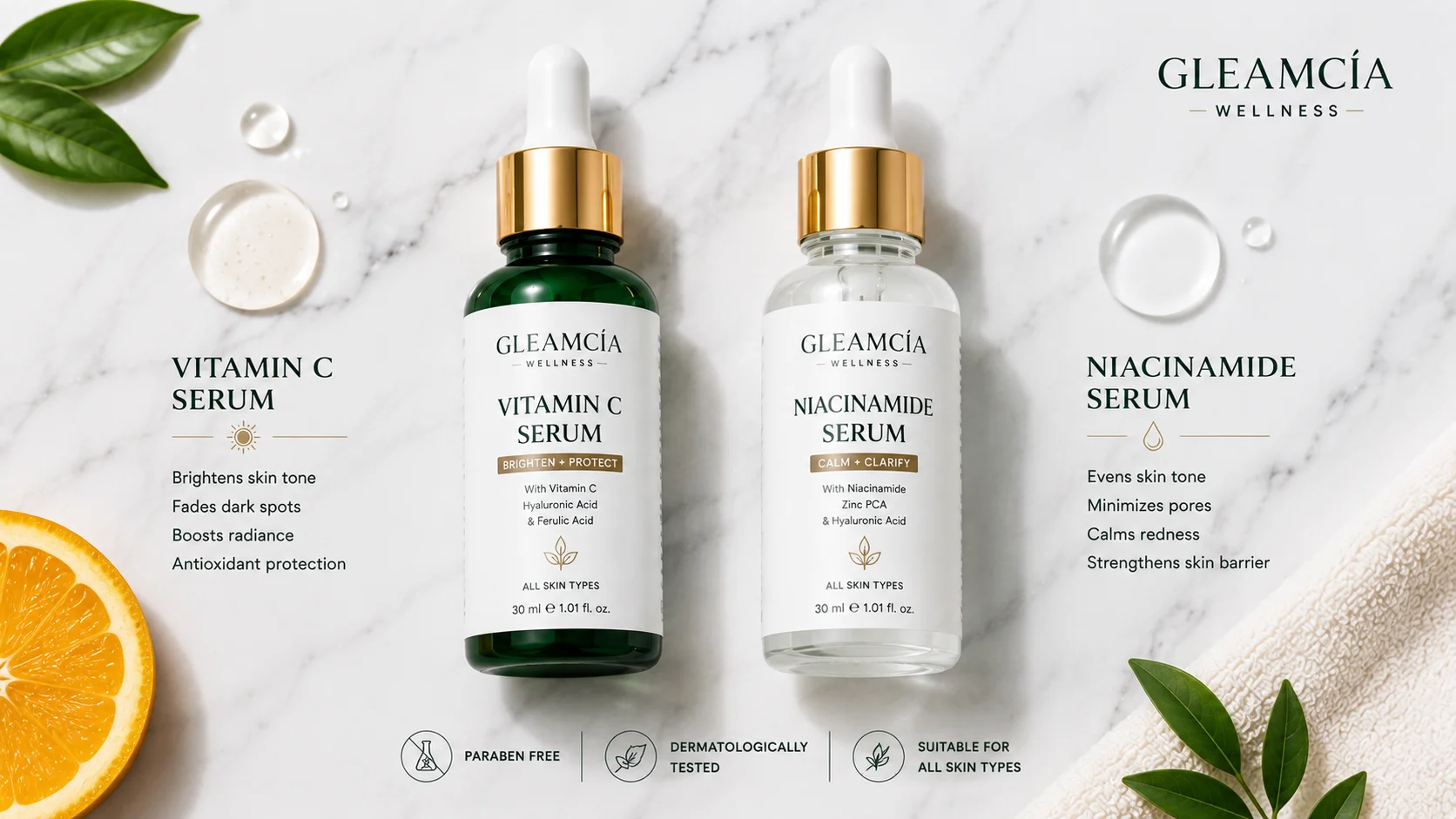
Can You Use Vitamin C and Niacinamide Together? The Real Answer
Yes. You can use Vitamin C and Niacinamide together. The concern that kept them apart for years was based on an outdated theory.
The old argument went like this: when Vitamin C (ascorbic acid) and Niacinamide combine, they react to form a compound called niacin, which causes skin flushing and redness. This was documented in laboratory studies — but in concentrations far higher than anything found in a skincare routine, and under conditions that do not reflect how products sit on skin.
At the concentrations used in actual skincare formulations, the conversion of niacin is so minimal it does not produce a meaningful reaction on the skin surface. Formulation chemists and dermatologists have reviewed this extensively. The American Academy of Dermatology and modern cosmetic science both confirm that using these two ingredients in a real-world routine poses no significant risk.
The more relevant issue is not whether they react with each other. It is about pH compatibility and absorption order, which we get into next.
Why Some People Say You Can’t Mix Vitamin C and Niacinamide
The confusion is understandable, even if the conclusion was wrong.
The original concern came from in-vitro studies done in lab settings with pure compounds, not finished skincare formulations. Those studies were not replicated in real human skin trials at typical cosmetic concentrations. The theory spread before the correction did, which is very common in the skincare world where information moves faster than the science behind it.
There is also a secondary reason some people report irritation when using both. Vitamin C serums sit at a very low pH. If you apply Niacinamide directly on top of a low-pH Vitamin C formula without letting it absorb first, you are essentially destabilising both products before they have a chance to work. The irritation people sometimes feel is not from a dangerous chemical reaction. It is from pH disruption on the skin surface.
The fix is straightforward: correct timing and correct order.
Which Serum First: Vitamin C or Niacinamide?
Vitamin C goes first. Always.
Here is the logic. Vitamin C in L-Ascorbic Acid form needs a low pH environment to penetrate the skin effectively. If you apply a higher-pH product like Niacinamide on top before the Vitamin C has absorbed, it raises the pH of the skin surface, reducing how much Vitamin C actually gets in. You are essentially wasting the active.
The correct approach within a single routine:
- Cleanse your face with a gentle, balanced face wash. The Gleamcia Brightening Face Wash is a good starting point for a brightening-focused routine.
- Apply your Vitamin C serum to clean, dry skin. Let it absorb for 5 to 10 minutes. Do not rush this.
- Apply your Niacinamide serum over the top. At this stage the Vitamin C has absorbed, pH has balanced, and the Niacinamide can do its job without interference.
- Follow with moisturiser and SPF in the morning, or moisturiser alone at night.
That waiting time between serums is the step most people skip. It is also the step that makes the biggest difference.
The Alternative Approach: Different Times of Day
If layering two serums feels complicated or your skin is on the sensitive side, splitting them across your morning and evening routine is equally effective and arguably simpler.
Morning: Vitamin C serum after cleansing, followed by moisturiser and SPF. Vitamin C’s antioxidant properties actively protect skin from UV-related free radical damage throughout the day, making it a natural fit for your morning routine.
Evening: Niacinamide serum after cleansing. Niacinamide supports skin barrier repair and regulates sebum overnight, working well while the skin goes through its natural overnight renewal cycle.
This split approach completely sidesteps any concern about pH interaction and gives each ingredient its own uncontested window to absorb and work. For beginners building a skincare routine, starting with this method and adding layers gradually is often the smarter approach.
What Is the Correct Order of Serums in a Full Skincare Routine?
Beyond just Vitamin C and Niacinamide, the general rule for layering multiple serums follows one principle: thinnest texture to thickest, and lowest pH to highest.
A complete morning routine with both would look like this:
- Cleanser — Removes overnight oil and surface buildup
- Toner (if used) — Balances and preps the skin
- Vitamin C Serum — Thinner texture, low pH, goes on first
- Wait 5 to 10 minutes
- Niacinamide Serum — Water-based, higher pH, goes second
- Eye Cream (if used)
- Moisturiser — Seals in the actives
- SPF — Non-negotiable in the morning, especially when using Vitamin C
At night, the morning routine replaces Vitamin C with any treatment serums or retinol, and skips SPF. Niacinamide works well in both AM and PM routines.
Benefits of Using Vitamin C and Niacinamide Together for Skin
When used in the right order, these two ingredients actually complement each other better than either works alone.
- Accelerated brightening as Vitamin C reduces melanin production and Niacinamide prevents its transfer to the surface skin cells — two different pathways targeting the same outcome
- Even skin tone with consistent use over 6 to 8 weeks, addressing both the cause and expression of hyperpigmentation
- Strengthened skin barrier through Niacinamide’s ceramide-boosting action, which helps the skin tolerate the lower pH of Vitamin C over time
- Reduced inflammation from Niacinamide that balances any mild sensitivity Vitamin C actives introduce on reactive skin
- Antioxidant protection from Vitamin C guarding against UV and pollution-related free radical damage daily
- Pore-minimising effect from Niacinamide, particularly noticeable on oily and combination skin types
- Collagen support from Vitamin C contributing to firmer, more youthful-looking skin with continued use
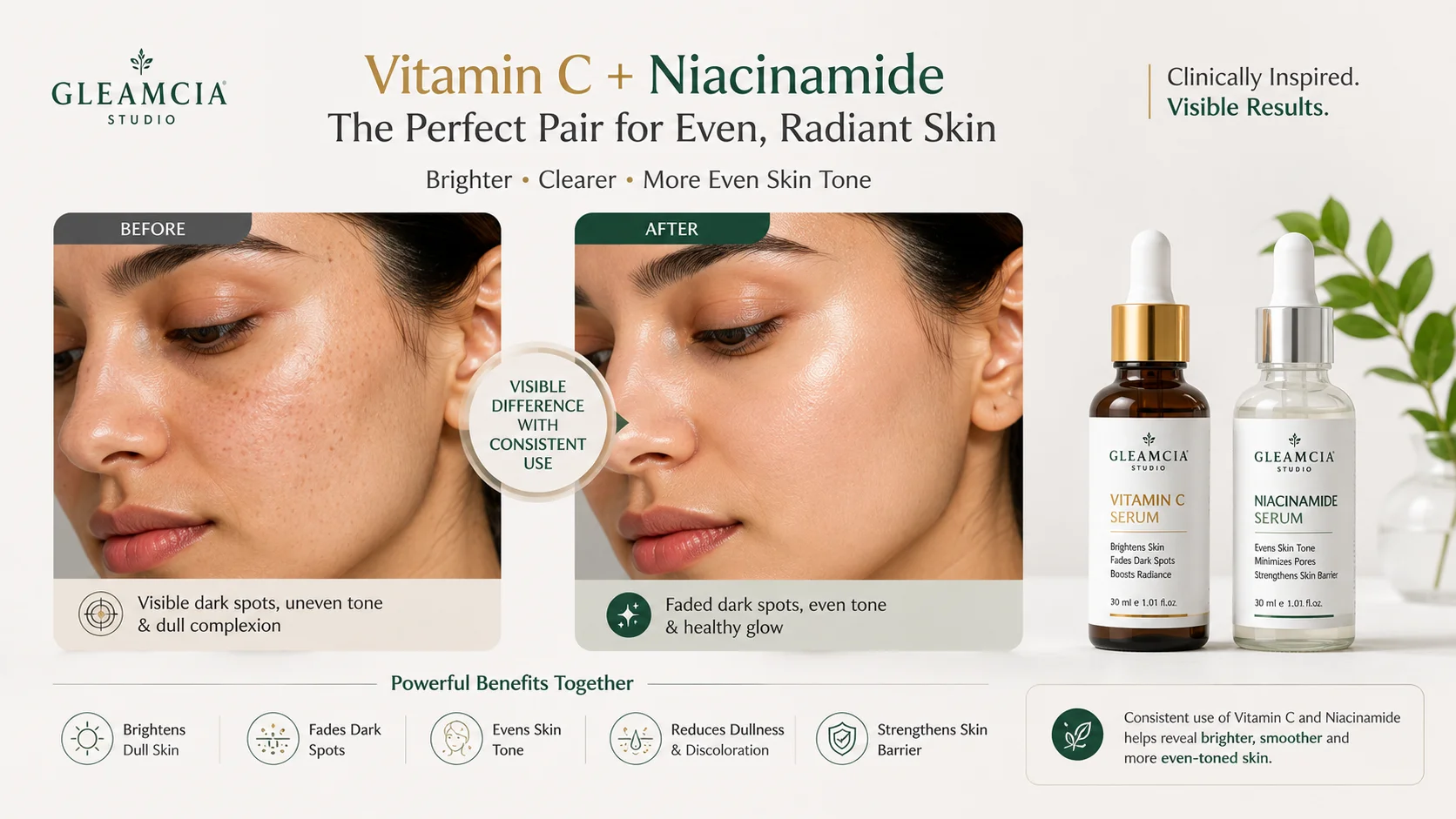
Vitamin C Serum vs Niacinamide Serum: What Each One Does Best
Not sure which one to prioritise for your skin concern? Here is a clear breakdown of where each ingredient performs strongest:
| Concern | Vitamin C Serum | Niacinamide Serum |
| Brightening dark spots | Excellent | Good |
| Controlling oily skin | No direct effect | Excellent |
| Minimising pores | Minimal | Excellent |
| Reducing redness or inflammation | Moderate | Excellent |
| Collagen production | Excellent | Moderate |
| Antioxidant protection | Excellent | Moderate |
| Strengthening skin barrier | Minimal | Excellent |
| Fading post-acne marks | Good | Very good |
| Sensitive skin compatibility | Moderate (can be irritating) | Excellent |
| Morning use with SPF | Ideal | Suitable |
| Evening use | Suitable | Ideal |
The conclusion here is clear. For most people dealing with multiple skin concerns — uneven tone, pigmentation, oily skin, and barrier weakness — using both is smarter than choosing one. They cover different ground and together they cover almost everything.
Who Should Use Vitamin C and Niacinamide Together?
This combination works well for a wide range of skin types and concerns, but it is especially worth building into a routine if you:
- Have hyperpigmentation, sun damage, or stubborn dark spots
- Deal with an uneven skin tone or dull complexion
- Experience oily or congested skin alongside pigmentation concerns
- Have post-acne marks that linger long after breakouts clear
- Want to build a brightening routine without using harsh exfoliants
- Are in your late 20s or 30s and starting to focus on collagen maintenance
- Have a sensitive skin type that reacts to single-active formulas used alone
The one group that needs extra caution is people with very reactive or rosacea-prone skin. Vitamin C at higher concentrations can aggravate existing redness. Starting with a lower concentration (10% or under) and applying Niacinamide immediately after to calm the skin is the right approach for sensitive types.
What Not to Mix with Niacinamide
Niacinamide is one of the most compatible actives in skincare, but there are a few combinations that do not perform well together.
Niacinamide and strong AHAs or BHAs at the same time. Acids like glycolic acid, lactic acid, or salicylic acid work at a very low pH. When mixed directly with Niacinamide in a single step, the pH difference reduces both their effectiveness. The better approach is to use your acid treatment first, wait for it to absorb, then apply Niacinamide — or use them at different times of day.
Niacinamide and high-concentration Vitamin C serums applied simultaneously without waiting. As discussed, this is a timing issue rather than a true chemical conflict. Wait for Vitamin C to absorb fully before applying Niacinamide.
Niacinamide and Retinol at the same time in high concentrations. Both are highly active and layering them in one step without a buffer can overwhelm sensitive skin. Using Retinol first and following with Niacinamide as a calming layer is a better strategy.
For everything else — hyaluronic acid, peptides, ceramides, SPF, moisturiser — Niacinamide layers without issue and actually enhances the performance of most of them.
How Soon Do You See Results from Vitamin C and Niacinamide Together?
Results build gradually and the timeline varies based on your skin concern and starting point.
- Weeks 1 to 2: Skin typically starts to feel more balanced, less oily at midday, and calmer with reduced redness
- Weeks 3 to 4: A mild brightening effect becomes visible, skin tone starts to look more even, and pore appearance may reduce
- Weeks 6 to 8: Dark spots and hyperpigmentation show noticeable fading, complexion looks clearer and more uniform
- 3 months: With consistent daily use, significant improvement in overall skin radiance, tone evenness, and skin texture
Individual results vary based on skin type, concern severity, sun exposure habits, and how consistently the routine is followed. Wearing SPF every morning when using Vitamin C is essential. Sun exposure without SPF reverses brightening progress faster than any serum can address it.
Aftercare Tips for Using Vitamin C and Niacinamide Together
Do:
- Always apply SPF in the morning after Vitamin C. This is not optional.
- Store your Vitamin C serum away from direct sunlight to prevent oxidation — it degrades faster than most actives
- Be consistent for at least 8 weeks before judging results
- Use a gentle, balanced cleanser that does not strip your skin before applying either serum. The Gleamcia Brightening Face Wash prepares the skin without disrupting its pH before active application
Do not:
- Apply both serums one immediately after the other without a waiting period
- Use a high-percentage Vitamin C formula if you are new to actives — start at 10% and build up
- Layer with a strong acid on the same step without buffering
- Expect results in days. These ingredients work on a biological cycle that takes weeks
What Does Vitamin C and Niacinamide Serum Cost in Pakistan?
Formulation quality drives the price gap significantly in this category. A Vitamin C serum with stabilised L-Ascorbic Acid at an effective concentration (10% to 20%) requires a precise pH-controlled base and packaging that prevents oxidation. Cheap Vitamin C serums often use less stable Vitamin C derivatives that do not perform the same way on skin. The price difference reflects what is actually inside.
Niacinamide serums are generally more affordable to produce but vary widely in concentration and formula quality. A product containing 5% to 10% niacinamide with added actives like zinc or hyaluronic acid commands a higher price because the formulation is more targeted.
Bundle pricing for a Vitamin C and Niacinamide serum together from the same range is typically more economical than buying separately and ensures compatibility between the two formulas. Single product sizes for trial purposes are available at a lower entry point.
Gleamcia offers nationwide delivery across Pakistan, from Karachi to every major city. Visit gleamcia.com/shop for current pricing on the skincare range.
Why Choose Gleamcia
Gleamcia builds every serum around actives that have a real evidence base, not just trendy labels.
- Vitamin C and Niacinamide formulations developed at effective, clinically relevant concentrations
- Compatible formulas designed to work together without compromising either ingredient’s performance
- Targeted at real skin concerns common in Pakistan’s climate: sun damage, hyperpigmentation, oily skin, uneven tone
- Quality-checked before every dispatch, delivered nationwide across Pakistan
- Transparent ingredient listings so you always know what percentage of active you are getting
When you order from Gleamcia, you are investing in formulations built to actually work, not just look impressive on a shelf.
Frequently Asked Questions
1. Should I use niacinamide before or after vitamin C? Vitamin C goes before Niacinamide. Vitamin C serums need to absorb into clean, dry skin at their native low pH to work effectively. Applying Niacinamide first raises the surface pH and reduces how much Vitamin C actually penetrates. Apply Vitamin C, wait 5 to 10 minutes, then follow with Niacinamide for the best result from both.
2. Which serum should be applied first, Vitamin C or Niacinamide? Vitamin C serum goes first. As a rule, serums go on in order from thinnest texture to thickest, and from lowest pH to highest. Vitamin C serums are typically thinner and more acidic, which makes them the first layer on clean skin. Niacinamide is applied after it has fully absorbed.
3. What is the correct order of serums in a skincare routine? The general rule is cleanser, toner (if used), then serums from thinnest to thickest and from most acidic to most neutral. For a Vitamin C and Niacinamide routine: cleanse, Vitamin C serum, wait 5 to 10 minutes, Niacinamide serum, moisturiser, SPF in the morning. In the evening, skip SPF and Vitamin C can be replaced with a treatment serum or retinol if your routine includes one.
4. What not to mix with niacinamide? Niacinamide should not be applied in the same step as high-concentration AHAs or BHAs (glycolic acid, salicylic acid) without allowing for absorption time between them, as the pH difference reduces both. It also does not pair well with very high-concentration Retinol applied simultaneously on sensitive skin. Everything else — hyaluronic acid, peptides, SPF, ceramides, moisturiser, and Vitamin C with correct timing — layers well with Niacinamide.
5. Why can’t you use Vitamin C and Niacinamide? The idea that you cannot use them together is based on outdated in-vitro research suggesting they form niacin and cause flushing. In real skincare concentrations and on actual skin, this reaction is minimal and not clinically significant. Modern formulation science confirms these two can be used together safely. The only thing to manage is the application order and a short waiting time between the two.
6. Can I use Vitamin C and Niacinamide in the same morning routine? Yes. Apply your Vitamin C serum first to freshly cleansed skin. Allow 5 to 10 minutes for it to absorb. Then apply your Niacinamide serum, follow with moisturiser, and finish with SPF. This sequence gets the full benefit from both actives without any pH interference.
7. Can Vitamin C and Niacinamide be used for dark spots? Absolutely. This is actually one of the strongest combinations for fading dark spots and hyperpigmentation. Vitamin C reduces melanin production by inhibiting tyrosinase. Niacinamide prevents the transfer of melanin to surface skin cells. They target pigmentation from two different biological pathways, which is why using both consistently produces faster and more visible results on dark spots than using either one alone.
8. Is it safe to use Vitamin C and Niacinamide every day? For most skin types, yes. Niacinamide is gentle enough for twice-daily use. Vitamin C can be used once daily, typically in the morning. If your skin is sensitive or new to Vitamin C, start with every other day and build up to daily as your skin adjusts.
Ready to Build a Brighter Skin Routine?
You do not have to choose between Vitamin C and Niacinamide. Used in the right order, they do more together than either ingredient manages alone. Order from the Gleamcia Skin Care range via our online store, with nationwide delivery across Pakistan — from Karachi to Islamabad, Lahore to Quetta.
You can also place your order on WhatsApp at 0336 1223363 and our team will help you build the right serum routine for your skin type and concern.