Introduction
Large pores are one of the most searched skincare concerns in the world, and also one of the most misunderstood. People try primers, peel-off masks, pore strips, cold water rinses — and when none of it works the way they hoped, the question shifts to something bigger: what actually works for large pores?
The honest answer is that pores cannot be permanently erased. They are a structural part of your skin. But they absolutely can be made to look significantly smaller — and for many people, that difference is dramatic enough to change how their skin looks in daylight, under makeup, and even in close-up photos. Knowing how to minimize large pores correctly, with the right ingredients and the right routine, is what makes that possible.
This guide covers the causes, the clinically supported solutions, the Korean skincare approach that has the whole world paying attention, and a step-by-step routine you can start tonight. Browse the Gleamcia Skin Care range for pore-targeting formulas built around ingredients that actually do something.
What Causes Large Pores? Understanding the Problem First
Pores do not just randomly become visible. There are specific reasons they enlarge and knowing them makes it much easier to choose the right solution.
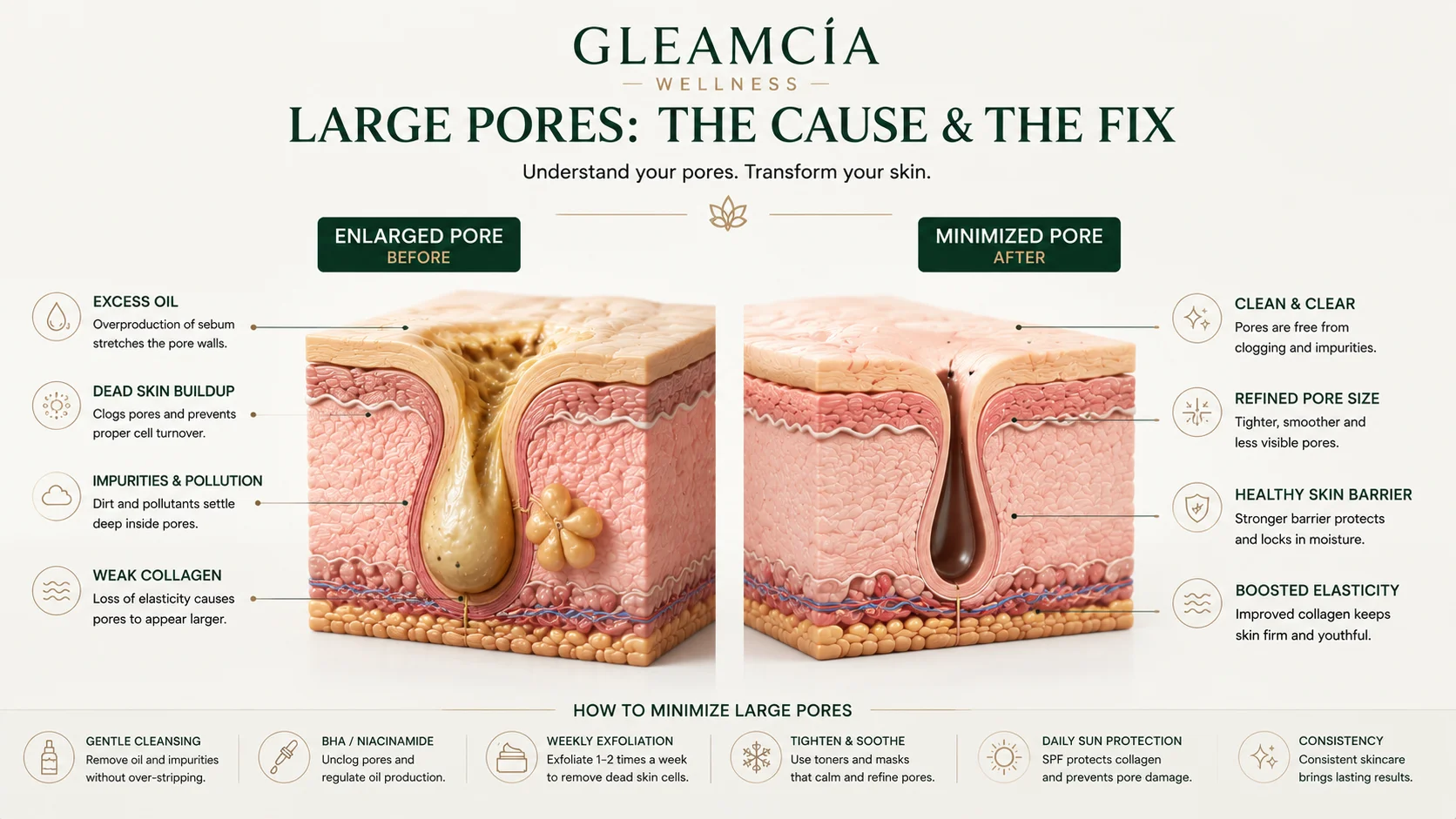
Excess sebum production is the leading cause. When the skin produces too much oil, it stretches the walls of the pore outward to accommodate the volume. Over time, chronically overworked pores lose elasticity and remain dilated even when they are not congested.
Genetics and skin type play a significant role. People with naturally oily skin or South Asian and Middle Eastern skin tones — more common in Pakistan’s climate — tend to have more active sebaceous glands and visibly larger pores. This is biological, not a hygiene issue.
Age and collagen loss change pore appearance over time. Collagen fibres surround each pore and act as scaffolding. As collagen production slows with age, the skin around pores loses its firmness and the pore entrance widens visibly.
Sun damage accelerates this process. UV exposure breaks down collagen and thickens the outer layer of skin, making pores appear more prominent. The American Academy of Dermatology confirms that UV damage is one of the primary structural causes of enlarged pore appearance.
Congestion and blackheads physically stretch pores. When a pore is blocked with oxidised sebum and dead skin cells, it expands to hold the material. If that congestion is not cleared regularly, the pore stays stretched.
Dehydration is the most overlooked cause. When skin lacks moisture, it overproduces oil to compensate. That oil excess then clogs pores and stretches them further. Properly hydrated skin produces less compensatory sebum and therefore shows smaller pores.
Can You Actually Shrink Pores Permanently?
No. Pores do not open, close, shrink, or disappear permanently. They are fixed structures in the dermis.
What you can do — and what actually works — is reduce the visible size of pores by keeping them clear of congestion, regulating the oil that stretches them, stimulating the collagen that supports their walls, and smoothing the skin surface around them. All of these create a real, visible reduction in pore size that shows up in daylight.
The most significant visible pore reduction comes from consistency. One good product used once does not change pore appearance. The same product used correctly every day for six to eight weeks produces a result that is noticeably different to where you started.
How to Minimize Large Pores: What Actually Works
Several approaches have solid evidence behind them. These are the ones worth building a routine around.
Double cleansing. Oil-based cleanser first to dissolve sebum and SPF from inside the pore, followed by a gentle water-based cleanser to lift everything out. Pores that are regularly cleared of congestion look smaller because they are not physically stretched by the buildup inside them. The Gleamcia Brightening Face Wash works well as the second cleanse step in a double-cleansing routine.
Salicylic acid (BHA) exfoliation. Unlike AHAs which work on the skin’s surface, salicylic acid is oil-soluble. It penetrates inside the pore, dissolves the sebum and dead cell buildup that stretches pore walls, and reduces congestion at the source. Used two to three times a week, it is one of the most effective pore-clearing ingredients available without a prescription.
Niacinamide. Regulates sebum production, which is the root cause of enlarged pores in oily skin types. Less oil being produced means less stretching of the pore over time. Also strengthens the skin barrier and reduces inflammation around pores. Works best at concentrations between 5% and 10% used consistently.
Retinol. Stimulates collagen production around pore walls, which physically tightens the structural support of the pore. Also increases cell turnover, preventing the dead skin buildup that blocks and stretches pores. One of the most researched ingredients for long-term pore reduction, particularly in people whose pores have enlarged with age.
Clay masks. Absorb excess oil directly from within the pore. Not a permanent solution, but a highly effective maintenance treatment when used one to two times per week.
SPF — daily without exception. Preventing further UV-related collagen breakdown is the most important long-term pore management strategy. Pores that are already enlarged get worse faster with ongoing sun damage. Pores that are protected while other treatments work tend to respond better over time.
Best Ingredients for Shrinking Large Pores
Not all ingredients marketed for pores actually work. These are the ones with clinical backing and real-world results:
- Niacinamide (Vitamin B3) — Regulates sebum production, reduces pore visibility, strengthens barrier
- Salicylic Acid (BHA 0.5% to 2%) — Unclogs pores from within, reduces blackheads and congestion
- Retinol — Rebuilds collagen around pore walls, increases cell turnover, reduces pore dilation over time
- Glycolic Acid (AHA) — Resurfaces skin surface, smooths the raised edges around pores that make them more visible
- Kaolin and Bentonite Clay — Absorb excess sebum from pore openings
- Hyaluronic Acid — Restores skin hydration to reduce compensatory oil production
- Zinc PCA — Controls sebum production and has mild antibacterial action on congested pores
- Azelaic Acid — Reduces inflammation around pores and targets the buildup that stretches them
Browse the Gleamcia Skin Care range to find formulas that combine these ingredients for targeted pore care.
What Do Koreans Use to Minimize Pores?
Korean skincare has become globally recognised for producing consistently clear, smooth, low-pore skin. The approach is not one single product — it is a framework built around consistency, layering, and preventing problems before they develop.
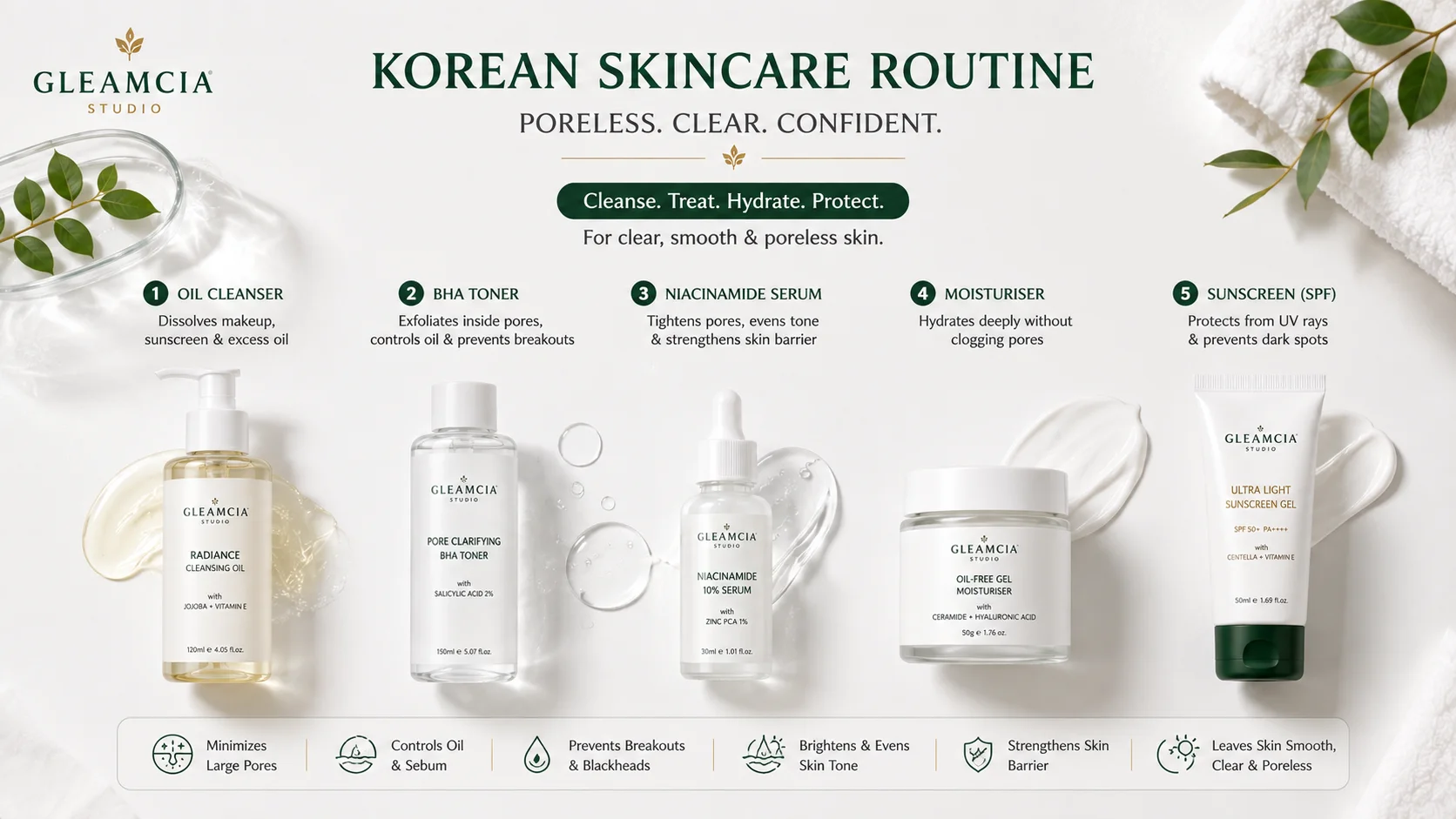
The core Korean routine for pore minimization includes:
Double cleansing as a non-negotiable. Oil cleanser first to dissolve the day’s buildup inside pores, followed by a foam or gel cleanser. This is the most foundational step and the one that creates the biggest difference in pore appearance over time.
BHA/AHA toners and essences. Korean skincare incorporates exfoliating actives as lightweight liquids — applied like toners — which means they cover the full face evenly and penetrate more efficiently than a thick gel serum. Ingredients like betaine salicylate (a gentler BHA) and PHA exfoliants are popular in Korean formulas for daily pore maintenance without irritation.
Niacinamide as a staple. Most Korean serums and moisturisers include Niacinamide at meaningful concentrations. It is genuinely central to the “glass skin” aesthetic because of its ability to regulate sebum and visibly reduce the appearance of pores.
Hydration layering. Multiple thin hydrating layers rather than one thick moisturiser. Hydrated skin produces less compensatory sebum, which directly reduces pore stretching over time. The Korean “7 skin method” involves applying lightweight toner in seven thin layers to maximise moisture uptake.
Clay or charcoal mask two to three times weekly. Targeted treatment for congested pores specifically. Applied to the T-zone and areas of concern rather than the full face.
Daily SPF. Without exception. UV protection is treated as the single most important anti-ageing and pore-maintenance step in Korean beauty culture, not an afterthought.
How Do Koreans Have Such Small Pores and Poreless Skin?
The idea of “Korean poreless skin” circulates heavily online and the reality is a bit more nuanced than any single explanation. A few things are genuinely true.
Korean beauty culture emphasises preventive skincare from a very young age. Consistent SPF use, double cleansing, and regular exfoliation from the teenage years means far less cumulative sun damage, collagen loss, and chronic pore congestion by the time someone is in their 30s. Prevention at 17 shows up as better skin at 35.
Korean skin types also tend to have slightly higher natural melanin levels, which offers some inherent protection from UV damage. This slows some of the collagen breakdown that enlarges pores with age. That said, it is not the whole picture — Korean skincare diligence is a much bigger factor than genetics alone.
The aesthetic of glass skin and poreless skin in Korean media is also partly makeup, partly lighting, and partly the specific skincare philosophy that treats skin maintenance as a daily practice rather than a crisis response.
The actual results achievable with a consistent Korean-inspired routine — double cleansing, regular BHA exfoliation, daily Niacinamide, layered hydration, and SPF — are real and replicable for any skin type in Pakistan.
How Do Koreans Have No Blackheads?
The honest answer: they work hard to prevent them, not remove them.
In Korean skincare, blackhead prevention is built into the daily routine rather than treated as an occasional problem to fix with pore strips. Oil cleansing every night dissolves sebum inside pores before it has a chance to oxidise and become a blackhead. BHA exfoliation two to three times a week keeps pore openings clear. Regular clay masks draw out congestion before it becomes visible.
Pore strips — still popular elsewhere — are largely discouraged in Korean skincare because they remove the surface plug without addressing the excess oil production underneath. The blackhead comes back within days. Korean routines attack the cause (sebum buildup) rather than the symptom (the visible plug).
This same approach works for anyone. Double cleanse nightly, use a BHA exfoliant regularly, and incorporate a clay mask weekly. The blackheads do not disappear overnight, but they reduce significantly with two to three weeks of consistent prevention-focused cleansing.
What Exactly Is Korean Pore Surgery?
“Korean pore surgery” is not a medical procedure. It is a phrase that spread online as a myth — some viral posts and social media accounts claimed that Korean celebrities have a secret surgical treatment that permanently eliminates pores. This is not real.
Pores are biological structures in the dermis. There is no surgical method to remove them without removing the skin itself. They cannot be surgically eliminated.
What does exist in Korean clinics and dermatology practices are professional treatments that significantly minimise pore appearance:
Carbon laser facials — A carbon peel applied to the skin and then vaporised with a laser. The process clears sebum from inside pores, stimulates collagen, and resurfaces the skin surface. Popular and effective for large pores and oily skin.
Chemical peels — Professional concentration AHA/BHA peels administered by a dermatologist. Creates controlled exfoliation that clears pores and smooths skin texture over a course of treatments.
Microneedling — Creates micro-channels in the skin that trigger collagen production. The new collagen tightens the structural support around pores, making them appear smaller over time.
Extraction facials — Professional deep-cleansing treatments that clear congested pores safely without the damage that comes from unsupervised squeezing at home.
These treatments exist globally, not only in Korea. The term “Korean pore surgery” is a marketing myth that does not reflect any actual surgical procedure.
Step-by-Step Daily Routine to Minimize Large Pores
A pore-minimizing routine does not need to be complicated. This is a workable daily structure:
Morning:
- Gentle face wash with a gel or foam cleanser — no second oil cleanse needed in the morning
- Niacinamide serum — apply to freshly cleansed, slightly damp skin
- Lightweight moisturiser — one that does not feel heavy or occlusive
- SPF — broad spectrum, minimum SPF 30, non-negotiable
Evening:
- Oil-based cleanser to remove SPF and makeup
- Gel or foam cleanser as second cleanse — use the Gleamcia Brightening Face Wash here
- BHA exfoliant (2 to 3 times a week, not every night)
- Niacinamide serum
- Retinol (if in your routine — start 2 to 3 nights a week, not nightly)
- Moisturiser to seal everything in
Weekly:
- Clay or kaolin mask once or twice a week on areas of concern (nose, chin, forehead)
- This draws out sebum from pore openings and reduces visible congestion
Niacinamide vs Salicylic Acid for Large Pores: Which Works Better?
Both are among the most effective pore-minimizing ingredients available. They target pores differently and the best approach is using both in the same routine, not choosing between them.
| Feature | Niacinamide | Salicylic Acid (BHA) |
| Primary action | Regulates sebum production | Unclogs pores from the inside |
| How it reduces pores | Less oil = less pore stretching | Dissolves buildup that physically stretches pores |
| Best for | Oily skin, daily use, long-term regulation | Blackheads, congestion, enlarged pores from buildup |
| Suitable for daily use | Yes, most skin types | 2 to 3 times per week is typical |
| Sensitivity level | Low — well tolerated by sensitive skin | Moderate — can cause dryness if overused |
| Results timeline | 4 to 6 weeks of consistent use | 2 to 4 weeks for visibly clearer pores |
| Best application step | Serum step, after cleansing | Toner or targeted serum after cleansing |
| Suitable for dry skin | Yes | With caution — moisturise well after |
| Suitable for oily skin | Excellent | Excellent |
| Works on blackheads | Indirectly by reducing oil | Directly — dissolves the material inside pores |
Use Salicylic Acid in the evening two to three times a week to clear congestion. Use Niacinamide daily to regulate oil and maintain clear pores. Together, they tackle both the cause and the result of enlarged pores.
Who Is Most Likely to Have Large Pores?
Some people are more predisposed to visibly large pores, and understanding this helps set realistic expectations.
Oily skin types show larger pores most consistently because high sebum production stretches pore walls over time. Pakistan’s humid climate — particularly in Karachi and Lahore — amplifies oil production in already oily skin types.
People in their 30s, 40s, and beyond tend to see pore appearance increase as collagen diminishes and the skin loses the firmness that kept pores tight in younger years.
Anyone who spent significant time in the sun without consistent SPF protection is likely to have more visible pores than their genetics would otherwise produce, because UV damage breaks down the collagen support structures around each pore.
People of South Asian descent often have more active sebaceous glands as part of natural skin biology. This is not a flaw — it is a characteristic that simply responds well to the right routine and targeted actives.
Common Mistakes That Make Large Pores Look Worse
These habits actively enlarge pore appearance over time and are worth stopping immediately.
Skipping SPF is the single biggest mistake. Ongoing UV damage destroys collagen faster than any serum can rebuild it. Pores that are already visible get worse year on year without daily UV protection.
Washing the face too frequently or too harshly. Over-cleansing strips the skin’s natural oil barrier, triggering more compensatory sebum production, which stretches pores. Twice a day with a gentle formula is enough.
Using pore strips repeatedly. They remove the visible plug without clearing the oil production underneath. The plug returns within days and repeated use can actually damage the skin around the pore, causing it to appear larger.
Skipping moisturiser because the skin is oily. Dehydrated oily skin overproduces sebum, which is the opposite of what you want. A lightweight, oil-free moisturiser keeps the skin balanced.
Using heavy, pore-blocking products. Thick creams, coconut oil, and heavy foundations applied without proper removal at night are a fast way to consistently clogged pores.
How Soon Can You Minimize the Appearance of Large Pores?
Results from a consistent pore-minimizing routine build over time. This is the general timeline most people experience:
- Week 1 to 2: Skin feels less congested and oily, particularly after double cleansing is established
- Week 3 to 4: Blackheads and surface congestion visibly reduce with BHA use; pore openings look cleaner
- Week 6 to 8: Visible reduction in pore size appearance with consistent Niacinamide use; skin texture smoother
- 3 months+: Significant improvement in overall pore appearance and skin evenness with daily SPF, Niacinamide, and periodic BHA use
Individual results depend on how enlarged the pores are at the start, the underlying cause, skin type, and how consistently the routine is followed.
Aftercare and Daily Habits for Minimizing Large Pores
Do:
- Double cleanse every evening without skipping
- Apply SPF every single morning — this is the most important long-term pore habit
- Change pillowcases two to three times a week — used pillowcases deposit oil and bacteria back onto a freshly cleansed skin
- Keep hands off the face throughout the day — touching transfers oil and bacteria that congest pores
- Use non-comedogenic product labels as a guide when choosing makeup and moisturisers
Do not:
- Squeeze or pick at pores and blackheads at home — this damages the pore wall and makes the pore permanently larger
- Use very hot water to cleanse — it strips the skin barrier and triggers more oil production
- Apply thick, oil-rich products to an already oily T-zone without checking their comedogenic rating
- Expect results in less than four weeks — pore appearance changes on the skin’s biological timeline, not yours
What Does Pore-Minimizing Skincare Cost in Pakistan?
Formulation quality is the biggest cost driver in this category. A Niacinamide serum at 5% or 10% with a stable preservation system and supporting actives like Zinc or Hyaluronic Acid costs more to produce than a basic moisturiser with a niacinamide trace amount added to the label. What you are paying for is the concentration and the stability.
BHA exfoliants vary in pricing based on salicylic acid concentration and the formula surrounding it. Gentle, low-pH formulas designed for daily or near-daily use require more careful formulation than a simple acid wash.
Buying a pore-focused routine as a bundle — cleanser, BHA treatment, Niacinamide serum, and moisturiser — from the same range is almost always more economical per item than buying individual products separately. It also ensures all products in the routine are formulated to work together rather than potentially conflicting.
Gleamcia ships nationwide across Pakistan from Karachi. Visit gleamcia.com/shop for current prices and active promotions on pore-targeting skincare.
Why Choose Gleamcia
Gleamcia builds every skincare product around a single question: does the formula actually do what it claims on the label?
- Active ingredients at concentrations that produce results, not trace amounts included for marketing
- Pore-targeting formulas designed for the skin realities of Pakistan’s climate — humidity, heat, and higher natural sebum production
- Transparent ingredient lists with no hidden fillers or misleading label claims
- Nationwide delivery from Karachi to every city in Pakistan, with reliable packaging and fast dispatch
- A skincare range that treats your skin concerns as the starting point, not an afterthought
Frequently Asked Questions
1. What do Koreans use to minimize pores? Korean skincare for pore minimization is built around oil cleansing to dissolve sebum from inside pores every night, BHA exfoliants (especially betaine salicylate) to keep pores clear, Niacinamide to regulate oil production, layered lightweight hydration, and daily SPF without exception. The approach prioritises daily prevention over weekly correction. Most Korean pore-minimizing products include Niacinamide, gentle BHAs, and clay or charcoal masks for weekly deep cleansing.
2. How do Koreans have such small pores? Consistent preventive skincare from a young age is the primary reason. Korean beauty culture treats double cleansing, regular exfoliation, Niacinamide use, and daily SPF as non-negotiable daily habits from the teenage years onward. This means far less cumulative pore congestion, UV-related collagen damage, and sebum-related pore stretching by the time someone reaches their 30s. Genetics play a role, but skincare consistency is the bigger factor.
3. How do Koreans have no blackheads? Korean skincare focuses on preventing blackheads, not removing them. Daily oil cleansing dissolves sebum before it oxidises inside the pore. BHA exfoliation clears pore openings two to three times a week. Clay masks draw out congestion weekly. Pore strips are largely avoided because they remove the surface plug without addressing the ongoing sebum production that creates blackheads in the first place. Consistent prevention is what produces consistently clear pores.
4. What exactly is Korean pore surgery? Korean pore surgery is not a real surgical procedure. It is a myth that spread through social media claiming Korean celebrities have access to a secret pore-elimination treatment. Pores are biological skin structures and cannot be surgically removed. What does exist in Korean dermatology clinics are professional treatments including carbon laser facials, chemical peels, microneedling, and extraction facials — none of which are exclusive to Korea and none of which are surgery. Consistent skincare, not surgery, produces the pore results associated with Korean beauty.
5. How do Koreans have poreless skin? The “poreless” look associated with Korean skin is produced by a combination of rigorous daily skincare (double cleansing, BHA exfoliation, layered hydration, SPF), professional treatment access, and the aesthetic of glass skin that the K-beauty industry promotes. It is also partly the result of skilled makeup application and carefully produced photography and video content. Real Korean skin has pores. What the routine produces is skin that is so consistently cared for that pores stay clean, clear, and tight relative to untreated skin.
6. What skincare is best for shrinking large pores? The most effective skincare for large pores includes Niacinamide (5% to 10%) for sebum regulation and daily pore maintenance, Salicylic Acid (BHA) for clearing congestion from inside pores two to three times a week, Retinol for rebuilding collagen around pore walls over time, and SPF every morning to prevent UV-related collagen breakdown. Clay masks used once or twice a week remove excess surface sebum. A consistent daily routine with these ingredients over 6 to 8 weeks produces visible pore reduction.
7. Does Niacinamide really minimize pores? Yes, but through sebum regulation rather than physical pore shrinking. Niacinamide reduces the amount of oil the skin produces, which means pores are stretched less by ongoing oil pressure. With consistent daily use over four to six weeks, most people with oily or combination skin notice a visible reduction in pore size, particularly around the nose, chin, and forehead. It works best alongside a BHA exfoliant that physically clears the congestion already inside the pores.
8. Can large pores be permanently closed? Pores do not open or close — this is a common misconception. They are fixed skin structures. What you can do is make them consistently appear smaller by keeping them clear of congestion, regulating oil production, stimulating collagen support around the pore walls, and protecting the skin from UV damage that enlarges them over time. With the right routine maintained consistently, the improvement is real and lasting — but it requires ongoing care, not a one-time fix.
Start Your Pore-Minimizing Routine Today
Large pores are manageable. With the right ingredients, a consistent daily routine, and a little patience, the difference over six to eight weeks is something you will actually be able to see. Order from the Gleamcia Skin Care range via our online store with nationwide delivery across Pakistan — from Karachi to Lahore, Islamabad to Peshawar.
Order on WhatsApp at 0336 1223363 and our team will help you choose the right pore-targeting products for your skin type and concern.