Introduction
Most people own a night cream but very few are actually using it correctly. They either apply too much, put it on at the wrong stage of their routine, or skip it entirely because they are not sure what it is really doing while they sleep. And that is a shame, because when you know how to use night cream properly, it becomes one of the most effective products in your entire skincare routine.
Night cream is not just a heavier moisturiser. It is a targeted treatment designed to work in sync with your skin’s natural overnight repair cycle. This guide walks you through exactly when to apply it, how much to use, the correct steps to follow, and what the popular 4-2-4 skincare rule has to do with all of it. Browse the Gleamcia Skin Care range for night creams formulated with actives that support this overnight process.
What Does Night Cream Do That Day Cream Doesn’t?
Night cream is built around a simple biological fact. Your skin does its heaviest repair work while you sleep.
During the night, skin cell turnover accelerates, collagen production increases, and the skin barrier works to restore moisture lost throughout the day. Cortisol — the stress hormone that causes inflammation and suppresses repair — drops significantly at night. Blood flow to the skin increases. All of this creates a window where active ingredients can penetrate deeper and work more effectively than they can during the day.
A good night cream takes advantage of this window by delivering hydration, actives like retinol, peptides, or niacinamide, and barrier-supporting ingredients like ceramides and fatty acids during the hours your skin is most receptive to them.
Day creams, by contrast, are formulated around protection. They typically include SPF, lighter textures that sit well under makeup, and antioxidants to guard against environmental damage. They are not designed for deep penetration because daytime is about defending, not repairing.
Night cream does not need an SPF because you are not exposed to UV during sleep. This allows for richer textures, higher active concentrations, and formulas that would feel too heavy or cause photosensitivity in the morning sun.
Who Should Use Night Cream?
Night cream is not age-restricted, but some skin types and concerns benefit more than others.
Night cream is particularly well suited for people with dry or dehydrated skin that feels tight after cleansing. The richer texture and barrier-sealing ingredients in most formulas replenish what dry skin loses throughout the day and overnight.
Anyone dealing with signs of ageing — fine lines, loss of firmness, uneven skin tone, or dullness — benefits from a night cream that contains actives like retinol, peptides, or hyaluronic acid. These ingredients work better overnight and at the higher concentrations found in night formulas.
Oily and combination skin types are not excluded, though they do better with gel-based or lighter night creams rather than heavy, occlusive formulas. The goal is still barrier support and hydration — just in a texture that does not feel suffocating.
Sensitive skin types should look for fragrance-free, minimally formulated night creams with ceramides, aloe vera, or centella asiatica, which calm the skin rather than stress it during overnight repair.
Night cream is also a worthwhile addition for anyone who lives in a dry climate, uses active ingredients like retinol or acids that increase skin sensitivity, or has noticed their skin looks duller or more fatigued than it used to in the morning.
How to Use Night Cream Correctly: The Step-by-Step Routine
How to use night cream is about more than just opening the jar and applying. The steps before and after matter as much as the cream itself.
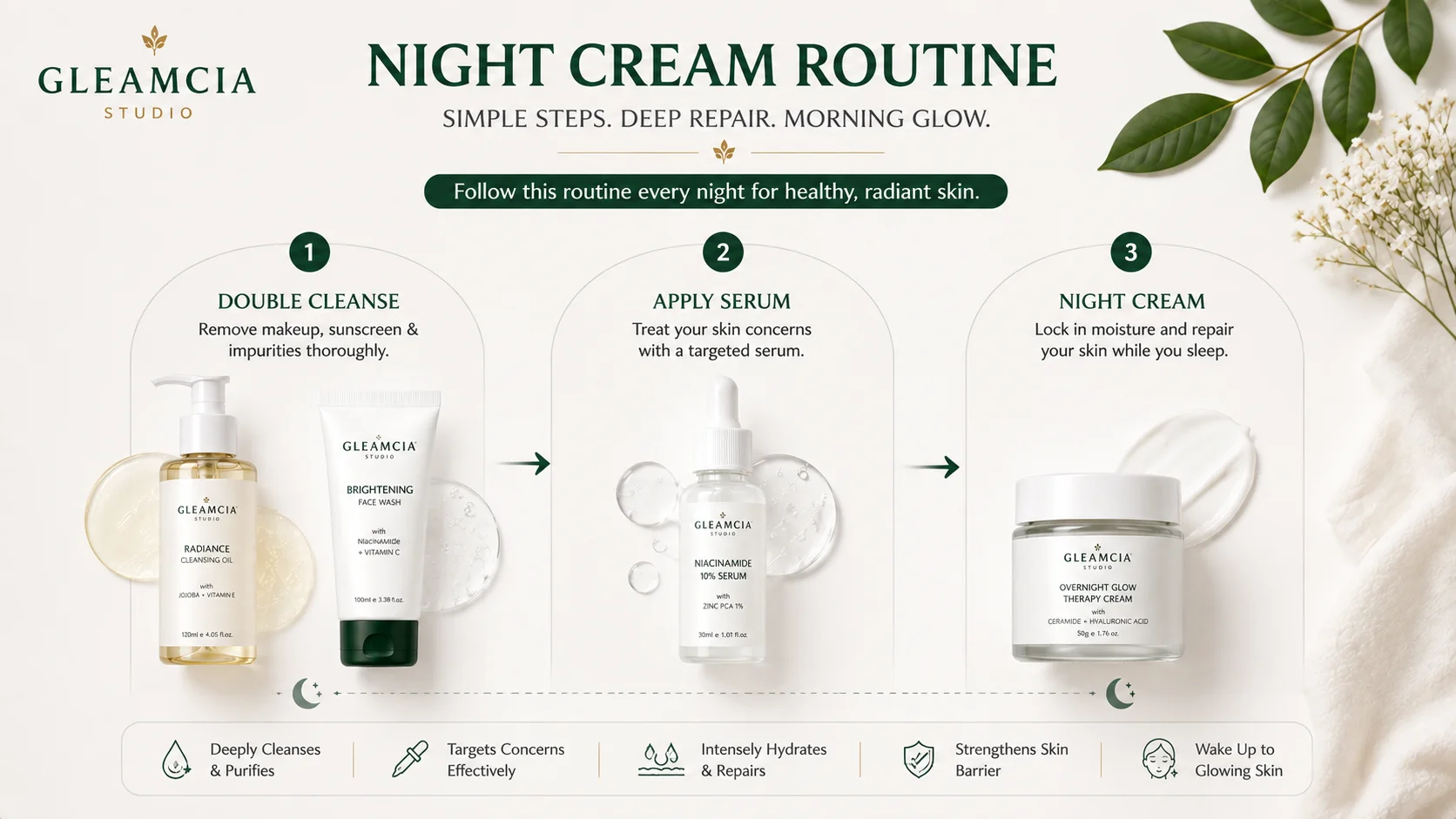
Step 1: Double Cleanse Start with an oil-based cleanser or micellar water to remove SPF, makeup, and surface pollutants. Follow with a gentle foam or gel cleanser to deep-clean the pores. This two-step method (and the foundation of the 4-2-4 rule discussed later) ensures the skin is fully prepped before actives go on. Try the Gleamcia Brightening Face Wash as your second cleanse step.
Step 2: Toner (Optional) If your routine includes a hydrating or balancing toner, apply it here with a cotton pad or by pressing it gently into the skin with your hands. This preps the skin to absorb the layers that follow.
Step 3: Serum or Treatment Apply any targeted serums — Niacinamide, Retinol, Peptides, or Hyaluronic Acid — before your night cream. Serums are thinner and need to sit directly on the skin surface to absorb properly. Night cream goes on top.
Step 4: Eye Cream If you use an eye cream, apply it before your night cream by tapping gently around the orbital bone with your ring finger. Never drag the skin around the eye area.
Step 5: Apply Night Cream Take the correct amount (see the next section), warm it between your fingertips for a few seconds, and apply across the face starting from the centre and working outward. Use upward strokes and press gently rather than rubbing. Include the neck and décolletage if your formula allows.
Step 6: Let It Absorb Before Sleep Ideally apply your night cream 20 to 30 minutes before you actually sleep. This gives it time to partially absorb so it is not transferring entirely onto your pillow before it has done anything.
How Much Night Cream Should You Apply?
Less than you think. This is consistently where people go wrong with night cream.
A pea-sized amount for the face. A slightly larger amount — roughly the size of two peas — if you are also applying to the neck and décolletage.
Night creams are typically richer and more concentrated than day moisturisers. A thin, even layer is enough to cover the skin surface and allow the actives to penetrate. Applying a thick layer does not increase the benefit. The excess sits on top, can clog pores, and often leads to that greasy, heavy feeling in the morning that makes people dislike night creams in general.
The way to check if you are using the right amount: after applying, your skin should feel comfortable and slightly dewy. Not slick, not sticky, not shiny like you have layered on oil. If it feels too heavy, you have used too much or the formula is too rich for your skin type.
Warm the product between your fingers before applying. Night cream applied cold does not spread evenly and you end up using more than you need to cover the same area.
When to Apply Night Cream in Your Skincare Routine
Night cream goes on as the last step of your skincare routine, after cleansing, toning, serum, and eye cream. It is the seal that locks everything underneath in.
Timing matters a little more than most people realise. Applying night cream directly after washing your face while the skin is still slightly damp is ideal. Damp skin absorbs actives and moisturising ingredients more efficiently than completely dry skin.
The window between 10pm and midnight is when skin cell turnover is at its most active, according to research on circadian skin biology. Applying your night cream during this window aligns the product’s active ingredients with the peak of your skin’s natural repair cycle. This does not mean you need to be rigid about it, but making your skincare routine part of a consistent pre-sleep habit makes a real difference to results over time.
Do not apply night cream and then go back to sitting in front of a screen for two more hours in a brightly lit room. Skin repair is tied to melatonin release, which happens in low-light conditions. The earlier you start the process, the more repair time the skin actually gets.
What Is the 4-2-4 Rule in Skincare?
The 4-2-4 rule is a double cleansing method designed to ensure the skin is completely clean before applying any skincare at night. It is especially popular in Korean skincare routines and works particularly well as the foundation step before night cream application.
Here is how the 4-2-4 rule works:
4 minutes: Massage an oil-based cleanser or cleansing balm onto dry skin for a full 4 minutes. This is longer than most people think to cleanse. The extended massage breaks down SPF, makeup, sebum, and environmental pollutants at a level that a quick 30-second wash simply does not achieve. The massage also improves blood circulation to the face, which supports the overnight repair process.
2 minutes: Emulsify the oil cleanser with a small amount of water and massage for a further 2 minutes before rinsing off with warm water. This step ensures the oil — along with everything it has dissolved — lifts cleanly away from the skin.
4 minutes: Apply a water-based or foam cleanser and massage for another 4 minutes, then rinse thoroughly. This second cleanse removes any remaining residue and cleanses the pores directly.
After the 4-2-4 cleanse, the skin is completely clear of barriers that would prevent your serums and night cream from absorbing properly. Active ingredients penetrate significantly better onto skin that has been properly cleansed this way compared to a standard 30-second wash.
The 4-2-4 rule is not necessary every single night. Two to three times a week — or on days when you have worn full makeup and SPF — delivers the most benefit without over-cleansing the skin.
Can I Apply Night Cream Daily?
Yes. Night cream is designed for daily use, and consistent nightly application is what builds visible results over time.
The skin goes through its repair and renewal cycle every night, so there is no natural rest period where skipping night cream would be beneficial. The only exception is if your skin is reacting to a specific active ingredient in the formula. In that case, reducing frequency gives the skin time to adjust rather than abandoning the product entirely.
Night creams with retinol are often introduced gradually because retinol is a potent active that can cause initial sensitivity, dryness, or mild peeling. Starting with two to three nights per week and building to daily use over four to six weeks is the standard approach for retinol-containing formulas.
For night creams based on hydrating or barrier-supportive ingredients — hyaluronic acid, ceramides, peptides, niacinamide — daily use is well tolerated by almost all skin types, including sensitive skin.
The American Academy of Dermatology recommends moisturising the skin daily as a core component of a healthy skincare routine, particularly at night when the skin’s barrier function is most active in repair mode.
Night Cream vs Day Cream: What Actually Differs
A lot of people use one cream for morning and night and wonder why their skin is not responding. Here is why the distinction matters:
| Feature | Night Cream | Day Cream |
| Primary purpose | Overnight repair and restoration | Daytime protection and hydration |
| Texture | Richer, thicker, more occlusive | Lighter, more easily absorbed |
| Contains SPF | No | Usually yes |
| Active ingredients | Higher concentration retinol, peptides, AHAs | Antioxidants, SPF-compatible actives |
| Application time | Evening, after full skincare routine | Morning, before SPF and makeup |
| Photosensitising ingredients | Often yes (retinol, AHAs) | Rarely |
| Skin absorption window | Higher — skin is in repair mode | Lower — skin is in protection mode |
| Suitable for under makeup | No | Yes |
| Scent and texture preference | Richer, more spa-like | Fresh, lightweight |
Using a day cream at night is not harmful, but it misses the opportunity to deliver the repair-focused actives your skin specifically needs during sleep. And using a night cream during the day — especially one with retinol or AHAs — can cause photosensitivity and increase the risk of sun damage.
Key Ingredients to Look for in a Night Cream
The formula inside the jar determines how much benefit you actually get. Look for these actives:
- Retinol — The most researched anti-ageing ingredient available without a prescription. Increases cell turnover, reduces fine lines, and fades pigmentation. Needs to be introduced gradually.
- Peptides — Short chains of amino acids that signal the skin to produce more collagen. Particularly good for firmness and elasticity.
- Hyaluronic Acid — Draws moisture into the skin and holds it there overnight. Works at multiple molecular sizes for surface and deeper hydration.
- Ceramides — Lipids that restore the skin barrier. Essential for dry, dehydrated, or compromised skin.
- Niacinamide — Reduces inflammation, regulates sebum, fades dark spots, and strengthens the barrier. Works well in a night cream for all skin types.
- Squalane — A lightweight, non-comedogenic oil that mimics the skin’s own sebum. Adds softness without heaviness.
- Centella Asiatica — Calms inflammation and supports wound healing. Excellent in night creams for sensitive or post-treatment skin.
Browse the active ingredients listed in any Gleamcia night cream on the Gleamcia Skin Care range page before purchasing.
How Soon Do You See Results from Night Cream?
Consistency is everything here. A single night of use does nothing visible — and that is completely normal.
- Week 1 to 2: Skin starts to feel more hydrated and plump in the morning. Tightness after cleansing reduces.
- Week 3 to 4: Skin tone looks more even and the complexion appears less dull. Any active ingredients like niacinamide begin showing subtle brightening effects.
- Week 6 to 8: Visible improvement in hydration levels, texture, and fine line appearance with continued daily use.
- 3 months+: More significant changes in skin firmness, dark spot reduction, and overall radiance, particularly with retinol-containing formulas.
Individual results vary based on skin type, starting condition, the specific formula, and how consistently it is used. Always apply SPF in the morning, especially if your night cream contains retinol or AHAs, because these ingredients increase photosensitivity.
Common Mistakes People Make When Using Night Cream
Knowing how to use night cream correctly also means knowing what to stop doing.
Applying night cream without cleansing properly first means the cream is sitting over a layer of SPF, pollution, and sebum. None of its actives are reaching the skin. The 4-2-4 method mentioned earlier directly solves this.
Using too much is the most common error. More product does not mean more results. It means wasted product and a higher chance of clogged pores overnight.
Applying night cream too close to sleep time means it transfers to the pillow before absorbing. A 20 to 30 minute buffer between application and sleep makes a real difference.
Skipping the neck is a habit that leads to a mismatch over time between the face and neck as skin ages. The neck has thinner skin and fewer oil glands, making it more prone to dryness and crepiness. Include it every night.
Expecting results in three days and abandoning the product. Night cream works on a biological cycle. Give it a minimum of four weeks of consistent use before assessing.
Aftercare Tips for Night Cream Use
Do:
- Sleep on a clean pillowcase. Used pillowcases carry bacteria, oils, and product residue that counteract everything your night cream is trying to do. Changing pillowcases two to three times a week makes a real difference.
- Drink water consistently through the day. Skin hydration is partly driven by internal water intake, which no topical cream fully compensates for.
- Use SPF without fail every morning after a night cream that contains retinol or AHAs.
- Store your night cream with the lid tightly closed and away from humidity. Bathroom steam degrades formulas faster than most people expect.
Do not:
- Layer night cream over a heavy oil directly. Oil acts as a barrier and reduces absorption of actives underneath. Apply your night cream first and add a facial oil on top if needed.
- Use a new night cream for the first time immediately before an event. Introducing a new active formula gives the skin a small adjustment window.
- Combine retinol night cream with exfoliating acids on the same night unless you have established skin tolerance for both. Alternate them instead.
What Does Night Cream Cost in Pakistan?
Formulation complexity determines pricing across the range. A basic night cream with simple moisturising ingredients is priced at the lower end. A night cream that includes Retinol, Peptides, and Hyaluronic Acid at meaningful concentrations — alongside a stable preservation system — costs more to produce, and that is reflected in the price.
Jar size also factors in. A 30ml jar used nightly will last roughly one month with pea-sized applications. A 50ml jar extends to two months or more. The per-use cost between sizes often favours the larger format significantly.
Bundle pricing — a night cream paired with a matching day cream, serum, or eye cream from the same range — delivers better value per product and ensures formulation compatibility between the steps in your routine.
Gleamcia ships nationwide across Pakistan from Karachi. Visit gleamcia.com/shop for current pricing on the full skincare range and any active offers.
Why Choose Gleamcia
Gleamcia formulates every skincare product with purpose. Nothing goes into the jar that does not serve a function.
- Night creams built around actives at concentrations that actually work, not trace amounts added just for label marketing
- Formulas tested for safety and stability before they ship
- Clear, honest ingredient lists so you know exactly what you are applying to your skin overnight
- Skin care designed for the real concerns of people in Pakistan — sun damage, humidity, uneven tone, oiliness, and ageing
- Nationwide delivery from Karachi to every city in Pakistan, with fast dispatch and reliable packaging
Frequently Asked Questions
1. How much night cream should I apply? A pea-sized amount for the face is the right quantity. For the face and neck together, use roughly the equivalent of two peas. Night creams are concentrated formulas and a thin, even layer is enough for full coverage and absorption. Applying more does not increase the benefit and can lead to clogged pores or a heavy feeling on the skin.
2. How to apply night cream correctly? Start with thoroughly cleansed skin. Apply any serums first and let them absorb. Then take a pea-sized amount of night cream, warm it between your fingertips for a few seconds, and apply in gentle upward strokes starting from the centre of the face outward. Press the product lightly into the skin rather than rubbing. Include the neck. Allow 20 to 30 minutes before sleeping for partial absorption.
3. What is the 4-2-4 rule in skincare? The 4-2-4 rule is a deep double-cleansing technique. It involves massaging an oil-based cleanser onto dry skin for 4 minutes, emulsifying and rinsing for 2 minutes, then applying a water-based cleanser and massaging for another 4 minutes before rinsing. This thorough cleanse removes SPF, makeup, and environmental buildup completely, allowing night cream and serums to absorb directly into the skin rather than sitting on top of residue. Two to three times a week is sufficient.
4. Can I apply night cream daily? Yes. Night cream is designed for nightly use and consistent daily application is what produces visible results over weeks and months. The only exception is retinol-based night creams, which are best introduced gradually — starting at two to three nights per week and building to daily as the skin adjusts. Hydration and barrier-focused night creams are generally well tolerated daily by all skin types.
5. Can I use night cream in the morning instead? Night creams are not recommended for morning use, particularly if they contain retinol, AHAs, or other photosensitising actives. These ingredients increase the skin’s sensitivity to UV light and using them in the morning without extremely high SPF protection increases sun damage risk. The richer texture also does not sit well under makeup. Use your night cream only at night and choose a dedicated SPF-containing day moisturiser for mornings.
6. Do I need night cream if I already use a serum? Yes. Serums and night creams serve different purposes. A serum delivers targeted active ingredients in a lightweight, fast-absorbing formula. A night cream seals in those actives, provides deeper hydration, and supports the skin barrier overnight. Using both in the correct order — serum first, night cream second — means you get the benefit of both layers, not one at the expense of the other.
7. At what age should I start using night cream? There is no strict age minimum. People in their early to mid-20s benefit from hydrating, barrier-supporting night creams, especially if they have dry or sensitive skin. From the late 20s onward, adding actives like peptides or low-dose retinol becomes increasingly relevant as collagen production naturally starts to slow. Starting a consistent night cream habit in your 20s is significantly more effective than starting in your 40s when signs of ageing are already visible.
Start Using Night Cream the Right Way Tonight
Your skin does its best work while you sleep. A well-formulated night cream used correctly gives it what it needs to do that work more effectively. Order from the Gleamcia Skin Care range available at gleamcia.com, with nationwide delivery across Pakistan.
Prefer to order directly? Reach us on WhatsApp at 0336 1223363 and our team will help you find the right night cream for your skin type. We ship from Karachi to every city in Pakistan.