Introduction
Pakistan’s heat is not gentle on any skin type. But for people with oily or acne-prone skin, stepping out in peak summer without the right sunscreen is one of the fastest ways to trigger breakouts, worsen pigmentation, and undo weeks of skincare progress. The problem is that most sunscreens feel heavy, greasy, and pore-clogging — exactly what oily skin does not need.
Finding the best sunscreen for oily skin in Pakistan is not as simple as grabbing the highest SPF on the shelf. The texture, formulation type, and active ingredients all determine whether a sunscreen protects your skin or makes things worse. This guide breaks it down clearly so you can make the right call — and actually stick to wearing SPF every day.
Explore the Gleamcia Skin Care range for SPF and skincare products formulated with oily and acne-prone skin in mind.
Why Oily Skin Needs Sunscreen Even More
There is a common assumption that oily skin needs fewer products, not more. That assumption costs people. UV damage is one of the primary triggers of post-inflammatory hyperpigmentation — the dark marks left behind after acne clears. If you are already dealing with breakouts, skipping sunscreen turns every spot into a long-lasting dark mark.
Beyond that, UV exposure breaks down collagen, increases inflammation in the skin, and worsens existing acne over time. The sun does not discriminate by skin type. It damages oily skin just as aggressively as dry.
The American Academy of Dermatology recommends daily broad-spectrum SPF 30 or higher for all skin types, regardless of concerns or climate. In Pakistan where UV index regularly hits extreme levels from April through September, SPF 50 is the more responsible standard.
The right sunscreen for oily skin does not add grease — it protects without disrupting the skin’s balance. That distinction is everything.
What Makes a Sunscreen Good for Oily Skin?
Not every SPF product is built the same way, and the gap between a sunscreen that works for oily skin and one that makes it worse comes down to a handful of specific formulation decisions.
Here is what to look for:
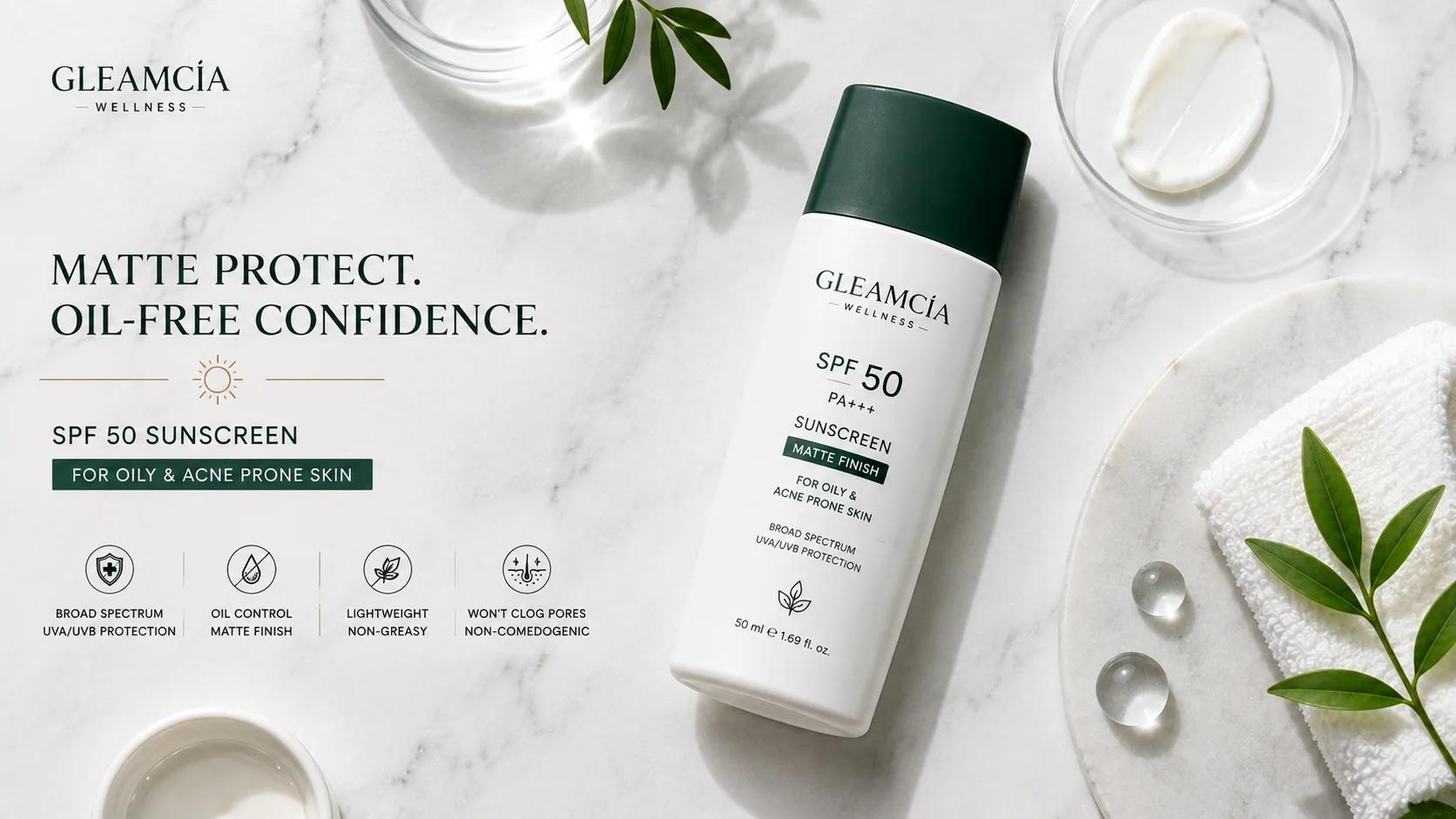
Matte or semi-matte finish. Any sunscreen marketed for oily skin needs to absorb excess sebum rather than sit on top of it. Matte-finish formulas contain ingredients like silica, clay, or zinc that absorb oil and control shine throughout the day.
Water-based or gel texture. Thick creams and oil-based formulations are designed for dry skin. For oily skin, a gel, fluid, or lightweight lotion formula applies evenly, absorbs quickly, and does not leave a heavy residue.
Non-comedogenic. This means the formula is designed not to clog pores. For acne-prone skin, this is the most important label to check. A sunscreen that blocks pores adds to congestion and makes breakouts worse, no matter how high the SPF.
Oil-free formulation. Sunscreens with mineral oils, heavy silicones, or lanolin-based thickeners feed the greasiness that oily skin is already managing on its own.
Broad-spectrum SPF 50 with PA+++ or PA++++ rating. SPF only measures UVB protection. In Pakistan’s climate, UVA protection — indicated by PA ratings — is equally important for preventing pigmentation and long-term skin damage.
Active ingredients that do double duty. The best sunscreens for oily skin include actives like Niacinamide to control sebum and reduce pore size, or Zinc Oxide which provides sun protection while also calming inflammation from acne.
Which Type of Sunscreen Is Best for Acne-Prone Skin?
Two main types of sunscreen exist — chemical and mineral — and they perform very differently on acne-prone skin.
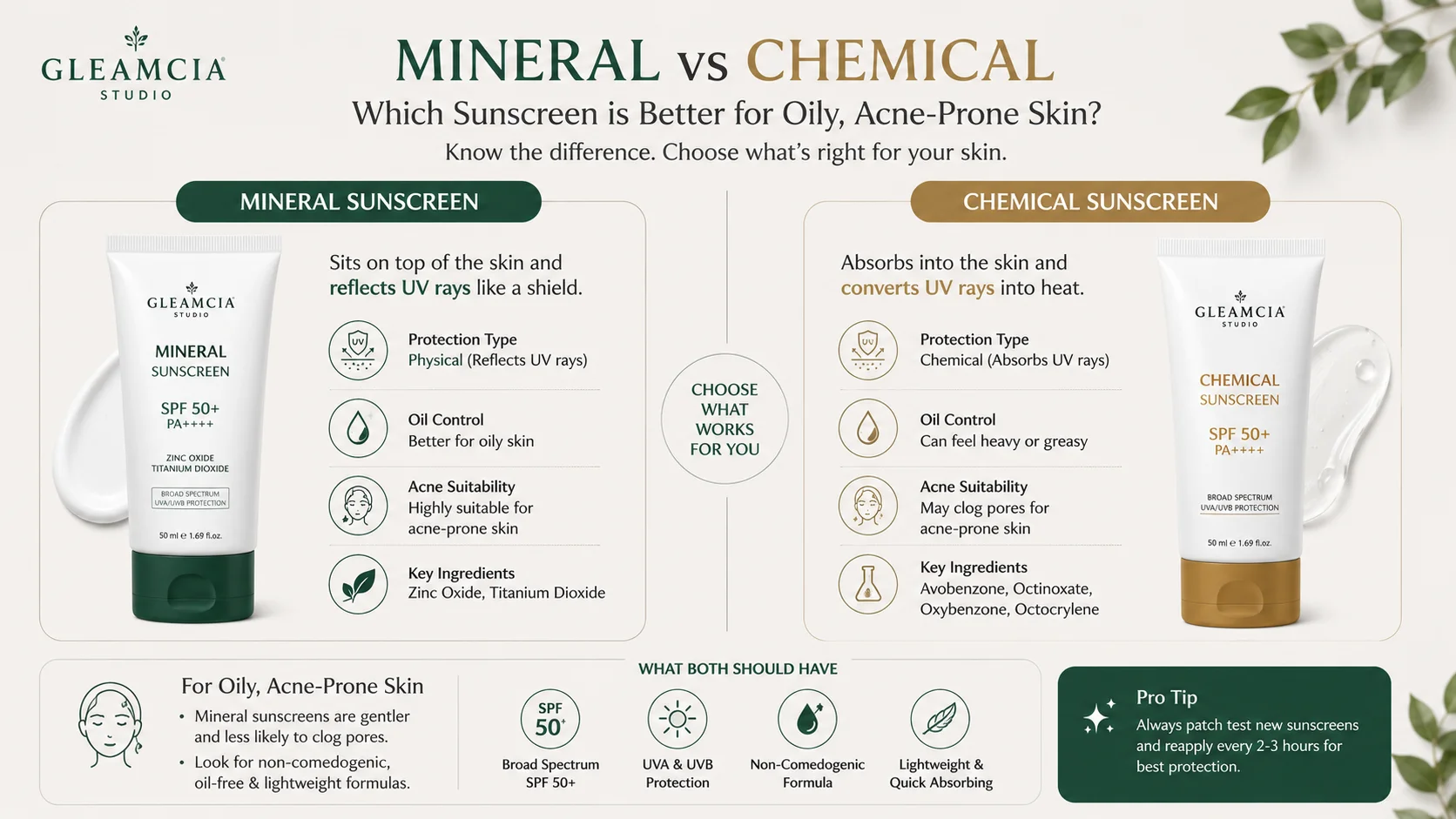
Chemical sunscreens absorb UV rays and convert them into heat, which is then released from the skin. They tend to be lighter in texture, but some chemical filters — particularly oxybenzone, avobenzone, and octinoxate — can trigger irritation and clog pores in sensitive or acne-prone skin. They also generate a mild heat response in the skin which can worsen redness in reactive skin types.
Mineral sunscreens sit on top of the skin and physically deflect UV rays. The two key mineral filters are Zinc Oxide and Titanium Dioxide. Zinc Oxide is particularly valuable for acne-prone skin because it does not just block the sun — it actively calms inflammation, reduces redness, and has antimicrobial properties that support acne management. Zinc-based sunscreens are also less likely to cause sensitivity reactions.
For acne-prone skin in Pakistan’s heat, a mineral sunscreen with Zinc Oxide as the primary filter, formulated in a lightweight gel or fluid texture, is the strongest starting recommendation. If you prefer a chemical sunscreen, look for one that is fragrance-free, oil-free, and contains no known comedogenic ingredients.
Hybrid formulations — combining mineral and chemical filters — are increasingly common and offer the light texture of chemical sunscreens with the gentleness of minerals. These are worth considering for people who find pure mineral sunscreens too heavy or white-cast-producing.
Which Sunscreen Is Good for Acne and Oily Skin?
The best sunscreen for both acne and oily skin is one that manages multiple concerns simultaneously without adding another product layer to an already active routine.
Key active ingredients to look for in a sunscreen that works for acne and oily skin:
- Zinc Oxide (15% to 20%) — Broad-spectrum mineral protection with anti-inflammatory and antimicrobial benefits directly relevant to acne-prone skin
- Niacinamide (5%) — Regulates sebum production, minimises pore appearance, and fades post-acne marks. A sunscreen with Niacinamide built in effectively combines two skincare steps
- Silica or Kaolin Clay — Oil-absorbing minerals that provide a matte finish and reduce midday shine without drying the skin
- Hyaluronic Acid — Lightweight hydration that keeps the skin barrier functioning without adding heaviness. Dehydrated oily skin actually produces more sebum as a compensatory response, so hydration remains important
- Centella Asiatica or Allantoin — Calming actives that reduce irritation for acne-prone skin that reacts easily
What to avoid in a sunscreen for acne and oily skin:
- Synthetic fragrances — a leading cause of contact dermatitis and breakout triggers
- Mineral oils or petrolatum in high concentrations
- Lanolin, which is highly comedogenic
- Alcohol in formulations already targeting dry or sensitive skin types
- Very high silicone content which can trap sebum under a film on the skin
Mineral Sunscreen vs Chemical Sunscreen for Oily and Acne-Prone Skin
| Feature | Mineral Sunscreen | Chemical Sunscreen |
| How it works | Sits on skin, reflects UV physically | Absorbs into skin, converts UV to heat |
| Best for acne-prone skin | Yes — especially Zinc Oxide formulas | Depends on formula; some filters are comedogenic |
| Texture | Can feel heavier; modern formulas improving | Generally lighter |
| White cast | Can occur, especially on deeper skin tones | No white cast |
| Irritation risk | Very low | Slightly higher in reactive skin |
| Oil control | Good — Zinc Oxide absorbs sebum | Varies; depends on added mattifying agents |
| Suitable for Pakistan’s heat | Yes, with lightweight fluid/gel base | Yes, particularly for daily outdoor use |
| Reapplication ease | Slightly thicker but effective | Easier for reapplication over makeup |
| Post-acne mark protection | Excellent — Zinc calms inflammation | Good but no anti-inflammatory benefit |
| Recommended for beginners | Yes — gentler, less risk of reaction | Yes — if formula is non-comedogenic and fragrance-free |
For most oily and acne-prone skin types in Pakistan, a hybrid or mineral sunscreen in a fluid, non-greasy texture delivers the best balance of protection, oil control, and acne safety.
Who Should Use a Sunscreen Formulated for Oily Skin?
Any sunscreen works for some people. The specifically oil-control and non-comedogenic category is most beneficial for:
- People with clinically oily skin that becomes shiny within an hour or two of washing
- Anyone with active acne, cystic breakouts, or congested skin
- People with acne-prone skin dealing with recurring blackheads and whiteheads
- Those with post-acne hyperpigmentation who need daily SPF to prevent marks from deepening
- Anyone living in high-UV environments — which includes most cities across Pakistan from March through October
- People who exercise outdoors or work in direct sun for extended periods
- Those with combination skin, particularly if the T-zone is significantly oily
- Teenagers and young adults in their 20s and 30s managing hormonal acne
Even people with dry skin occasionally experience oily skin in peak Pakistani summer heat. A matte-finish sunscreen provides comfortable wear in humid conditions regardless of base skin type.
How to Apply Sunscreen on Oily Skin Without Looking Greasy
Application method matters as much as the formula itself. A sunscreen applied incorrectly on oily skin makes even the best product feel heavy and greasy.
- Cleanse first. Apply sunscreen to clean skin. Any residual sebum, product, or environmental debris under SPF reduces its effectiveness and feels worse.
- Let your serum or moisturiser absorb. If you use a serum (like Niacinamide) or a lightweight moisturiser, let it absorb fully before applying sunscreen. Two to three minutes is enough.
- Use the right amount. About a 2-finger length of sunscreen for the face is the recommended amount for full protection. Using too little is one of the most common reasons SPF underperforms.
- Pat, do not rub. Gently pat sunscreen into the skin using fingertips. Rubbing too vigorously moves the product around without letting it form a consistent protective film.
- Let it set for 5 minutes before makeup. If you wear makeup over SPF, give the sunscreen time to settle before applying anything on top.
- Reapply every 2 hours in direct sun. No sunscreen lasts all day without reapplication. A lightweight setting spray SPF or powder SPF makes reapplication over makeup more practical.
- Blotting paper during the day helps manage midday shine without disturbing the SPF layer underneath.
How Often Should You Use Sunscreen on Oily Skin?
Daily. Without exception.
UV damage accumulates even on cloudy days, even indoors near windows, and even in the fifteen minutes between leaving home and reaching a car or office. For someone managing acne-prone skin with post-inflammatory marks, daily SPF use is one of the non-negotiable steps that prevents existing marks from permanently darkening.
Morning use is mandatory. If spending extended time outdoors, reapplication every 2 hours maintains effective protection. Evening reapplication is not needed — but a Niacinamide serum or treatment at night supports what sunscreen does during the day by working on oil control and barrier repair overnight.
Browse the Gleamcia Skin Care range for SPF and daily skincare products suited to oily skin types across Pakistan’s climate.
How Long Does It Take to See a Difference After Switching to the Right Sunscreen?
The right sunscreen does not produce visible results the way an active serum does — its job is prevention. But switching from a wrong formula to the right one does produce noticeable changes.
- Days 1 to 7: Skin feels less congested and oily by midday. Existing breakouts are less likely to worsen.
- Weeks 2 to 4: With consistent SPF use, post-acne marks stop darkening. New marks are lighter than previous ones. Skin tone starts to feel more even.
- Weeks 6 to 8: Reduced new breakouts linked to comedogenic sunscreen ingredients. Existing hyperpigmentation starts to fade visibly when paired with a Vitamin C or Niacinamide serum underneath.
- 3 months: Long-term UV damage prevention becomes visible as pigmentation lightens and skin tone becomes noticeably more even with daily protection.
SPF is the one skincare step where consistency shows its value cumulatively, not immediately. The best results come from treating it as non-negotiable, not occasional.
Aftercare Tips for Wearing Sunscreen on Oily and Acne-Prone Skin
Do:
- Apply sunscreen as the last step of your morning skincare routine, after moisturiser
- Use a gentle, balanced face wash at the end of the day to remove sunscreen fully — incomplete SPF removal is a real cause of clogged pores
- Pair with a Niacinamide serum underneath for added oil control and pore-minimising effect
- Carry a small blotting paper or setting powder SPF for reapplication without disturbing makeup
- Store sunscreen away from direct heat or sunlight — degraded SPF formulas are far less effective
Do not:
- Skip SPF on overcast or indoor days — UV penetrates glass and cloud cover
- Apply sunscreen without cleansing first — the combination of old sebum and SPF is a recipe for congestion
- Use a sunscreen formulated for body skin on the face — body SPF is typically much thicker and far more comedogenic
- Assume makeup with SPF provides adequate protection — the amount needed for full SPF coverage far exceeds what most people apply in makeup
- Stop using SPF because skin is oily in summer — that is precisely when protection is most needed
What Does a Good Sunscreen for Oily Skin Cost in Pakistan?
Sunscreen pricing is directly tied to formulation quality, and the difference matters more in the SPF category than almost anywhere else in skincare.
The active filter quality is the biggest cost factor. A mineral sunscreen using micronised Zinc Oxide at 15% to 20% concentration costs more to produce than a basic chemical SPF with low-grade filters. The micronisation process ensures the mineral sits on skin without a heavy white cast and provides more even coverage.
Texture engineering is the second major cost driver. A gel or fluid matte formula for oily skin requires a more complex base than a standard cream SPF. Oil-control agents, skin-feel modifiers, and comedogenicity testing all add to the production cost.
Added actives like Niacinamide or Centella Asiatica built into the SPF formula mean you are getting two skincare steps in one product — which changes the value calculation significantly. A sunscreen with these inclusions at effective concentrations is a better investment than two separate budget products.
Bundle pricing with a face wash and serum from the same brand range typically offers better value per product and ensures ingredient compatibility. Visit gleamcia.com for current pricing and any active promotions on the skincare range.
Why Choose Gleamcia
Gleamcia’s approach to skincare is built on one standard: formulations that are actually designed for Pakistani skin in Pakistan’s climate. Not imported textures that feel heavy in Karachi’s humidity. Not fragrance-heavy formulas that irritate already acne-stressed skin.
- SPF and skincare formulations developed with oily and acne-prone skin types in mind
- Non-comedogenic formulas tested to avoid clogging pores on active and breakout-prone skin
- Active ingredients like Niacinamide, Zinc, and Vitamin C included at concentrations that perform, not just appear on a label
- No unnecessary synthetic fragrances or known comedogenic ingredients
- Nationwide delivery across Pakistan, from Karachi to Lahore, Islamabad to Hyderabad
- Full ingredient transparency so you know exactly what you are putting on your skin
Order from the Gleamcia Skin Care range and get a sunscreen and skincare routine built for real Pakistani skin in real Pakistani weather.
Frequently Asked Questions
1. Which sunscreen is good for acne and oily skin? The best sunscreen for acne and oily skin is non-comedogenic, oil-free, and ideally mineral-based with Zinc Oxide as a primary filter. Zinc Oxide protects against UV while also calming inflammation and controlling sebum — making it a natural fit for acne-prone skin. Look for a matte or semi-matte gel or fluid texture with no synthetic fragrances, and ideally one that contains Niacinamide for added oil control and pore minimisation. Gleamcia’s skincare range is formulated with these exact priorities. Browse at gleamcia.com.
2. What are the top 3 sunscreens for oily skin in Pakistan? Rather than listing brand names, the top three categories of sunscreen that consistently perform on oily skin in Pakistan are: a lightweight gel-based SPF 50 with Zinc Oxide and Niacinamide for acne-prone skin; a hybrid chemical-mineral fluid SPF 50 PA++++ with a matte finish for combination skin in humid weather; and a water-based tinted SPF 50 with mattifying agents for people who wear light coverage over their SPF. What all three have in common is non-comedogenic formulation, oil-free texture, and broad-spectrum UVA/UVB protection at SPF 50 or above.
3. What are the top sunscreens for oily skin in Pakistan’s heat? The sunscreens that perform best in Pakistan’s summer heat share specific characteristics: SPF 50 or above with a PA++++ UVA rating for protection against the high UV index, water-resistant or sweat-resistant formulas for humid outdoor conditions, matte or oil-control finishes that last 4 to 6 hours before reapplication, non-comedogenic formulation that does not contribute to heat-triggered breakouts, and lightweight gel or fluid textures that do not feel heavy in 40-degree temperatures. Gleamcia’s skin care range is developed with these exact climate conditions in mind. Shop via gleamcia.com or order on WhatsApp at 0336 1223363.
4. Which type of sunscreen is best for acne? Mineral sunscreen, particularly formulas containing Zinc Oxide, is the most consistently recommended type for acne-prone skin. Zinc Oxide provides broad-spectrum UV protection while also reducing inflammation and carrying mild antimicrobial properties — all directly relevant to acne management. Chemical sunscreens are not automatically off-limits for acne-prone skin, but require more careful ingredient screening to avoid comedogenic filters and irritating fragrances. If in doubt, mineral first.
5. Can I use sunscreen every day on oily skin without breaking out? Yes — if the sunscreen is non-comedogenic and formulated for oily skin. The breakouts people associate with sunscreen are almost always caused by the wrong formula: thick creams, comedogenic ingredients, or synthetic fragrances. A lightweight, oil-free, non-comedogenic SPF 50 used daily will not cause breakouts. It actively prevents the UV-triggered inflammation that makes acne-prone skin worse.
6. Does sunscreen make oily skin more oily? Wrong formula, yes. Right formula, no. A sunscreen formulated with oil-absorbing agents like silica or kaolin clay actually reduces shine compared to wearing nothing at all, because it controls sebum on the skin surface. The shine and greasiness people associate with sunscreen comes from using a moisturising cream SPF designed for dry skin on an already-oily complexion. Switch to a matte gel or fluid SPF and the experience is completely different.
7. Do I need moisturiser under sunscreen if I have oily skin? It depends on the sunscreen formula. Some lightweight SPF 50 formulas for oily skin include enough hydrating agents to skip a separate moisturiser, particularly for very oily skin types. If your sunscreen does not include hydrating actives, a thin layer of lightweight water-based moisturiser underneath is still recommended. Dehydrated oily skin compensates by producing more sebum, which is counterproductive. The goal is skin that is hydrated but not greasy — a lightweight moisturiser under the right SPF achieves this well.
Protect Your Skin the Right Way
In Pakistan’s heat, sunscreen is not optional. It is the most important skincare step you can take — and with the right formula for oily skin, it does not have to feel heavy, greasy, or breakout-causing.
Order from Gleamcia’s Skin Care range available at gleamcia.com. Nationwide delivery across Pakistan. You can also reach us on WhatsApp at 0336 1223363 and our team will help you find the right SPF and skincare combination for your skin type and concerns.