Niacinamide vs Vitamin C: The Comparison Your Skin Routine Actually Needs
If you have been trying to figure out whether niacinamide or vitamin C is the right active for your skin, you are asking a question that trips a lot of people up. Both are brightening ingredients. Both show up in serums, creams, and cleansers all over the market. And yet they work in entirely different ways, at different depths, for different concerns.
The short version: niacinamide vs vitamin C is less a competition and more a decision about what your skin actually needs right now. Understanding the difference between the two is what helps you pick the right one, or in many cases, layer both strategically. Gleamcia’s skincare range carries both actives across multiple formulas, and this guide will walk you through exactly what each one does and how to use them properly.
What Is Niacinamide and How Does It Work for Your Skin?
Niacinamide is Vitamin B3, a water-soluble vitamin that works at the surface and just below it. It does not bleach the skin or strip it. Instead, it works by reducing how much pigment gets transferred between skin cells, which is what causes uneven tone and dark spots to gradually fade over time. On top of that, niacinamide strengthens the skin barrier, helps regulate oil production, and visibly reduces the appearance of pores with consistent use.
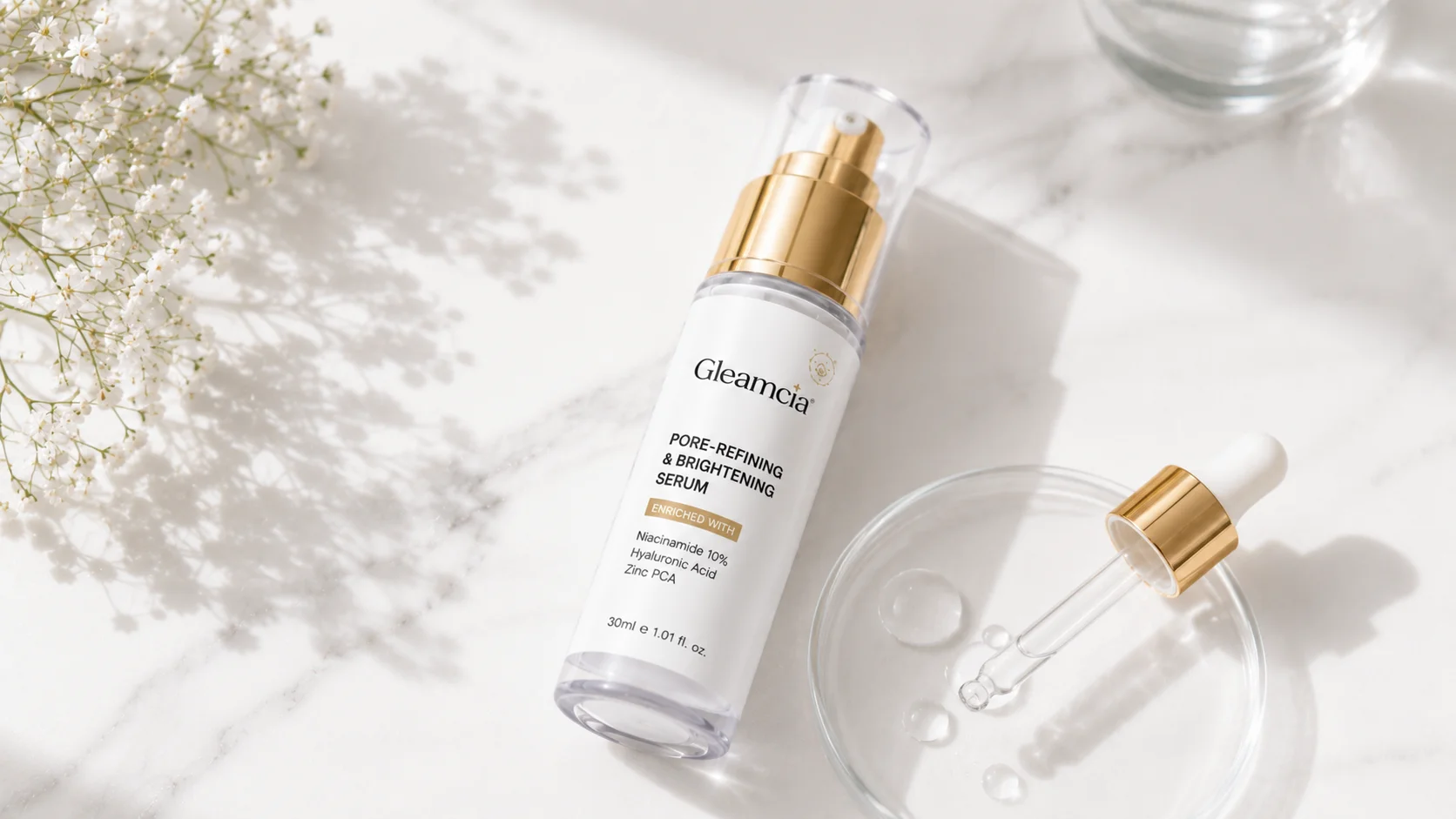
It is one of the most studied actives in topical skincare, largely because it suits almost every skin type without causing irritation. Oily skin, dry skin, combination, sensitive, all of them respond well to niacinamide. That broad tolerability is a big part of why it appears in the Gleamcia Pore-Refining and Brightening Serum as a primary active alongside alpha arbutin, zinc PCA, witch hazel, hyaluronic acid, green tea, and panthenol. The serum is built for daytime or nighttime use, and niacinamide is stable in both light and dark conditions, which makes it a practical daily ingredient.
What Is Vitamin C and How Does It Work for Skin Brightening?
Vitamin C is an antioxidant, and that distinction matters. Unlike niacinamide which works primarily at the pigment transfer level, vitamin C works by neutralising free radicals, the environmental damage from sun exposure and pollution that accelerates dull, uneven, and ageing-looking skin. It also interferes with an enzyme called tyrosinase, which plays a role in melanin production, making it an effective brightening ingredient at a different point in the pigment cycle than niacinamide.
Vitamin C is present in both the Gleamcia Overnight Glow Therapy Night Cream and the Gleamcia Brightening Face Wash. In the night cream it sits alongside alpha arbutin, kojic acid, licorice root, hyaluronic acid, and glutathione, making it part of a multi-active formula focused on overnight skin brightening and repair. In the face wash it appears as Vitamin C SAP and MAP, which are stabilised derivatives of vitamin C that remain effective in a rinse-off formula without oxidising before they reach the skin.
The key thing to know about vitamin C is that it is more reactive than niacinamide. It degrades with exposure to air, light, and heat, and certain forms are less stable in water-based formulas. Stabilised derivatives like SAP (sodium ascorbyl phosphate) and MAP (magnesium ascorbyl phosphate), which Gleamcia uses in the face wash, were developed specifically to address that issue while maintaining efficacy.
Who Should Choose Niacinamide for Their Skin Concern?
Niacinamide is the right place to start if your main concerns are visible pores, oily or congested skin, mild uneven tone, or a compromised skin barrier. It is also the better first choice for anyone who has sensitive or reactive skin, since its tolerability profile is exceptionally consistent across skin types.
It suits combination to oily skin especially well. The zinc PCA in the Gleamcia Pore-Refining Serum works alongside niacinamide to regulate sebum production and keep pores from looking enlarged or congested throughout the day. If your skin gets shiny quickly or your pores are one of your main frustrations, a niacinamide-forward serum used daily is a strong foundation.
Niacinamide is also a good starting point for anyone new to active skincare who wants results without the irritation risk that sometimes comes with higher-strength actives like pure L-ascorbic acid vitamin C.
Who Should Choose Vitamin C for Their Skin Concern?
Vitamin C is the right focus if your skin is dealing with dullness caused by sun damage, environmental exposure, or a general lack of radiance. People who spend a lot of time outdoors, live in a heavily polluted city, or notice their skin looking tired and flat rather than glowing will get more targeted benefit from vitamin C than from niacinamide alone.
It works especially well as a nighttime ingredient because vitamin C applied while the skin is in its natural repair cycle, and protected from UV exposure that would otherwise oxidise it, has a longer window to do its job. The Gleamcia Overnight Glow Therapy Night Cream pairs vitamin C with glutathione, which is another antioxidant that supports brightening through a slightly different mechanism, making the combination more effective than either ingredient would be on its own.
Key Benefits of Niacinamide for Skin
- Reduces pigment transfer between skin cells, which gradually fades dark spots and uneven tone with consistent use
- Visibly minimises pore appearance by regulating oil production at the follicle level
- Strengthens the skin’s moisture barrier, which reduces sensitivity and improves overall skin resilience
- Broadly well-tolerated across oily, dry, combination, and sensitive skin types
- Works in both AM and PM routines without photo-sensitivity concerns
- Pairs comfortably with most other actives including alpha arbutin, hyaluronic acid, and zinc
Key Benefits of Vitamin C for Skin Brightening
- Neutralises free radicals from UV and pollution that accelerate dullness and uneven tone
- Inhibits tyrosinase activity to slow down melanin production at the source
- Supports collagen production, which contributes to firmer, more plump-looking skin over time
- Works well as a nighttime active since it absorbs without UV interference during the repair cycle
- Stabilised vitamin C forms like SAP and MAP offer the benefits of vitamin C without the instability of pure ascorbic acid
- Pairs effectively with glutathione and kojic acid for a more complete brightening effect
How to Use Niacinamide and Vitamin C Together in Your Routine
The earlier concern that niacinamide and vitamin C should not be used together has largely been addressed by dermatology research. At the concentrations used in modern skincare formulas, the two actives are compatible and actually complement each other across different steps of a routine.
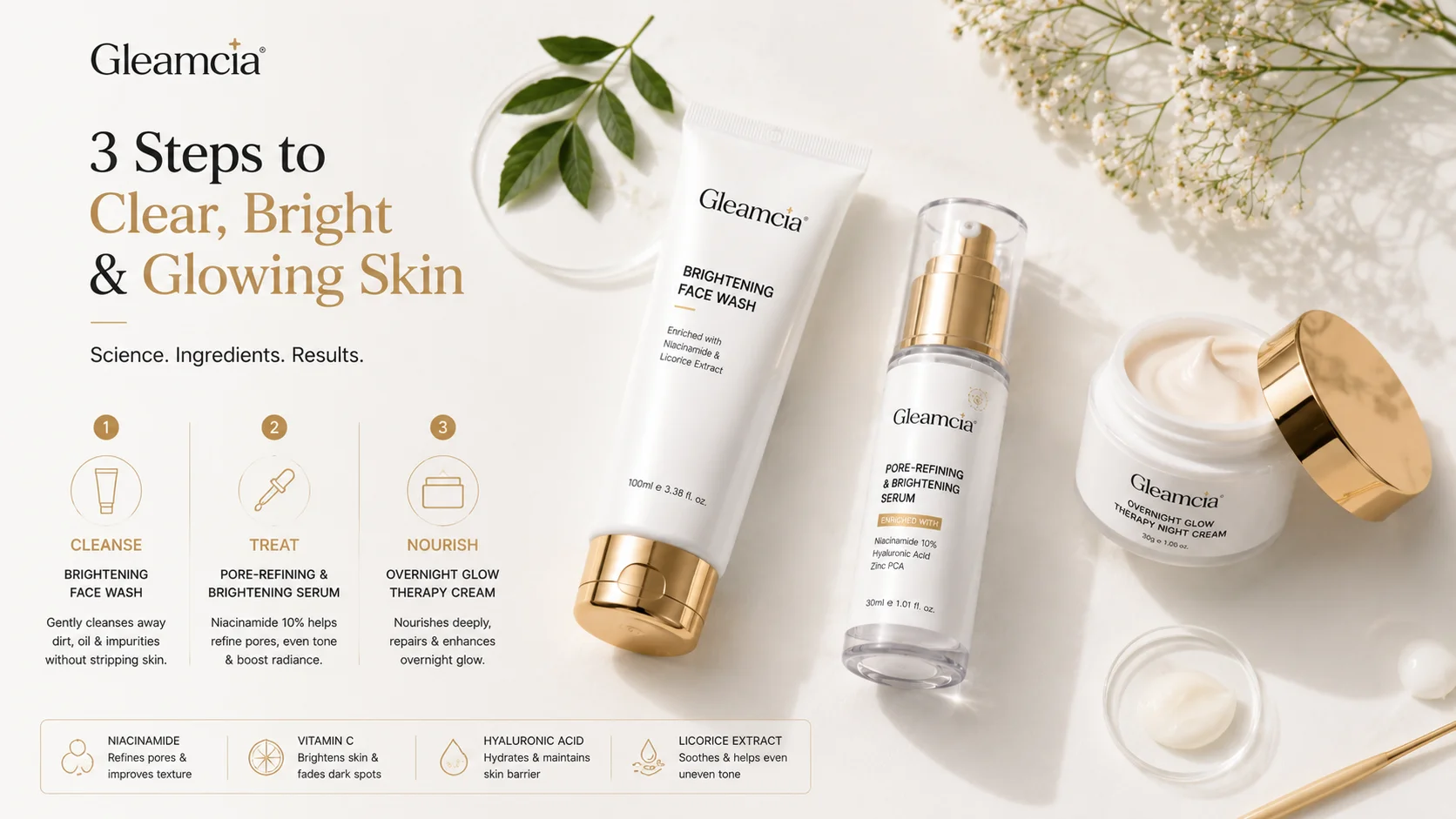
Here is a practical routine using the Gleamcia range that covers both:
- Cleanse with the Gleamcia Brightening Face Wash morning and evening. The combination of niacinamide, vitamin C SAP and MAP, alpha arbutin, licorice, and mulberry extract in the cleanser means your skin is being prepped with actives before you even reach the serum step.
- Pat the skin dry thoroughly. Leftover water on the skin dilutes whatever you apply next.
- Apply 2 to 3 drops of the Gleamcia Pore-Refining and Brightening Serum and press it gently into the skin. This is where niacinamide does the heavier lifting for pores and tone.
- Wait 60 to 90 seconds for the serum to absorb before moving to the next step.
- In the evening, apply the Gleamcia Overnight Glow Therapy Night Cream as the last step. This is where vitamin C, glutathione, and kojic acid work through the night.
- In the morning, always follow the serum with SPF. Niacinamide itself is not photo-sensitising, but alpha arbutin and the skin’s overall active routine benefit from UV protection during the day.
How Soon Do Results from Niacinamide vs Vitamin C Appear?
Both actives work gradually, and the timeline is similar enough that the real variable is consistency rather than which one you chose.
With niacinamide, the first changes tend to be functional rather than visible. Skin feels less oily, less congested, and more comfortable within the first two to three weeks. Pore appearance and tone improvements typically become noticeable around four to six weeks of daily use.
With vitamin C, radiance is usually the first visible shift, sometimes apparent within two to three weeks as the antioxidant effect reduces the dull, tired look that comes from oxidative stress. Longer-term tone correction from tyrosinase inhibition takes closer to six to eight weeks of consistent nightly use.
Results vary based on skin type, the depth of existing pigmentation, and how consistently the routine is maintained. These are not quick fixes but the kind of ingredients that build real, visible improvement over time.
How Often Should You Use Niacinamide and Vitamin C?
Niacinamide is well-suited for twice-daily use. Morning and evening, as part of both your AM routine under SPF and your PM routine before a night cream, is an approach most skin types handle without any adjustment period.
Vitamin C applied topically works best at night for most people, particularly in a cream format like the Gleamcia Overnight Glow Therapy. That said, stabilised vitamin C forms in a morning cleanser like the Gleamcia Brightening Face Wash are fine for daily AM use since they are rinsed off before prolonged sun exposure.
If you are just starting with active skincare, beginning with once-daily use for the first week and building up to twice daily gives your skin barrier time to adjust without the risk of over-stimulation.
Aftercare Tips When Using Niacinamide and Vitamin C
Do use SPF every single morning. Both ingredients are working to reduce pigmentation, and sun exposure actively reverses that progress. A daily sunscreen is not optional if you want results from either active.
Do keep your routine consistent. Skipping days adds up quickly, and the skin cycle that both actives work within resets without regular input.
Do introduce new products one at a time if you are starting from scratch. Adding the serum, night cream, and face wash all in week one is fine for most people, but if your skin is reactive, start with the face wash and serum and add the night cream after ten days.
Do not layer multiple vitamin C formats on top of each other in the same step. The Gleamcia routine is designed so that each product does a specific job without doubling up on the same active in the same step.
Do not expect overnight results. Pigment correction and barrier improvement happen within the skin cycle, which takes around 28 to 42 days. The visible results come with time.
Possible Side Effects and Precautions
Niacinamide at typical serum concentrations is among the best-tolerated actives in skincare. A mild flushing sensation is occasionally reported in the first few days of use, particularly with higher concentrations, but this usually settles without needing to stop the product. It is suitable for most skin types including sensitive skin.
Vitamin C in its stabilised forms, as used in the Gleamcia range, is gentler than pure L-ascorbic acid and is unlikely to cause the tingling or irritation that some people associate with vitamin C products. If you have a history of reacting to vitamin C products specifically, patch testing before full-face use is the practical step.
Neither active is photosensitising in the conventional sense, but SPF use is still strongly recommended as a complementary step whenever brightening actives are part of your routine.
According to the American Academy of Dermatology, both niacinamide and vitamin C are recognised as evidence-supported actives for addressing uneven skin tone and improving overall skin radiance, with a well-established safety profile across most skin types.
Niacinamide vs Vitamin C: Direct Comparison for Skin Brightening
| Niacinamide | Vitamin C | |
| Type of ingredient | B vitamin (water-soluble) | Antioxidant vitamin |
| Primary skin concern | Pores, oily skin, uneven tone, barrier repair | Dullness, sun damage, oxidative stress, pigmentation |
| How it brightens | Reduces pigment transfer between skin cells | Inhibits tyrosinase, neutralises free radicals |
| Skin type suitability | All skin types including sensitive | Most skin types; stabilised forms suit sensitive skin |
| Best time to use | AM and PM | PM preferred; rinse-off forms fine in AM |
| Stability | Highly stable, no special storage needed | Sensitive to air, light, heat; stabilised forms resolve this |
| Gleamcia product | Pore-Refining and Brightening Serum | Overnight Glow Therapy Night Cream, Brightening Face Wash |
| Works best when | Used daily, AM and PM | Used consistently at night as part of a full routine |
The clearest takeaway from this comparison: niacinamide is your daily workhorse active for pores, tone, and barrier support. Vitamin C is your nighttime repair and brightening specific active. They address the same broad concern from two different mechanisms, which is why the most effective routines tend to include both.
What Does a Niacinamide and Vitamin C Skincare Routine Cost in Pakistan?
Pricing across active skincare depends on formulation quality, active ingredient concentration, product size, and whether you are buying individual items or a full routine together.
The Gleamcia Pore-Refining and Brightening Serum is Rs. 3,475 for 30ml. At 2 to 3 drops per application, that is approximately one to two months of daily use. The formula carries niacinamide, alpha arbutin, zinc PCA, hyaluronic acid, and green tea, which at that concentration level represents genuine value compared to single-active serums at similar price points.
The Gleamcia Overnight Glow Therapy Night Cream is Rs. 2,350 for 30gm, and carries vitamin C alongside five other actives including glutathione, kojic acid, and alpha arbutin in a nightly formula. The Gleamcia Brightening Face Wash is Rs. 1,925 for 100ml and covers both niacinamide and vitamin C in a daily cleanser step.
Running all three as a complete routine from gleamcia.com gives you niacinamide and vitamin C working across every step, cleanser, serum, and cream, with nationwide delivery across Pakistan included.
Why Choose Gleamcia for a Niacinamide and Vitamin C Routine
Gleamcia formulates around actives that have a real clinical track record. Niacinamide, vitamin C in its stabilised forms, alpha arbutin, and glutathione are not trend ingredients. They are compounds that consistently deliver results in published dermatological research, and Gleamcia builds them into formulas at concentrations that are designed to actually do something.
The full Gleamcia Skin Care range is built as a layering system. The face wash, serum, and night cream each serve a distinct step without ingredient conflicts or unnecessary overlap. You are not doubling up on the same active in the same format, you are covering the brightening concern from multiple angles within a single coordinated routine.
Every product is quality-checked before dispatch. Ingredient information is transparent and matches what is in the formula. Gleamcia ships nationwide across Pakistan, and customer support is available on WhatsApp for anyone who wants help building the right routine for their skin type.
Frequently Asked Questions About Niacinamide vs Vitamin C
Which is better for uneven skin tone, niacinamide or vitamin C? Both address uneven tone, but through different mechanisms. Niacinamide reduces pigment transfer between skin cells, making it effective for general unevenness and pore-related dullness. Vitamin C inhibits the enzyme that triggers melanin production and neutralises oxidative damage, making it more targeted for sun-related discolouration and radiance loss. For best results, use both in the same routine at different steps.
Can niacinamide and vitamin C be used together in the same skincare routine? Yes. At the concentrations used in modern skincare formulas, the two actives are compatible. The earlier concern about them interacting and reducing each other’s effectiveness has not held up consistently in practice. Using niacinamide in a serum and vitamin C in a night cream, as in the Gleamcia routine, naturally separates them by step and timing without any compatibility issue.
Is niacinamide or vitamin C better for sensitive skin? Niacinamide has a broader tolerability profile and is generally the safer starting point for sensitive skin. Stabilised vitamin C forms like SAP and MAP, which Gleamcia uses, are gentler than pure L-ascorbic acid and are suitable for most skin types including sensitive skin. Patch testing before full-face use is always a sensible step if your skin has a history of reacting to actives.
How long does it take to see results from niacinamide vs vitamin C? Both actives work within the skin cycle, which takes approximately 28 to 42 days. Niacinamide improvements in pores and oiliness may be noticed within two to three weeks. Vitamin C radiance improvements can show up around the same time. Tone correction from both ingredients typically becomes clearly visible around six to eight weeks of consistent daily use.
Does Gleamcia deliver skincare products nationwide across Pakistan? Yes, Gleamcia ships to all cities across Pakistan. Order via gleamcia.com or reach out on WhatsApp at 0336 1223363 to place your order directly.
Start Your Niacinamide and Vitamin C Routine with Gleamcia Today
Both actives belong in a well-built brightening routine, and the Gleamcia range makes it straightforward to use them in the right steps without guesswork. Order the Gleamcia Pore-Refining and Brightening Serum, the Gleamcia Overnight Glow Therapy Night Cream, and the Gleamcia Brightening Face Wash on our website with nationwide delivery across Pakistan. Order from Karachi and get it delivered anywhere in Pakistan, or place your order on WhatsApp at 0336 1223363 for direct assistance.