Introduction
Two weeks in Ramazan heat, or a summer in Karachi where the midday UV index regularly hits 11 or 12, or a few school pickup routines in June — and the face comes back distinctly darker than it was before. The neck does not match the jawline. The forearms are three shades deeper than the chest. Sun tanning in Pakistan is not an abstract skincare concern. It is a practical, seasonal reality that affects most people who spend any meaningful time outdoors.
How to remove sun tan from skin is a question that has genuine, specific answers — ones that go well beyond lemon and turmeric on the face. This guide covers the active ingredients that actually fade a tan, how sunscreen interacts with tanning (the real answer is more nuanced than most people expect), and the complete routine that works for sun tan removal in Pakistan’s UV conditions. Browse the Gleamcia Skin Care range for brightening serums and SPF formulas developed specifically for South Asian skin and Pakistan’s sun intensity.
What Actually Causes a Sun Tan? The Mechanism Behind the Darkening
A tan is not the sun warming your skin and making it golden. It is your skin’s emergency response to UV radiation damage.
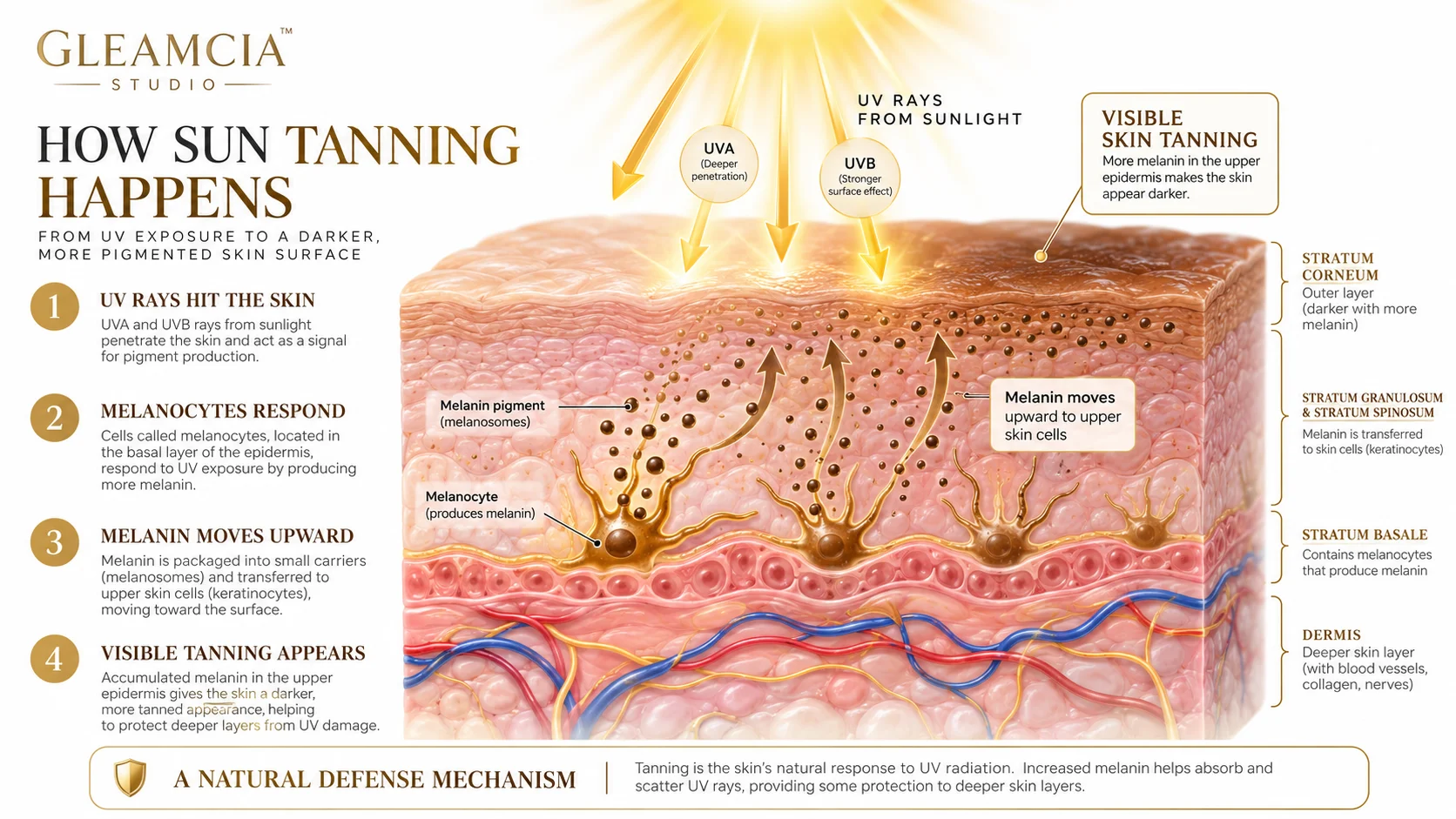
When UV rays — primarily UVB for burning but also UVA for deeper, longer-lasting pigmentation — hit the skin, they cause damage to the DNA in skin cells. Melanocytes, the specialised cells that produce pigment, detect this damage signal and produce more melanin as a shield. The extra melanin moves up through the skin layers to surround and protect the cell nuclei from further UV damage. That accumulation of melanin at the surface is what appears as the visual darkening of a tan.
A tan is not a sign of healthy skin. It is a sign of your skin deploying its backup defence system against cellular damage. The American Academy of Dermatology is clear on this: there is no such thing as a safe tan produced by UV exposure. Any UV-induced tan represents measurable DNA damage in skin cells.
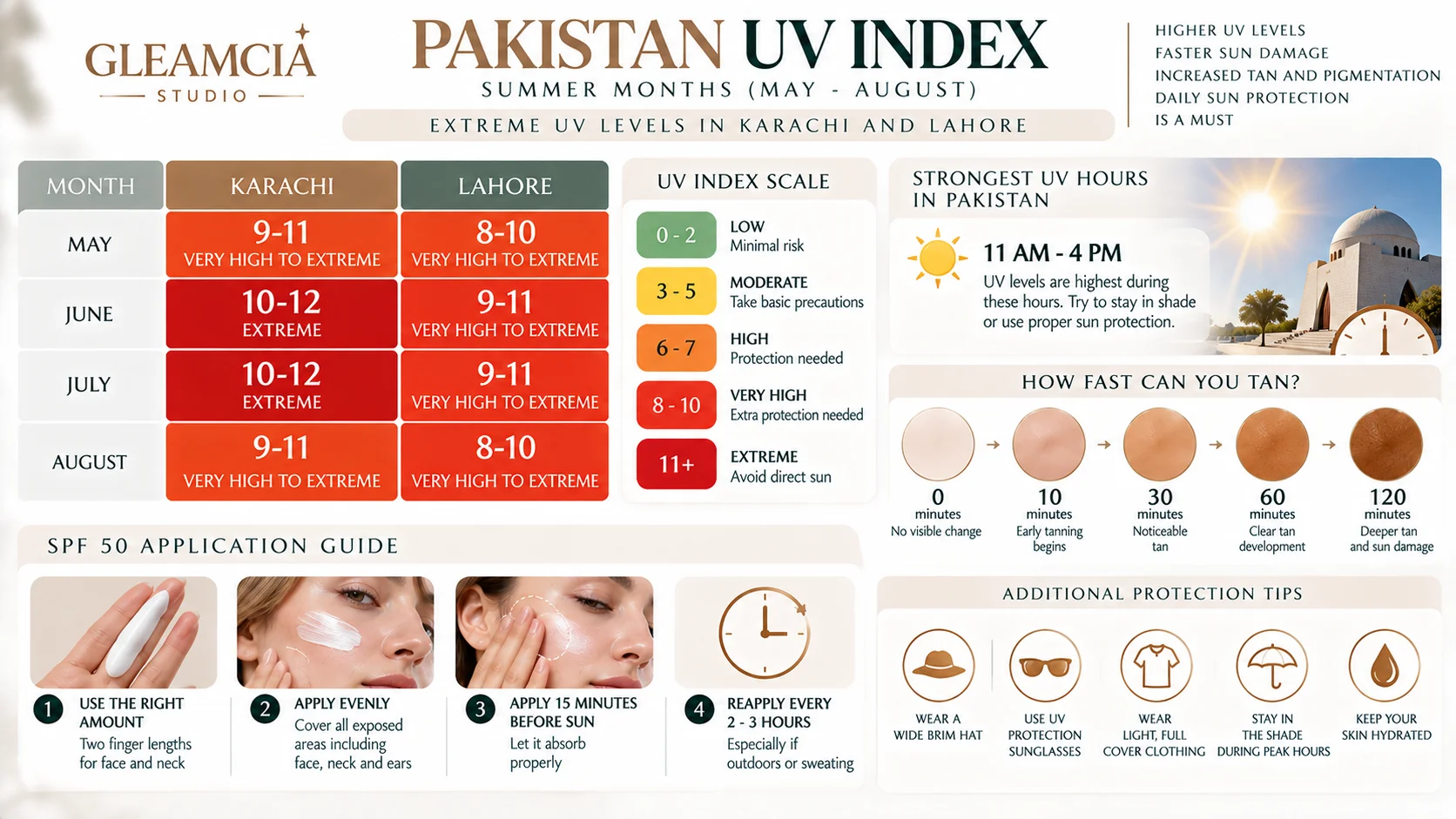
In Pakistan’s climate — particularly during peak summer months when the UV index in Karachi and Lahore regularly reaches the “extreme” category above 11 — this process happens significantly faster and with more intensity than in countries where the sun tan conversation is often framed around leisure tanning. The tanning here is not a choice most people are making. It is the consequence of daily life in direct sunlight without adequate protection.
How to Remove Sun Tan from Skin: The Active Approach
Removing a sun tan requires addressing the melanin that has already been deposited in the skin. This is not a fast process — melanin sits in the epidermis and the skin cell cycle determines how quickly the pigmented cells move to the surface and shed. But with the right actives applied consistently and SPF preventing new UV stimulation, a tan can be visibly reduced over six to ten weeks.
Vitamin C (L-Ascorbic Acid) is the most effective first-line active for sun tan removal. It inhibits tyrosinase — the enzyme that produces melanin — and acts as an antioxidant that neutralises the UV-generated free radicals that trigger continued melanin production. Applied in the morning under SPF, it addresses both the existing tan and the ongoing stimulus for more of it. Concentrations of 10% to 15% produce the most visible brightening results for tan removal within four to eight weeks.
AHAs (Glycolic and Lactic Acid) accelerate the skin cell turnover that moves melanin-rich surface cells upward and off. Used two to three evenings per week, they bring newly brightened cells to the surface faster than the natural 28 to 40-day cycle would allow. Glycolic acid is more potent and penetrates deeper; lactic acid is gentler and better tolerated on sensitive skin — both are effective for tan line fading when used consistently.
Niacinamide blocks the transfer of melanin from melanocytes to the surface skin cells where it becomes visible. It does not stop melanin production at the source but prevents the distribution that makes existing pigment visible. This makes it a strong complement to Vitamin C — both targeting different steps in the melanin pathway simultaneously.
Alpha Arbutin is a stable, gentle tyrosinase inhibitor particularly well suited for tan removal rather than general brightening because it works specifically on UV-stimulated melanin overproduction without the irritation risk of hydroquinone.
Retinol increases cell turnover more dramatically than AHAs over a longer period, and reduces the melanin content of individual skin cells alongside its turnover effects. Best introduced in the evening routine after tan-removal actives are established, as it amplifies the overall brightening rate significantly.
The Correct Ingredients to Remove Sun Tan — Ranked for Pakistan’s Skin Tone Context
Pakistan’s population has predominantly medium to deep skin tones — in the Fitzpatrick III to V range. This matters for ingredient selection because some brightening actives that work well on lighter skin tones can cause paradoxical darkening (PIH) on medium to deep skin if used at too high a concentration or without adequate SPF.
Vitamin C, Niacinamide, and Alpha Arbutin are the safest and most effective combination for Pakistani skin across all tones for tan removal. They address the melanin pathway without the irritation risk that makes some other brightening actives problematic on darker skin.
AHAs used at appropriate concentrations — glycolic acid at 5% to 10% for regular use, not pharmaceutical-strength peels applied at home — are effective and generally well tolerated. The risk on darker skin types is post-exfoliation PIH if the barrier is over-disrupted and then exposed to UV without adequate SPF protection.
Kojic Acid is another accessible tan-removal active with a good safety profile for medium to deep skin. It is naturally derived, inhibits tyrosinase, and works particularly well for patchy tan lines that are darker in some zones than others.
Does Sunscreen Stop Tanning Completely?
No. No sunscreen stops tanning completely. This is one of the most commonly misunderstood things about SPF and it is worth explaining clearly.
SPF 50 blocks approximately 98% of UVB rays. The remaining 2% that reaches the skin is still sufficient to trigger melanocyte activity and produce a tan over extended exposure. The tan happens more slowly and less intensely under SPF 50, but it does happen — particularly in Pakistan’s extreme UV conditions where the incident UV radiation is so high that even 2% of it represents significant melanocyte stimulation over a full day outdoors.
UVA rays — which penetrate deeper, cause longer-lasting pigmentation, and are the primary driver of skin ageing — are not captured by the SPF rating at all. SPF measures UVB protection only. UVA protection is indicated by the PA rating (used across Asia) or the UVA circle symbol (used in Europe). A sunscreen with SPF 50 but no PA rating may block most UVB but let through substantial UVA, which continues to stimulate melanin production through a different pathway.
The practical implication: wearing SPF 50 with a high PA rating (PA+++ or PA++++) applied in the correct two-finger amount, reapplied every two hours of outdoor exposure, significantly reduces the rate of tanning compared to no SPF. It does not create a complete UV shield. But the difference between protected and unprotected tanning in Karachi’s summer sun is the difference between a gradual lightening of tan over months and a deeper, more uneven tan accumulating week on week.
Does Sunscreen Remove an Existing Sun Tan?
No. Sunscreen is preventive, not corrective. It does not fade existing melanin deposits or brighten skin that has already darkened from UV exposure.
The confusion around this is understandable — people start using SPF consistently, notice their tan fading over weeks, and attribute the fading to the sunscreen. What is actually happening is that the skin’s natural cell turnover cycle is replacing the UV-damaged, melanin-rich cells at the surface with newer cells from below — and because UV exposure has stopped or significantly reduced through SPF use, those new cells are not being stimulated to produce the same excess melanin. The SPF created the conditions for fading by stopping new UV damage. The actual fading is the skin doing its own renewal work.
To actively remove a sun tan rather than wait for natural fading, brightening serums with Vitamin C, Niacinamide, and AHAs are what produce the result. SPF then protects the newly brightened skin from re-tanning as the routine works.
Is SPF 50 Too Much for Tanning?
No. There is no such thing as “too much SPF” in terms of safety or skin health. SPF 50 blocks 98% of UVB — SPF 30 blocks 97%. The difference between the two is marginal in terms of protection added, but neither creates a barrier that is harmful to the skin in any way.
In the context of tanning: SPF 50 significantly slows UV-induced melanin production compared to lower SPF or no protection. If the goal is to avoid further darkening and remove an existing tan, SPF 50 is the appropriate choice. If the intent is to tan more slowly rather than not at all, lower SPF allows more UV through.
From a skin health perspective, the UV radiation that produces a tan is the same radiation that causes collagen breakdown, hyperpigmentation, and cumulative DNA damage in skin cells. A “lower” SPF for tanning purposes is not a safer tan — it is the same UV damage at a slightly higher rate. SPF 50 is not too much for tanning. It is the minimum that meaningful protection from Pakistan’s UV environment requires.
Which SPF Is Best If You Want to Tan in Pakistan?
This question deserves an honest answer rather than an evasive one. If the goal is to tan in Pakistan’s sun, a lower SPF — SPF 15 or SPF 30 — allows more UV radiation through than SPF 50 and will produce a faster visible tan.
But every dermatologist and the American Academy of Dermatology will add the following: any tan produced by UV exposure in Pakistan’s extreme UV index represents real UV damage to skin cells. The melanin that darkens the skin is a response to that damage, not evidence of healthy sun exposure. Even a gradual tan under SPF 15 in Karachi’s summer involves measurable collagen breakdown, DNA strand damage, and hyperpigmentation accumulation in the dermis.
The alternatives that provide a tanned glow without UV damage: bronzing drops, tinted moisturisers, and self-tanning body creams produce a visual tan effect from DHA (dihydroxyacetone) reacting with skin proteins — no UV involvement, no melanin production, no UV damage. These are the options that provide the aesthetic without the skin cost.
For anyone committed to some sun exposure in Pakistan, SPF 30 at minimum with reapplication every two hours is the approach that allows some UV through while providing the most meaningful protection from the most damaging portion of the UV spectrum.
Will 10 Minutes of Sun Give Me a Tan in Pakistan?
In Pakistan’s summer, particularly at midday from April through October, the answer is yes — 10 minutes of unprotected sun exposure on the face and arms is enough to initiate the melanin production cascade that will show as visible darkening within 24 to 48 hours.
Pakistan’s UV index during peak summer months in Karachi and Lahore regularly reaches 10 to 12 — classified as “extreme” by the World Health Organization’s UV scale. At UV index 10, skin damage on unprotected medium-toned skin can begin within 15 to 20 minutes. At UV index 12, that window shortens further.
The timeline of what happens during those 10 minutes: UV radiation reaches the melanocytes immediately. The damage signal is detected within minutes. Melanin production begins during the exposure. The visual darkening does not appear immediately — it takes hours for the melanin to migrate upward to the visible skin surface and oxidise to its darker colour. This is why a sunburn appears hours after the exposure and why tanning seems to “develop” overnight after a day in the sun.
In Karachi and Lahore between 10am and 4pm during summer, 10 minutes of unprotected midday exposure is not a negligible UV dose. For someone trying to remove an existing tan and brighten their skin, those 10 minutes of daily unprotected exposure undo a significant portion of the brightening routine’s nightly work.
Chemical Exfoliation vs Physical Exfoliation for Sun Tan Removal
Both types of exfoliation support tan removal, but they work at different levels and with different mechanisms.
| Feature | Chemical Exfoliation (AHAs, BHAs) | Physical Exfoliation (Scrubs, Konjac) |
| Mechanism | Dissolves bonds between dead skin cells chemically | Physically removes dead skin cells through abrasion |
| Penetration depth | Works at the surface and slightly below — reaches melanin-rich cells more effectively | Surface only — removes what is already loosened |
| Effect on tan removal | More effective — reaches the deeper melanin deposits in the epidermis | Limited — removes surface cells but does not reach deeper pigmentation |
| Suitable for Pakistan skin tones | Yes — when concentration is appropriate | Yes — gentle versions are safe for all skin tones |
| Frequency | 2 to 3 times per week for AHAs | Once or twice per week maximum |
| Risk of PIH on darker skin | Moderate — do not overuse and always apply SPF after | Low with gentle formulas |
| Best for | Tan line fading, uneven skin tone from UV | Surface brightening, supplementing chemical exfoliation |
| Suitable for sensitive skin | Lactic acid is the gentler AHA option | Very gentle konjac sponge is appropriate |
| Paired with Vitamin C | Yes — enhances brightening results when used in routine | Yes |
| Pakistan climate suitability | Excellent for monsoon and summer tan treatment | Year-round for supplementary use |
Chemical exfoliation produces more meaningful tan removal results because it penetrates to the melanin-rich cells in the deeper layers of the epidermis rather than only removing the outermost surface. Physical exfoliation is a useful supplementary step. Both require daily SPF use afterwards — exfoliated skin is more UV-sensitive.
The Complete Sun Tan Removal Routine for Pakistan
Morning: Gentle brightening face wash, Vitamin C serum (wait 5 to 10 minutes for absorption), lightweight moisturiser, SPF 50+ with high PA rating applied in the two-finger amount. This order is non-negotiable — Vitamin C under SPF is the most impactful morning combination for preventing new tan formation while addressing existing pigment.
Evening: Double cleanse to remove the day’s SPF and pollution. AHA exfoliant (glycolic or lactic acid) two to three evenings per week — leave on the skin, do not rinse. Niacinamide serum on the evenings without AHA. Moisturiser as the final step.
Weekly: A gentle physical exfoliant once weekly to supplement the chemical exfoliation and remove the accumulated surface cells that the AHA has loosened over the week.
Daily supplement support: Vitamin C through diet — guava, citrus fruits, and papaya are abundantly available in Pakistan across most seasons. Dietary Vitamin C supports collagen synthesis and provides internal antioxidant protection against free radical damage from UV exposure.
Home Remedies for Sun Tan Removal — What Actually Works and What Doesn’t
Pakistani households rely on a range of traditional remedies for sun tan — some of which have a basis in reality and others that are worth approaching carefully.
Besan (gram flour) with yoghurt and lemon: The lemon juice contains citric acid (a mild AHA) and Vitamin C derivatives. The yoghurt provides lactic acid. Besan provides mild physical exfoliation. This combination has a weak but real brightening mechanism when used consistently. The risk is lemon juice’s phototoxicity — if rinsed off incompletely and the skin then faces sun exposure, it can worsen pigmentation rather than improve it.
Turmeric (haldi): Curcumin in turmeric has mild antioxidant and anti-inflammatory properties. The evidence for significant tan removal is limited, but as a weekly mask combined with yoghurt it provides mild skin-calming and some surface brightening. It also stains the skin yellow temporarily, which some people find more alarming than the tan they were trying to address.
Raw potato slices: Potato contains catecholase, an enzyme with some tyrosinase-inhibiting activity. The effect is very mild and slow — not equivalent to clinical-grade Alpha Arbutin or Vitamin C, but not ineffective either for regular supplementary use.
Cold milk: Contains lactic acid, which provides genuine gentle exfoliation. A consistent cold milk rinse or cotton pad application daily provides mild, cumulative brightening that suits very sensitive skin types who cannot tolerate AHA formulas.
What does not work and can actively cause harm: undiluted lemon juice left on the skin in sunlight (phototoxic reaction), toothpaste (not a skincare ingredient — causes chemical burns), and baking soda (extremely alkaline, disrupts skin pH significantly).
How Long Does It Take to Remove Sun Tan from Skin?
The timeline depends on how deep the pigmentation is and how long it has been accumulating.
A fresh seasonal tan — four to six weeks of summer outdoor exposure — responds to a consistent brightening routine within four to six weeks. Light tan lines from a few weeks of sun may clear within two to three weeks of AHA exfoliation and Vitamin C use.
An accumulated tan from months or years of sun exposure without adequate SPF sits deeper in the epidermis and may have some component of dermal pigmentation — which responds significantly more slowly to topical actives. This type of pigmentation typically takes three to six months of consistent treatment before meaningful improvement is visible.
The non-negotiable variable in all of this is SPF. A brightening routine applied without daily SPF protection is working against ongoing UV stimulation that continues to produce new melanin at the same rate the actives are trying to inhibit. SPF is the variable that determines whether the brightening routine produces the result on the timeline it is capable of, or whether it is permanently playing catch-up.
Common Mistakes When Trying to Remove Sun Tan from Skin
Skipping SPF during the brightening treatment period. Every day without SPF while using AHAs or Vitamin C is a day where the UV stimulation negates a portion of what the active ingredients achieved the night before.
Using high-concentration AHAs daily. AHA exfoliants used daily on Pakistani skin — which is more melanin-rich and therefore more prone to PIH under barrier stress — can cause micro-inflammation that triggers more pigmentation rather than less. Two to three times weekly is the appropriate frequency.
Applying lemon juice directly to the skin and then going outside. The combination of citric acid and UV exposure causes phototoxic hyperpigmentation. This is well-documented and results in patchy, irregular darkening that is harder to treat than the original tan.
Expecting results in a week. Skin cell turnover takes 28 to 40 days. A brightening routine that started this Monday will not have produced visible results by next Monday. Month-by-month progress photos are the correct way to evaluate any tan removal routine.
Using multiple new brightening products simultaneously without testing compatibility. A Vitamin C serum, an AHA toner, and a new Kojic Acid moisturiser all started in the same week can cause formula conflict, barrier disruption, and PIH on darker skin tones — the opposite of the intended result.
Aftercare Habits for Sun Tan Removal
Do:
- Apply SPF as the absolute last morning step before stepping outside — no exceptions, including on school pickup days, commutes, and cloudy mornings
- Reapply SPF every two hours of outdoor exposure — the UV from Pakistan’s sun at peak hours degrades a morning SPF application within two hours
- Apply Vitamin C in the morning under SPF specifically — the antioxidant protection it adds during UV exposure significantly boosts the SPF’s effectiveness against new melanin stimulation
- Wear protective clothing and a wide-brimmed hat during extended outdoor time — physical protection from UV is the most reliable complement to topical SPF
Do not:
- Start an AHA exfoliant and immediately increase frequency if the first week shows no dramatic change — the cycle takes time
- Use the brightening routine inconsistently — the melanin production pathway is continuously active and consistent inhibition over months is what produces lasting results
- Assume tan removal is permanent — if SPF is discontinued and outdoor UV exposure resumes, the tan returns. Ongoing SPF use is what maintains the results.
What Does Sun Tan Removal Skincare Cost in Pakistan?
Vitamin C serum pricing reflects the formulation challenge of the active. Stabilised L-Ascorbic Acid at 10% to 15% in a photostable base costs significantly more to produce than a serum labelled as containing Vitamin C but using an unstable derivative at low concentration. This matters specifically for tan removal because the efficacy of the tyrosinase inhibition is proportional to the actual concentration and stability of the active in the formula.
An AHA toner used two to three times weekly depletes slowly — a 100ml bottle might last three months at that frequency, bringing the per-use cost down significantly compared to a daily-use product.
SPF — the most impactful product in the entire tan removal routine — needs to be applied in the full two-finger amount for face and neck daily. A 50ml tube depletes in approximately 30 days. Larger formats or monthly purchasing reduces the per-day SPF cost.
Buying a brightening bundle — Vitamin C serum, Niacinamide, AHA, and SPF from the same range — ensures ingredient compatibility and typically reduces the per-product price compared to individual purchases. Gleamcia ships nationwide from Karachi to every city in Pakistan. Visit gleamcia.com/shop for current pricing on the brightening and SPF range.
Why Choose Gleamcia
Gleamcia formulates every brightening product with South Asian skin tones and Pakistan’s UV reality in mind — which means concentrations and combinations chosen for medium to deep skin tones that prioritise efficacy without the PIH risk that some brightening actives carry on darker complexions.
- Vitamin C and Niacinamide serums at concentrations verified for visible tan removal results in six to ten weeks
- SPF formulas with both UVB and UVA protection — the PA rating is included, not just the SPF number — for full spectrum protection against Pakistan’s intense summer sun
- AHA formulas buffered for safe use on South Asian skin without barrier disruption that worsens pigmentation
- Transparent active concentrations so the routine is built on what is actually in the formula
- Nationwide delivery from Karachi, available at gleamcia.com, with fast dispatch and careful packaging
Frequently Asked Questions
1. Does sunscreen stop tanning at all? Sunscreen significantly reduces tanning but does not stop it entirely. SPF 50 blocks approximately 98% of UVB rays — the remaining 2% is still sufficient to trigger melanin production over extended sun exposure, particularly in Pakistan’s extreme UV conditions. UVA rays, which also cause tanning and are the primary drivers of skin ageing, require a separate PA rating for coverage. SPF 50 with a high PA rating reduces the rate of tanning dramatically but does not create a complete UV shield.
2. Does sunscreen remove an existing tan? No. Sunscreen is preventive — it stops new UV-induced melanin production but does not fade melanin that has already deposited in the skin. To remove an existing tan, brightening actives are needed: Vitamin C inhibits tyrosinase, Niacinamide blocks melanin transfer, and AHAs accelerate cell turnover to shed melanin-rich surface cells. SPF then protects the newly brightened skin from re-darkening while those actives work.
3. Is SPF 50 too much for tanning? No. There is no such thing as too much SPF in terms of skin safety. SPF 50 blocks 98% of UVB — SPF 30 blocks 97%. If the intent is to minimise tanning and protect against UV damage, SPF 50 is the appropriate choice. If the intent is to tan more slowly, lower SPF allows more UV through — but that increased UV also increases DNA damage and hyperpigmentation accumulation. No SPF makes tanning safe from a skin health perspective.
4. Which SPF is best for tanning? Lower SPF allows more UV through and produces a faster tan. SPF 15 or SPF 30 lets through more UV radiation than SPF 50. However, the UV rays that cause tanning are the same ones that cause collagen breakdown, premature ageing, and dark spots. From a skin health perspective, SPF 50 with a high PA rating is the correct choice for Pakistan’s UV conditions — any tan that forms despite that protection forms more slowly and with significantly less cumulative damage than tanning with lower protection or no protection. For the appearance of a tan without UV damage, bronzing products and self-tanner are the safer alternative.
5. Will 10 minutes of sun give me a tan in Pakistan? In Pakistan’s summer — particularly during peak hours from 10am to 4pm when the UV index regularly reaches 10 to 12 in Karachi and Lahore — 10 minutes of unprotected exposure on the face and arms is enough to initiate the melanin production process. The visible darkening does not appear immediately — it develops over hours as melanin migrates upward and oxidises. In cooler months or during early morning or late afternoon, 10 minutes produces less UV stimulus. In summer midday conditions, those 10 unprotected minutes are enough to begin both tanning and UV damage simultaneously.
6. What is the fastest way to remove sun tan from skin? The fastest visible results from an at-home routine come from combining AHA exfoliation (glycolic or lactic acid) two to three evenings per week with a Vitamin C serum every morning under SPF 50+. The AHA accelerates the shedding of melanin-rich surface cells while Vitamin C inhibits new melanin production. Consistent daily SPF prevents UV from continuing to stimulate melanin. This combination can produce visible tan fading within four to six weeks for a seasonal tan. Deeper or longer-standing pigmentation takes three to six months of the same consistent approach.
7. Can a sun tan be removed permanently? A tan fades when the melanin-containing cells at the skin surface shed through natural cell turnover and are replaced by cells that have not been UV-stimulated to the same degree. With consistent brightening treatment and SPF, the visible tan can be substantially reduced. Whether it returns depends on continued UV exposure. If SPF is used consistently going forward, the tan does not return at the same intensity. If outdoor exposure without SPF resumes, melanin production resumes accordingly.
Start the Routine That Actually Removes the Tan
Vitamin C in the morning, AHAs a few evenings a week, SPF every day without skipping — that is the tan removal routine. Not lemon and turmeric alone, and not SPF without the brightening actives. Order from the Gleamcia Skin Care range on our website — nationwide delivery across Pakistan available at gleamcia.com.
Order via WhatsApp at 0336 1223363 and our team will help you build the right sun tan removal routine for your skin tone and the specific type of pigmentation you are dealing with.