Introduction
You start a new serum — Retinol, or a Vitamin C formula, or maybe an AHA. A week later, there are more spots on your chin than you have had in months. And now comes the question that stalls most people: is this skin purging, which means the product is working, or is this a breakout, which means the product is wrong for your skin?
The difference between skin purging vs breakout determines whether you push through or stop. It determines whether you are about to have the clearest skin you have had in years, or whether continuing will keep making things worse. Getting this question right is genuinely important — and it is answerable with a few specific things to look for. This guide tells you exactly what to check. Browse the Gleamcia Skin Care range for actives formulated to deliver results with the lowest possible purging severity.
“Understanding skin purging vs breakout can help you decide whether to continue a new skincare product or stop using it.”
What Is Skin Purging and Why Does It Happen?
Skin purging is what happens when an active ingredient significantly accelerates the skin’s cell turnover rate. Normally, skin cells move from the deepest layers to the surface and shed over a cycle of 28 to 40 days depending on age. When you introduce a product like Retinol, glycolic acid, or salicylic acid that speeds up this process, all the congestion that was sitting below the surface — the sebum mixed with dead cells that would have surfaced gradually over weeks — is pushed up at once.
The result is a temporary cluster of breakouts in areas where you were already congested beneath the surface. Not new spots created by the product. Old congestion surfaced early because the product accelerated the timeline.
This is why purging is sometimes described as a good sign. The product is working fast enough to push subcutaneous congestion to the surface. But feeling good about it while your chin is broken out requires understanding the distinction between this — which is finite and resolves — and a genuine skin reaction, which does not resolve while the product continues.
Skin Purging vs Breakout: What Is the Difference?
How Do I Tell If I Am Purging?
The fastest way to determine whether you are purging or reacting is to run through a simple diagnostic. Ask yourself four questions.
Did you recently start a new product with a cell-turnover-accelerating active — Retinol, glycolic acid, lactic acid, salicylic acid, or high-concentration Vitamin C? If the answer is yes, purging is a genuine possibility. If the breakouts appeared after introducing a hyaluronic acid serum or a new moisturiser — products that do not accelerate cell turnover — that is a reaction, not a purge.
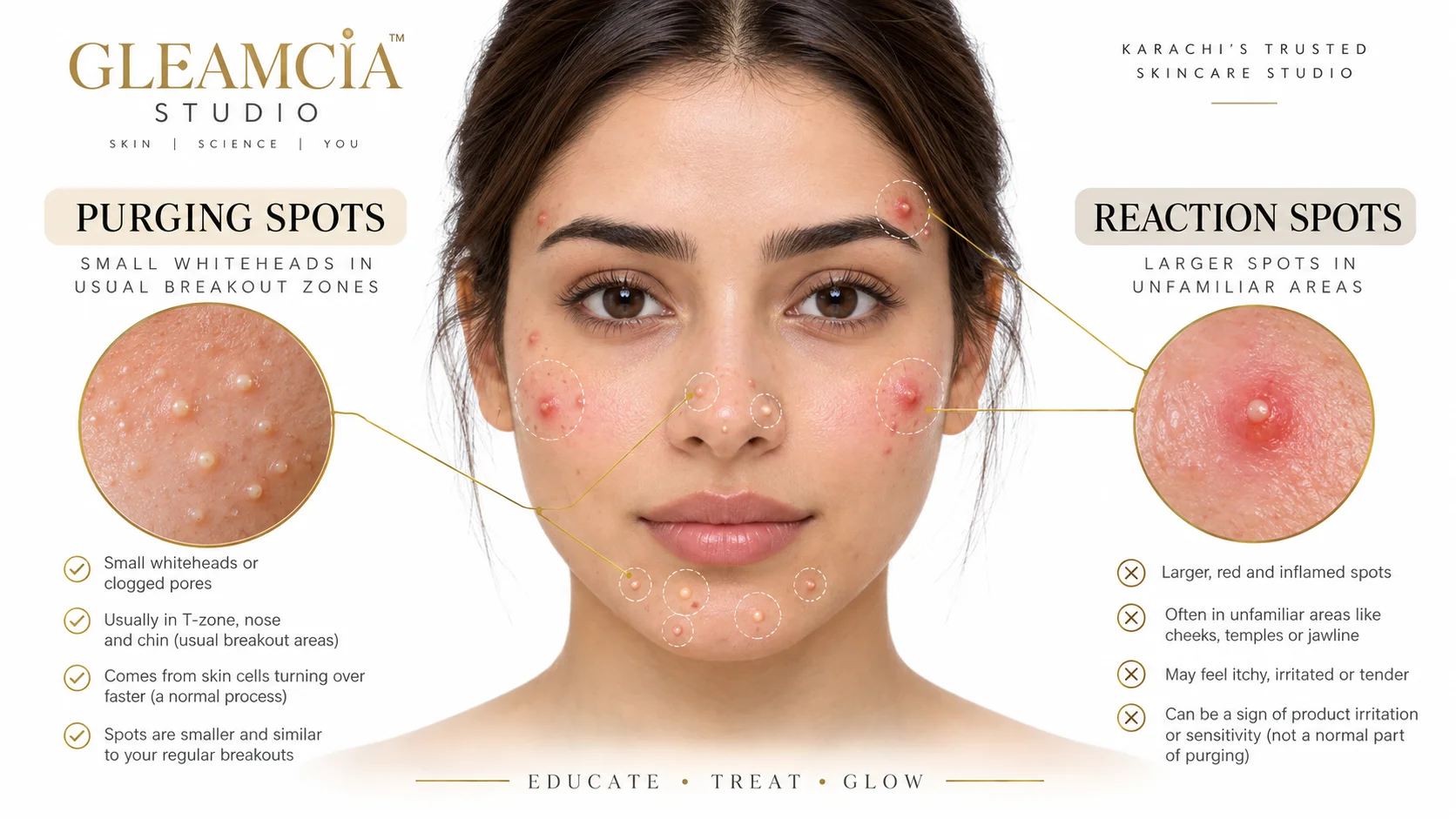
Are the spots appearing in areas where you typically break out? Purging surfaces existing congestion from your normal congestion zones. If your chin and nose are your typical breakout areas and those are what is flaring, that supports purging. If the spots are appearing on your cheeks or temples in areas that are usually clear, the product is causing new inflammation.“The biggest difference in skin purging vs breakout is where the spots appear, how they look, and how long they last.”
Are the spots mostly small whiteheads or papules rather than large, deep, painful cysts? Purging produces the small, surfacing congestion type of spot. Cysts forming in new areas are a reaction signal.
Did the spots appear within the first one to four weeks of starting the product? Purging starts quickly because the acceleration of an existing congestion cycle is rapid. Reactions can appear anytime, including after weeks of use, but the classic purge onset is within the first two to four weeks.
If the answer to all four is yes — active product, typical zones, small whiteheads and papules, recent onset — you are most likely purging.
What Does Normal Purging Look Like?
Purging has a specific presentation that is different from inflammatory cystic acne or an allergic reaction, and knowing what to look for makes the diagnostic much clearer.
Normal purging spots are predominantly closed comedones — small, skin-coloured or white-tipped bumps that sit at or just below the skin surface. They feel slightly raised and rough to the touch. They are not deeply painful or tender the way inflammatory cysts are. In a purge, you often get clusters of these in your typical congestion zones rather than one or two isolated spots.
Some pustules appear during purging — small bumps with a visible yellow or white head. These are different from the large, deep pustules that form in inflammatory acne. Purging pustules are closer to the surface, smaller, and cycle through faster than typical breakouts. They come and go over days rather than the week-plus timeline of a deep pimple.Another section:
“When comparing skin purging vs breakout, pay attention to whether blemishes appear in your usual breakout areas.
What purging does not look like: large, painful nodules under the skin that take weeks to resolve. Widespread flat redness like a rash. Hives or raised itchy welts. Spots spreading to entirely new face zones week after week. These are reaction presentations — not purge presentations.
The other notable characteristic of purging spots is how fast they move. Because the cell turnover acceleration that brought them to the surface is still running, purging spots cycle through and clear faster than normal breakouts. A whitehead that would normally take ten to fourteen days to surface, come to a head, and clear might take three to five days during a purge. This speed is actually one of the more reliable signs that the spots are purge-related rather than new inflammatory acne.
How Do I Tell If I Am Purging or Breaking Out? The Clear Distinction
The diagnostic table that most clearly separates the two:
Purging: location matches your normal acne zones. Spots are small whiteheads and papules. Started within weeks of beginning an active product. Cycle through faster than usual. No itching, burning, hives, or spreading to unfamiliar face zones.
Breakout from a product reaction: spots appear in zones that are new to you. Larger, more inflammatory spots including cysts. May start at any point including after weeks of use. Accompanied by itching, burning, redness, or rash. Does not slow down or resolve while the product continues.
The location test is the single most reliable indicator. Purging is literally the acceleration of congestion that already exists. That congestion lives where your skin naturally accumulates it — your typical breakout zones. If the spots are where you normally get spots, purging is the more likely explanation. If they are somewhere that has always been clear, the product is creating new inflammation rather than surfacing existing congestion.
Skin Purging vs Breakout: Full Diagnostic Comparison
| Feature | Skin Purging | Product-Triggered Breakout |
| Caused by | Cell-turnover-accelerating actives (Retinol, AHAs, BHAs, Vitamin C) | Comedogenic ingredients, irritants, fragrance, allergens |
| Location | Where you normally break out | New, unfamiliar skin zones |
| Spot type | Whiteheads, small papules, surface pustules | Cysts, hives, rashes, widespread redness |
| Onset timing | Within first 1 to 4 weeks of starting product | Can appear anytime including after weeks of use |
| Cycling speed | Faster than normal breakouts | Normal or slower than usual |
| Accompanied symptoms | Minimal — mainly the spots | Itching, burning, stinging, heat |
| Response to continuing product | Improves within 4 to 6 weeks | Continues or worsens |
| Skin after resolution | Clearer than before the product | Returns to pre-product baseline |
| Action to take | Continue product, simplify routine | Stop product, assess ingredients |
| Itching or hives | No | Possible — sign of allergic reaction |
Should I Pop Purging Acne?
No. The answer is the same whether the spots are purging or a true breakout — the American Academy of Dermatology consistently advises against popping, squeezing, or picking at any pimple.
The temptation during a purge is higher because there are more spots than usual and the spots are closer to the surface — some already at a whitehead stage that looks easy to extract. But the consequences of popping during a purge are the same as at any other time, and possibly worse.
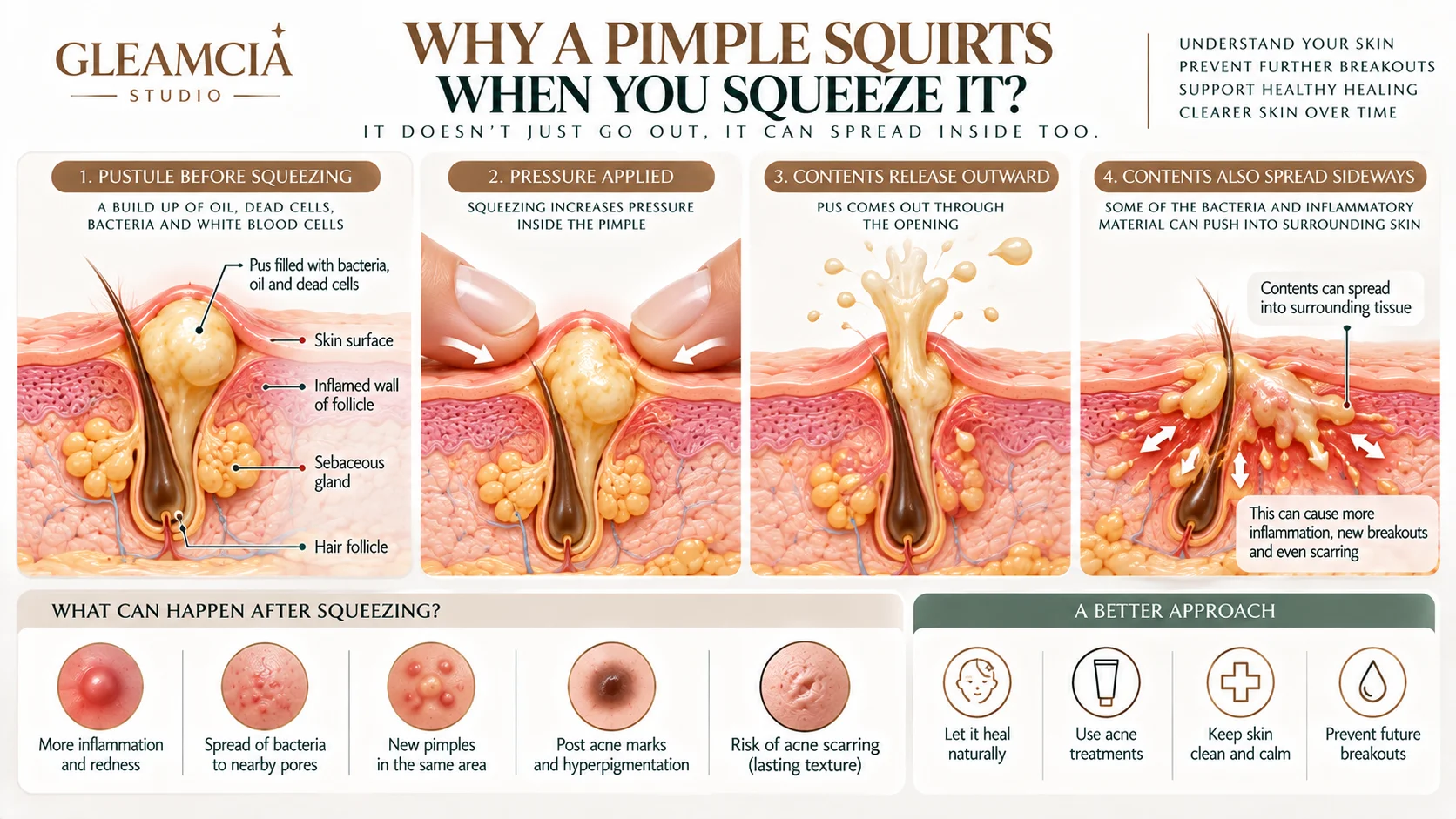
Popping forces the spot’s contents outward in multiple directions. Some of the material does go up and out — the intended direction. But the pressure also pushes bacteria, sebum, and dead cells sideways through the follicle wall into surrounding tissue. This creates new inflammation in the surrounding skin, can convert a surface whitehead into a deeper inflammatory pimple, and introduces whatever is on your fingertip — bacteria, oils, environmental debris — directly into an already-compromised follicle.
The post-inflammatory hyperpigmentation (PIH) that a popped pimple leaves behind is the practical cost that lasts longest. A small whitehead that is left to resolve during a purge leaves no mark. The same whitehead popped may leave a dark spot that takes months to fade. During a purge where you might have twenty such spots, that calculation matters. Twenty unpopped purging whiteheads versus twenty popped ones is potentially twenty months of dark mark treatment versus no marks at all.
Purging spots clear faster than normal breakouts on their own — sometimes in three to five days for a surface whitehead. The fastest resolution of a purge is leaving the spots alone.
Why Did My Pimple Squirt When I Popped It?
This is worth explaining because it happens often and the reaction it produces — surprise, sometimes alarm — usually leads to more squeezing rather than stopping.
A pimple that squirts under pressure is a mature pustule. The spot has been developing below the skin surface for days, and during that development it has filled with a mixture of dead white blood cells (the immune response to the bacteria and sebum), liquefied sebum, and the bacteria themselves. This mixture sits under the outer skin layer, and the surrounding tissue is under pressure from the immune and inflammatory response happening around it.
When the outer layer is punctured — by a fingernail, a pin, or compression — the pressurised material releases rapidly. The squirt is that pressurised content releasing upward through the opening. The volume is disproportionate to how the spot looked because the space below the skin surface is larger than the small external bump suggests.
During a purge specifically, the cell-turnover acceleration means that whitehead contents are being pushed upward faster than the outer skin layer fully forms. The result is spots that are often more fluid than a typical slow-forming pimple — they have not had the weeks of consolidation that a deeper pimple goes through. When squeezed, they release quickly and more dramatically.
The important medical point is what happens next: after the visible discharge releases upward, the pressure inside the follicle does not fully equalise. The remaining material disperses sideways through the damaged follicle wall, triggering new inflammation in surrounding tissue. This secondary inflammation is what produces the redness, swelling, and sometimes the new pimple that appears next to where you just popped one. It is not a coincidence — it is the same material that squirted upward having also gone sideways.
Leave the pimple alone. A cold compress or a small amount of non-comedogenic, anti-inflammatory topical on top — niacinamide, aloe vera — reduces the surface inflammation without the compounding damage of manual extraction.
How Long Does Skin Purging Last?
Four to six weeks is the standard window for over-the-counter active products like Retinol at standard concentrations, salicylic acid, and glycolic acid. This aligns with one full skin cell turnover cycle — the time it takes for all the sub-surface congestion that is going to be surfaced to complete its journey.
During those four to six weeks the purge does not maintain its peak intensity throughout. It typically escalates in the first two to three weeks, peaks somewhere in that window, and then gradually reduces as the accessible sub-surface congestion is cleared. By week five or six, the spots are fewer, clearing faster, and the intervals between new ones are longer.
For prescription-strength Tretinoin or Adapalene, the purge window can extend to eight to twelve weeks because the cell turnover acceleration is significantly more aggressive. This is documented and expected — not a reason to stop.
If the spots are still increasing at week eight with no sign of reducing, or if they have spread to new skin zones over that period, what you are experiencing is not purging. The product needs to be reassessed.
How to Tell If Your Serum Is Working Beyond the Purge
Knowing when a serum is producing the results it is designed for, rather than just the clearing-house phase of a purge, is what most people actually want to understand.
The signs that a Retinol or AHA serum is delivering its intended benefit rather than just processing a purge come in a specific sequence. By weeks four to six, skin texture starts to smooth. The rough bumps that were not visibly inflamed spots — often called milia or congested texture — begin to reduce. Skin surface feels more even under fingertips even before it looks dramatically different in the mirror.
By weeks eight to twelve, existing hyperpigmentation may start to lighten. Post-acne dark marks that were present before the product was introduced begin to fade as cell turnover accelerates the movement of pigmented cells upward and off. This is one of the clearest signals that the active ingredient is working systemically across the whole skin rather than just clearing congestion.
Pore size in the mirror starts to look reduced by month three. As congestion clears and cell turnover normalises, the follicles are less distended and the pores look smaller in direct light.
The serum is not working if the purge ends but none of these texture and tone improvements follow over the three to four months after. At that point, the concentration may be insufficient, the formula may be poorly stabilised, or the cause of the skin concern needs reassessment.A skin purging vs breakout comparison becomes easier when you look at timing, location, and the type of spots appearing.”
What Products Cause Purging and What Cannot
Being clear on which actives can produce a purge and which cannot is essential for correctly diagnosing what is happening on your skin.“One useful way to understand skin purging vs breakout is to track how quickly new spots appear after starting an active serum.”
Products that can cause a genuine purge are exclusively those that accelerate cell turnover. This includes retinoids (Retinol, Retinaldehyde, Tretinoin, Adapalene), alpha-hydroxy acids (glycolic acid, lactic acid, mandelic acid), beta-hydroxy acids (salicylic acid), and high-concentration Vitamin C (L-Ascorbic Acid at 15% or above). Enzyme exfoliants like papain and bromelain can also produce a mild purge.“If you are unsure about skin purging vs breakout, stop adding multiple new products at the same time so you can identify the real cause.”“Another key sign in skin purging vs breakout is how the skin feels, because irritation may come with burning, itching, or tenderness.When checking skin purging vs breakout, pay attention to your usual acne-prone areas such as the chin, nose, and forehead.
Products that cannot produce a true purge include hyaluronic acid, ceramides, peptides, niacinamide, moisturisers in general, SPF formulas, and squalane. These ingredients do not interact with the cell turnover rate. A breakout after introducing any of these is a reaction — either to a comedogenic ingredient in the formula, a fragrance, a preservative, or a silicone base.
If you break out after introducing a niacinamide serum, that is not purging. If you break out after introducing a Retinol, it very well might be.
What to Do During a Skin Purge: The Correct Approach
The most important thing during a purge is simplicity. Strip the routine back to the essentials: gentle cleanser, the active product that is producing the purge, a lightweight non-comedogenic moisturiser, and SPF in the morning. Do not introduce additional actives during this period. Adding a BHA toner on top of a Retinol purge compounds the exfoliation beyond what the skin barrier can comfortably manage.
Keep the skin hydrated. Hyaluronic Acid serum or a hydrating gel moisturiser supports the barrier during the elevated cell turnover period without adding comedogenic ingredients or clogging active follicles.
Apply SPF every morning without exception. The cell turnover acceleration from AHAs, BHAs, and Retinol increases UV sensitivity. Purging skin without SPF is inflaming spots and then making every mark they leave worse with UV-triggered post-inflammatory pigmentation.
A Gleamcia Brightening Face Wash used as the daily cleanser during a purge keeps the scalp surface clear without the stripping that a high-surfactant cleanser would apply to skin that is already in a period of elevated sensitivity.
Continue through the purge consistently. Missing applications during the purge phase extends the timeline without shortening the intensity — the congestion is there regardless of the product and will clear faster with it than without it.
Common Mistakes During a Skin Purge
Stopping the product at week three because the purge seems to be getting worse. Week two to three is often the peak. Stopping at that point means enduring the full purge without the benefit that follows it. The timeline restarts if the product is reintroduced.
Adding multiple spot treatments directly to purging spots. A patch of twenty purging whiteheads does not need twenty applications of a different product. A calming gel or niacinamide serum applied over the area as a whole reduces inflammation without the mechanical disruption of individual spot treatments.
Introducing a new cleanser, toner, or serum simultaneously while purging. When multiple new products are introduced at once, attributing a reaction to the right one becomes impossible. Introduce one new active at a time and wait for the purge or settling period to pass before the next.
Skipping SPF during the purge because the skin is broken out. This is exactly when SPF matters most. Every purging spot that does not get post-inflammatory hyperpigmentation is a mark that does not need treatment later. SPF is the most impactful step during this period.Knowing the signs of skin purging vs breakout can prevent you from stopping an effective product too early or continuing one that is irritating your skin.”
Aftercare and Habits for Managing a Skin Purge
Do:
- Keep a simple, consistent routine for the duration of the purge window — nothing new, nothing added
- Take a photo of the purge at its peak and again at weeks four and six — the comparison is the clearest confirmation of whether the product is working
- Use a cool to lukewarm water temperature for cleansing — heat increases inflammation in already-stressed skin
- Change pillowcases every two to three days during a purge — the bacteria, oil, and dead cells that accumulate on a pillowcase transfer back to inflamed purging skin overnight
Do not:
- Exfoliate with a physical scrub on top of purging skin — mechanical exfoliation on an already-accelerated turnover state damages the skin surface
- Wear heavy, occlusive makeup directly on purging areas if you can manage it — mineral or light coverage is a better choice during this period
- Apply multiple spot treatments, pick at spots, or use comedone extractors at home on purging skin — each intervention extends the recovery time and increases the mark risk
How Long Until Clear Skin After a Purge?
After the purge resolves at weeks four to six, the skin does not instantly arrive at its final state. The weeks following the purge are when the real benefit starts to show.
Texture improves noticeably in the week or two after the peak purge ends. Existing dark spots begin to fade. Pore appearance starts to reduce. Over months three through six of consistent active use — now that the congestion clearing phase is behind — the skin tone evenness, texture smoothness, and overall radiance that the product was purchased for begins to show up clearly.
The purge was the price of entry. Everything after it, if the right product was used correctly, is the return on that investment.
What Does a Quality Serum for Clear Skin Cost in Pakistan?
Serum pricing in Pakistan is driven by active ingredient quality and concentration. A Retinol serum with encapsulated, stabilised retinol at 0.5% in a properly buffered base costs more than a basic formula with an unstated concentration. A Vitamin C serum with stabilised L-Ascorbic Acid at 15% in a photostable base costs more than a Vitamin C-derivative serum at 2%.
For an active that produces a purge period — meaning it is working at a concentration sufficient to accelerate cell turnover — paying for quality in the formula makes the purge worth it. A trace-amount Retinol that produces a purge without producing the subsequent skin improvement is worse than not having the purge at all.
Buying the serum alongside a complementary gentle cleanser and lightweight moisturiser from the same formulation range ensures the routine is compatible during the purge period. Single product purchases are available at gleamcia.com, and bundle pricing across a full routine reduces the per-product cost. Gleamcia ships nationwide across Pakistan from Karachi. Visit gleamcia.com/shop for current serum and skincare pricing.
Why Choose Gleamcia
Gleamcia formulates every active serum with one specific goal: results that arrive after a manageable purge, not a relentless reaction.
- Active concentrations calibrated to produce the results on the label without unnecessary barrier disruption that extends the purge beyond the normal window
- Encapsulated Retinol and pH-buffered acid formulas that reduce purging severity while maintaining efficacy
- Complementary routine products — cleanser, moisturiser, SPF — designed to support skin through an active purge period without compounding it
- Transparent active concentrations so you know exactly what is on your skin and what response to expect from it
- Nationwide delivery from Karachi across Pakistan, fast dispatch, and packaging that protects sensitive serum formulas
Frequently Asked Questions
1. How do I tell if I am purging? Check four things: you recently started a product with a cell-turnover-accelerating active (Retinol, AHA, BHA, or high-concentration Vitamin C); the spots are in areas where you typically break out; the spots are predominantly small whiteheads or papules rather than deep cysts; and they appeared within the first one to four weeks of starting the product. If all four are true and there is no itching, burning, or hives, you are most likely purging. If any of those do not apply — particularly if the spots are in new skin zones — the product is causing a reaction rather than a purge.
2. What does normal purging look like? Normal purging presents as small, surface-level spots in the zones where you already break out. The most common types are closed comedones (small white or skin-coloured bumps under the surface), small papules (red bumps without heads), and occasional small pustules (spots with a visible white or yellow head). What purging does not produce is deep, painful cystic nodules, widespread redness, hives, or spots spreading to new skin areas. Purging spots also cycle through faster than regular breakouts — a whitehead that would typically take ten days to clear may clear in three to five during a purge.
3. Should I pop purging acne? No. The American Academy of Dermatology advises against popping any pimple, and this applies equally to purging spots. Popping pushes bacteria and sebum sideways through the follicle wall alongside the material that exits through the opening, creating new inflammation in surrounding tissue and converting a surface whitehead into a potentially deeper spot. The post-inflammatory pigmentation (dark mark) left by a popped spot lasts significantly longer than the purging spot itself. Purging spots clear faster on their own than typical pimples — leaving them alone is the most efficient approach.How can I tell skin purging vs breakout apart?
4. How do I tell if I am purging or breaking out from a product? The most reliable indicator is location. Purging surfaces existing subcutaneous congestion from your normal breakout zones. If the spots are where you always break out, the product is surfacing what was already there. If the spots are in new zones that have always been clear, the product is creating new inflammation — that is a reaction. The spot type also matters: purging produces whiteheads and small papules, while a reaction often produces larger cysts, hives, or rashes. If the skin calms down after four to six weeks without changing anything, it was a purge. If it worsens or stays the same indefinitely, it is a reaction.
5. Why did my pimple squirt when I popped it? A pimple that squirts is a mature pustule under pressure. During its development beneath the skin surface, the spot fills with a mixture of dead white blood cells, liquefied sebum, and bacteria. The surrounding tissue is under pressure from the immune response to this material. When the outer skin is punctured, that pressurised content releases rapidly upward — which is the squirt. During purging, spots are pushed to the surface faster than usual and their contents are often more fluid than a slow-forming deep pimple, making the release more pronounced. What follows the squirt is important: the remaining material under pressure also goes sideways through the damaged follicle wall, creating the new inflammation that appears around a popped spot. This is why popping always makes things worse rather than better.
6. How long does skin purging last from Retinol or AHA? For over-the-counter Retinol and standard AHA or BHA formulas, four to six weeks is the typical purge window — aligning with one full skin cell turnover cycle. Prescription-strength Tretinoin or Adapalene can produce a purge lasting eight to twelve weeks. The peak intensity typically falls in weeks two to three, after which the spots become fewer and clear faster until the purge resolves. If significant worsening or spreading to new skin zones continues past week eight, the product needs to be reassessed rather than continued.
7. Is it normal for purging to feel worse before it gets better? Yes — the classic purge pattern involves a period in weeks two to three where the skin looks worse than it did before starting the product. This is the peak of the surfacing congestion: the maximum volume of sub-surface material is being pushed upward at once during this window. The skin typically starts improving noticeably after this peak, with fewer new spots forming and existing ones clearing faster. This pattern — worse first, then significantly better — is a strong indicator that what you experienced was a genuine purge rather than a product-driven breakout.
Push Through the Purge or Stop? This Guide Just Answered That
The difference between a serum that will eventually give you the clearest skin of your life and one that is genuinely wrong for your skin comes down to these specific signs. Now you know what to look for. Order from the Gleamcia Skin Care range available at gleamcia.com — nationwide delivery across Pakistan, order via WhatsApp at 0336 1223363 and our team will help you choose the right active formula for your skin type and concern.