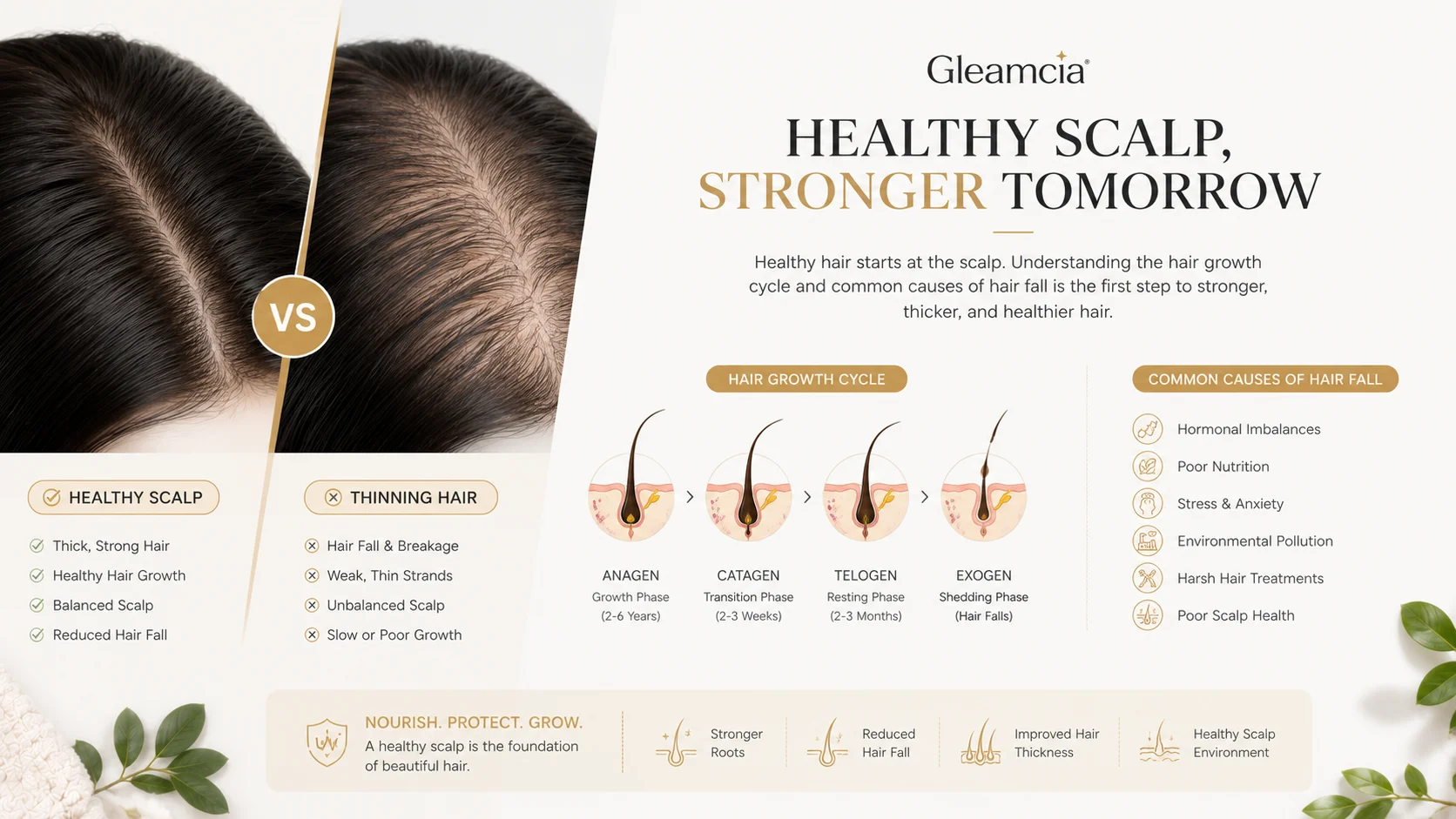
Introduction
Hair oiling is deeply woven into Pakistani household routines — mothers oiling daughters’ hair, grandmothers swearing by sarson ka tel, the widespread belief that regular oiling is the single most powerful thing you can do against hair fall. And there is something to that tradition. Just not in the way most people think.
Does hair oiling stop hair fall? The honest answer is: partially, for some types of hair fall, and not at all for others. Hair oiling is not a treatment for the hormonal causes of pattern hair loss, and it does not address nutritional deficiency or stress-related shedding at the root. What it does — when the right oil is chosen and applied correctly — is real and worth understanding. Because once you know what oiling actually accomplishes, you can use it correctly alongside the right targeted products rather than relying on it alone. Browse the Gleamcia Hair Care range for treatments that work alongside oil routines for visible hair fall reduction.
Does Hair Oiling Stop Hair Fall? The Direct Answer
No, hair oiling does not stop hair fall caused by the most common underlying drivers — DHT-related follicle miniaturisation, telogen effluvium from stress or illness, or nutritional deficiency. These causes operate at the follicle level and below the scalp surface, where topical oil has no meaningful reach.
What hair oiling does stop — or significantly reduce — is mechanical breakage. When the hair shaft is lubricated and protected, it breaks less during combing, detangling, styling, and sleeping. Broken strands found on the brush or shower floor look identical to shed hairs, but they are a different problem entirely. For people whose “hair fall” is predominantly breakage rather than root-level shedding, oiling can produce a meaningful visible reduction in the strands appearing daily.
Beyond breakage reduction, scalp massage during oiling improves blood circulation to the follicle bed. Improved circulation delivers more oxygen and nutrients to follicles — the same principle behind the circulation-boosting effect of caffeine in anti-hair fall formulas. The massage component of a proper oiling session is arguably as beneficial as the oil itself.
The distinction between what oiling can and cannot address is what determines whether it becomes a genuinely useful part of a hair care routine or a false comfort that delays the real treatment.
What Hair Oiling Genuinely Helps With Hair Fall
Several mechanisms make hair oiling a legitimate part of a hair health routine — not a complete solution, but a real contributor within the right context.
Reduced protein loss from the hair shaft. Coconut oil is the most studied oil for this property. Research has shown that coconut oil, applied before washing, penetrates the hair shaft and fills gaps in the cuticle. This reduces protein loss during washing — protein loss that would otherwise contribute to weakened, brittle strands that break more easily. The study findings are specific: coconut oil reduces protein loss; mineral oil and sunflower oil do not, because they do not penetrate the shaft the same way.
Strand lubrication and reduced mechanical breakage. A lubricated hair shaft has less friction during combing and detangling. Less friction means fewer strands snapping mid-shaft. For hair types common across South Asian populations — dense, thick, coarser textures — this protection during mechanical handling is genuinely significant.
Scalp massage improves follicle blood supply. The act of massaging oil into the scalp increases blood circulation in the dermal papilla area around each follicle. A better-supplied follicle produces a healthier, more anchored strand. A 2019 study published in Eplasty found that four minutes of daily standardised scalp massage increased hair thickness measurably over 24 weeks. The massage delivers this benefit whether oil is present or not — but the oiling step creates a natural occasion for consistent massage.
Anti-inflammatory scalp support from specific oils. Rosemary oil and tea tree oil both have demonstrated anti-inflammatory properties. Scalp inflammation is one of the most overlooked contributors to hair shedding — an inflamed follicle environment shortens the anagen phase and increases the rate of premature shedding. Using oils with anti-inflammatory properties addresses this contributing factor directly.
What Hair Oiling Cannot Do for Hair Fall
Understanding the limits of hair oiling is as important as understanding its benefits. These are the hair fall causes that oiling does not address:
DHT-driven follicle miniaturisation. The primary cause of pattern hair loss (androgenetic alopecia) is dihydrotestosterone binding to androgen receptors in hair follicles. This causes the follicle to shrink progressively over time, producing thinner and shorter strands until the follicle can no longer produce visible hair. No topical oil blocks DHT — this requires saw palmetto, finasteride, or other DHT-inhibiting actives delivered to the follicle through leave-on treatments with appropriate contact time.
Telogen effluvium from stress, illness, or nutritional deficiency. When the body pushes follicles into the resting phase en masse due to stress hormones, illness, or nutrient depletion, the solution is addressing those triggers — not applying oil. Hair fall from these causes requires stress management, nutritional rebuilding, and time for the follicle cycle to normalise.
Scalp conditions that require medicated treatment. Seborrhoeic dermatitis, scalp psoriasis, and fungal infections that cause hair fall need specific treatment — medicated shampoos, antifungal treatments, or dermatologist-prescribed formulas. Oiling over an active scalp condition without treating it can worsen the condition by creating a warm, occlusive environment that fungal organisms thrive in.
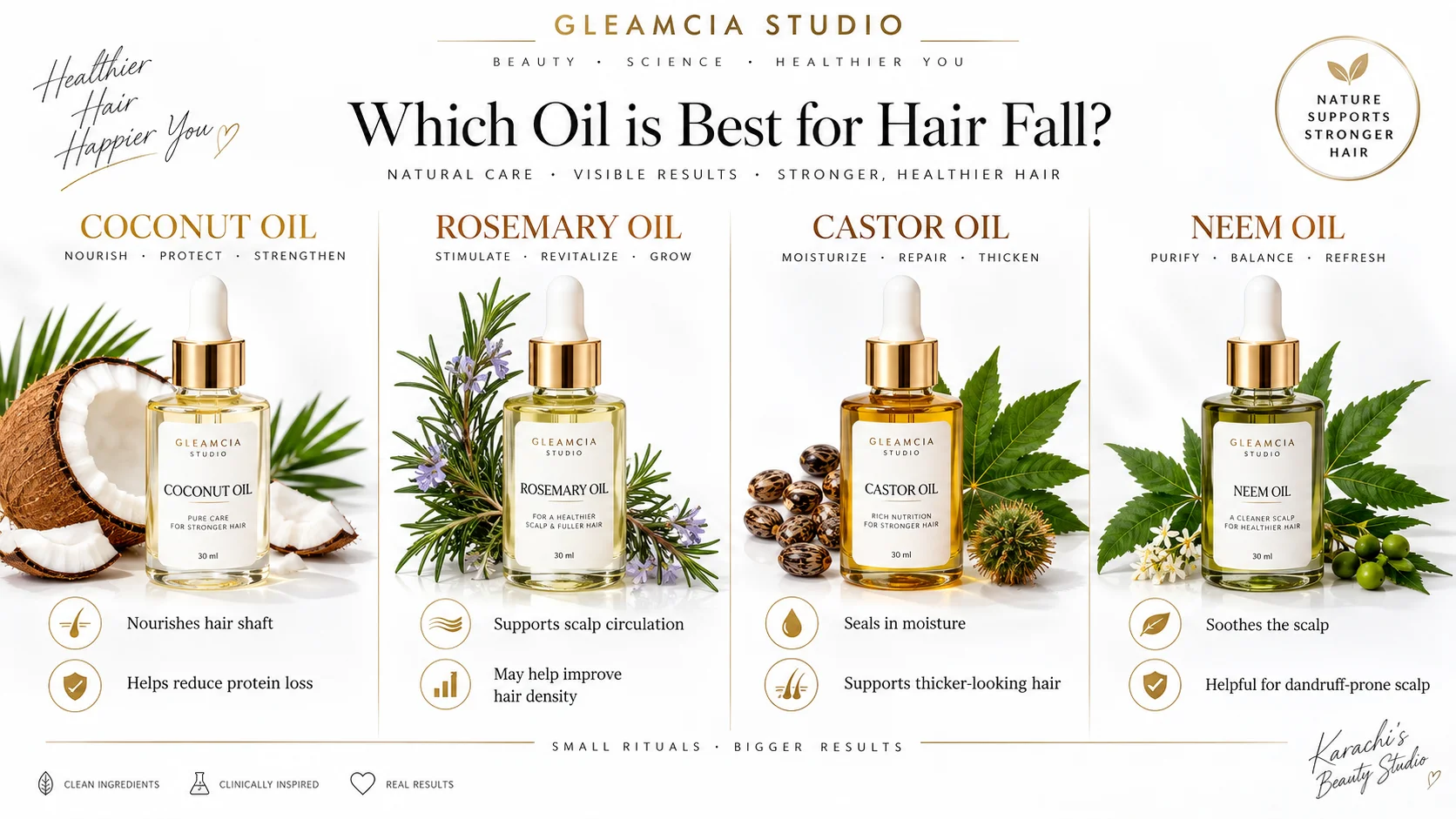
Which Oil Is Best for Hair Fall?
Different oils address different aspects of the hair fall problem. The best one for your situation depends on what is driving your specific hair fall.
Rosemary oil is the most evidence-backed oil for hair fall. A randomised controlled trial published in the Journal of Skin Appendage Disorders compared rosemary oil to 2% minoxidil over six months and found comparable hair growth results, with rosemary oil producing less scalp itching. It works by improving scalp circulation and has demonstrated anti-inflammatory properties that address follicle-level inflammation. Dilute it in a carrier oil (2 to 5 drops per tablespoon of carrier) before scalp application.
Coconut oil is the most studied oil for hair strand protection. The lauric acid in coconut oil penetrates the hair shaft — an ability most other oils lack — and fills cuticle gaps to reduce protein loss during washing. Best used as a pre-shampoo treatment applied 30 minutes to several hours before washing rather than as a leave-in.
Castor oil is widely used across Pakistan for hair fall, particularly Jamaican Black Castor Oil. It is rich in ricinoleic acid, which improves scalp circulation. Clinical evidence for castor oil specifically in hair growth trials is limited, but the scalp circulation effect and the thick, occlusive texture create a protective environment. It should be diluted with a lighter carrier oil as its thick consistency makes it difficult to remove from the scalp.
Neem oil is specifically useful when hair fall is associated with dandruff, scalp flaking, or scalp fungal conditions. Its antifungal and antibacterial properties address the scalp environment that often underlies inflammation-driven shedding.
Mustard oil (sarson ka tel) has been used traditionally across Pakistan and South Asia for generations. It has warming properties that stimulate scalp circulation and contains selenium and omega-3 fatty acids. Some people find it mildly irritating on the scalp with prolonged contact — test on a small area first. Not ideal as an all-over overnight treatment for sensitive scalps.
Peppermint oil (diluted in a carrier oil — one to two drops per tablespoon) has shown hair growth promotion in animal studies and some small human trials through improved dermal papilla cell activity. Used as part of a scalp massage, not as a standalone treatment.
What Happens If You Oil Your Hair Every Day?
Daily oiling is a traditional habit for many families across Pakistan, but whether it is beneficial or counterproductive depends heavily on the skin type, the oil used, and how thoroughly it is removed.
For dry hair and scalp types, daily light oiling — particularly with penetrating oils like coconut or argan — provides genuine strand protection and moisture retention. The hair feels softer, detangles more easily, and breakage reduces noticeably.
For oily scalp types, daily heavy oiling creates a significant problem. The scalp is already producing excess sebum. Adding oil on top — particularly heavy, occlusive oils like castor oil — compounds the congestion at the follicle opening. Blocked follicle openings weaken the hair root’s anchoring and can increase shedding from the congested environment. Heavy daily oiling on an oily scalp also increases the sebum-pollution interaction that dull hair and attracts dust.
Daily oiling without proper cleansing is arguably the most problematic pattern. Oil left on the scalp for extended periods without effective removal builds up, traps dead skin cells and product residue, and creates an environment less conducive to healthy follicle function rather than more.
The optimal approach for most hair types in Pakistan’s climate: two to three times per week application, removed thoroughly with a sulphate-free or gentle cleansing shampoo, with a proper scalp massage during each oiling session.
How to Oil Hair Correctly for Hair Fall Prevention
Application technique matters as much as oil choice. These steps produce the best outcome from any oiling session.
- Warm the oil slightly — warming to body temperature improves penetration and feels more comfortable on the scalp. Microwave for ten seconds or hold the bottle in warm water for a few minutes.
- Part the hair into sections and apply the oil directly to the scalp in each parting rather than rubbing it through the length first.
- Massage with fingertips for three to five minutes — use circular motions and gentle pressure across the full scalp. This is the most important step for follicle stimulation. The massage delivers the blood circulation benefit that the oil alone does not.
- Work the oil from scalp to ends after the scalp massage. The length and ends benefit from the lubrication even if they are not the primary target for hair fall treatment.
- Leave on for at least 30 minutes before washing. Overnight treatment is more beneficial for dry hair types — allowing more penetration time — but requires thorough removal the following morning.
- Shampoo out thoroughly. Oil that is not fully removed becomes the scalp buildup that blocks follicles. Use a gentle, sulphate-free shampoo and ensure the scalp feels clean, not greasy, after rinsing.
How to Stop Hair Fall Naturally Beyond Oiling
Hair oiling is one element of a natural hair fall reduction approach. The most effective natural interventions work together:
Scalp massage without oil, if oiling is not practical. The circulation benefit of massage is independent of oil. Two to three minutes of daily fingertip massage, even during shampooing, produces real follicle stimulation over weeks.
An anti-hair fall shampoo with active ingredients — caffeine, biotin, saw palmetto, niacinamide — used consistently with a scalp massage during washing. The scalp contact time during washing is short, but daily applications of active ingredients accumulate over weeks. Browse the Gleamcia Hair Care range for shampoos formulated with these actives at meaningful concentrations.
Biotin supplementation at 2,500 to 5,000 mcg daily supports keratin production from within — the internal foundation that topical treatments build on.
Protein-rich diet provides the amino acids that hair is structurally made of. Eggs, lentils, chicken, fish, and dairy are the most accessible sources in Pakistan. Low protein intake is one of the most common underdiagnosed contributors to hair fall.
Iron and Vitamin D — both widespread deficiencies in Pakistan, both directly linked to hair fall when low. A simple blood test confirms deficiency; correcting it produces visible hair fall reduction within months.
Stress management. Cortisol directly suppresses hair growth by pushing follicles toward the resting phase. Chronic stress is one of the most consistent drivers of hair fall across age groups in Pakistan’s current urban environment.
The American Academy of Dermatology consistently identifies nutritional factors and scalp health as the most addressable contributors to non-genetic hair loss — the categories where natural approaches produce genuine results.
Why Is Gen Z Losing Hair at a Younger Age?
Hair thinning in the teens and early 20s is genuinely increasing — the causes are specific and largely addressable.
Chronic psychological stress is the most significant single driver. Academic pressure, career anxiety, financial stress, and the constant social comparison that social media creates have produced a generation operating at sustainably elevated cortisol levels from an early age. Cortisol is directly anti-anabolic for hair follicles — it shortens the growth phase and pushes follicles toward premature shedding.
Diet is the second major factor. Ultra-processed foods — high in refined carbohydrates, low in protein, zinc, iron, and B vitamins — have replaced the nutrient-dense home-cooked meals of previous generations in many urban Pakistani households. Hair is a protein structure and cannot grow with density when dietary protein is inadequate.
Scalp care is essentially absent from most young people’s routines. There is significant awareness of skincare but the scalp — which is skin and behaves like skin — is treated as something that only needs shampoo. No active scalp treatment, no regular oil massage, no anti-hair fall targeted product.
Heat styling has become routine from the teenage years, creating cumulative structural damage to the hair shaft over years before visible thinning becomes apparent.
Hard water exposure in Karachi, Lahore, and other urban centres adds mineral and pH damage to the scalp with every wash, further weakening the follicle environment.
All of these are modifiable. The earlier the intervention — a targeted scalp routine, supplementation, dietary awareness, stress management — the better the outcome.
What Is the Most Effective Hair Loss Treatment in Japan?
Japan has a distinctive approach to hair loss that differs from Western pharmaceutical-first models. The Japanese hair care philosophy prioritises scalp cleanliness, circulation, and active scalp serums as a foundational approach before reaching for pharmaceutical interventions.
The most notable Japan-approved active ingredient for hair loss is adenosine — approved by Japan’s PMDA (the equivalent of the FDA) for hair growth promotion. Adenosine works by stimulating dermal papilla cells and extending the anagen phase through a pathway different from minoxidil. It is found in Japan-developed scalp serums and hair growth treatments as an alternative to minoxidil.
Rice water has a long history in Japanese hair care — the water rinsed from washing rice contains inositol, a carbohydrate compound linked to hair strengthening by reducing breakage. Traditional Japanese women have used rice water as a hair rinse for centuries.
Camellia oil (tsubaki oil) is another traditional Japanese hair oil — lightweight, high in oleic acid, and used for scalp massage and strand conditioning. It is significantly lighter than castor oil and penetrates more easily.
Japanese scalp care routines also emphasise meticulous double cleansing of the scalp — removing sebum and buildup fully — followed by scalp serums left on for active ingredient contact time. This approach of treating the scalp with the same attention as the face mirrors Korean skincare philosophy applied to hair.
The scalp serum approach — targeted, leave-on, active-ingredient-focused — is what distinguishes the Japanese model from simply oiling and shampooing. It is also the direction that evidence-based hair care globally is moving toward.
Hair Oiling vs Anti-Hair Fall Shampoo and Scalp Spray: What Each Does Better
| Feature | Hair Oiling (Coconut/Rosemary/Castor) | Anti-Hair Fall Shampoo + Scalp Spray |
| Reduces mechanical breakage | Yes — lubrication protects strands during handling | Partially — strengthening actives help |
| Reduces protein loss from shaft | Yes — coconut oil specifically | Not primary function |
| Blocks DHT | No | Yes — with saw palmetto in shampoo/spray |
| Scalp circulation benefit | Yes — from massage during application | Yes — caffeine in shampoo and spray |
| Active ingredient contact time | Short — removed by washing | Long — leave-on spray stays on scalp all day |
| Addresses pattern hair fall | No | Yes — targeted actives address follicle-level cause |
| Suitable for oily scalp daily | No | Yes — with sulphate-free formula |
| Biotin delivery | No | Yes — topical biotin in some formulas |
| Evidence for hair regrowth | Rosemary oil has trial evidence | Caffeine, saw palmetto, niacinamide have clinical backing |
| Best used | 2 to 3 times per week before washing | Daily — shampoo at washes, spray between washes |
The clearest conclusion from this comparison: hair oiling and an active hair care routine are complementary, not competing. Oiling provides the mechanical protection and massage-driven circulation that the shampoo and spray cannot fully replicate. The active products address the follicle-level causes that oiling cannot reach.
How Often Should You Oil Your Hair for Hair Fall?
Two to three times per week is the practical sweet spot for most hair types in Pakistan’s climate. It is enough frequency to consistently deliver the scalp massage and strand protection benefits without creating the buildup that daily oiling on oily scalps produces.
For dry hair types: up to four times per week with lighter oils is manageable, particularly in the cooler winter months when the scalp’s natural sebum production is lower.
For oily scalp types: once or twice a week with a lighter, diluted oil — focusing the application on the hair lengths rather than saturating the scalp — reduces the congestion risk while maintaining the strand protection benefit.
Overnight oiling once a week is a high-benefit approach for people with dry or damaged hair. Apply a generous amount of coconut or argan oil through the lengths and a smaller amount on the scalp, wrap in a cotton cloth, sleep, and shampoo thoroughly in the morning. The extended contact time increases penetration and moisture retention.
Common Hair Oiling Mistakes That Can Make Hair Fall Worse
Applying oil to a dirty scalp. Old sebum and product buildup combined with heavy oil creates a congested scalp environment that worsens follicle function rather than supporting it. Oil before a wash, not days after the last one.
Using too much castor or mustard oil directly on the scalp. These heavy oils are difficult to remove and create buildup that blocks follicle openings when used without proper dilution or appropriate shampoo removal.
Leaving oil on for multiple days without washing. Extended oil buildup traps dead skin cells, pollution particles, and bacteria against the scalp. A two to three hour application before washing is optimal. Overnight once a week is fine if removed thoroughly the following morning.
Washing with a harsh sulphate shampoo every time to remove oil. Using high-SLS shampoo daily to remove oil aggressively strips the scalp barrier and triggers the compensatory oil production that makes the scalp messier in the long run. A gentle, sulphate-free shampoo used twice — or a targeted anti-hair fall sulphate-free formula — removes oil effectively without stripping.
Skipping the scalp massage. Applying oil and leaving it without massaging misses the most biologically significant benefit. The massage is not optional. It is the step that delivers the circulation improvement that the oil facilitates.
What to Expect from Hair Oiling for Hair Fall Prevention
These are realistic expectations — not promises.
If hair fall is predominantly mechanical breakage, consistent oiling two to three times weekly with a correct technique and proper removal can produce a noticeable reduction in strands found on the brush and shower floor within two to four weeks.
If hair fall is root-level shedding from pattern hair loss, stress, or nutritional deficiency, oiling will not meaningfully reduce the fall rate without the underlying cause also being addressed. The scalp massage component contributes to follicle health, but the oil itself is not the therapeutic agent in this context.
The timeline for visible density improvement from oiling alone — where relevant — is measured in months, not weeks. Combined with an anti-hair fall shampoo, scalp spray, and biotin supplementation, the combined approach produces results in three to six months that oiling alone does not.
Aftercare and Oiling Habits for Healthy Hair in Pakistan
Do:
- Warm the oil before application — penetration is better and the experience is more comfortable
- Always massage the scalp with fingertips for at least three minutes during every oiling session
- Use sulphate-free shampoo to remove oil thoroughly — one or two passes depending on how much was applied
- Choose oils based on your scalp type: lighter oils (rosemary in jojoba, argan) for oily scalps; richer oils (coconut, castor diluted) for dry scalps
Do not:
- Assume more oil means more benefit — excess oil on the scalp creates buildup without adding to the follicle stimulation
- Comb hair aggressively while oiled — the hair is more pliable when oiled, not more resistant to breakage during harsh combing
- Skip the shampoo step after overnight oiling — leaving oil on the scalp beyond 8 to 12 hours without removal is past the point of benefit
What Does Hair Oil and a Hair Fall Routine Cost in Pakistan?
Hair oils purchased as individual products vary significantly depending on the oil type and formulation. A basic coconut oil at pharmacy concentration is among the most economical options. A rosemary essential oil for diluted scalp application costs more per millilitre but is used in very small quantities per session. Castor oil sits between the two. Blended scalp oils with multiple actives — rosemary, peppermint, neem, bhringraj — are formulated for convenience and consistency but priced above single-oil options.
For a complete hair fall routine — oil for massage and strand protection, sulphate-free anti-hair fall shampoo for active cleansing, scalp spray for leave-on follicle stimulation, and biotin supplement for internal support — bundle pricing across these four products from the same range reduces the per-item cost compared to buying individually. The combined protocol also produces faster, more comprehensive results than any single element alone.
Gleamcia delivers from Karachi to every city in Pakistan. Visit gleamcia.com/shop for current pricing on hair fall treatment products and bundles.
Why Choose Gleamcia
Gleamcia builds hair care around what works — not just what has been used by tradition.
- Anti-hair fall shampoos and scalp sprays with active ingredients at concentrations that deliver results at the follicle level — complementing oil routines rather than replacing them
- Formulas designed for Pakistan’s climate, water quality, and the specific hair fall triggers most common across South Asian hair biology
- Transparent ingredient listings so every product decision is informed, not guesswork
- Products that pair with traditional oiling routines rather than requiring their replacement
- Nationwide delivery from Karachi to every city in Pakistan, fast dispatch, and reliable packaging
Frequently Asked Questions
1. Does hair oiling stop hair fall? Hair oiling reduces hair fall caused by mechanical breakage — the hair shaft snapping during combing, styling, or sleeping. The lubrication and strand protection oils provide make strands less brittle and less prone to this breakage type. What oiling does not stop is root-level shedding from DHT-driven pattern hair loss, stress-related telogen effluvium, or nutritional deficiency. For those causes, targeted actives like saw palmetto, caffeine, and scalp serums are needed alongside — not instead of — the oil routine.
2. Which oil is best for hair fall? Rosemary oil is the most evidence-backed for follicle stimulation and hair growth support — a direct comparison study showed it performed comparably to 2% minoxidil over six months. Coconut oil is the most studied for reducing protein loss from the hair shaft, which reduces breakage. For scalp circulation, castor oil’s ricinoleic acid content is beneficial. For inflamed or dandruff-prone scalps where inflammation is driving hair fall, neem oil addresses the underlying scalp condition. In Pakistan’s context, warm sarson ka tel or coconut oil for scalp massage and rosemary oil diluted as a targeted scalp treatment covers the most ground.
3. What happens if I oil my hair every day? For dry hair types, daily light oiling supports strand moisture and reduces breakage. For oily scalp types, daily heavy oiling creates scalp buildup, congests follicle openings, and can worsen the oiliness cycle rather than help it. Daily oiling without effective removal is the most counterproductive pattern — the accumulation blocks follicle function rather than supporting it. Two to three times weekly with proper removal is the more appropriate frequency for most people in Pakistan’s climate.
4. How do I stop hair fall naturally? Combine scalp massage (daily, with or without oil), an anti-hair fall shampoo with active ingredients used consistently three to five times weekly, biotin supplementation at 2,500 to 5,000 mcg daily, adequate dietary protein and iron, stress management, and in hard water cities like Karachi, a chelating shampoo used weekly to clear mineral buildup. No single step produces dramatic results alone. The combination addresses hair fall from the scalp level, the strand level, and the systemic nutritional level simultaneously.
5. What is the most effective hair loss treatment in Japan? Japan’s approach to hair loss emphasises scalp health as the primary foundation — meticulous double cleansing, consistent scalp massage, and active scalp serums. The most distinctive Japan-approved active ingredient for hair growth is adenosine, approved by Japan’s pharmaceutical regulator for hair loss and found in scalp serum formulas as an alternative to minoxidil. Traditional Japanese hair care ingredients include camellia (tsubaki) oil, rice water containing inositol, and scalp massage-focused routines. The fundamental principle — treating the scalp with the same active-ingredient seriousness as a skincare routine — is where Japanese hair care differs most significantly from basic oil-and-shampoo approaches.
6. Why is Gen Z losing hair younger than previous generations? Chronic psychological stress, ultra-processed diets low in protein and micronutrients, absence of scalp care routines despite skincare awareness, hard water exposure in Pakistan’s cities, early and regular heat styling, and in some individuals, earlier onset of DHT sensitivity. All of these factors are converging at once in a generation that has grown up with more environmental and psychological stressors than previous ones — and that convergence is producing visible hair thinning in the late teens and early 20s at rates previous generations did not experience.
7. How long should I leave oil in my hair for hair fall? A minimum of 30 minutes before washing is enough for basic penetration and the scalp massage benefit. Two to three hours is better for dry hair types or when using coconut oil as a pre-shampoo protein-loss treatment. Overnight once a week delivers the most intensive strand treatment — applied before sleep, covered with a cotton cloth, removed with gentle shampoo the following morning. Beyond 24 hours without removal, the accumulation of oil, dead cells, and bacteria on the scalp begins working against follicle health rather than supporting it.
Oil Smarter, Not More — and Pair It With Products That Actually Treat the Cause
Hair oiling is a legitimate and useful part of a hair fall prevention routine — for the right reasons. Breakage reduction, strand protection, scalp massage circulation, and anti-inflammatory support from the right oils are all real benefits. They are not, however, the treatment for DHT-driven hair loss, stress shedding, or nutritional deficiency. Pair the oiling habit with a targeted anti-hair fall shampoo and scalp spray from the Gleamcia Hair Care range for a complete protocol. Order via our online store at gleamcia.com, delivered nationwide across Pakistan from Karachi.
Order via WhatsApp at 0336 1223363 for personalised advice on the right combination of products for your hair type and fall pattern.