Introduction
Dengue season in Pakistan is predictable — Karachi and Lahore see it every year between July and November. Typhoid is even more consistent across the country. And for a significant number of people who recover from either, a second shock arrives two to three months later: handfuls of hair in the shower drain, strands on the pillow, visible thinning where there was none before.
Hair loss after dengue and typhoid fever is one of the most alarming post-illness experiences people in Pakistan face because the timing makes no sense at first. The illness passed weeks ago. You were fine. And now, without any warning, the hair is falling. Understanding why this happens — and why it almost always resolves — is what separates unnecessary panic from a targeted, calm recovery approach. Browse the Gleamcia Hair Care range for recovery-focused hair products designed to support regrowth after illness-related hair fall.
What Causes Hair Fall After Dengue, Typhoid or High Fever?
The mechanism is called telogen effluvium. It is not specific to dengue or typhoid — it can follow any significant physical stressor that places the body under acute physiological strain. High fever is one of the most reliable triggers.
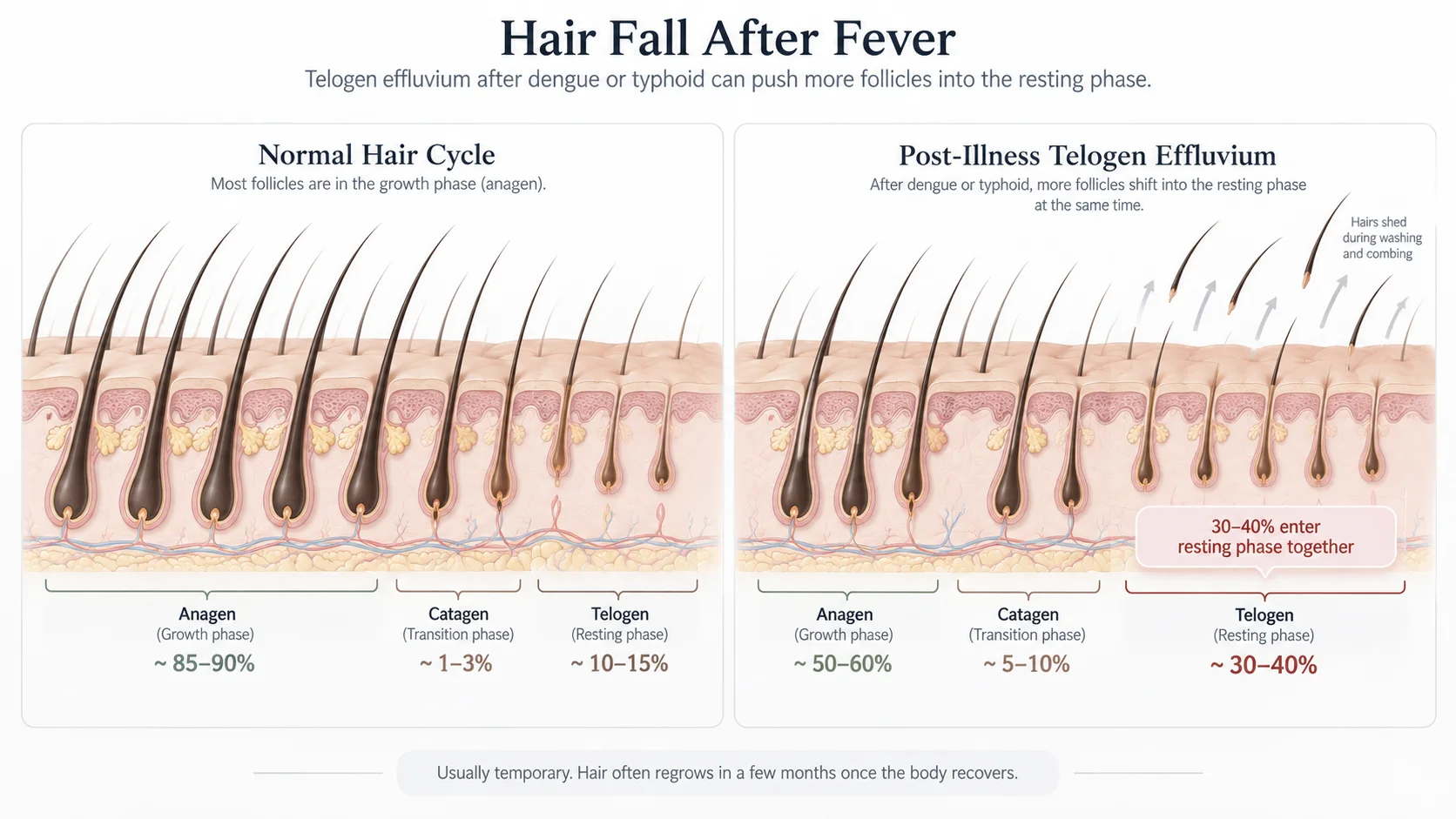
Under normal conditions, approximately 85% to 90% of hair follicles are in the anagen phase — actively growing hair. The remaining 10% to 15% are in the telogen phase — resting before shedding naturally. The body cycles a small number of follicles through this rest-and-shed phase continuously, which is why losing 50 to 100 hairs daily is normal.
When the body experiences a severe physical stressor — a sustained high fever, a major infection like dengue or typhoid, significant blood loss, or serious nutritional depletion — the response system shifts. The body interprets the stressor as a survival threat and diverts resources away from non-essential functions. Hair growth is not a survival priority. The result is that a disproportionately large number of follicles — sometimes 30% to 40% of the total — are simultaneously pushed into the telogen resting phase.
The hair does not fall immediately. Telogen hairs complete their resting phase over two to three months before shedding. This is the delay that makes the connection so difficult to recognise. The fever from dengue or typhoid passes. The body recovers. Life returns to normal. And then, two to three months later, the follicles that were pushed into telogen during the illness all complete their rest and shed at once — producing the alarming daily loss that seems to have no logical trigger.
Understanding Telogen Effluvium After Illness
Telogen effluvium is worth understanding in full because the same reassurance applies whether the trigger was dengue, typhoid, a COVID infection, major surgery, childbirth, or extreme emotional stress.
The American Academy of Dermatology identifies telogen effluvium as one of the most common causes of sudden, diffuse hair shedding in adults. It is characterised by widespread thinning across the full scalp rather than the patterned thinning of androgenetic alopecia, which affects specific zones like the crown or temples.
The critical fact about telogen effluvium is that it is self-limiting. Once the triggering stressor has resolved — the illness has passed, the fever has come down, the body has recovered — the follicles that entered telogen gradually return to the anagen (growth) phase. New hair begins growing from each follicle that shed. The hair fall gradually reduces over weeks and months as the follicle cycle normalises.
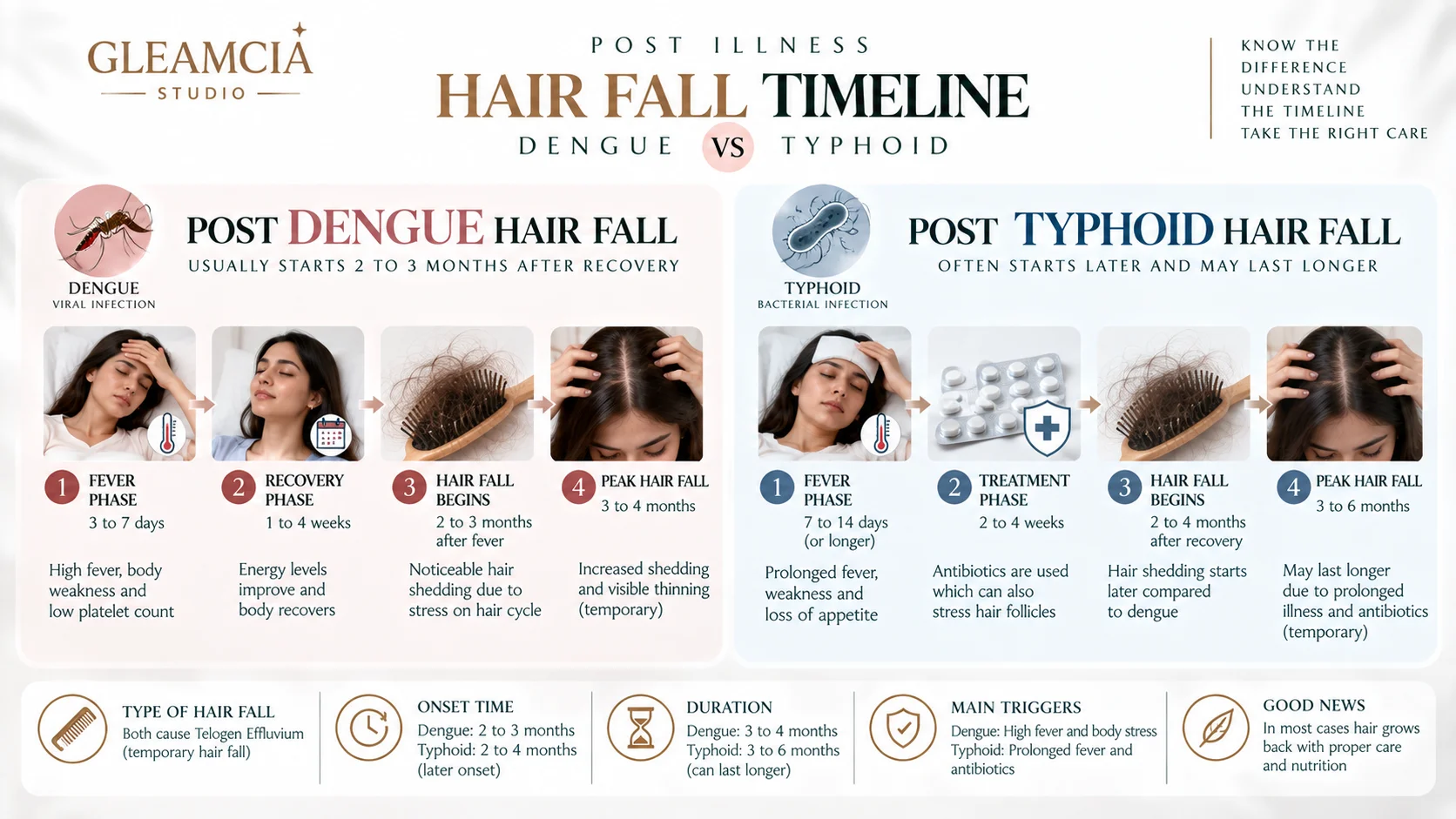
Most people experiencing telogen effluvium after dengue or typhoid see the peak hair fall between months two and four after the illness, a gradual reduction from month four through month six, and visible regrowth by months six to twelve. The full recovery to pre-illness hair density takes up to twelve months in most cases, sometimes longer for people with additional nutritional deficiencies.
Is Hair Loss a Symptom of Dengue?
Hair loss is not a direct symptom of active dengue infection. It is a consequence that appears well after the infection has resolved — not something that happens during the acute illness phase.
During active dengue, the most prominent symptoms are high fever, severe joint and muscle pain, headache, nausea, and the characteristic dengue rash. The rash, which appears during the fever-break phase on days three to seven, is a maculopapular eruption that can be intensely itchy and appears across the body including, for some people, on the scalp.
It is the systemic impact of that acute phase — the sustained high fever above 39°C, the platelet drop, the widespread inflammation, and the severe physical depletion — that sets the telogen effluvium process in motion. But the hair fall from that process does not start until two to three months later, which is why many people do not connect the dengue episode to the hair fall they experience in December when they were sick in September.
For someone experiencing hair fall right now and trying to identify the cause: think back two to three months. A dengue fever, a typhoid course, any serious illness or high fever during that window is the most likely trigger for the shedding pattern currently appearing.
Why Does Itching Occur With Dengue and Can It Affect the Scalp?
The itching associated with dengue is primarily driven by the dengue rash — a systemic inflammatory skin reaction that is part of the immune response to the flavivirus. During the critical phase as the fever breaks, blood vessels become more permeable, fluid moves into the skin, and the characteristic spotted rash appears, often with significant itching.
For people where this rash extends to the scalp, the itching is real and the scalp becomes inflamed during this period. Scalp inflammation contributes to follicle stress — an already-inflamed follicle environment adds to the physiological pressure that pushes follicles into telogen prematurely.
The itching during the dengue rash phase itself is not a hair loss indicator — it is a dengue symptom that resolves within days. But it is one more piece of the physical stress picture that the follicles are navigating during a dengue illness, and in people with an already-sensitive scalp or one predisposed to inflammation, the combined effect can produce a more pronounced telogen effluvium in the months that follow.
How to Stop Hair Fall After Dengue and Typhoid: The Recovery Strategy
The most important thing to understand first: this hair fall is almost always temporary. The follicles are not damaged. They are resting. What the recovery strategy does is create the best possible environment for them to return to the growth phase faster and with less overall density loss.
Nutrition restoration is the most critical step. During dengue or typhoid, the body depletes its reserves of protein, iron, zinc, Vitamin D, and B vitamins. Hair follicles require all of these to produce healthy strands and complete the growth cycle. Rebuilding these nutrient stores as rapidly as possible after illness is what shortens the telogen effluvium duration.
Protein intake should be prioritised specifically — at least 1.2 to 1.5 grams per kilogram of body weight daily during recovery. Chicken, eggs, lentils, legumes, fish, and dairy are the most accessible high-protein sources in Pakistan. Hair is a protein structure and cannot grow with density without adequate keratin building blocks.
Biotin supplementation at 2,500 to 5,000 mcg daily supports keratin production and strand strength during the recovery phase. This is particularly useful when dietary intake is still normalising in the weeks after illness. Browse the Gleamcia hair supplement range for biotin options formulated for post-illness hair recovery.
Iron deserves particular attention after both dengue and typhoid. Dengue causes a platelet drop and associated bleeding tendency; typhoid causes systemic inflammation and gastrointestinal impact — both conditions deplete iron stores. Iron deficiency alone is a known cause of telogen effluvium, and recovering from it after illness-related depletion is essential for restoring the hair growth cycle. Iron-rich foods include red meat, lentils, spinach, and eggs.
Anti-hair fall shampoo used consistently supports the scalp environment during recovery by keeping the follicles clear of buildup, reducing inflammation, and delivering active ingredients during washing. Used with a scalp massage during each wash, it improves the microcirculation in the follicle environment that illness may have disrupted.
A scalp serum or hair growth spray applied between washes delivers follicle-stimulating actives — caffeine, niacinamide, rosemary extract — directly to the scalp for extended contact time. Leave-on products have significantly more active ingredient exposure time than rinse-off shampoos and support the transition of telogen follicles back to the anagen phase.
How to Recover from Dengue and Support Hair Recovery Simultaneously
Dengue recovery follows a specific medical timeline. For the hair specifically, supporting the body’s overall recovery is the most direct way to shorten the telogen effluvium window.
During acute dengue: rest, aggressive hydration (dengue causes severe dehydration and plasma leakage), platelet monitoring if severe, and the absolute avoidance of NSAIDs like aspirin or ibuprofen — these increase the bleeding risk in dengue by further suppressing platelet function. Paracetamol (acetaminophen) is the appropriate fever management drug under medical guidance.
After the acute phase: rebuilding nutrition is the primary task. Soft, protein-rich foods that the stomach can handle during recovery — eggs, lentils, chicken soup, dahi — begin restoring the nutrient reserves the follicles will need. Papaya leaf extract has been widely used in Pakistan for platelet recovery in dengue, and while evidence is still developing, the traditional use persists broadly.
For hair recovery specifically: the nutrition rebuilding above, combined with a consistent hair care routine that includes scalp massage, a sulphate-free anti-hair fall shampoo, and a targeted scalp spray, creates the environment for follicles to cycle back to growth as quickly as the biology allows.
Post-Typhoid vs Post-Dengue Hair Fall: Is There a Difference?
Both dengue and typhoid trigger telogen effluvium through the same physiological mechanism — physical stressor pushing follicles into the telogen phase — but the specific contributing factors differ slightly.
Dengue hair fall is primarily driven by the acute fever and the systemic inflammatory response. The platelet drop and associated depletion also contribute. Most dengue episodes are resolved within ten to fourteen days, and the telogen effluvium that follows is typically a single clear episode that resolves over the subsequent six to twelve months.
Typhoid hair fall tends to be amplified by the antibiotic treatment itself. Prolonged antibiotic use — commonly a fourteen-day course of fluoroquinolones or azithromycin — disrupts the gut microbiome, which affects nutrient absorption including the B vitamins and minerals hair follicles need. The sustained fever of typhoid, which can last two to three weeks untreated, is also a longer-duration stressor than the typical dengue fever timeline. This can produce a more pronounced or longer-duration telogen effluvium.
The recovery strategy is the same for both, but people recovering from typhoid benefit from additional probiotic support to rebuild gut microbiome function after antibiotic treatment, which indirectly supports the nutrient absorption that fuels hair recovery.
Telogen Effluvium vs Androgenetic Alopecia: Why Knowing the Difference Matters
A lot of anxiety after post-illness hair fall comes from not knowing whether the thinning is temporary or permanent. The distinction between telogen effluvium and pattern hair loss (androgenetic alopecia) is what answers that.
| Feature | Telogen Effluvium (Post-Illness) | Androgenetic Alopecia (Pattern Hair Loss) |
| Cause | Physical or emotional stressor — illness, fever, childbirth | DHT hormonal sensitivity + genetics |
| Pattern | Diffuse — thinning across the entire scalp | Patterned — crown, temples, hairline recession |
| Onset | 2 to 3 months after the triggering stressor | Gradual over years |
| Reversible | Yes — almost always fully reversible | Without treatment, progressive and largely permanent |
| Scalp appearance | General thinning, no defined bald spots | Defined thinning zones matching the Norwood or Ludwig scale |
| Hair fall type | Diffuse shedding across all areas | Concentration in specific zones |
| Duration | Typically resolves within 6 to 12 months | Continues without intervention |
| Treatment needed | Nutritional support and scalp care | DHT blockers, minoxidil, medical management |
| Prognosis | Full hair density recovery expected | Without treatment, continuing progression |
Post-dengue and post-typhoid hair fall is almost always telogen effluvium — diffuse, temporary, and fully reversible. If the thinning is concentrated in specific zones (the crown, the temples, the hairline), a pattern-related component may also be present and warrants a dermatologist assessment.
The Hair Care Routine During Recovery from Post-Illness Hair Fall
Daily:
- Gentle, sulphate-free anti-hair fall shampoo used three to five times weekly — with two to three minutes of scalp massage during each wash
- Light-weight conditioner from mid-length to ends only — not applied to the scalp
- Leave-on scalp serum or hair growth spray applied to the scalp on non-wash days
Daily supplements:
- Biotin 2,500 to 5,000 mcg
- Iron (if deficiency is confirmed or suspected after dengue/typhoid)
- Vitamin D if your levels are low — very common across Pakistan
Weekly:
- Scalp exfoliation once a week to remove buildup and keep follicle openings clear
- Deep conditioning mask from mid-length to ends to reduce breakage on strands that are weaker during the recovery period
Habits:
- Reduce heat styling during the recovery period — the hair strands produced during illness are structurally weaker and more prone to breakage under heat
- Avoid tight hairstyles — traction on follicles already in the telogen phase increases shedding unnecessarily
- Scalp massage for two minutes daily, even without product — the circulation improvement adds up significantly over weeks
Common Mistakes During Hair Recovery After Dengue or Typhoid
Panicking and over-treating. The instinct is to apply everything possible as fast as possible. Starting five new products simultaneously makes it impossible to know what is helping and creates potential formula conflicts on an already-stressed scalp.
Using harsh or sulphate-heavy shampoos more frequently. Washing daily with a stripping cleanser strips the scalp barrier and worsens the inflammatory environment that is already compromised from illness. Gentle, sulphate-free, and three to five times weekly is the formula.
Stopping all product use because “nothing is working.” Telogen effluvium resolves on its own in most cases, but the timeline shortens with nutritional support and a consistent scalp routine. Products work gradually — abandoning the routine at month three because the hair is still falling means missing the recovery window that starts around month four.
Attributing all hair fall to the illness indefinitely. If hair fall continues beyond twelve months or follows a visible patterned progression, a dermatologist assessment is needed. Telogen effluvium resolves. If it is not resolving, another factor may be contributing.
Ignoring nutrition. The scalp spray and shampoo address the external environment. Without protein, iron, zinc, and Vitamin D in the diet and through supplementation if needed, the follicles do not have the raw materials to produce hair even after returning to the anagen phase.
Results Timeline for Hair Recovery After Dengue or Typhoid
This is the most searched question after the initial alarm and it deserves a direct answer.
- Months 1 to 3 after illness: Hair fall increases and peaks. This is the most alarming phase but it is also the expected one. The telogen follicles from the illness period are completing their rest phase and shedding simultaneously.
- Months 3 to 4: Hair fall begins to slow as fewer follicles remain in the simultaneous telogen peak. The rate of daily loss starts decreasing.
- Months 4 to 6: Visible reduction in daily shedding. New, fine hairs may be noticeable at the hairline and scalp surface — vellus hairs that will mature into terminal hairs over the next months.
- Months 6 to 9: Hair fall has largely normalised to pre-illness baseline. The new growth from the recovered follicles begins contributing to visible density.
- Months 9 to 12: Most people are at or near their pre-illness hair density. The recovery is substantially complete for most cases of straightforward telogen effluvium.
This timeline is based on consistent nutritional support and a scalp-active hair care routine. Without nutrition and scalp care, the recovery is the same biologically but often slower.
Aftercare Habits That Speed Up Post-Illness Hair Recovery
Do:
- Eat adequate protein at every meal throughout the recovery period — this is the single most impactful dietary habit
- Keep scalp massage consistent — two minutes daily, even without product in the hair
- Track progress with monthly hair density photos in consistent lighting — the recovery is gradual and daily comparison undersells how much has changed
- Drink adequate water — the body’s nutrient transport and follicle nourishment depend on proper hydration
Do not:
- Colour, bleach, or chemically treat the hair during the acute telogen effluvium phase — the strands are structurally weaker and chemical treatment risks breakage and further shedding
- Wear tight ponytails, braids, or buns that create traction on follicles already in the resting phase
- Add aggressive actives like high-strength Retinol or strong AHAs to the scalp routine during recovery — the system is already stressed
What Does Post-Illness Hair Recovery Cost in Pakistan?
Recovery-focused hair products do not need to be the most expensive ones — they need to be the right ones. A sulphate-free anti-hair fall shampoo with caffeine and biotin, a scalp serum or spray with rosemary extract and niacinamide, and biotin tablets together represent the complete recovery protocol. The price per day is modest compared to the months of consistent use needed to support the follicle recovery timeline.
Bottle size matters for a routine maintained over six to twelve months. Larger formats or bundles — anti-hair fall shampoo paired with a matching scalp spray and biotin supplement — reduce the per-month cost compared to buying products individually and ensure formula compatibility across the routine.
Single product entry points are available for anyone starting with one step and building gradually. Gleamcia ships from Karachi to every city in Pakistan. Visit gleamcia.com/shop for current pricing on hair recovery products.
Why Choose Gleamcia
Gleamcia builds hair care products for real Pakistan hair concerns — and post-illness telogen effluvium, driven by dengue and typhoid, is one of the most common hair concerns the country faces seasonally.
- Anti-hair fall shampoos with caffeine, biotin, and scalp-active ingredients at concentrations that support the recovery environment, not just cleanse
- Scalp serums and growth sprays formulated for the post-illness follicle — gentle enough for a sensitised scalp, active enough to accelerate the telogen-to-anagen transition
- Biotin supplements at effective concentrations for internal keratin support during the nutritional recovery phase
- Full ingredient transparency and routine guidance so recovery is not guesswork
- Nationwide delivery from Karachi to every city in Pakistan, fast dispatch, and reliable packaging
Frequently Asked Questions
1. Is hair loss a symptom of dengue? Not a direct symptom of the active dengue infection — hair does not fall during the illness itself. Post-dengue hair loss is a consequence that appears two to three months after the illness resolves. It is caused by telogen effluvium — the body’s physical stress response during severe illness pushes a large number of hair follicles into the resting phase simultaneously, and they shed when that phase completes around two to three months later. It is one of the most common complaints after dengue recovery in Pakistan.
2. How do I stop hair fall after dengue? Restore nutrition first — protein, iron, zinc, and Vitamin D are the most critical for follicle recovery. Biotin supplementation at 2,500 to 5,000 mcg daily supports keratin production. Use a sulphate-free anti-hair fall shampoo three to five times weekly with consistent scalp massage during each wash. Apply a scalp spray or serum with rosemary extract, caffeine, or niacinamide between washes. Reduce heat styling and avoid tight hairstyles during the recovery period. The biological process resolves on its own — these steps shorten the timeline and reduce the density loss.
3. How do you recover from dengue? Medically: rest, aggressive hydration (dengue causes severe plasma leakage and dehydration), paracetamol for fever management (not aspirin or ibuprofen — these increase bleeding risk with dengue), and platelet monitoring in severe cases. After the acute phase: rebuild nutrition with protein-rich foods, iron sources, and fresh fruit. For hair specifically, rebuilding protein and micronutrient levels after dengue is the most important recovery step because telogen effluvium severity is influenced by how quickly the body’s nutrient reserves are restored.
4. Why does dengue cause itching? The itching during dengue is primarily caused by the dengue rash — a maculopapular skin reaction that appears as the fever breaks on days three to seven. This is an immune response to the virus, characterised by red spots on a white background on the skin and often intense itching. The rash can extend to the scalp in some people, causing scalp itching during the illness. This scalp inflammation adds to the follicle stress that contributes to post-dengue telogen effluvium.
5. Is Dengvaxia being discontinued? Dengvaxia (Sanofi Pasteur’s dengue vaccine) is not being fully discontinued globally, but its use has been significantly restricted following controversy over adverse events in seronegative recipients in the Philippines program. As of current regulatory guidance, Dengvaxia is approved in several countries — including FDA approval in the US — specifically for individuals aged 9 to 16 with confirmed prior dengue infection. It is not approved for those without a prior dengue infection due to the increased risk of severe dengue in seronegative individuals upon subsequent exposure. Its status varies by country and health authority. For the most current guidance in Pakistan, consult the DRAP or a physician for updated local policy.
6. How long does hair fall last after dengue or typhoid? Most cases of post-illness telogen effluvium peak between months two and four after the illness and begin reducing by months four to six. The majority of people see hair fall return to their pre-illness baseline by months six to nine, with full density recovery by month twelve. Recovery is faster in people who restore nutrition quickly after illness and maintain a consistent scalp care routine. If significant hair fall continues beyond twelve months or follows a patterned progression, a dermatologist assessment is advisable.
7. Is post-dengue hair fall permanent? No — in the vast majority of cases, post-dengue and post-typhoid hair fall is fully reversible. Telogen effluvium does not damage the hair follicle. The follicles rest, then return to the anagen growth phase, and the hair grows back. The concern about permanence applies when there is an underlying pattern hair loss that was masked before the illness and becomes visible during the telogen shedding phase. If recovery is not occurring by month twelve, a dermatologist can determine whether an additional factor is contributing.
Your Hair Will Come Back — The Process Just Needs Support
Post-illness hair fall after dengue or typhoid is one of the most alarming experiences people go through after recovery — but it is also one of the most predictable and reversible types of hair loss. The follicles are intact. They are resting. The right nutrition and scalp care environment brings them back faster. Order from the Gleamcia Hair Care range available at gleamcia.com — nationwide delivery across Pakistan from Karachi.
To get personalised guidance on the right post-illness hair recovery products for your hair type and timeline, reach us on WhatsApp at 0336 1223363.