Introduction
Dark spots and melasma look similar enough on the surface that most people treat them the same way — a brightening serum, consistent SPF, and patience. For dark spots, that approach works well. For melasma, it works partially. And the frustration of a routine that clears one patch and leaves another stubbornly unchanged often comes from not knowing which condition is which.
Dark spots vs melasma is a distinction that changes what you use, how long you use it, and how realistic your expectations should be. This guide explains the real difference between the two, what a brightening serum is genuinely capable of for each, and which actives produce the best results across both conditions in Pakistan’s climate. Browse the Gleamcia Skin Care range for brightening serums formulated for both post-acne hyperpigmentation and hormonal melasma.
What Are Dark Spots and What Causes Them?
The phrase “dark spots” covers a range of different pigmentation types, all of which share one characteristic: localised excess melanin in a defined area of the skin.
Post-inflammatory hyperpigmentation (PIH) is the most common dark spot type in Pakistan. It is the brown or grey mark left after an acne pimple, eczema flare, or any skin trauma heals. The inflammation during healing triggers melanocytes to produce excess melanin in that area. It is not scarring — it is pigment — which is why it is treatable with the right ingredients.
Sun spots (solar lentigines) are flat, brown patches that develop on areas of consistent UV exposure — the cheeks, nose, forehead, and hands. They are the visual accumulation of years of UV-stimulated melanin overproduction in specific zones. They develop slowly and respond well to brightening over a consistent treatment period.
Post-inflammatory erythema (PIE) is technically different from dark spots — it is the pink or red mark left after acne rather than a brown one. It is vascular (caused by dilated blood vessels) rather than pigment-based. Brightening ingredients that target melanin do not address PIE directly, though Niacinamide has anti-redness properties that help.
All standard dark spots have one thing in common: they are the result of past events — acne, UV exposure, skin trauma. Once the triggering event is over, no new pigment is being added. That makes them respond meaningfully to brightening serums over a consistent treatment period.
What Is Melasma and Why Is It Different from Dark Spots?
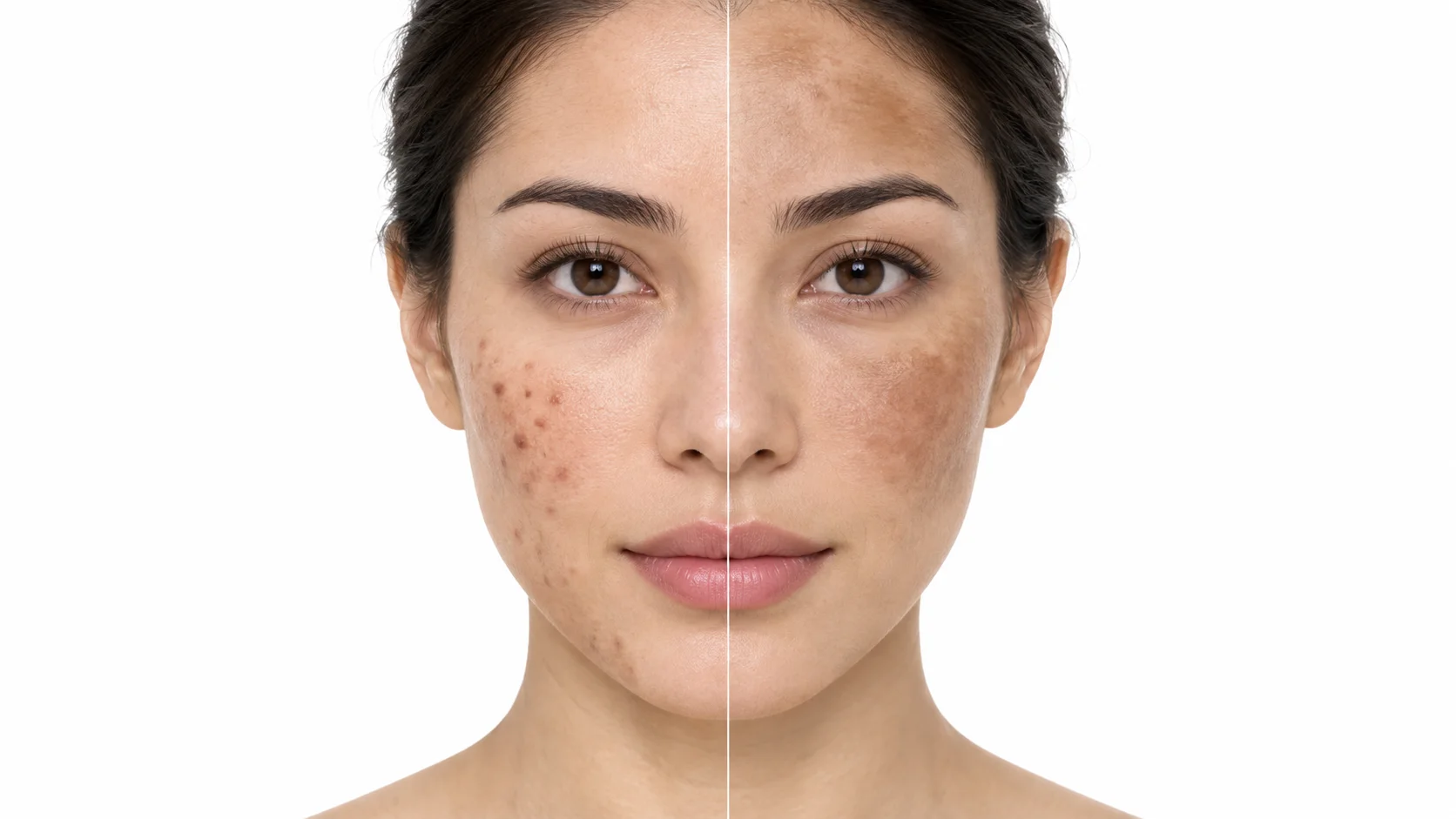
Melasma is a chronic pigmentation condition characterised by symmetrical, large, irregular brown patches on the face — typically across the cheeks, upper lip, forehead, and chin. Unlike standard dark spots, melasma is driven by an ongoing internal trigger: hormonal fluctuations.
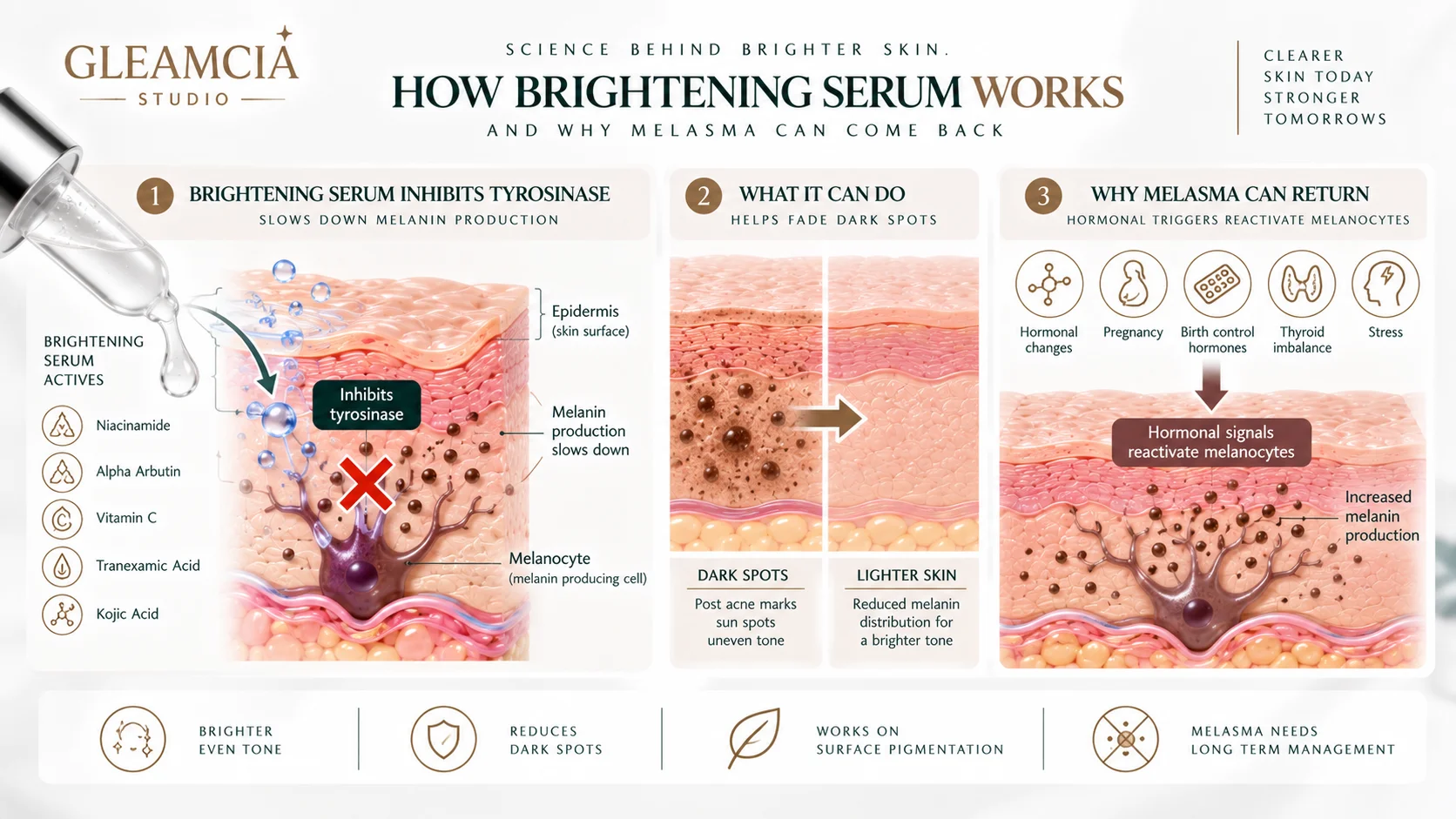
Oestrogen and progesterone stimulate melanocyte activity. When those hormone levels fluctuate — during pregnancy, while taking hormonal contraceptives, or during hormonal treatments — the melanocytes on the face respond by producing excess melanin in a characteristic symmetrical pattern. UV exposure amplifies this hormonal melanocyte stimulation significantly, which is why melasma almost always worsens in summer and in people without consistent SPF habits.
Melasma is notably more common in women — approximately 90% of cases — and is significantly more prevalent in darker skin tones, including South Asian complexions common across Pakistan. It is one of the most-treated skin concerns in Pakistani dermatology practices, particularly post-pregnancy and in women on hormonal contraception.
The critical difference between melasma and a standard dark spot is this: melasma has an active, ongoing trigger. A post-acne mark forms from a past event and then sits waiting to be faded. Melasma forms from a continuing hormonal signal that keeps restimulating the same melanocytes in the same zones. This is why the treatment approach, timeline, and realistic expectations are so different between the two.
Dark Spots vs Melasma: The Core Differences That Change Your Treatment
Understanding these distinctions is what determines whether your brightening routine produces the results you expect.
Cause: Dark spots result from past events (acne, sun damage, trauma). Melasma results from ongoing hormonal stimulation amplified by UV exposure.
Appearance: Dark spots are typically irregular in shape and confined to specific areas corresponding to past breakouts or sun exposure zones. Melasma presents as symmetrical, larger patches with blurred edges — if one cheek has it, the other side usually has a matching patch.
Location pattern: Melasma almost always appears bilaterally — both cheeks, the full forehead, or across the upper lip. Dark spots appear where events happened — the nose, isolated cheek areas, the jawline from acne.
Response to brightening serums: Dark spots respond clearly and consistently to brightening serums with Vitamin C, Alpha Arbutin, and AHAs over 6 to 12 weeks. Melasma improves with brightening treatment but does not fully resolve as long as the hormonal trigger is active and SPF is inconsistent.
Seasonal behaviour: Dark spots are relatively stable across seasons. Melasma typically worsens visibly in summer months with increased UV exposure and may improve slightly in winter.
Risk of recurrence: Treated dark spots do not automatically return. Treated melasma almost always recurs if the hormonal trigger continues or SPF use lapses.
What a Brightening Serum Can Fix: Dark Spots and Post-Acne Marks
Brightening serums are genuinely effective for standard hyperpigmentation — post-acne marks, sun spots, and uneven tone from cumulative UV exposure.
The mechanism is clear. Ingredients like Vitamin C block tyrosinase — the enzyme that drives melanin production — and the melanin already deposited in the skin gradually moves upward through cell turnover to be shed. Niacinamide prevents the transfer of melanin from melanocytes to surface skin cells, reducing how much pigment reaches the visible skin layers. AHAs accelerate cell turnover so the treated cycle happens faster.
Over six to twelve weeks of consistent use with daily SPF, these mechanisms produce visible fading of post-acne marks and sun spots. Results are gradual and build across multiple skin cell cycles. Monthly progress photos are the most reliable way to see what is happening, since day-to-day comparison underestimates the cumulative change.
For dark spots specifically, the brightening serum approach works because there is no new melanin production being triggered. The serum is addressing a finite, defined problem — excess melanin from past events — and it can address it completely over sufficient time.
What a Brightening Serum Cannot Fully Fix: Melasma and Its Hormonal Driver
A brightening serum is not a complete melasma solution. It is part of one, but only one part.
The limitation is the ongoing hormonal trigger. While a Vitamin C serum is inhibiting tyrosinase and reducing melanin production in the existing patches, the oestrogen-driven melanocyte stimulation is producing more. The serum is working against a current that keeps replenishing the pigment it is trying to fade.
This is why people with melasma using excellent brightening serums consistently with perfect SPF still see partial rather than complete improvement. The serum is doing everything it is supposed to do. The problem is that the condition has a driver the serum cannot address.
What a brightening serum does accomplish for melasma: meaningful lightening of existing patches, slowing the rate of new pigment accumulation, and visibly improving overall skin tone evenness. That is real and worth pursuing. It just needs to be combined with robust SPF protection, and in some cases with prescription treatment or dermatologist guidance, for the most complete results.
The American Academy of Dermatology classifies melasma as a chronic condition requiring ongoing management rather than a one-time correctable concern — which is an important realistic expectation to carry into any treatment approach.
Best Brightening Serum Ingredients for Dark Spots
For post-acne marks, sun spots, and standard UV hyperpigmentation, these ingredients have the clearest evidence and the strongest real-world results:
- Vitamin C (L-Ascorbic Acid at 10% to 20%) — the most researched and fastest-acting brightening active for dark spots. Inhibits tyrosinase and provides antioxidant protection against new UV-triggered pigmentation.
- Niacinamide (5% to 10%) — blocks melanin transfer to surface cells. Works at a different point in the pigmentation pathway than Vitamin C, so the two together are significantly more effective than either alone.
- Alpha Arbutin — a stable, gentle tyrosinase inhibitor that works well for consistent daily application on brown post-acne marks.
- AHAs (Glycolic or Lactic Acid) — accelerate cell turnover, bringing newly cleared skin cells to the surface faster. Best used two to three evenings per week alongside a daily brightening serum.
- Retinol — increases cell turnover dramatically over a longer period and fades pigmentation while also improving overall skin texture. Best introduced gradually with SPF use established first.
Best Serum Ingredients That Work for Melasma
Melasma requires a different — or at least extended — ingredient approach because the hormonal melanocyte stimulation pathway needs to be specifically addressed.
- Tranexamic Acid — the most specifically effective over-the-counter ingredient for melasma. It inhibits the plasmin-prostaglandin pathway that connects hormonal and UV stimulation to melanocyte activation — which is exactly the pathway that drives melasma rather than standard dark spots. At 2% to 5% concentration, Tranexamic Acid produces visible melasma improvement that other brightening actives cannot match alone.
- Niacinamide — reduces melanin transfer and supports the barrier, which is important for melasma-prone skin that is often sensitised by years of topical treatment and sun exposure.
- Azelaic Acid — reduces melanin synthesis through a gentler mechanism than hydroquinone. Well-suited for darker skin tones where some brightening ingredients carry irritation risk.
- Kojic Acid — a naturally derived tyrosinase inhibitor particularly effective for melasma. Often found in combination formulas designed for hormonal hyperpigmentation.
- Vitamin C — still beneficial for melasma as an antioxidant and melanin inhibitor, but works best in combination with Tranexamic Acid rather than as a standalone melasma treatment.
What Is the Best Serum for Dark Spots and Melasma?
For dark spots, the best serums combine Vitamin C at 10% to 15% with Niacinamide at 5% to 10%, used in the correct order (Vitamin C first, Niacinamide second after absorption) with daily SPF. The combination covers two different melanin pathways simultaneously and consistently produces the most visible fading across a six to twelve week period.
For melasma, the most effective serum combination centres on Tranexamic Acid — ideally at 2% to 5% — paired with Niacinamide and applied twice daily with SPF 50+ every morning without exception. Tranexamic Acid’s specificity for the hormonal melanocyte trigger that standard brightening ingredients do not address is what makes it the most effective OTC ingredient for melasma specifically.
For both conditions simultaneously, a serum containing Niacinamide as the consistent daily base, Tranexamic Acid for the melasma component, and Vitamin C in the morning for dark spot fading and antioxidant protection creates the most complete approach. The SPF is not optional in this combination — it is what determines whether any of it works.
Browse the Gleamcia Skin Care range for brightening serums formulated with these actives at concentrations matched to real pigmentation concerns.
What Is the Fastest Way to Remove Melasma?
There is no truly rapid melasma removal — and claiming otherwise is the first signal that a product or treatment is not being honest about the condition. Melasma is a chronic, hormonally driven concern with a timeline measured in months, not weeks.
The fastest results from over-the-counter treatment come from the Tranexamic Acid plus SPF 50+ combination used consistently twice daily, every single day. Most people see meaningful lightening within eight to twelve weeks, with continued improvement to the three to six month mark.
Beyond topical serums, several professional treatments accelerate melasma improvement for people who want faster results:
Chemical peels with lactic acid, kojic acid, or mandelic acid are among the most appropriate professional treatments for melasma on darker South Asian skin. They accelerate cell turnover and deliver higher concentrations of brightening actives than OTC serums can.
Prescription topical combinations — typically hydroquinone 4% paired with Tretinoin and a topical corticosteroid — are the strongest non-laser melasma treatment available and produce faster results than OTC serums alone. These require a dermatologist prescription and careful monitoring.
Laser treatments such as fractional laser, PicoWay, or Q-switched Nd:YAG lasers can produce significant melasma improvement when administered by an experienced dermatologist. However, melasma on darker skin tones requires very experienced laser operators because the wrong approach can worsen pigmentation. This is not a first-line treatment.
The universal truth about melasma is that without daily SPF 50+ every single morning — regardless of weather, season, or whether going outdoors — all of these treatments are undermined. UV exposure continuously restimulates the melanocytes that drive melasma. A single day of unprotected sun exposure can undo weeks of treatment progress.
Dark Spots vs Melasma: Side-by-Side Treatment Comparison
| Feature | Dark Spots (Post-Acne, Sun Damage) | Melasma (Hormonal Pigmentation) |
| Primary cause | Past inflammation or UV events | Ongoing hormonal stimulation + UV |
| Active ongoing trigger | None — the event is over | Yes — hormonal drive continues |
| Pattern | Localised, irregular, single patches | Symmetrical, bilateral, larger patches |
| Best brightening actives | Vitamin C, Alpha Arbutin, AHAs, Retinol | Tranexamic Acid, Niacinamide, Kojic Acid, Azelaic Acid |
| Response to OTC brightening serum | Strong — can clear fully with consistency | Partial — improves but often does not fully resolve |
| SPF role | Prevents new formation and speeds fading | Absolutely essential — melasma worsens rapidly without it |
| Seasonal behaviour | Relatively stable | Worsens in summer, slightly better in winter |
| Likelihood of recurrence after treatment | Low unless re-triggered | High — especially without SPF or if hormonal trigger continues |
| Prescription treatment needed | Rarely — OTC serums usually sufficient | For significant melasma, often yes |
| Typical treatment timeline | 6 to 12 weeks for significant fading | 3 to 6 months for meaningful improvement, ongoing management |
| Dermatologist involvement | Not usually necessary | Recommended for moderate to severe cases |
SPF: The Single Most Important Step for Both Dark Spots and Melasma
If there is one thing both conditions agree on, it is this: no brightening serum can outpace daily UV exposure without SPF in place.
For dark spots, UV exposure continues stimulating new melanin production in already-damaged zones. A brightening serum fades existing pigment. Unprotected UV adds it back. The two cancel each other out and the skin stays stuck.
For melasma, UV is an active driver of the condition itself — not just a background risk factor. Even brief UV exposure on unprotected melasma-prone skin stimulates melanocyte activity in those patches. A single morning without SPF during a treatment course is not a minor inconvenience — it actively reverses progress.
SPF 50+ broad-spectrum protection applied in the correct two-finger amount for face and neck every morning without exception is the non-negotiable foundation beneath every brightening product. Without it, neither dark spots nor melasma improve at the rate the serum is capable of producing.
What Helps with Dark Spots and Melasma Beyond Serums?
Serums and SPF are the core — but supporting habits make the full difference.
A gentle, brightening-focused cleanser keeps the skin surface clean and receptive without disrupting the barrier that active brightening ingredients need to work through. The Gleamcia Brightening Face Wash prepares the skin for serum absorption without stripping.
Consistent sleep supports the cell turnover that moves faded skin cells to the surface and sheds them. The overnight renewal cycle is where much of the brightening serum’s work actually produces visible change.
Wearing a wide-brimmed hat on high-UV days, particularly in Pakistan’s summer, provides physical UV protection for melasma that even the most robust SPF cannot fully substitute for during extended outdoor exposure.
Hydration from within — consistent water intake throughout the day — supports the cellular transport mechanisms that carry brightening actives through the skin. Dehydrated skin absorbs products less efficiently.
For melasma specifically, discussing the hormonal trigger with a doctor is worth considering if the condition is significant and persistent. Changing the hormonal context — switching contraceptive methods if appropriate, or managing other hormonal factors — removes the driver that topical treatments are fighting against.
Common Mistakes When Treating Dark Spots and Melasma
Treating melasma the same as post-acne marks. The same Vitamin C serum that fades a chin breakout mark will partially improve melasma but never fully clear it without the Tranexamic Acid component and robust SPF. Correct diagnosis changes the product selection.
Inconsistent SPF use. Every missed morning of SPF during a brightening treatment course extends the timeline and potentially reverses recent progress. SPF is not part of the routine — it is the condition for the routine to work.
Expecting melasma to clear completely. Melasma is a managed condition for many people, not a cured one. Setting realistic expectations prevents abandoning an effective routine too early.
Exfoliating too aggressively. AHAs and retinol are valuable brightening accelerators, but overuse sensitises the skin, compromises the barrier, and can actually worsen inflammation-driven pigmentation. Two to three evenings per week for AHAs is the appropriate frequency.
Switching products before the first ones have had a full treatment cycle. Six to eight weeks minimum is needed to see meaningful change from brightening serums. Switching at week three because the result is not yet visible means never completing a treatment cycle.
Results Timeline for Dark Spots vs Melasma Treatment
Dark spots (post-acne, sun damage):
- Weeks 3 to 4: Edges of spots begin to soften and lighten
- Weeks 6 to 8: Visible fading across most spots with consistent serum and SPF
- Weeks 10 to 12: Significant clearance of mild to moderate hyperpigmentation
- 3 to 6 months: Full clearing of older or deeper spots with continued consistency
Melasma:
- Weeks 4 to 6: Overall skin tone may begin to even slightly; patches may appear slightly lighter at the edges
- Weeks 8 to 12: Meaningful lightening of patches with Tranexamic Acid-based treatment and consistent SPF
- 3 to 6 months: Most significant visible improvement for moderate melasma with consistent OTC treatment
- Ongoing maintenance: Required indefinitely to prevent full return, particularly without hormonal trigger resolution
Aftercare and Habits That Support Both Dark Spot and Melasma Treatment
Do:
- Apply SPF 50+ every morning as the final skincare step before leaving the house — no exceptions for cloudy days or short outdoor trips
- Use a wide-brimmed hat during extended outdoor time in Pakistan’s summer months
- Keep progress photos — monthly comparison in consistent light reveals changes that daily observation misses
- Apply the brightening serum consistently, twice daily if the formula is designed for AM and PM use
Do not:
- Pick at hyperpigmented areas — mechanical trauma to already-pigmented skin can worsen PIH and create new dark spots
- Use highly fragrant products on melasma-prone skin — inflammation and sensitisation worsen the condition
- Apply brightening actives in a high concentration immediately after exfoliation on the same evening — the skin needs a buffer
- Take extended breaks in the routine and expect consistent results — the biology requires continuous active management
What Does a Brightening Serum for Dark Spots or Melasma Cost in Pakistan?
Formulation complexity is the price driver in this category. A Vitamin C serum with stabilised L-Ascorbic Acid at 15% in a photostable base costs more than an unstable Vitamin C derivative at 2%. A Tranexamic Acid serum at 5% in a formula tested for melasma-specific efficacy costs more than a general brightening product that lists Tranexamic Acid in its ingredient deck without disclosing concentration.
What you are paying for in a quality brightening serum is the concentration and stability of the active — the two things that determine whether the product produces the result on the label. Lower-priced brightening serums that show no results over 12 weeks of use are more expensive in practice than a higher-priced effective formula.
Serums formulated for melasma treatment are typically priced above general brightening serums because of the specificity of the actives (Tranexamic Acid, Azelaic Acid) and the precision required in formulation. For a condition that requires ongoing management rather than a one-time course, the cost-per-month calculation over a sustained period is the more practical measure.
Buying a brightening bundle — serum, SPF, and a gentle brightening face wash — from the same formulation range ensures ingredient compatibility and reduces the per-product cost compared to purchasing separately. Visit gleamcia.com/shop for current pricing on the full brightening skin care range, with nationwide delivery across Pakistan.
Why Choose Gleamcia
Gleamcia formulates every brightening product with the South Asian skin reality in mind — Pakistan’s sun intensity, the prevalence of both post-acne marks and hormonal melasma, and the need for formulas that work on medium to deep skin tones without causing further irritation or unwanted reactions.
- Brightening serums with Vitamin C, Niacinamide, and Tranexamic Acid at concentrations backed by clinical evidence, not label-level trace amounts
- SPF and serum formulas designed to work as a system — compatible bases, complementary actives, and packaging that preserves formula stability in Pakistan’s heat
- Transparent ingredient and concentration disclosure so you know exactly what you are using and why
- Full skin care ranges that cover cleanser, serum, and SPF as a complete brightening routine rather than individual isolated products
- Nationwide delivery from Karachi to every city in Pakistan, with fast dispatch and careful packaging
Frequently Asked Questions
1. What is the best serum for dark spots and melasma? For dark spots, a serum combining Vitamin C at 10% to 15% and Niacinamide at 5% to 10% produces the most consistent fading results when used daily with SPF. For melasma, Tranexamic Acid at 2% to 5% paired with Niacinamide is the most specifically targeted OTC approach. For both conditions simultaneously — which is common — a serum with Niacinamide as the consistent base, Tranexamic Acid for the melasma component, and Vitamin C in the morning routine addresses both pigmentation types from the angles they each need.
2. What is the best product for dark spots and melasma? There is no single product that addresses both completely — the most effective approach is a system. A Tranexamic Acid and Niacinamide serum for melasma, a Vitamin C serum for dark spots, a brightening face wash like the Gleamcia Brightening Face Wash as the daily base, and SPF 50+ applied every morning without exception. The SPF is arguably the single most important product in the system because without it none of the serums perform at their rated capacity.
3. What serum works for melasma specifically? Tranexamic Acid is the most specifically effective OTC serum ingredient for melasma because it targets the plasmin-prostaglandin pathway that connects hormonal and UV stimulation to melanocyte overactivation — the specific pathway driving melasma. Azelaic Acid and Kojic Acid are strong supporting ingredients. Niacinamide is essential for reducing melanin transfer. Vitamin C helps but is more broadly effective across general dark spots than specifically for melasma.
4. What helps with melasma and dark spots together? Niacinamide is the one ingredient that effectively addresses both — it blocks melanin transfer regardless of whether the source is post-acne inflammation or hormonal stimulation. Beyond that, SPF 50+ applied daily is the most impactful single habit for both conditions. For a complete dual-purpose approach: Vitamin C in the morning with SPF, Tranexamic Acid and Niacinamide in the evening, AHA exfoliation two evenings per week, and a consistent sleep and hydration routine that supports overnight skin cell turnover.
5. What is the fastest way to remove melasma? No OTC product removes melasma quickly because melasma is hormonally driven and requires sustained inhibition of an active trigger. The fastest OTC approach is Tranexamic Acid at 5% used twice daily with SPF 50+ every single morning — most people see meaningful lightening by week eight to twelve. The fastest overall approaches involve prescription treatments (hydroquinone 4% with Tretinoin combination, managed by a dermatologist) or professional treatments (chemical peels, laser). All of these are significantly undermined without consistent daily SPF.
6. Can dark spots and melasma be confused with each other? Yes, and often are. The key diagnostic difference is symmetry and pattern. Melasma presents in bilateral, symmetrical patches across the cheeks, forehead, or upper lip — if it mirrors itself on both sides of the face, it is more likely melasma. Post-acne dark spots and sun damage are irregular and appear where the original event happened — a specific cheek zone from old breakouts, the nose from UV exposure, isolated patches rather than bilateral coverage. Hormonal history matters too — if the pigmentation started during pregnancy or alongside hormonal contraception, melasma is the more likely diagnosis.
7. Does SPF alone help melasma without a brightening serum? SPF alone does not fade existing melasma — it prevents new UV-triggered stimulation of the melanocytes driving the existing patches. Without a brightening serum, the existing pigment stays. Without SPF, any brightening serum is fighting UV-triggered pigmentation being added while trying to fade what is already there. Both are necessary — SPF prevents new formation, serum addresses what is already there. Neither works adequately without the other when melasma is the concern.
Know What You Are Treating — Then Treat It Correctly
Dark spots and melasma look similar but they are not the same problem. Getting clear on which one — or which combination — you are dealing with is what makes the difference between a routine that produces real results and one that partially works and plateaus. Order from the Gleamcia Skin Care range — available at gleamcia.com with nationwide delivery from Karachi to every city in Pakistan.
Order via WhatsApp at 0336 1223363 and our team will help you identify the right brightening serum combination for your specific pigmentation concern.