Introduction
Biotin sits at the top of almost every hair growth supplement list. So when someone starts taking it for thicker hair and a week later finds their chin breaking out, the first question is obvious: does biotin cause acne? And because the internet has strong opinions in both directions — some saying biotin is completely safe, others saying it always triggers breakouts — the answer gets buried in contradictions before it ever gets clear.
The truth is more specific than either camp suggests. Biotin does not directly cause acne in the way that hormones or comedogenic ingredients do. But at high doses, it can set off a chain of events in the body that leads to increased oiliness and breakouts in people who are already prone to them. Understanding that chain is what allows you to take biotin for your hair without sacrificing your skin. Browse the Gleamcia Hair Care and supplement range for biotin formulas designed around effective concentrations with lower breakout risk.
What Is Biotin and What Does It Do for the Skin?
Biotin is Vitamin B7 — a water-soluble B-complex vitamin essential for the metabolism of fatty acids, glucose, and amino acids. Hair, nails, and skin are all heavily dependent on these metabolic processes, which is why biotin became so closely associated with beauty supplementation.
For the skin specifically, biotin plays a role in fatty acid synthesis — the production of the lipids that make up the skin’s barrier layer. A biotin deficiency (which is rare but does occur) produces visible skin symptoms: scaly, red rashes around the nose, mouth, and eyes, along with hair loss and brittle nails. These deficiency signs are what led to biotin’s reputation as a “skin supplement.”
What biotin does not do is directly control sebum production, fight acne bacteria, or clear existing pimples. Its relationship with skin is indirect — it supports the metabolic pathways that keep the skin healthy, rather than acting as a targeted treatment for any specific skin concern.
The complication arises not from what biotin does but from what happens when it is taken in doses far above what the body actually needs.
Does Biotin Cause Acne? The Real Mechanism Explained
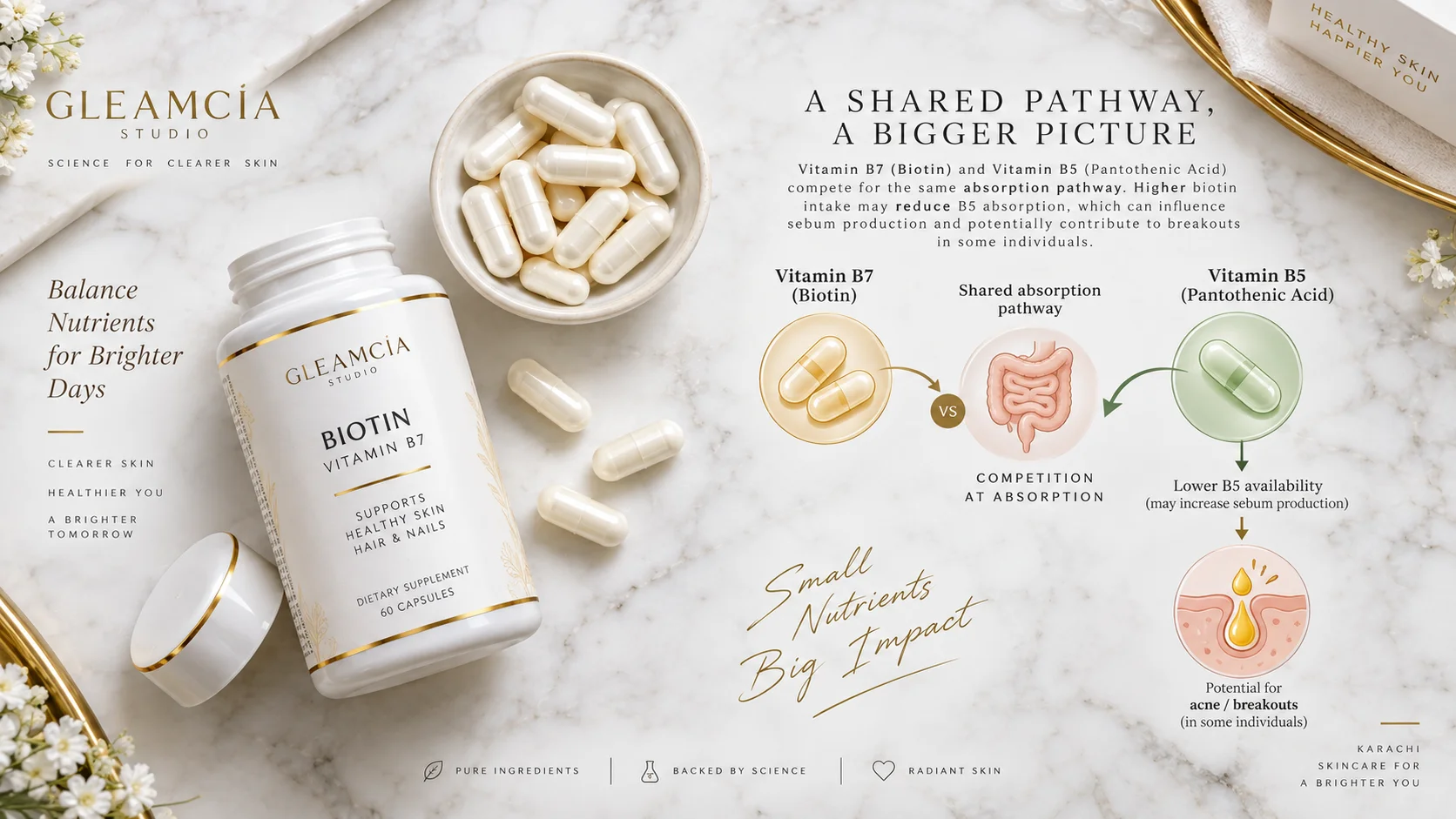
Biotin does not cause acne directly. What it does at high doses is interfere with the absorption of another B vitamin — Pantothenic Acid, also called Vitamin B5 — and that interference is what triggers breakouts in susceptible people.
Biotin and Pantothenic Acid are absorbed through the same intestinal transporter in the body, called the Sodium-Dependent Multivitamin Transporter (SMVT). This transporter handles only one B vitamin at a time. When very high doses of biotin flood the system, the transporter prioritises biotin absorption and Vitamin B5 absorption is reduced.
Vitamin B5 is deeply involved in the regulation of fatty acid metabolism in the sebaceous glands — the glands that produce oil in the skin. When B5 levels drop, the sebaceous glands lose some of their regulatory control over sebum output. Oil production increases. Increased oil in already-prone pores creates the conditions for acne to develop.
So the sequence is: high-dose biotin replaces B5 in the transporter, B5 drops, sebum regulation is disrupted, oiliness increases, and in people with acne-prone skin, breakouts follow. It is an indirect pathway — not biotin triggering acne directly, but biotin creating a deficiency in the vitamin that keeps oil production in check.
This mechanism explains why the biotin-acne connection does not affect everyone. People who eat a diet rich in natural Vitamin B5 sources (eggs, meat, whole grains, legumes), or who take a B-complex supplement alongside biotin, maintain adequate B5 levels even with higher biotin doses. People with acne-prone or oily skin, or those relying on supplementation alone without dietary support, are more vulnerable.
Can Biotin Trigger Acne Breakouts? Who Is Most at Risk?
Biotin-triggered breakouts are most likely in people who meet specific conditions rather than being a universal response.
You are at higher risk of biotin-related acne if you take doses of 5,000 mcg or above daily, particularly without a corresponding Vitamin B5 source. Very high-dose biotin supplements (10,000 mcg, which is used clinically for deficiency) carry the most significant B5-displacement effect.
Oily and acne-prone skin types are more susceptible because their sebaceous glands are already more reactive to changes in sebum regulation. An incremental increase in oil production from B5 displacement pushes them over a threshold that a dry or balanced skin type would not cross.
People eating low-B5 diets — particularly those on restrictive eating patterns, high-carbohydrate diets low in eggs and meat, or those with limited variety in their food choices — have less B5 reserve to buffer the displacement effect.
And people who take biotin in isolation, without other B-complex vitamins in the same supplement or diet, run a higher displacement risk than those taking biotin as part of a balanced B-complex.
Lower risk or no risk includes:
- People taking moderate doses (2,500 mcg or below)
- People with a balanced diet containing adequate eggs, meat, nuts, and whole grains
- People taking a B-complex supplement alongside biotin that includes meaningful Pantothenic Acid
- Dry skin types with naturally lower sebum production
- People whose acne was not pre-existing before starting biotin
Can You Take Biotin If You Have Acne?
Yes — with the right approach. Acne-prone skin does not automatically disqualify biotin supplementation, and many people with acne take biotin for hair growth without any worsening of their skin.
The strategy is to minimise the B5 displacement effect rather than avoid biotin entirely.
Starting with a lower dose — 2,500 mcg rather than jumping straight to 10,000 mcg — gives the body time to establish the B5 balance and allows you to observe whether the skin responds negatively before committing to a higher therapeutic dose.
Taking biotin alongside a B-complex supplement that includes at least 500 mg of Pantothenic Acid (Vitamin B5) is the most reliable way to maintain B5 levels even as biotin intake increases. The additional B5 ensures there is enough for the transporter to absorb both vitamins rather than prioritising one at the other’s expense.
Eating a diet that includes B5-rich foods daily provides a natural buffer. Eggs, chicken, beef, whole grains, sunflower seeds, and legumes are all high in Pantothenic Acid and eating them consistently alongside biotin supplementation reduces the chance of displacement-driven breakouts significantly.
Monitoring the skin in the first two to three weeks after starting biotin is the practical way to catch any early reaction before it becomes a full breakout pattern. If the chin or jawline starts breaking out and nothing else has changed, biotin dose or B5 co-supplementation is the first place to look.
Does Biotin Stop Acne or Remove Existing Pimples?
No. Biotin does not treat acne, stop breakouts from occurring, or remove existing pimples.
Biotin is a metabolic vitamin. It does not have comedolytic properties — it does not dissolve or clear blocked pores. It has no antibacterial action against the C. acnes bacteria responsible for inflammatory acne. It does not suppress sebum production or reduce skin inflammation.
The confusion around this comes from the skin-benefit narrative attached to biotin marketing. Biotin genuinely supports skin health through its role in fatty acid metabolism and barrier function. That support reduces rashes and skin deterioration associated with biotin deficiency. But deficiency-related skin problems and acne are completely different conditions with different causes and different treatments.
If anything, biotin at high doses has a slightly sebum-promoting effect through the B5 displacement pathway — the opposite of what an acne treatment would do.
For people looking to address acne directly, the ingredients with actual evidence are Salicylic Acid for pore clearance, Niacinamide for sebum regulation and inflammation reduction, Benzoyl Peroxide for bacterial reduction, and prescription retinoids for cell turnover and follicle normalisation. Biotin is not in that category.
Is Biotin Good for Clear Skin?
At moderate, appropriate doses — up to 2,500 mcg daily — biotin is broadly neutral to mildly beneficial for skin health. It supports the metabolic processes that maintain skin barrier function and reduces the skin symptoms of genuine biotin deficiency.
For someone with truly biotin-deficient skin, supplementation can produce visible improvement in rash, dryness, and barrier integrity. But most people in Pakistan eating a standard diet with eggs, lentils, nuts, and grains are not meaningfully biotin-deficient. The supplement adds more than the body is short of, and the incremental benefit for skin is minimal in that context.
The American Academy of Dermatology notes that biotin deficiency is uncommon in people eating a varied diet, and that biotin supplementation for skin improvement in well-nourished individuals has limited clinical evidence.
For clear, bright, even-toned skin, ingredients like Niacinamide, Vitamin C, and AHAs have significantly stronger evidence for visible improvement. Biotin’s contribution to skin is real but indirect — the foundation, not the treatment.
High-Dose Biotin vs Low-Dose Biotin: How Dose Affects Skin and Acne Risk
| Feature | Low-Dose Biotin (up to 2,500 mcg) | High-Dose Biotin (5,000 mcg and above) |
| B5 displacement risk | Low — minimal transporter competition | Higher — significant B5 competition |
| Acne risk | Low for most skin types | Moderate to high for oily or acne-prone skin |
| Hair growth benefit | Good — adequate for nutritional support | Stronger — used for visible density improvement |
| Thyroid test interference | Not typically at this level | Can occur at very high doses (10,000 mcg+) |
| Recommended starting dose | Yes — appropriate for most adults | Only after tolerance established at lower dose |
| Best paired with | Balanced diet, B-complex optional | B-complex with B5 strongly recommended |
| Skin oiliness change | Typically no change | Possible increase in oily skin types |
| Safe for acne-prone skin | Yes with normal dietary B5 intake | Requires B5 co-supplementation |
| Duration before results | 3 to 4 months for hair | Similar — biology is the same |
| Best for | General hair support, new biotin users | Faster or more pronounced hair growth results |
The conclusion is clear: start lower, observe the skin, and build to a higher dose with B5 support in place if needed. Higher doses produce more hair growth support but carry more skin risk without the dietary or supplementary B5 buffer.
How to Take Biotin Without Breaking Out
These steps specifically address the B5 displacement risk that causes biotin-related breakouts.
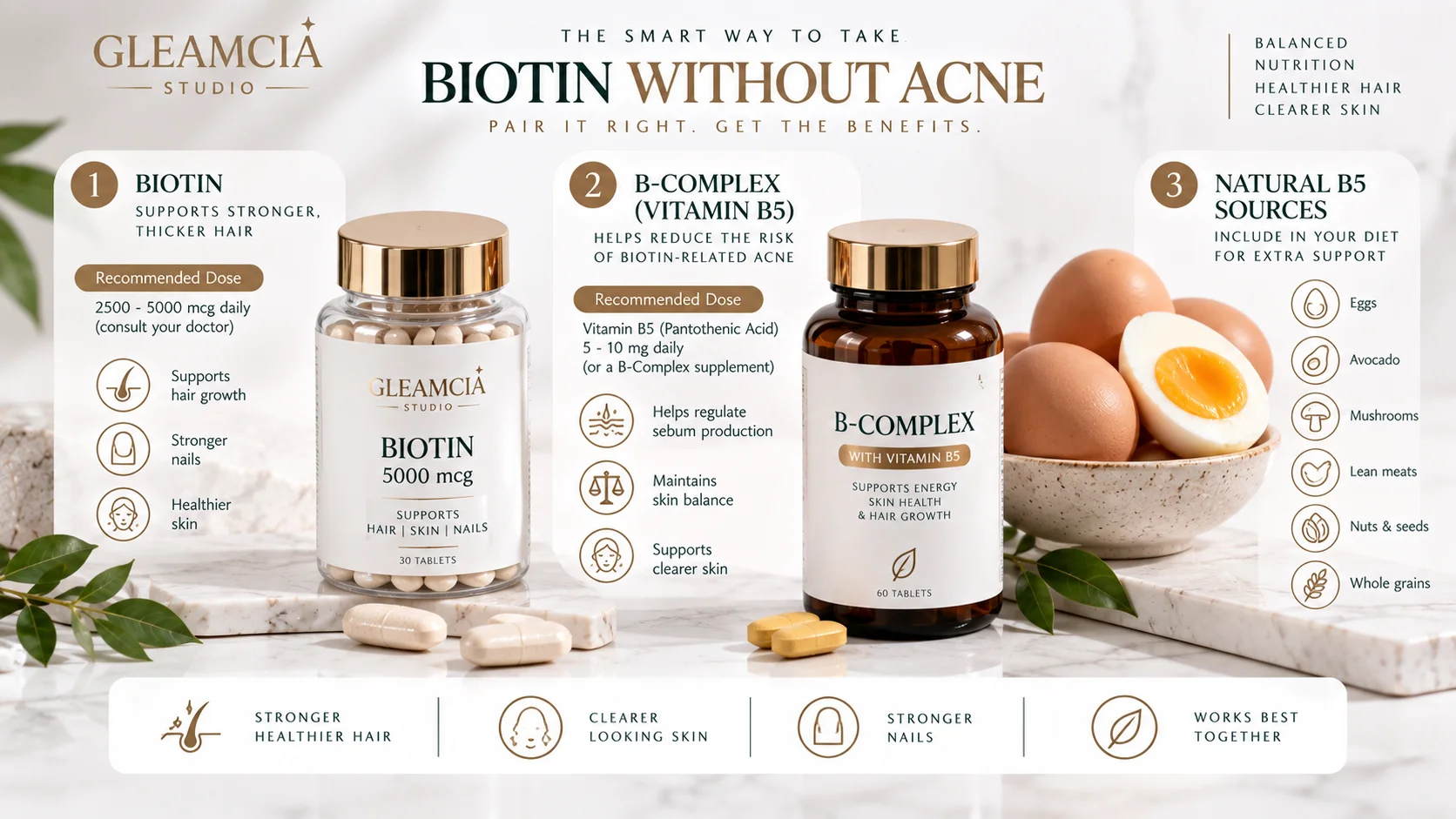
Start at 2,500 mcg daily rather than jumping to the highest dose available. The body’s biotin-to-B5 absorption ratio is more manageable at moderate doses, and the lower starting point lets you observe whether the skin reacts before committing to a higher dose.
Pair with a B-complex supplement that includes Pantothenic Acid (Vitamin B5) at 500 mg or more. This is the most reliable prevention strategy. The additional B5 in the system means the SMVT transporter has enough B5 to absorb even when biotin is present in high amounts.
Eat B5-rich foods daily. Eggs are the most accessible — two eggs per day cover a significant portion of the daily B5 requirement. Chicken, beef, whole grains, lentils, sunflower seeds, and avocado are also high in natural Pantothenic Acid. A diet that regularly includes these foods provides a continuous buffer against biotin-driven B5 depletion.
Drink adequate water throughout the day. Water-soluble vitamins — including all B vitamins — depend on good hydration for proper metabolism and transport. Dehydration slows the metabolic pathways biotin is supposed to be supporting.
Monitor the skin in the first three weeks. If the chin and jawline start breaking out and nothing else has changed, reduce the biotin dose first and add a B5 supplement before stopping biotin entirely. Very often the response is dose-dependent and reducing rather than eliminating resolves it.
Do not take biotin on an empty stomach if your digestive system is sensitive. Some people experience nausea at higher doses taken without food. Taking it with a meal also improves absorption.
Signs That Biotin Is Causing Your Acne
The timing and location of biotin-related breakouts follow a specific pattern that makes them identifiable.
Breakouts appear within one to three weeks of starting biotin supplementation. This is the timeline for B5 levels to begin dropping under sustained high-dose biotin input, and for the resulting sebum increase to manifest as visible breakouts.
The chin, jawline, and lower face are the most common locations. These areas correspond to the zones most responsive to sebum regulation changes — the same areas that flare in hormonal acne for similar sebaceous-gland-driven reasons.
Oiliness increases noticeably alongside the breakouts. If the skin is genuinely producing more sebum since starting biotin, and the breakouts arrived at the same time, the connection is probable.
The breakouts reduce or clear when biotin is paused or the dose is reduced, without any other change to the routine. This is the clearest confirmation — if stopping or reducing biotin resolves the breakouts, the supplement was the trigger.
No other dietary or lifestyle change happened at the same time. New breakout triggers need to be isolated. If a new face wash, dietary change, or significant stress event coincided with starting biotin, those need to be ruled out as the cause first.
What to Do If Biotin Is Breaking You Out
Step one is reducing the dose rather than stopping entirely. If the breakouts are mild to moderate, halving the dose and adding a B5 supplement frequently resolves the issue without sacrificing the hair growth benefit.
Step two is increasing dietary B5 alongside the reduced dose. Two to three eggs daily, or adding legumes and nuts to the diet consistently, raises the baseline B5 level and buffers the displacement effect more naturally.
Step three — if breakouts continue after dose reduction and B5 supplementation — is pausing biotin for four to six weeks and observing whether the skin clears. If it does, the connection is confirmed and the supplement strategy needs to be rebuilt from a lower dose baseline with stronger B5 support.
Step four is addressing the breakout directly while working through the supplement adjustment. A Niacinamide serum reduces sebum production and inflammation. A Salicylic Acid toner keeps pores clear. Consistent SPF prevents the post-acne pigmentation that often outlasts the breakout itself.
Stopping biotin cold because of breakouts and never returning to it means missing the hair growth benefit for a manageable side effect that can almost always be resolved with the right dose and B5 pairing.
Common Mistakes That Make Biotin-Related Acne Worse
Starting at the highest available dose immediately. Many people buy the 10,000 mcg tablet because the packaging suggests it is the most effective dose. Starting there with no B5 support and acne-prone skin is the fastest way to trigger the B5 displacement breakout.
Taking biotin without any dietary consideration. Biotin is a B-vitamin supplement. Taking it while eating a diet low in other B vitamins removes the natural buffer against displacement.
Switching skincare products at the same time as starting biotin. If the face wash, moisturiser, and serum all change simultaneously with the new biotin supplement, identifying which trigger is causing breakouts becomes very difficult.
Stopping biotin after the breakout and restarting at the same high dose. When the skin clears and the hair goal reasserts itself, restarting at the original high dose without any change to the approach produces the same outcome.
Not linking biotin to the breakout at all. Many people never consider the supplement they are taking for hair as the cause of new skin breakouts. It falls off the radar because biotin is framed as a beauty product rather than a supplement that interacts with other nutrients.
Aftercare for People Taking Biotin With Existing or Acne-Prone Skin
Do:
- Take biotin with food, not on an empty stomach
- Track any skin changes in the first three weeks after starting supplementation — a note in your phone weekly is enough
- If breakouts appear, add a Niacinamide serum to the skincare routine immediately — it addresses the sebum increase directly while the supplement dose is adjusted
- Use a gentle, sulphate-free face wash twice daily — the skin does not need aggressive cleansing to manage biotin-related oil
Do not:
- Add multiple new skincare actives at the same time as starting biotin — it makes breakout triggers impossible to identify
- Take significantly more biotin than recommended on the assumption that higher is faster — the hair growth timeline is the same and the acne risk scales with dose
- Use heavy, comedogenic moisturisers while taking high-dose biotin — the increased sebum production from B5 displacement combined with an occlusive product is a reliable breakout combination
What Does a Quality Biotin Supplement Cost in Pakistan?
Biotin supplement pricing is driven by dose concentration per capsule, capsule count, and whether the formula is standalone or includes supporting B-complex vitamins. A 5,000 mcg standalone biotin supplement costs less per capsule than a 5,000 mcg biotin supplement that also includes Pantothenic Acid, B12, and other co-factors — but the combined formula is significantly more useful for people concerned about acne risk.
Pack size changes the daily cost dramatically. A 30-capsule pack at a high per-unit price works out considerably more expensive per month than a 90-capsule pack of the same formula. For a supplement that requires three to six months of consistent use before hair growth results are visible, buying a larger pack at the outset is more economical.
Standalone biotin is less expensive than a B-complex or hair supplement bundle. But for people prone to acne, the cost of the B5 supplement alongside standalone biotin, or the skin treatment products needed to manage the breakout, often exceeds the cost difference. A combined formula is better value in that context.
Visit gleamcia.com/shop for current biotin supplement pricing and bundle options with nationwide delivery across Pakistan from Karachi.
Why Choose Gleamcia
Gleamcia builds biotin supplements around the full picture — not just the hair growth dose, but the formulation context that makes that dose safe and effective for skin that is also being managed.
- Biotin at meaningful concentrations for genuine hair growth support, not trace amounts added for label appeal
- Formula development that considers the B-vitamin interaction profile relevant to skin tolerance
- Supplements and hair care products that work together as a complete system rather than separately
- Full ingredient and dose transparency — you know exactly what you are taking and why
- Nationwide delivery from Karachi to every city in Pakistan, fast dispatch, and reliable packaging
Frequently Asked Questions
1. Can you take biotin if you have acne? Yes — with the right dose and supporting approach. Biotin at 2,500 mcg or below daily with a B5-inclusive B-complex supplement and a diet that includes B5-rich foods (eggs, nuts, whole grains) significantly reduces the risk of biotin-related breakouts. Oily and acne-prone skin types should start at a lower dose, observe the skin for three weeks, and add B5 supplementation before pushing to higher doses. Biotin does not have to worsen acne-prone skin when taken with the right strategy.
2. Does biotin stop acne or help with breakouts? No. Biotin does not treat or prevent acne. It is a metabolic B-vitamin that supports keratin production and fatty acid metabolism — not an antibacterial, comedolytic, or sebum-reducing agent. At high doses, biotin can actually worsen acne in susceptible individuals through the B5 displacement mechanism. For actual acne treatment, Salicylic Acid, Niacinamide, and Benzoyl Peroxide are the ingredients with clinical backing.
3. Can biotin remove pimples? No. Biotin has no pore-clearing, antibacterial, or anti-inflammatory properties that would remove existing pimples. It does not dissolve sebum plugs, kill acne-causing bacteria, or reduce the inflammation that makes a pimple visible. Biotin’s role in skin is metabolic — supporting the background processes that maintain overall skin health, not treating active breakouts.
4. Is biotin good for clear skin? At appropriate doses, biotin supports the metabolic processes that keep skin healthy, particularly the fatty acid synthesis involved in barrier function. For someone with a genuine biotin deficiency, supplementation can improve skin condition visibly. For well-nourished individuals without deficiency, the incremental skin benefit is modest. For clear skin specifically, Niacinamide, Vitamin C, and AHAs have significantly stronger clinical evidence as direct skin-improvement ingredients. Biotin is supportive, not transformative, for skin clarity.
5. Can biotin trigger acne breakouts? Yes, in specific circumstances. High-dose biotin (5,000 mcg and above) can displace Vitamin B5 from intestinal absorption because both vitamins share the same transporter. When B5 drops, sebum regulation in the sebaceous glands is disrupted and oil production increases. In oily or acne-prone skin, that oil increase is enough to trigger breakouts — typically at the chin and jawline within one to three weeks of starting high-dose supplementation. The risk is dose-dependent and can be managed by pairing biotin with B5 supplementation.
6. What is the safest biotin dose to avoid acne? Starting at 2,500 mcg daily with dietary B5 intake from eggs, nuts, and whole grains is the lowest-risk approach for acne-prone skin. If a higher dose is needed for hair growth goals, adding a B-complex supplement with at least 500 mg of Pantothenic Acid (Vitamin B5) before increasing the biotin dose is the most reliable prevention strategy. Monitor the skin in the first three weeks at any new dose level before continuing to build up.
7. How long after stopping biotin do breakouts clear? Biotin-related breakouts typically begin to improve within two to four weeks of stopping or significantly reducing the dose, as B5 levels rebalance and sebum production normalises. Post-acne marks — the redness and pigmentation left after the pimples clear — take longer. A consistent SPF and a Niacinamide serum during and after the breakout phase supports faster mark fading and prevents UV from deepening the pigmentation.
Take Biotin for Your Hair Without Compromising Your Skin
Biotin and clear skin are not mutually exclusive. The breakout risk is real but manageable with the right dose, the right B5 support, and a routine that responds if the skin reacts. Order from the Gleamcia hair supplement and Hair Care range available at gleamcia.com — nationwide delivery across Pakistan.
Order on WhatsApp at 0336 1223363 and our team will help you choose the right biotin dose and pairing supplements for your hair goals and skin type.