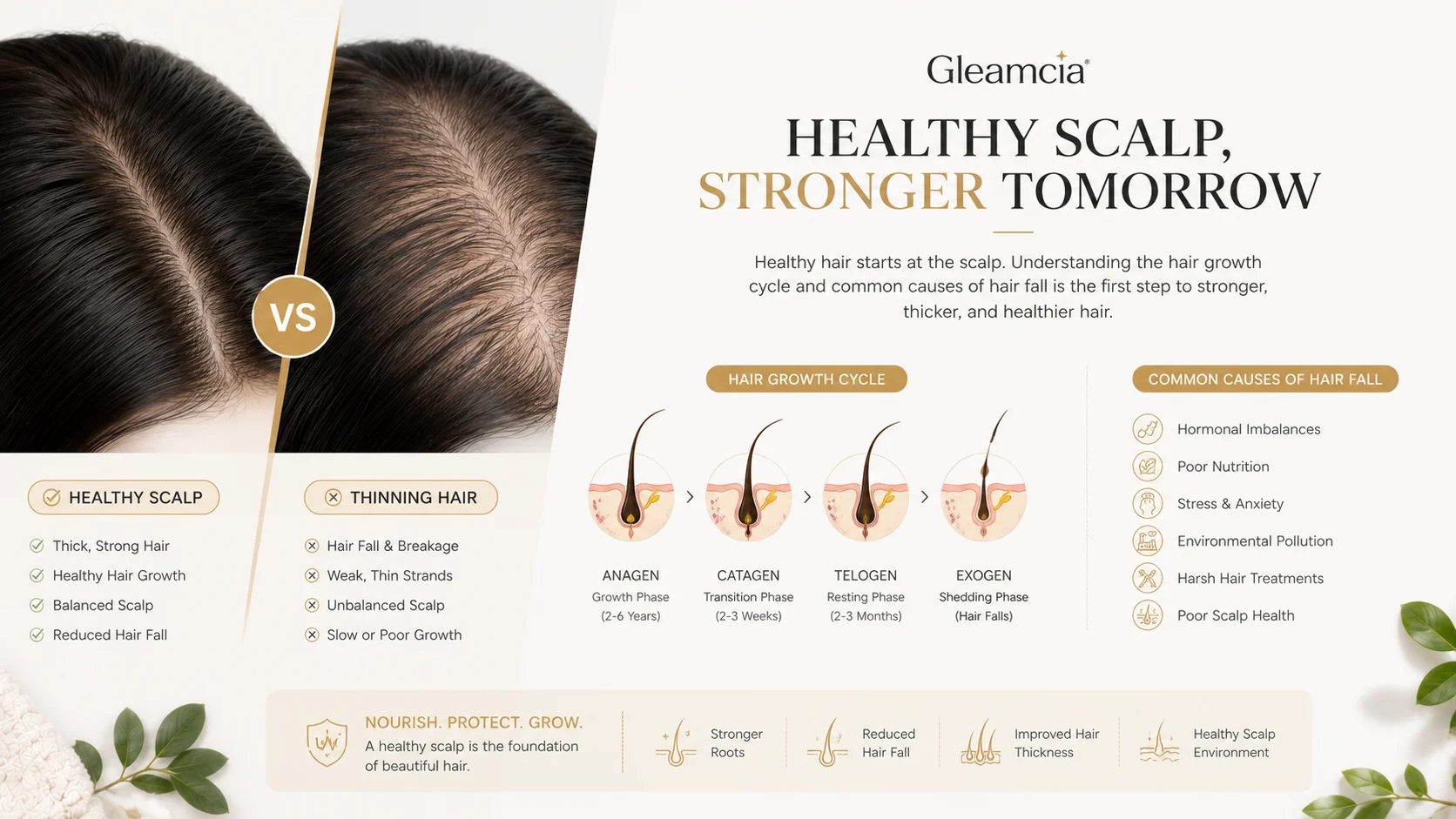
Introduction
If you live in Karachi, Lahore, or most other major cities in Pakistan, the water coming out of your taps is hard. That is not a subjective complaint — it is chemistry. And for a significant number of people dealing with unexplained hair fall, dull hair, and a persistently itchy or flaky scalp, the water itself is the culprit that no one has pointed at directly.
Does hard water cause hair fall? The answer is more layered than a simple yes or no, but the connection is real and it is under-discussed in Pakistan where hard water is essentially universal. This guide covers what hard water does to your scalp and hair strand, how to distinguish hard water damage from other types of hair loss, and what you can actually do about it. Browse the Gleamcia Hair Care range for hair fall solutions formulated to address scalp health in Pakistan’s water conditions.
What Is Hard Water and Why Is It Everywhere in Pakistan?
Hard water is water with a high concentration of dissolved minerals — primarily calcium and magnesium, along with smaller amounts of iron, copper, and chlorine in some municipal water supplies. Water becomes hard as it passes through rock and soil layers, picking up these minerals before reaching the water supply system.
Pakistan’s geography and groundwater composition mean that hard water is the norm in most urban areas. Karachi’s water supply — drawn heavily from groundwater sources and the Indus river system — consistently tests as hard to very hard by international standards. Lahore, Islamabad, Faisalabad, and most major cities have similar profiles. The mineral concentration is often high enough to leave visible white deposits on taps, tiles, and showerheads — that white scale is the same mineral residue that is also landing on your scalp and hair with every wash.
For context, water is classified as hard when it contains more than 120 milligrams of calcium carbonate per litre. Very hard water sits above 180 mg/L. Many urban water supplies in Pakistan exceed this threshold significantly.
Does Hard Water Cause Hair Fall? The Direct Answer
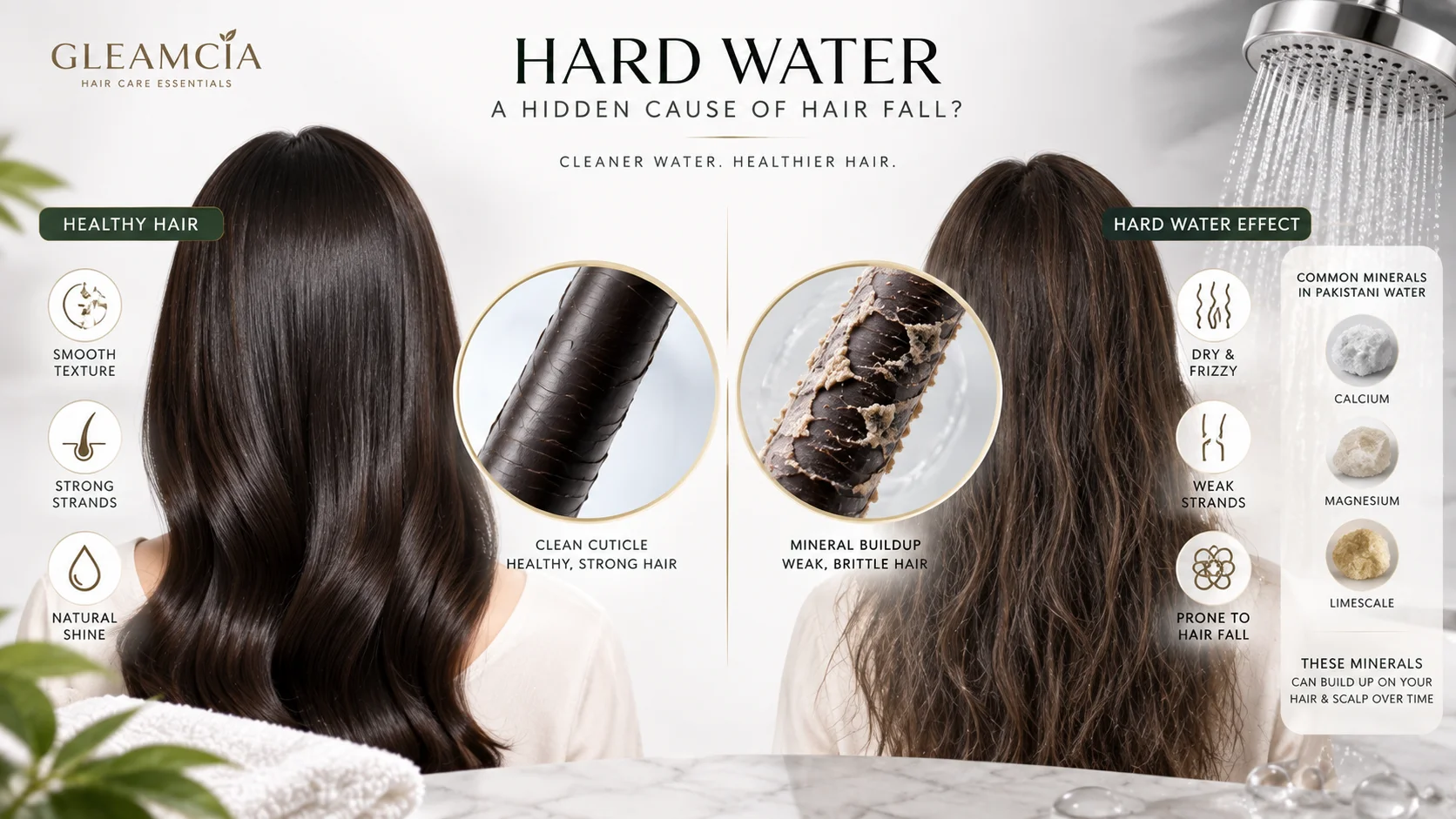
Hard water does not pull hair directly from the follicle the way DHT-driven androgenetic alopecia does. But it creates conditions that accelerate hair breakage, scalp inflammation, and follicle congestion — all of which contribute to visible hair loss and thinning over time.
The distinction matters. There are two types of hair loss at play: shedding (hair falling from the root) and breakage (hair snapping at the shaft). Hard water is a primary driver of breakage, which looks identical to root shedding when you find hair on the floor, brush, or shower drain.
Beyond breakage, the scalp effects of hard water — mineral buildup, pH disruption, and follicle congestion — do contribute to genuine shedding by weakening the scalp environment where hair roots are anchored. A chronically irritated, mineral-clogged scalp does not provide the healthy follicle environment needed to retain hair across the full growth cycle.
A 2016 study published in the International Journal of Dermatology measured hair tensile strength and elasticity in distilled water versus hard water — and found significantly higher breakage rates in hard water conditions. The data supports what people in hard water cities have experienced for years: the water genuinely damages hair in measurable ways.
What Does Hard Water Do to Your Scalp?
The scalp effects of hard water are ongoing and cumulative, building in severity the longer the exposure continues without intervention.
Mineral deposit buildup on the scalp surface is the starting point. Calcium and magnesium ions do not fully rinse away with standard shampoos. They adhere to the scalp skin and inside the hair follicle opening, accumulating with every wash. Over weeks and months, this buildup creates a layer that irritates the scalp, blocks follicle openings, and creates an environment where bacteria and fungal organisms can thrive more easily.
pH disruption is the second mechanism. Healthy scalp skin maintains a slightly acidic pH of around 5.5. Hard water is alkaline, often sitting at pH 8 to 9. Every wash with hard water shifts the scalp’s pH upward, disrupting the acid mantle that protects the scalp from irritants and pathogens. A chronically alkaline scalp becomes more prone to dandruff, seborrheic dermatitis, dryness, and inflammatory conditions — all of which are linked to accelerated hair shedding.
Scalp inflammation follows from both the mineral irritation and the pH disruption. Inflamed follicles weaken. A follicle spending energy managing inflammation produces a weaker hair shaft and enters the shedding phase earlier in the growth cycle than it should. This is not dramatic or sudden — it is a slow erosion of hair density that people notice as their hair looking thinner over months.
Itchiness and flaking are the surface-level symptoms. Many people in Karachi and Lahore with persistently itchy scalps attribute it to dandruff or sensitivity without ever connecting it to the water quality that is causing or worsening the condition.
What Does Hard Water Do to Your Hair Strands?
The damage at the hair strand level is structural and visible.
Calcium and magnesium ions bind to the negatively charged protein surface of the hair shaft. This binding creates a rough, raised cuticle layer rather than the smooth, flat cuticle of healthy hair. A rough cuticle catches on other hair strands, causes tangling, increases friction during combing, and makes breakage significantly more likely with every styling interaction.
The mineral film coating the strand also blocks moisture from entering. Hair that looks dry, feels brittle, and does not respond well to conditioner — despite regular conditioning — is often struggling with a mineral barrier rather than a simple moisture deficit. The conditioner cannot penetrate through the mineral coating to hydrate the cortex underneath.
Iron in hard water — present in many Pakistani water supplies — causes an additional problem. Iron oxidises and can cause hair to take on a brassy, dull, or slightly reddish tone over time. For people with colour-treated hair, iron from hard water accelerates colour fade and shifts the tone.
The cumulative effect of routine hard water exposure looks like: dry, dull hair that tangles easily, breaks more than it sheds, does not hold styles or moisture well, and looks progressively thinner even without any root-level follicle problem.
Why Is Baldness and Hair Fall So Common Now?
Hair fall is genuinely more prevalent than it was thirty years ago — not just more discussed. The reasons are multiple and overlapping.
Water quality in urban areas has not improved uniformly. As populations in cities like Karachi, Lahore, and Faisalabad have grown, more people are exposed to the same hard water supplies over longer periods. More people washing their hair in hard water more frequently means more cumulative mineral damage.
Stress has increased significantly across populations. Chronic psychological stress is one of the clearest documented drivers of telogen effluvium — a form of diffuse hair shedding triggered when stress hormones push a disproportionate number of follicles into the resting phase simultaneously. Urban life, financial pressure, academic stress, and constant digital stimulation have all contributed to chronically elevated stress levels in younger and older populations alike.
Diet has shifted toward processed foods lower in the protein, zinc, biotin, and iron that hair follicles depend on. Nutritional deficiencies that were rarer fifty years ago are significantly more common now, particularly in young people with irregular or convenience-food-dominated diets.
Heat styling has become routine from a young age, weakening the hair shaft structurally over years of use. And scalp care — which the previous generation managed through natural oil application — has been replaced by frequent washing with sulphate-heavy shampoos in hard water without any compensatory scalp treatment.
Why Is Gen Z Balding So Fast?
The question circulates online with a mix of concern and dark humour, but the data behind it is real. Younger generations are experiencing hair thinning earlier than previous cohorts.
The causes specific to Gen Z cluster around a few converging factors. Chronic high stress beginning in adolescence — academic pressure, social media comparison, anxiety disorders that are more prevalent and diagnosed in this generation — is a significant driver of early-onset telogen effluvium and stress-related hair fall.
Diet among younger urban populations in Pakistan skews toward convenience foods that are low in the protein, biotin, and zinc that hair requires to grow with density and strength. A scalp care routine is largely absent despite the fact that this generation is otherwise skincare-literate.
Hard water exposure is universal across Pakistani cities, and frequent washing with harsh shampoos in hard water — without chelating treatments to remove mineral buildup — creates cumulative structural damage to the hair shaft that is more severe the younger it starts and the longer it continues.
DHT sensitivity, which is the genetic basis of androgenetic alopecia, is also presenting earlier in some individuals for reasons researchers are still exploring. Earlier exposure to the environmental triggers that accelerate genetic hair loss — stress, nutritional gaps, hard water, and scalp inflammation — may be compressing the timeline at which genetic thinning becomes visible.
The American Academy of Dermatology identifies stress, nutritional deficiency, and scalp health as among the most treatable contributors to hair loss — which means this trend is not irreversible for most people in the age group. The right routine, started early, makes a significant difference.
How to Protect Hair from Hard Water Damage in Pakistan
The approach has several layers and each one addresses a different aspect of the hard water problem.
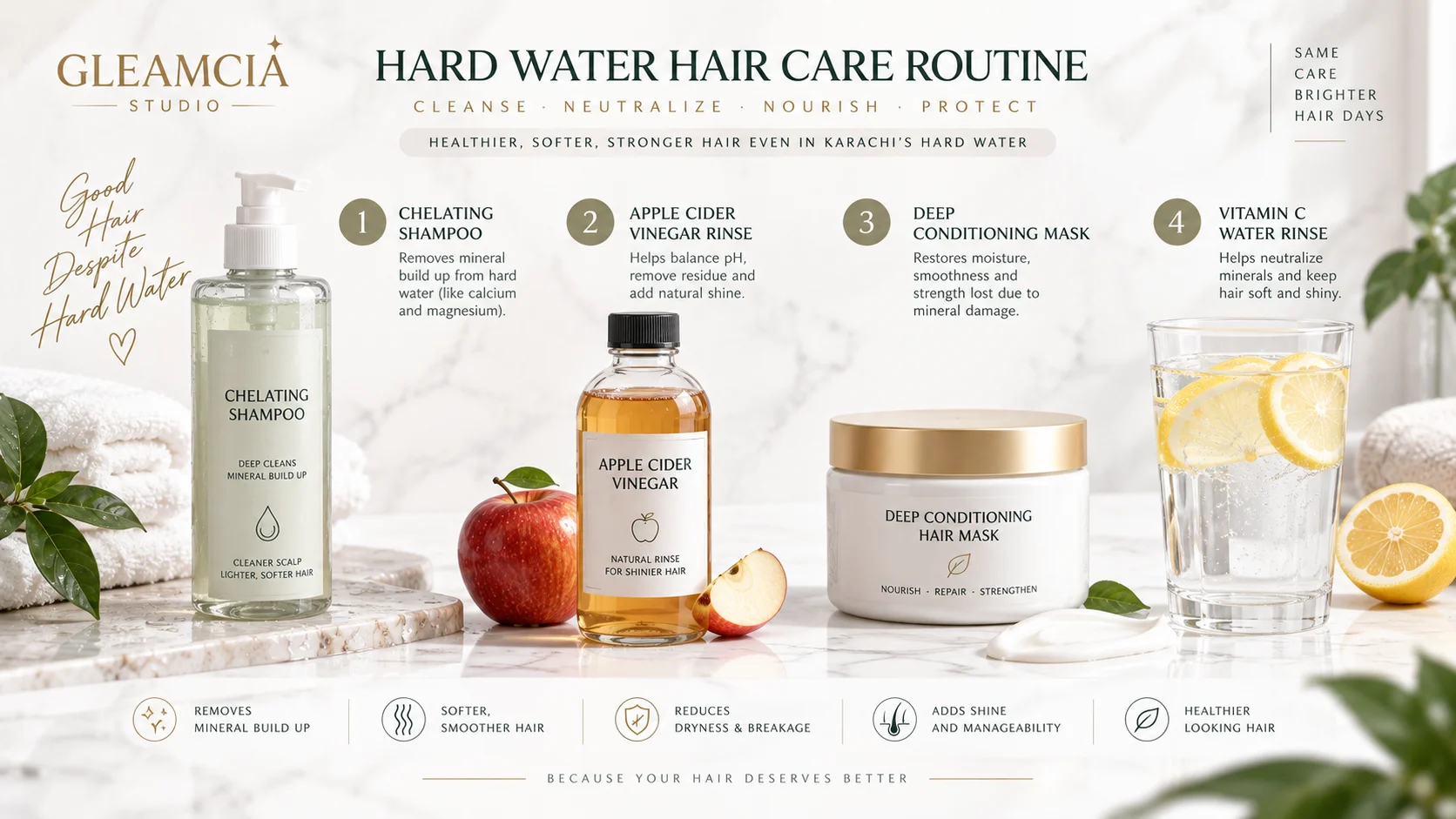
Chelating or clarifying shampoo, used weekly or fortnightly. A chelating shampoo contains ingredients like EDTA (ethylenediaminetetraacetic acid) or phytic acid specifically formulated to bind to and remove mineral deposits from the scalp and hair shaft. This is the most important hard water intervention and the one most people in Pakistan have never tried. Used once a week, it resets the mineral buildup that accumulates through the rest of the week’s washes.
Apple cider vinegar rinse. An old but genuinely effective approach. Diluted apple cider vinegar (two to three tablespoons in one litre of water) used as a final rinse after shampooing has a mildly chelating effect on calcium deposits and, more importantly, restores the scalp’s acidic pH after the alkaline hit of hard water washing. The smell dissipates once hair dries.
Vitamin C rinse. Crushed ascorbic acid dissolved in water applied as a pre-shampoo treatment is popular among people in very hard water areas. L-ascorbic acid chelates calcium and magnesium effectively. Many people mix a vitamin C tablet dissolved in water and apply it to the scalp 15 minutes before washing for a weekly reset.
Shower filter. A KDF or activated carbon shower filter installed on the showerhead reduces mineral content and chlorine in the water reaching the scalp. Not a complete solution but provides a consistent reduction in hard water exposure with every wash.
Deep conditioning mask weekly. After clarifying, the hair needs intensive moisture restoration. A protein and moisture-balanced mask applied weekly counteracts the dehydrating effect of mineral buildup removal.
Clarifying Shampoo vs Regular Shampoo for Hard Water Hair Fall
| Feature | Clarifying/Chelating Shampoo | Regular Shampoo |
| Removes mineral deposits | Yes — primary function | No — standard cleansers cannot chelate minerals |
| Frequency of use | Once weekly or fortnightly | Daily or every other day |
| Effect on moisture | Temporarily drying — follow with conditioner | Varies by formula |
| Restores scalp pH | Partially — depends on formula | Rarely — many shampoos are alkaline |
| Suitable for coloured hair | Use with care — can strip colour | Colour-safe options available |
| Best for | Hard water buildup reset, scalp detox | Regular cleansing maintenance |
| Results on hard water damage | Visible within 2 to 3 uses | None — does not address minerals |
| Cost consideration | Premium category | Wide range |
| Sulphate-free options | Available | Widely available |
| Recommended for Pakistan water | Absolutely — weekly use essential | Use between chelating washes |
The correct routine for hard water areas in Pakistan is chelating shampoo once a week, a gentle sulphate-free shampoo for other wash days, and a deep conditioning mask immediately after every chelating wash to restore moisture.
Ingredients That Help Reverse Hard Water Hair Damage
Building a hair care routine around these actives makes a real difference in Pakistan’s water conditions:
- EDTA (Ethylenediaminetetraacetic Acid) — chelating agent in clarifying shampoos. Binds and removes calcium and magnesium from the hair shaft and scalp surface.
- Citric Acid — found in some rinses and shampoos. Restores acidic pH and provides mild chelation of mineral deposits.
- Ascorbic Acid (Vitamin C) — used in vitamin C rinses and some formulas. Chelates hard water minerals and brightens dull, mineral-coated strands.
- Keratin — rebuilds the damaged hair shaft structure after mineral disruption has roughened the cuticle.
- Hydrolysed Wheat Protein — penetrates the cortex of mineral-damaged hair and restores elasticity and tensile strength.
- Niacinamide — improves scalp barrier function and reduces the inflammation triggered by hard water pH disruption.
- Caffeine and Saw Palmetto — stimulate follicles and reduce DHT activity at the scalp level, particularly important when hard water inflammation has weakened follicle environment.
Browse the full Gleamcia Hair Care range for products designed to address these concerns.
Common Mistakes That Worsen Hard Water Hair Fall in Pakistan
Washing hair frequently with a standard shampoo in hard water without chelating. Every wash in hard water adds to the mineral buildup. Washing five to six times a week without ever chelating creates rapidly accumulating damage.
Skipping conditioner after shampooing in hard water. Hard water strips moisture from the hair during washing. Going without conditioner leaves the hair shaft dehydrated and even more vulnerable to breakage.
Using very hot water to wash hair. Hot water opens the hair cuticle, allowing minerals to penetrate deeper into the shaft during washing. Washing with cool to lukewarm water reduces mineral uptake per wash.
Attributing all hair fall to genetics or stress and ignoring water quality. Hard water is an environmental factor that is very manageable with the right products, but only if it is identified as a contributor. Treating hair fall with serums and supplements while ignoring the water quality means the environmental damage continues at the same rate.
Not using a shower filter alongside topical treatments. Topical products address existing damage and scalp health but cannot prevent new mineral deposits being added every wash. A shower filter and a chelating shampoo together are far more effective than either one alone.
How Soon Do You See Improvement After Addressing Hard Water Hair Fall?
The timeline for improvement depends on how long the hard water damage has been accumulating.
- Week 1 to 2: After the first one to two chelating washes, hair feels noticeably lighter, smoother to the touch, and more responsive to conditioner. Shine returns to strands that had been dulled by mineral coating.
- Week 3 to 4: Reduced daily breakage becomes noticeable — fewer short broken strands on the brush and in the shower drain. Scalp feels less itchy and irritated.
- Month 2 to 3: Hair texture improves significantly as the mineral layer is consistently removed and new growth grows in without the accumulated coating. Scalp inflammation reduces and density begins to feel more stable.
- Month 3 and beyond: Sustained improvement as the routine prevents reaccumulation. Pairing with an anti-hair fall serum or growth spray addresses any follicle-level concerns alongside the structural improvements from chelation.
Aftercare Tips for Hard Water Hair Recovery in Pakistan
Do:
- Use a chelating shampoo once a week, every week, without skipping — mineral buildup restarts immediately after each hard water wash
- Follow every chelating wash with a deep conditioning mask or intensive hair treatment to restore moisture removed during mineral extraction
- Rinse hair with cool water rather than hot — lower temperature reduces mineral uptake per wash
- Install a shower filter for ongoing reduction in mineral and chlorine content before the water reaches the scalp
- Incorporate a leave-in anti-hair fall spray or serum to support the scalp environment between washes
Do not:
- Use clarifying shampoo daily — it removes the protective lipid layer of the hair alongside the minerals if used too frequently
- Detangle aggressively when hair is wet — mineral-damaged hair is most fragile when wet and breaks under tension far more easily
- Use styling products that contain silicone directly on the scalp — silicone seals in mineral deposits before they can be removed in the next chelating wash
What Does Hard Water Hair Care Cost in Pakistan?
Chelating shampoo pricing reflects the specialised active ingredients used to achieve mineral removal — EDTA and similar chelating agents add formulation cost compared to basic surfactant-only shampoos. A quality chelating shampoo used weekly (one wash per week) lasts significantly longer than a daily-use shampoo of the same size, which affects the per-use cost favourably.
Shower filters have a higher upfront cost but a low per-wash cost over a multi-month filter lifespan. The combination of a filter and a weekly chelating shampoo is more economical per wash than a filter alone, because some minerals still pass through filtration and need to be periodically cleared from the scalp.
Bundle purchasing — chelating shampoo, sulphate-free maintenance shampoo, deep conditioner, and a scalp serum — from the same range covers the full hard water hair routine and reduces the per-product cost compared to individual purchases.
Gleamcia delivers from Karachi to every city in Pakistan. Visit gleamcia.com/shop to see current pricing on hair care products suited to Pakistan’s hard water conditions.
Why Choose Gleamcia
Gleamcia builds hair care products for the real conditions Pakistani hair faces — and hard water is one of the most persistent and under-addressed of them.
- Hair care formulas developed with Pakistan’s water quality and South Asian hair biology in mind
- Active ingredients at concentrations that produce visible scalp and strand improvement, not label-only claims
- Scalp-targeted treatments that address both the follicle environment and the surface damage that hard water creates
- Transparent ingredient listings and application guidance with every product
- Nationwide delivery from Karachi across Pakistan, reliable packaging, and fast dispatch
Frequently Asked Questions
1. Does hard water cause hair fall? Hard water does not directly cause root-level hair loss the way hormonal factors or genetics do. What it causes is significant breakage through mineral coating that roughens the cuticle, and scalp inflammation through pH disruption and follicle congestion — both of which contribute to visible hair thinning over time. In cities like Karachi and Lahore where water hardness is high, hard water is a consistent and often unrecognised contributor to hair fall that does not improve with serums or supplements alone.
2. Why is Gen Z balding so fast? The combination of chronic high stress (academic pressure, social media anxiety, career uncertainty), processed food diets low in the protein and vitamins hair needs, universal exposure to hard water in Pakistani cities without targeted scalp care routines, and earlier onset of environmental triggers that accelerate genetic hair loss is compressing the timeline for visible thinning in younger people. Earlier intervention — a scalp-first hair care routine, chelating shampoos, biotin supplementation, and stress management — is both more accessible and more effective the earlier it starts.
3. Why is baldness so common now? Baldness and hair thinning are more prevalent across all age groups because multiple environmental and lifestyle factors have converged simultaneously: higher chronic stress levels, hard water exposure in urban areas, nutritional shifts toward processed foods, more frequent heat styling, and earlier onset of the hormonal sensitivity that drives androgenetic alopecia. Environmental hard water damage is one of the most manageable contributors — which is why addressing water quality alongside hormonal and nutritional factors produces the most complete result.
4. Will baldness be cured by 2030? Significant advances are happening. JAK inhibitors have shown remarkable results for alopecia areata and are approved for this use in several countries. Stem cell research for follicle regeneration and hair cloning are in active trials. However, a permanent cure for androgenetic alopecia (pattern baldness) by 2030 is unlikely. Treatments are becoming considerably more effective — particularly early intervention with topical actives, prescription treatments, and combination approaches — but a one-time cure is not at the horizon yet. What is true is that current treatments, used early and consistently, produce better outcomes than anything available a decade ago.
5. Can bald hair grow back? It depends entirely on the type and duration of hair loss. Telogen effluvium from stress or nutritional deficiency can fully reverse when the trigger is addressed — hair regrows within six to twelve months. Alopecia areata is treatable and can regrow, though it requires consistent treatment and management. Early-stage androgenetic alopecia can be significantly improved with topical actives, minoxidil, and DHT-blocking treatments, particularly when follicles are miniaturised but not yet permanently dormant. Scarring alopecia — where follicle tissue has been replaced by scar tissue — does not regrow. Hard water-related breakage and thinning is fully reversible with the right routine.
6. Do bald men have less sperm? No. This is a persistent myth worth dispelling clearly. Male pattern baldness is driven by sensitivity to DHT (dihydrotestosterone) at the hair follicle — meaning the follicle is genetically programmed to respond to DHT by miniaturising. It says nothing about overall testosterone levels or sperm count. Sperm production is driven by testosterone and other hormones through a different pathway entirely. Bald men do not have lower fertility indicators. If anything, DHT sensitivity in some cases correlates with higher androgen activity — which does not reduce fertility. Baldness and sperm count are biologically unrelated.
7. How do I know if my hair fall is from hard water or something else? Hard water hair loss is characterised primarily by breakage — short, blunt strands in the brush and shower drain — alongside dull, dry, tangled hair that does not improve with conditioner. Scalp itchiness and buildup despite regular washing are also strong indicators. If your hair fall improved during a holiday in a city or country with softer water, that is a useful diagnostic signal. If the fall is predominantly from the root (long strands with a white bulb visible at the end) rather than mid-shaft breakage, the cause is more likely hormonal, nutritional, or genetic, and should be assessed alongside addressing water quality.
Your Water Quality Is Affecting Your Hair More Than You Realise
Hard water is washing over your scalp every time you use the shower, and if you are in Karachi, Lahore, or most of Pakistan’s major cities, it is hard water. Addressing it is not complicated — it just requires the right products used consistently. Order from the Gleamcia Hair Care range available at gleamcia.com — nationwide delivery across Pakistan from Karachi.
To get personalised advice on the right chelating shampoo and scalp care routine for your hair type and water conditions, reach us on WhatsApp at 0336 1223363.