Introduction
There is a moment almost everyone goes through with a new brightening serum. You apply it faithfully every morning and night for the first two weeks, hold your face close to the mirror, and think: is this actually doing anything? Then the doubt creeps in. Maybe the formula is wrong. Maybe the concentration is too low. Maybe brightening serums just do not work for your skin.
Here is what is actually happening: your skin biology is working on a timeline that has nothing to do with how eager you are to see results. How long does brightening serum take to work is one of the most important questions to answer before you even buy the product — because understanding the real timeline is what stops people from quitting the one thing that was about to start working. This guide lays it out week by week, explains what the science says about each active ingredient, and tells you exactly what to look for at every stage. Browse the Gleamcia Skin Care range for brightening serums formulated with proven actives at concentrations that produce real results.
Why Brightening Serums Take Time to Show Results
The answer starts with how skin actually renews itself.
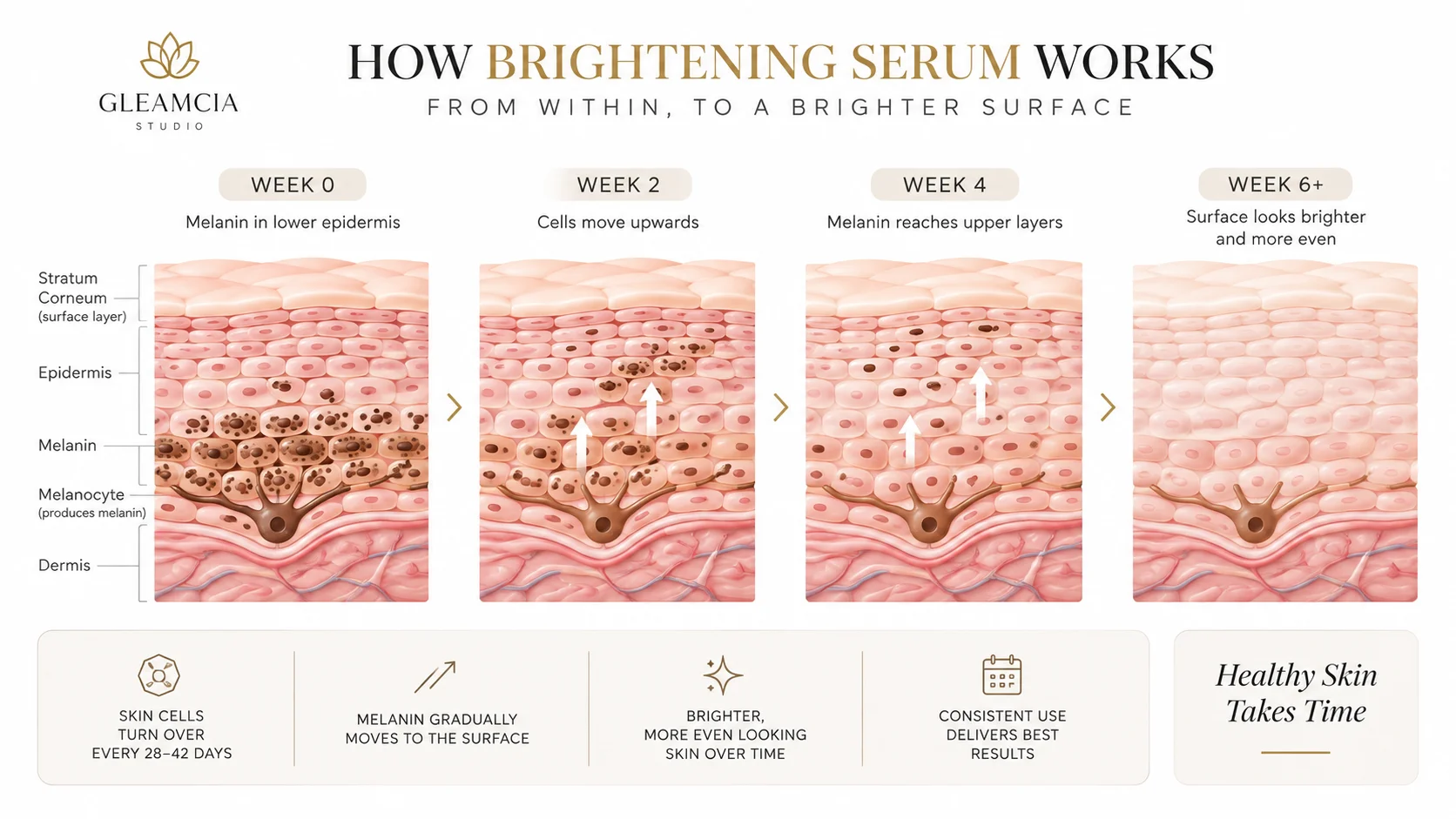
Your skin replaces its outer layer through a continuous process called cell turnover. New cells form in the deepest skin layers and migrate upward to the surface, where they eventually shed. In younger skin, this cycle takes about 28 days. In skin over 40, it slows to 40 to 60 days. This cycle is the clock that brightening results run on — because visible changes only appear when the newly treated skin cells have moved far enough up through the layers to be seen from the surface.
Hyperpigmentation — the dark spots, uneven patches, and post-acne marks that brightening serums target — forms when melanocytes produce excess melanin in specific areas. That melanin sits in the deeper layers of the epidermis and at the dermal-epidermal junction. A brightening serum applied to the surface has to work through the skin’s layers over multiple cell turnover cycles to fade that pigment visibly.
Add to this the fact that UV exposure from daily sun contact continuously triggers new melanin production. Without consistent daily SPF use, every application of brightening serum is fighting against fresh UV-driven pigmentation being added from above. The serum has to outpace a problem that is being actively renewed — which is one of the reasons results take longer than most people expect.
How Long Does a Brightening Serum Take to Work? Week-by-Week Timeline
This is the realistic sequence most people experience with consistent daily use and proper SPF application:
Week 1 to 2: The invisible work begins. The brightening actives are being absorbed and starting to inhibit the enzymes involved in melanin production. Nothing visible is happening yet at the skin surface. What you may notice is improved hydration (particularly with Niacinamide and Hyaluronic Acid) and slightly smoother texture — a sign the formula is absorbing correctly. This is not stagnation. This is the foundation phase.
Week 3 to 4: First subtle signs of change. The skin starts to look marginally more even in morning light. Redness and inflammation around existing dark spots may reduce, particularly with Niacinamide-based formulas. The outer edges of dark spots can begin to soften slightly — dark spots fade from the perimeter inward, so edge lightening is the first thing to look for. Skin tone overall may appear brighter even before individual spots visibly fade.
Week 5 to 6: Visible brightening progress. This is where the changes become noticeable enough that other people may comment on your skin looking better. Existing dark spots show more obvious lightening. Post-acne marks begin to fade more significantly. Skin tone evenness improves across the full face. If AHA exfoliation is part of the routine alongside the serum, the cell turnover acceleration makes results appear faster at this stage.
Week 7 to 8: Meaningful improvement in hyperpigmentation. For mild to moderate dark spots, significant fading is visible by week 8 with consistent daily use and daily SPF. Skin radiance improves noticeably — the dull, flat appearance associated with pigmentation starts lifting. For anyone who started with post-acne marks rather than long-standing melasma, results at this point can be quite striking.
Month 3 and beyond: Deep pigmentation responds. Older, more stubborn hyperpigmentation — sun damage accumulated over years, deep melasma, or dark spots on darker skin tones — requires three to six months of consistent use for meaningful fading. The biology is the same, the timeline is simply longer because the melanin is more deeply seated and more densely concentrated. Patience at this stage is not optional; it is the whole strategy.
Active Ingredients That Determine How Fast a Brightening Serum Works
Not every brightening serum works at the same speed. The active ingredients in the formula determine both the mechanism and the timeline.
Vitamin C (L-Ascorbic Acid) blocks the tyrosinase enzyme that drives melanin production at the source. It also has antioxidant action that protects against UV-triggered melanin signalling. At 10% to 20% concentration, results become noticeable from around week 4 to 6. L-Ascorbic Acid is the most researched brightening active and one of the fastest.
Niacinamide (Vitamin B3) works at a different stage — it blocks the transfer of melanin from melanocytes to surface skin cells. Rather than stopping production, it stops distribution. At 5% to 10% concentration, results on tone evenness and redness reduction begin around week 3 to 4. Works particularly well paired with Vitamin C.
Alpha Arbutin is a stable glycoside form of hydroquinone that inhibits tyrosinase without the irritation or sensitivity risks of prescription-grade hydroquinone. Results are gradual — expect 6 to 8 weeks for visible improvement on dark spots.
Tranexamic Acid reduces melanin synthesis and is particularly effective for melasma and PIE (post-inflammatory erythema — the redness left after breakouts). Noticeable results typically appear from week 6 to 10.
AHAs (Glycolic Acid, Lactic Acid) do not inhibit melanin but accelerate cell turnover, which speeds up the movement of treated skin cells to the surface. This makes other brightening actives appear to work faster. Results on surface brightness and texture can appear as early as week 2 to 3.
Kojic Acid is a naturally derived tyrosinase inhibitor. Effective for generalised uneven skin tone, with results typically appearing from week 6 to 8.
The fastest brightening results come from formulas that combine two or more of these actives targeting different steps in the melanin production and transfer pathway simultaneously.
Does Brightening Serum Really Work?
Yes — with the right active ingredients at meaningful concentrations, daily SPF use alongside it, and consistent application over sufficient time.
The evidence for brightening ingredients is solid. Vitamin C’s ability to inhibit tyrosinase and reduce hyperpigmentation has been demonstrated across numerous clinical studies. Niacinamide’s role in reducing melanin transfer is well documented. The American Academy of Dermatology recognises both as evidence-backed options for hyperpigmentation treatment.
Where brightening serums underdeliver — and where the “does it actually work” doubt comes from — is in three specific situations.
First, when the formula contains brightening actives at concentrations too low to produce a clinical effect. A serum with a trace amount of Vitamin C or 2% Niacinamide is not going to deliver the same results as one formulated at 10% to 15%.
Second, when SPF is not used consistently alongside it. A brightening serum applied without daily broad-spectrum SPF is working against ongoing UV-triggered melanin production. Results become slower, less significant, or entirely invisible because the serum is counteracting new pigmentation being formed faster than it can fade the old.
Third, when the cause of pigmentation is hormonal — specifically melasma. Hormonal pigmentation responds more slowly and less completely to topical serums alone. A dermatologist consultation is worth considering for melasma alongside a quality brightening serum.
Outside these three situations, a properly formulated brightening serum with consistent use and SPF does work. The results are real, they are progressive, and they hold as long as the routine and SPF use are maintained.
How to Brighten Skin Noticeably in 7 Days
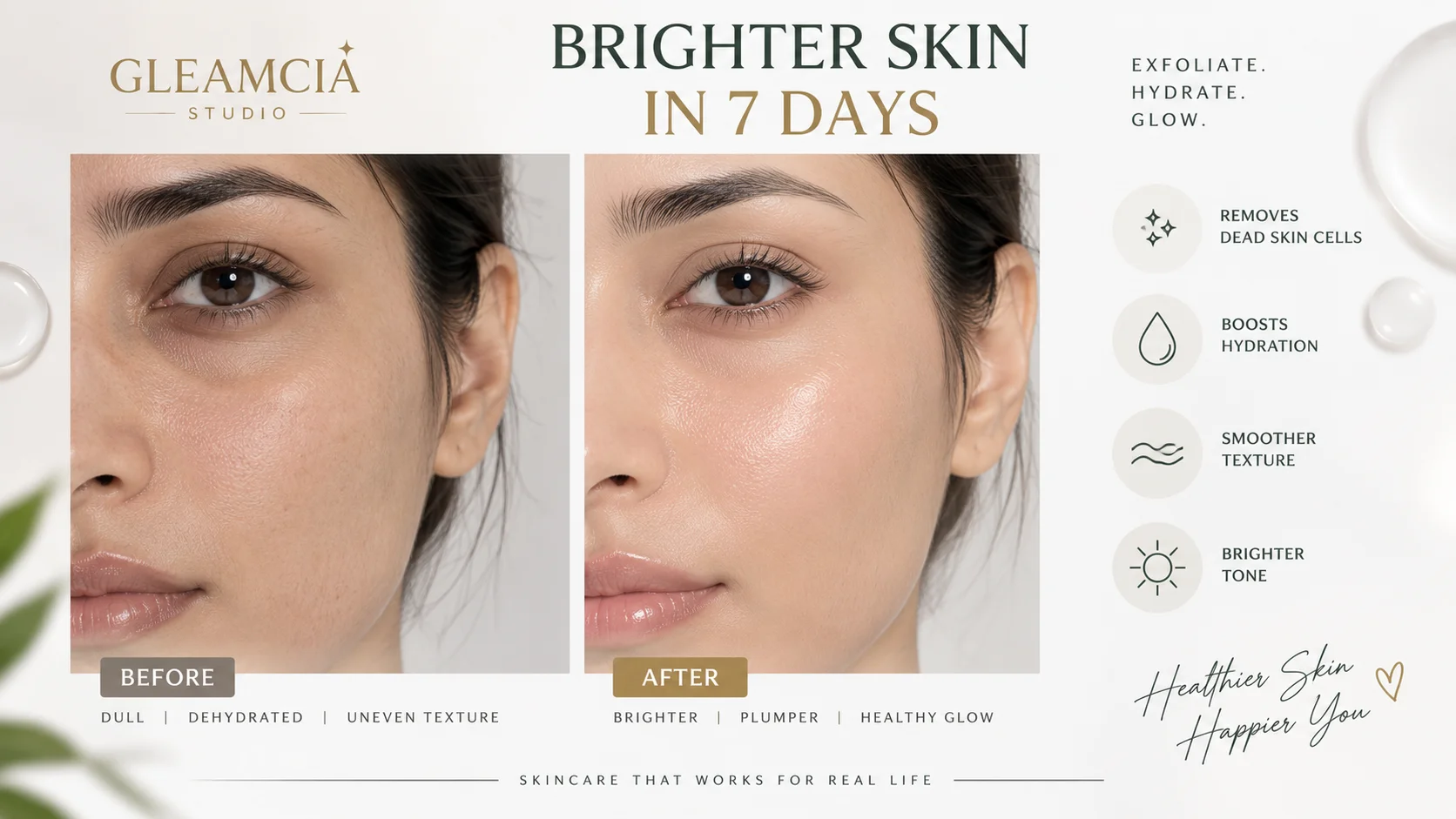
Seven days is not enough time to fade deep pigmentation. But it is enough time to produce a real, visible improvement in skin brightness and radiance — and understanding the difference between these two outcomes matters.
Surface brightness — the glow, the smoothness, the evenness that makes skin look refreshed and well-rested — can be significantly improved within a week through targeted steps:
AHA exfoliation (glycolic acid or lactic acid) used two to three times over the week lifts the dull, accumulated dead skin cells sitting on the surface. Removing that outer layer reveals the newer, brighter cells underneath within 24 to 48 hours of application. The effect is noticeable and immediate for most skin types.
Consistent double cleansing each evening removes SPF, pollution, and the residue that dull skin accumulates across a full day. A cleaner surface reflects light more evenly, which reads as brighter even before any active ingredient has had a chance to work.
Maximum hydration has a faster impact on appearance than most people expect. Dehydrated skin looks flat, grey, and uneven. Hyaluronic Acid applied under a serum and moisturiser plumps the surface cells with moisture, making the skin look more luminous within hours. A hydrating sheet mask used once or twice in the week accelerates this effect.
Starting a Vitamin C serum on day one plants the first seeds of tyrosinase inhibition, even though results at the pigmentation level are not yet visible. The antioxidant protection it adds during the week also prevents new UV-triggered melanin formation while the brightening process begins.
What a 7-day brightening push does not fix is deep pigmentation, long-standing dark spots, or melasma. Those require the consistent serum and SPF routine across multiple cell turnover cycles. The week one results are the glow. The month eight results are the actual tone correction.
How Do I Know If My Brightening Serum Is Working?
Progress in brightening routines is gradual enough that it is easy to miss if you are comparing your skin daily. Here is what to specifically look for at each stage.
The edges of dark spots soften first. Hyperpigmentation does not fade uniformly from the centre outward — it starts at the edges. If your dark spots appear slightly smaller or the borders look less defined than they did a month ago, the serum is working at the pigment level.
Overall skin tone becomes more even. Before individual spots visibly fade, the general brightness and tone evenness across the whole face improves. If your skin is looking more uniform and less patchy, the melanin transfer inhibition is working even before the dark spots fully clear.
Redness and inflammation reduce. If your dark spots are accompanied by redness — common with post-acne marks — a Niacinamide-containing serum produces visible reduction in that redness before the brown pigment fully fades. Calmer-looking skin is an early indicator.
Texture improves. A brighter complexion looks smoother because even pigmentation reflects light more evenly. If your skin texture is improving alongside tone work, the cell turnover acceleration from any AHAs or Vitamin C in the formula is doing its job.
The most reliable method: progress photos. Take a photo on day one in consistent natural light. Repeat every four weeks in the same light conditions. Day-to-day comparison is too gradual to perceive. Monthly comparison makes the change visible and measurable.
How to Know If Your Brightening Serum Is Not Working
Spending weeks on a product that is genuinely not doing anything is something most people want to avoid. These are the signs that a formula or approach needs to change.
No visible change after 10 to 12 weeks of consistent daily use with SPF. This is the outside limit for seeing at least some indication of improvement on mild to moderate pigmentation. If nothing has shifted by week 12 with consistent application, the formula’s active concentration is likely insufficient, or the cause of the pigmentation requires a different approach.
Skin is reacting negatively. New breakouts, persistent itching, burning that does not settle within the first application week, or worsening redness are signals the formula is not right for your skin type. Discontinue and reassess the ingredient list — high-concentration Vitamin C causes irritation in sensitive skin types, and certain preservatives trigger reactions in allergy-prone skin.
The Vitamin C serum has turned orange or brown. L-Ascorbic Acid oxidises when exposed to air, light, or heat — and an oxidised formula is an inactive one. The yellowing then browning of a Vitamin C serum is not a packaging issue; it is the active ingredient breaking down. A degraded Vitamin C serum produces little to no brightening effect and can cause more skin reactivity than a fresh one.
SPF is not being used consistently. This is not a formula problem — it is a routine problem. Without daily SPF, UV-triggered melanin production continuously counteracts the serum’s inhibition work. If the brightening serum appears to have plateaued or reversed during sunny months, SPF consistency is the first place to look.
The pigmentation is melasma. Hormonal melasma responds more slowly and incompletely to topical brightening actives than post-acne marks or sun spots. If your pigmentation is symmetrical, covers large areas across the forehead and cheeks, and has a hormonal history, a dermatologist consultation alongside the serum is the right next step.
How Long Do Serums Generally Take to Show Results?
Different serum types work on different biological timelines. Here is how brightening compares to other common serum concerns:
Hydration serums (Hyaluronic Acid) — effects on skin plumpness and comfort visible within hours to days. Surface appearance improves quickly.
Brightening serums (Vitamin C, Niacinamide, Alpha Arbutin) — first signs at 3 to 4 weeks, meaningful improvement at 6 to 8 weeks, full results at 3 to 6 months.
Anti-ageing serums (Retinol, Peptides) — initial texture improvement at 4 to 6 weeks, collagen rebuilding results at 3 to 6 months.
Pore-minimising serums (Niacinamide, Salicylic Acid) — sebum regulation visible at 3 to 4 weeks, pore appearance reduction at 6 to 8 weeks.
Acne-targeting serums (Salicylic Acid, Niacinamide) — active breakouts respond in 2 to 4 weeks, post-acne marks take the full brightening timeline.
Brightening falls in the middle of the serum result spectrum. It is slower than hydration and faster than structural anti-ageing work.
Vitamin C Serum vs Niacinamide Serum: Which Brightens Faster?
Both are among the most effective brightening actives available. They work through completely different mechanisms and suit different pigmentation concerns and skin types.
| Feature | Vitamin C Serum | Niacinamide Serum |
| Mechanism | Blocks tyrosinase (stops melanin production) | Blocks melanin transfer to surface cells |
| First visible results | Week 4 to 6 | Week 3 to 4 |
| Best for | Sun damage, brown spots, overall radiance | Post-acne marks, redness, uneven tone |
| Suitable for sensitive skin | Moderate — can irritate at high concentrations | Excellent — well tolerated by most skin types |
| Works best in | Morning routine with SPF | Morning or evening |
| Antioxidant protection | Yes — actively protects against UV-triggered melanin | Indirect only |
| Collagen support | Yes | Moderate |
| pH requirement | Low (2.5 to 3.5) — absorbed on clean skin first | Neutral — flexible |
| Best for dark skin tones | Very effective | Excellent |
| Best used with | Niacinamide (in the right order), SPF | Vitamin C, SPF, hyaluronic acid |
| Results on melasma | Slower than post-acne marks | Moderate — more consistent than Vitamin C alone |
Niacinamide tends to produce noticeable tone improvements slightly faster because its mechanism — stopping melanin transfer — takes effect earlier in the cycle than halting production entirely. Vitamin C’s results are more dramatic over the long term, particularly for brown sun spots and overall skin radiance.
Using both in the correct order — Vitamin C first thing in the morning, Niacinamide following after absorption — addresses brightening from two different biological pathways simultaneously and accelerates results compared to either one used alone.
What Slows Down Brightening Serum Results
Several factors can extend the timeline significantly and are worth understanding if your progress feels slower than expected.
Inconsistent use is the biggest delay. Brightening is a cumulative process. Applying the serum four days a week instead of seven gives the skin only four days of tyrosinase inhibition and melanin transfer blocking per cycle. The other three days, the process resumes at its normal rate. Consistency is not optional.
No daily SPF. Already covered above, but worth repeating because it is that significant. Every day of unprotected UV exposure adds new melanin formation that the serum then has to address alongside the existing pigmentation.
An oxidised or compromised formula. A Vitamin C serum left open in humidity or stored near heat loses potency fast. A Niacinamide serum past its expiry date may not maintain its active concentration. Fresh, properly stored formulas deliver what the label claims.
Starting with a concentration that is too low for the skin concern. A 2% Vitamin C serum will not produce the same results as a 15% one. Matching the active concentration to the severity of the concern is important.
Skin barrier disruption. An over-exfoliated, sensitised, or barrier-damaged skin struggles to absorb and use active ingredients efficiently. A damaged barrier prioritises repair over active uptake.
Common Mistakes That Delay Brightening Serum Results
Skipping SPF on cloudy days or while staying indoors. UVA penetrates windows and cloud cover. One UVA-heavy indoor day without SPF during a treatment cycle adds new melanin stimulation.
Switching serums before the first one has finished its cycle. The “not seeing results in two weeks” frustration leads to a new product, which restarts the clock and means neither product ever gets the sustained cycle it needs to show results.
Applying brightening serum on top of other product layers. A serum needs to sit on clean or toned skin for maximum absorption. Applied over a thick moisturiser or oil, the actives cannot penetrate to where they need to work.
Not photographing progress. Without photos, day-to-day comparison obscures real progress. The brain adjusts quickly to small changes and stops registering them. Documented monthly comparison makes progress visible.
Expecting the same result on melasma as on post-acne marks. These two types of pigmentation respond at different rates and to different degrees. Managing expectations by type prevents premature abandonment of a routine that is working correctly.
Aftercare Tips for Maximum Brightening Serum Results
Do:
- Apply SPF every morning without exception — this is half the brightening routine, not an optional extra
- Take progress photos every four weeks in natural window light from the same distance and angle
- Store Vitamin C serum in a cool, dark place — a bathroom cabinet away from shower steam is ideal
- Pair your brightening serum with the Gleamcia Brightening Face Wash to support the brightening routine from the cleanse step
- Use a gentle AHA exfoliant two to three times per week to accelerate cell turnover
Do not:
- Apply two brightening serums from different brands with overlapping actives without checking they are compatible
- Introduce retinol and a high-concentration Vitamin C serum at the same time — the combination can overwhelm sensitive skin before it adjusts
- Stop the routine when you see results — maintaining the brightening requires ongoing use, not a finish line
- Use an oxidised (orange or brown) Vitamin C serum — replace it immediately, it is no longer active
What Does a Brightening Serum Cost in Pakistan?
Formulation quality is the price driver across every brightening serum category. A Vitamin C serum at 15% L-Ascorbic Acid with a pH-controlled, photostable base costs more to produce than a “Vitamin C” serum using a less bioavailable derivative at 2%. The active concentration determines the result — and the production cost of getting it right is reflected in the price.
Bottle size and format affect overall value. A 30ml serum applied twice daily lasts roughly 30 to 45 days. For a treatment that requires consistent use over three to six months, buying two or three bottles at once or selecting a larger format is more economical than buying single small bottles throughout the treatment period.
Bundle pricing — a brightening serum paired with a matching face wash or SPF from the same range — ensures formulation compatibility across the routine and typically reduces the per-product price. Starting with a single serum and building the routine around it is a practical approach for new customers.
Gleamcia delivers from Karachi to every city in Pakistan. Visit gleamcia.com/shop for current brightening serum pricing and any active promotions on the skin care range.
Why Choose Gleamcia
Gleamcia formulates every brightening product around one question: does the active ingredient concentration actually match what the result requires?
- Brightening serums built with Vitamin C, Niacinamide, and Alpha Arbutin at concentrations tested for real clinical effect, not label appeal
- Stable formulations that protect actives from oxidation and degradation — so the product you apply in week 10 is as potent as the one you used on day one
- Full ingredient transparency so you know exactly what you are putting on your skin and what it is doing
- Skincare designed for South Asian skin tones, Pakistan’s sun intensity, and the pigmentation concerns most common in this climate
- Nationwide delivery across Pakistan from Karachi with fast dispatch and packaging that protects sensitive serum formulas in transit
Frequently Asked Questions
1. Does brightening serum really work? Yes, when the formula contains proven actives at meaningful concentrations — Vitamin C at 10% to 20%, Niacinamide at 5% to 10%, Alpha Arbutin, or Tranexamic Acid — and is used consistently with daily SPF. Without SPF, brightening serums fight against UV-triggered melanin production being added faster than the serum can reduce existing pigmentation. With the right formula, correct application, and daily sun protection, brightening serums produce real, measurable results over 6 to 12 weeks.
2. How to brighten skin in 7 days? Surface brightness can be significantly improved within a week through AHA exfoliation to lift dull dead skin cells, maximum hydration with Hyaluronic Acid to plump the skin surface, consistent double cleansing to remove buildup, and starting a Vitamin C serum to begin the inhibition process. Deep pigmentation and dark spots require the full 6 to 12 week serum timeline. Seven days improves radiance and texture — sustained months produce actual tone correction.
3. How do I know if my brightening serum is working? Look for the edges of dark spots softening before the centre fades — hyperpigmentation retreats from the outside in. Overall skin tone evenness improving across the full face is an early indicator. Redness around dark spots reducing (Niacinamide effect), smoother texture, and a generally more luminous appearance in morning light are all positive signs. Monthly progress photos in consistent natural light make subtle changes visible that daily comparison misses.
4. How long do serums take to show results? It depends on the concern. Hydration serums show improvement within hours to days. Brightening serums produce first signs at 3 to 4 weeks and meaningful results at 6 to 8 weeks for mild pigmentation, with 3 to 6 months needed for deeper or more stubborn hyperpigmentation. Anti-ageing serums with Retinol or Peptides take 3 to 6 months for structural results. Pore-minimising serums show sebum regulation changes at 3 to 4 weeks. Brightening is one of the more time-intensive serum goals, which is exactly why understanding the realistic timeline before starting matters.
5. How to know if brightening serum is not working? No visible change after 10 to 12 weeks of daily use with consistent SPF is the clearest signal. A Vitamin C serum that has turned orange or brown has oxidised and is no longer active — replace it immediately. New breakouts, stinging, or worsening pigmentation indicate the formula is not right for your skin. If the pigmentation is symmetrical and hormonal (melasma), a dermatologist consultation alongside the serum is likely needed. And if SPF is not being used daily, the serum will consistently underperform regardless of formulation quality.
6. Can I use brightening serum every day? Yes. Most brightening serums are formulated for daily use — twice daily for Niacinamide-based formulas and once daily in the morning for Vitamin C serums. Consistent daily application is what produces cumulative results over the skin cell turnover cycles that brightening depends on. Occasional use delivers inconsistent and slower results. The only exception is AHA-based brightening serums, which are typically used two to three times per week rather than daily to avoid over-exfoliation.
7. Do I need SPF with a brightening serum? Absolutely yes — without exception. UV exposure triggers the same melanin production pathway that brightening actives are working to inhibit. Using a brightening serum without SPF means the serum is competing with ongoing UV-driven pigmentation being created daily. In practice, unprotected UV exposure can regenerate dark spots faster than most brightening serums can fade them. SPF is not a supplement to a brightening routine — it is half the treatment.
Start Your Brightening Routine With the Right Expectations
Brightening serum results are real. They are also built over months of consistent daily use, not weeks of occasional application. Knowing the realistic timeline before you start is what keeps you in the routine long enough to see the skin you are working toward. Order from the Gleamcia Skin Care range via our online store — available with nationwide delivery to every city in Pakistan from Karachi.
Order on WhatsApp at 0336 1223363 and our team will help you choose the right brightening serum combination for your skin type and pigmentation concern.