Introduction
You start a new serum. Day four, your chin breaks out. Day ten, you have clusters of spots appearing in places that were clear last week. The question hits: is this skin purging or is your skin just reacting badly to something it hates?
It is one of the most confusing situations in skincare — and it matters enormously which one it is, because the right response to purging is to stay the course, while the right response to a reaction is to stop immediately. Getting this wrong either leads to weeks of unnecessary discomfort if you keep using a product that is genuinely irritating your skin, or to abandoning something that was actually on the verge of working.
This guide explains skin purging vs breakout clearly and completely. By the end of it, you will know exactly what you are dealing with and what to do about it. Browse the Gleamcia Skin Care range for serums and actives formulated to deliver results with minimal disruption to your skin barrier.
What Is Skin Purging? The Biology Behind It
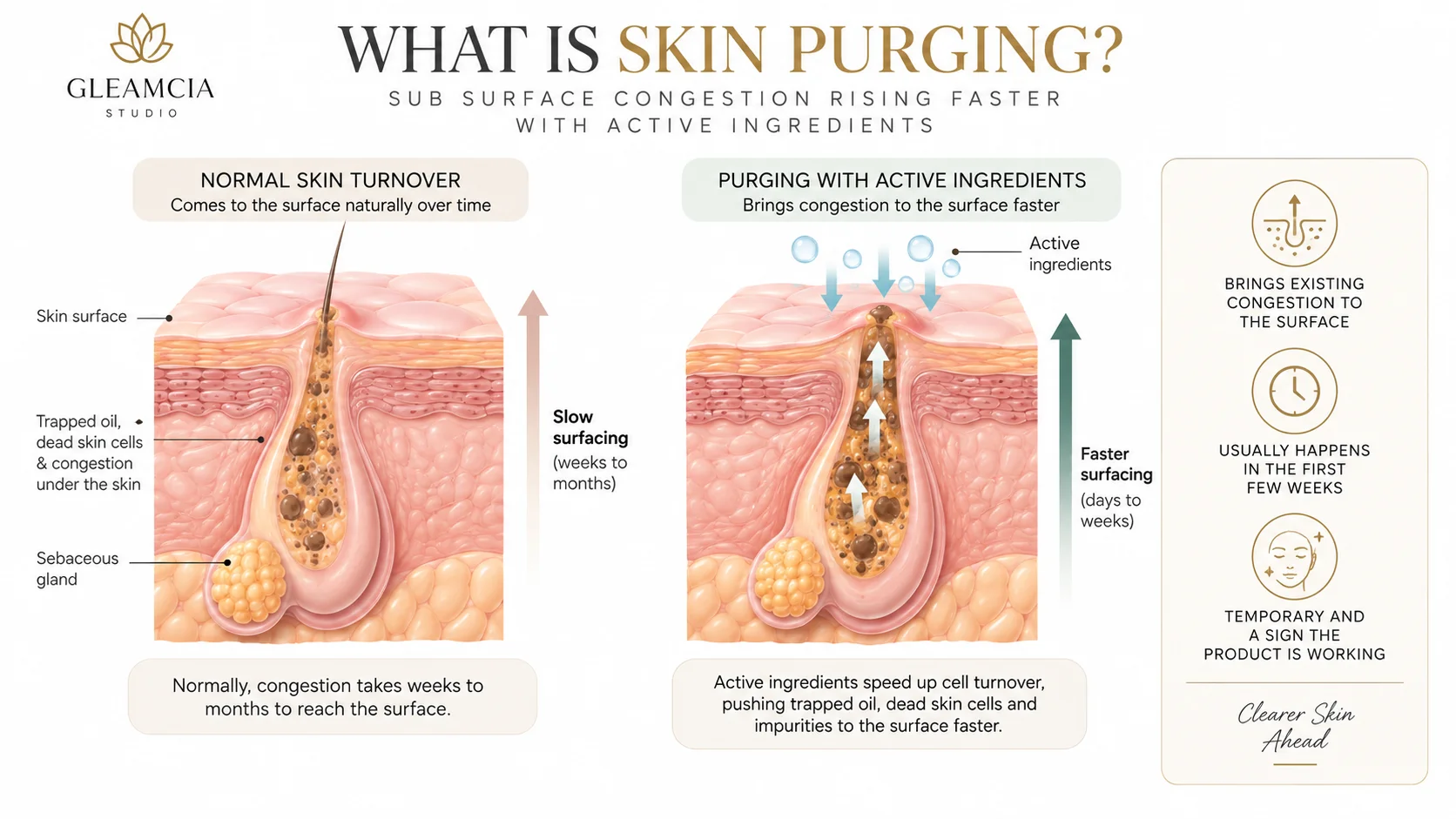
Purging is not a problem with the product. It is a predictable biological response to specific types of active ingredients — the ones that accelerate skin cell turnover.
Here is what is actually happening beneath the surface when purging occurs. Your skin always has a layer of congestion sitting below the surface — sebum mixed with dead skin cells that have not yet fully worked their way up to where they would naturally shed or appear as a spot. Under normal skin cell turnover speed, this congestion takes several weeks to surface. When you introduce an active ingredient that speeds up that turnover rate significantly, all of that sub-surface congestion is pushed upward at once rather than gradually.
The result is a temporary increase in breakouts — whiteheads, small papules, and closed comedones that were already forming below the surface appearing days rather than weeks ahead of their natural schedule. The serum did not cause new breakouts. It simply accelerated the timeline of ones that were already coming.
This is the key distinction between purging and a true product reaction. Purging is existing congestion surfacing faster. A reaction is the product itself creating new inflammation, irritation, or breakouts that would not have appeared otherwise.
What Is a Product-Triggered Breakout?
A product-triggered breakout is the skin’s inflammatory or allergic response to an ingredient it does not tolerate — not accelerated turnover, but genuine irritation or pore congestion caused by the product itself.
This can happen for several reasons. An ingredient in the formula is comedogenic (pore-clogging) for your specific skin type. A preservative, fragrance, or active is triggering a sensitisation response. The formula’s pH is disrupting your skin barrier. A new product is introducing bacteria or oil that is clogging follicles directly.
Product-triggered breakouts look and behave differently from purging, and those differences are diagnostic. Understanding them clearly is the most practical way to make the right decision about whether to stop or continue a product.
Skin Purging vs Breakout: The Definitive Comparison
| Feature | Skin Purging | Product-Triggered Breakout |
| What is happening | Existing sub-surface congestion surfacing faster | Product causing new inflammation or pore congestion |
| Caused by | Actives that increase cell turnover (Retinol, AHAs, BHAs, Vitamin C) | Comedogenic ingredients, irritants, fragrances, allergenic preservatives |
| Location on face | Only where you normally break out | New areas you do not typically get spots |
| Types of spots | Whiteheads, small papules, closed comedones | Cysts, nodules, hives, rashes, widespread redness |
| When it starts | Usually within the first 1 to 2 weeks of use | Can start at any point including after weeks of use |
| Duration | Resolves within 4 to 6 weeks | Persists or worsens as long as the product is used |
| What helps | Continuing the product, keeping routine minimal | Stopping the product immediately |
| Skin after it resolves | Clearer than before you started | Returns to pre-breakout state or worsens |
| Associated symptoms | Minimal — mainly the breakouts themselves | Itching, burning, stinging, redness, swelling |
| SPF and hydration | Help manage but do not stop purging | May reduce irritation slightly but do not resolve the reaction |
| Correct response | Continue consistently with a stripped-back routine | Discontinue the product |
What Does Skin Purging Look Like?
Skin purging has a specific appearance that is different from inflammatory cystic acne or an allergic reaction, though it can feel alarming when you are in the middle of it.
Purging spots are predominantly whiteheads — small, skin-coloured or white-tipped bumps that represent closed comedones reaching the surface. They appear clustered rather than scattered randomly, and they sit predominantly in the areas where you already have congestion history: the nose, chin, jawline, and forehead for most people.
The texture is notable. Purging tends to produce a cluster of smaller bumps that feel rough to the touch rather than the deep, painful cysts associated with hormonal or bacterial acne. The spots come and go faster than typical breakouts, clearing more quickly because the cell turnover acceleration that brought them to the surface also moves them through the cycle faster.
What purging generally does not look like: deep, painful cysts in areas that are new to you. It does not produce hives, rashes, or widespread flat redness. It does not spread progressively to new zones of the face week on week. And it does not cause the skin to feel hot, swollen, or intensely itchy.
If the spots you are developing are large, deeply painful, inflammatory cysts appearing in areas where you do not normally break out — that is not purging. That is a reaction.
Where on the Face Does Purging Happen?
This is one of the most reliable diagnostic questions. Location is the clearest signal.
Purging happens where you are already prone to congestion. If your chin and nose are your typical breakout zones and those are the areas flaring after a new active, that pattern supports purging. The active ingredient is surfacing what was already there in your most congested areas.
If the breakouts are appearing on your cheeks (usually a clear area for most people), the sides of your face, your neck, or around your hairline — and those are not zones where you typically get spots — that is a strong signal the product is causing a reaction rather than purging existing congestion.
The face map test is straightforward. Ask yourself: are these spots appearing in the same zones where I normally break out? Yes: supports purging. No: supports reaction.
Which Products Cause Skin Purging?
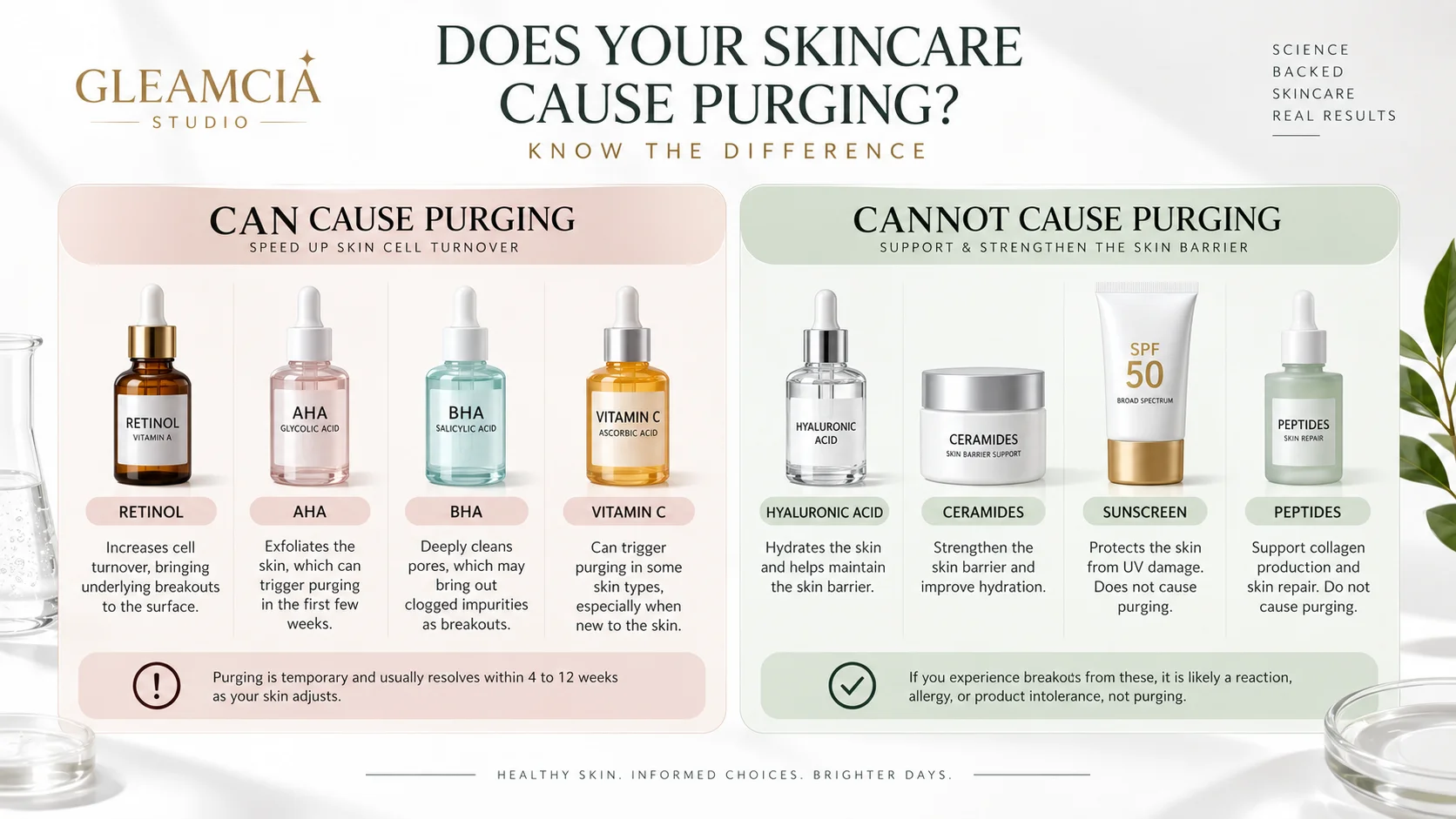
Purging is specifically caused by active ingredients that work by accelerating skin cell turnover. Not all skincare products can cause purging — only those that change the rate at which skin cells move from the deep layers to the surface.
Products that can cause genuine purging:
- Retinoids — Retinol, Tretinoin, Adapalene, Retinaldehyde. The most well-documented purging triggers because they significantly increase cell turnover rate.
- AHAs — Glycolic Acid, Lactic Acid, Mandelic Acid, Malic Acid. Chemical exfoliants that dissolve the bonds between dead cells and speed up their shedding.
- BHAs — Salicylic Acid. Oil-soluble exfoliant that penetrates inside pores and accelerates the clearing of trapped sebum and cells.
- Vitamin C — L-Ascorbic Acid at higher concentrations can mildly increase cell turnover alongside its other mechanisms.
- Exfoliating enzyme treatments — Papain, Bromelain, and other enzyme exfoliants.
- Chemical peels at home or professional concentrations.
The common thread is cell turnover acceleration. These are the only types of products from which a purging response is biologically valid.
Which Products Cannot Cause Skin Purging?
If you are breaking out from any of the products below, it is a reaction — not purging — because these ingredients do not interact with cell turnover speed:
- Hyaluronic Acid — hydrator only, no turnover effect
- Peptides — signal proteins that do not exfoliate
- Ceramides — barrier-repairing lipids
- Moisturisers without active exfoliants
- SPF formulas (though they can cause comedones in oily skin types if the formula is not non-comedogenic)
- Niacinamide — sebum regulator and barrier strengthener, not a turnover accelerant in the purging sense
- Hyaluronic Acid serums
- Face oils that are not naturally exfoliating
Breaking out after introducing any of these products means something in the formula is not agreeing with your skin — possibly a comedogenic ingredient, a fragrance, or a preservative. Stop the product, let the skin clear, and reassess.
What Clears Up Acne the Fastest?
If you are dealing with active acne alongside a purge — or if you have established that what you are experiencing is a true breakout rather than purging — these are the approaches with the clearest evidence for fast results.
Salicylic Acid (BHA) is the most effective over-the-counter option for clearing congested, blackhead-prone, and inflammatory acne because it is oil-soluble and penetrates inside the pore to dissolve the sebum and dead cell combination that creates the blockage. Results on active comedones are visible within one to two weeks of consistent use.
Niacinamide at 5% to 10% reduces the inflammation around existing breakouts and calms the redness and swelling that makes acne look worse than the underlying congestion. It does not clear blocked pores directly but significantly reduces the visible severity.
Benzoyl Peroxide kills the acne-causing bacteria (C. acnes) directly inside the pore. It is one of the fastest-acting acne treatments for inflammatory papules and pustules — visible reduction within 48 to 72 hours for surface-level spots. Note that Benzoyl Peroxide deactivates Retinol so do not use them in the same step.
Ice application is not a treatment but a fast inflammation reducer. Wrapping an ice cube in a cloth and pressing it gently against an active, inflamed spot for 30 to 60 seconds reduces swelling and redness temporarily while the underlying treatment works.
Minimal touching and hands-off habits make one of the most significant differences. Hands transfer bacteria and oil to the face constantly throughout the day. During an active acne or purge phase, keeping hands away from the face reduces the bacterial load being introduced to already-compromised pores.
The American Academy of Dermatology identifies Benzoyl Peroxide, Adapalene, and Salicylic Acid as the three strongest evidence-based over-the-counter acne treatments. For anything beyond mild to moderate acne, a dermatologist consultation delivers faster results than any OTC combination.
How to Know If Your Serum Is Not Working (and It Is a Reaction, Not a Purge)
These are the specific signs that separate a true product reaction from a purge, and that indicate the serum needs to stop.
Breakouts in new, untypical zones. Your routine breakout zones are your T-zone, chin, or specific areas of your jawline. If spots are appearing on your cheeks, temples, or neck — areas clear before the new product — the product is causing a reaction.
Cystic, deeply painful nodules. Purging produces predominantly whiteheads and small papules. Deep, tender, inflammatory cysts are not a purging presentation. They signal a more serious follicular response to something in the formula.
Itching, burning, hives, or rashes. These are not purging symptoms. Itching and burning beyond the first application indicate barrier sensitisation or an allergic response. Hives (raised, flat, itchy welts) are an allergic reaction and the product must stop immediately.
No improvement after 8 weeks. If the breakout pattern has not begun to resolve after two full cell turnover cycles, it is not purging. Purging is bounded by the biology of cell turnover. A reaction has no natural end point while the product is still in use.
Worsening at a progressive rate. Purging peaks in weeks two to three and then improves. A reaction continues to worsen or plateau at a high severity level week after week.
If any of these signals appear, stop the product, allow the skin 10 to 14 days to calm with a minimal routine, and then either reintroduce the active at lower frequency or choose a different formula.
Should You Push Through a Purge or Stop the Product?
Push through — if you are confident it is a purge.
Confirming it is a purge requires meeting all three criteria: the breakouts are in your typical zones, the product contains a cell-turnover-accelerating active, and no signs of reaction (itching, burning, new areas, cysts, hives) are present. If all three are true, stopping the product at week three means abandoning a serum that was about to clear your skin.
The discomfort of a purge is temporary and ends with better skin than you started with. The spots surfacing during a purge were already there — they were just being held below the surface at a slower rate. Accelerating that clearance phase is the whole point of the active ingredient doing its job.
If only one or two of the three criteria are met, proceed with caution. Drop the application frequency to every other night, simplify the rest of the routine, and reassess at week six. If the pattern is improving, continue. If it is worsening or stable at a high severity, stop.
Common Mistakes People Make During a Skin Purge
Adding more products to “fix” the purging skin. More cleansers, more spot treatments, more actives — during a purge, more intervention equals more disruption. The routine needs to be minimal, not expanded.
Switching to a new serum immediately. Abandoning the purging product at week two and starting something new restarts the cell turnover acceleration clock. New product, new purge. The cycle continues indefinitely without ever completing.
Over-exfoliating on top of a purge. Purging skin is already in a state of accelerated turnover. Adding manual scrubs or additional acid exfoliants on top of a Retinol purge strips the barrier and turns a manageable purge into a full barrier-disruption event.
Assuming all breakouts are purging. The purging justification becomes a comfortable reason to keep using a product that is genuinely wrong for the skin. Apply the diagnostic criteria honestly. Not every post-new-product breakout is purging.
Skipping moisturiser to reduce greasiness during the purge. The skin needs barrier support during this phase. Dehydration makes inflammation worse. A lightweight, non-comedogenic moisturiser is not optional during a purge.
Aftercare Tips During and After a Skin Purge
Do:
- Simplify the routine to four products maximum: gentle cleanser, active serum, lightweight moisturiser, SPF
- Apply SPF every morning — purging skin heals better and leaves fewer marks when protected from UV
- Use a non-comedogenic moisturiser even on oily skin — hydration reduces the severity of purging inflammation
- Be consistent with the active — applying it every third day extends the purge timeline without accelerating the clearance
- Document the skin weekly with photos to track whether the pattern is improving or worsening
Do not:
- Use physical exfoliants (scrubs) during a purge — the barrier is already stressed
- Introduce new active products until the purge has fully resolved
- Steam the face during a purge — heat increases inflammation and opens already-disrupted pores to bacteria
- Go to bed without cleansing — SPF and pollution sitting on purging skin overnight worsens congestion
What Do Serums for Purging-Prone Skin Cost in Pakistan?
Active ingredient concentration drives pricing across the serum category. A Retinol serum at 0.5% or 1% requires careful encapsulation technology to maintain stability and minimise irritation — that process costs more than a basic moisturiser with a Retinol trace added. A well-formulated AHA serum at 10% Glycolic Acid with a properly buffered pH system is more expensive to produce than a generic fruit acid formula with an unlisted concentration.
The investment matters because under-strength actives produce the worst outcome: enough turnover acceleration to cause a purge, but not enough to actually produce the improvements that make the purge worthwhile. Paying for a formula at an effective concentration means the disruption of purging is followed by real skin improvement.
Bottle size affects the full purging-to-results journey. A 30ml Retinol serum used nightly depletes in approximately 30 to 45 days. Since the full cycle from purge to visible improvement takes 8 to 12 weeks, two bottles is the realistic minimum for the first complete treatment cycle.
Bundle pricing — a serum paired with a gentle cleanser and lightweight moisturiser from the same range — covers the full minimal routine needed during a purge and is typically more economical per product than buying each separately.
Gleamcia delivers from Karachi to every city across Pakistan. Visit gleamcia.com/shop for current pricing and active promotions on the skincare range.
Why Choose Gleamcia
Gleamcia formulates every active serum to deliver results while keeping barrier disruption to a minimum — because a purge that damages the skin barrier defeats the purpose of starting a treatment in the first place.
- Active serums at concentrations calibrated for real results without unnecessary formula aggression
- Encapsulated Retinol and pH-buffered acid formulas that reduce purging severity while maintaining efficacy
- Pairing guidance for combining actives with barrier-supportive products that manage the purging phase correctly
- Full ingredient transparency so you can confirm what is in the formula before it touches your skin
- Nationwide delivery from Karachi to every city in Pakistan, fast dispatch, and careful packaging for sensitive serum formulas
Frequently Asked Questions
1. What does skin purging look like? Purging most commonly appears as clusters of small whiteheads (closed comedones), tiny papules, and occasionally pustules in the areas where you typically break out. The spots are generally smaller and more superficial than the deep cysts associated with hormonal acne. They appear quickly — within the first one to two weeks of starting an active product — and cycle through faster than typical breakouts. The skin may look worse before it looks better, which is the most disconcerting aspect of a purge for most people experiencing it for the first time.
2. How long until skin purging goes away? Purging from standard over-the-counter actives like Retinol, AHAs, and Salicylic Acid typically resolves within four to six weeks — one full skin cell turnover cycle. For prescription-strength Tretinoin or Adapalene, the purging window can extend to eight to twelve weeks because the turnover acceleration is more aggressive. If breakouts are still increasing or spreading past the eight-week mark, the product is causing a reaction rather than a purge, and should be discontinued.
3. How to clear up a skin purge faster? Purging cannot be significantly shortened because it follows the biological pace of the skin cell turnover cycle. What helps manage it is keeping the rest of the routine minimal — gentle cleanser, lightweight moisturiser, SPF — while avoiding the addition of other active products during the phase. Consistent hydration reduces the severity of inflammation. Daily SPF protects healing skin from UV-triggered post-inflammatory hyperpigmentation. Not picking at purge spots prevents bacterial spread and lasting marks. The purge clears most effectively when the triggering active is used consistently and the surrounding routine is kept as simple as possible.
4. What clears up acne the fastest? Salicylic Acid (BHA) is the most effective over-the-counter option for clearing pore congestion and comedonal acne — visible improvement within one to two weeks of consistent use. Benzoyl Peroxide kills acne-causing bacteria directly inside the pore and reduces inflammatory papules and pustules within 48 to 72 hours. Niacinamide reduces the redness and swelling around existing breakouts without directly clearing pores. For faster results beyond these options, a dermatologist can prescribe stronger topicals or professional treatments such as chemical peels that accelerate clearance significantly.
5. How to know if your serum is not working and it is a reaction, not a purge? A product reaction rather than purging is indicated by breakouts appearing in areas where you do not normally break out, deeply painful cystic nodules rather than small whiteheads, itching or burning that does not settle after the first application week, hives or widespread redness, and no improvement after eight weeks of consistent use. A purge is bounded, predictable, and located in existing breakout zones. A reaction worsens progressively, spreads to new areas, and is accompanied by discomfort beyond the spots themselves. If these reaction signals appear, stop the product immediately.
6. Can purging happen from Niacinamide? Niacinamide does not cause purging in the same way that Retinol or AHAs do because it does not significantly accelerate cell turnover. Breakouts after starting a Niacinamide product are more likely to be a reaction to another ingredient in the formula, a comedogenic base, or a formulation issue rather than true purging. That said, a very small percentage of people do experience initial skin adjustment to Niacinamide that settles within two to three weeks. If it persists beyond that, the product is not right for your skin.
7. Should I stop my Retinol if my skin is purging? No — if you have confirmed it is a true purge (spots in your normal breakout zones, no hives or burning, the product contains Retinol as the active). Stopping Retinol at the height of the purge means abandoning the product before the skin has cleared the sub-surface congestion the accelerated turnover was surfacing. Push through with a minimal routine, stay consistent, and assess at week six. If the pattern is improving, continue. If it is worsening or showing reaction signals, reduce frequency first before stopping entirely.
Your Skin Is Not Betraying You — It Is Working
A purge is not a sign that something is wrong. It is often a sign that the active ingredient is doing exactly what it is supposed to — it just looks alarming in weeks two and three. Understanding the difference between skin purging vs breakout removes the panic from that phase and gives you the information to make the right decision. Order from the Gleamcia Skin Care range available nationwide across Pakistan via gleamcia.com.
Order on WhatsApp at 0336 1223363 and our team will help you choose the right active serum and supporting routine for your skin type and concern — and guide you through the purging phase if it happens.